Fireplace Safety Fence vs. Glass Guard: Pros and Cons
Use a fireplace safety fence when your main job is blocking child or pet access; use a glass guard when your main job is stopping sparks, embers, and heat from an active fire. Choosing the wrong barrier can leave a child too close to hot surfaces or let embers escape onto flooring. This guide compares both options by hazard, fit, limits, and where each one falls short.
Fireplace safety fence vs. glass guard: what each one is built to do


A fireplace safety fence is a physical barrier placed in front of the hearth to keep children and pets away from the opening and hot surround. A glass guard covers the firebox opening and is generally used to help manage sparks, embers, drafts, and radiant heat. Different jobs. Different limits.
The confusion usually starts because both products sit in front of a fireplace. That does not make them interchangeable. A fence can block wandering hands and paws, while a glass guard can close off the opening and reduce airflow, but neither one automatically solves the other problem.
Where a fireplace screen fits in the comparison
A fireplace screen sits closer to the fire than a fence and is usually meant to catch sparks and embers from an open fire. It is less of an access barrier than a fence and is easier to move when adding logs. In other words, it is a spark-control tool, not a child barrier.
Quick answer for open hearth fireplaces
An open hearth fireplace may need more than one layer of protection. A screen can help with spark and ember control, while a fence can keep children and pets back from the hot zone around the hearth. Supervision still matters, because no barrier stops every hazard at an active fire.
| Decision factor | Fireplace safety fence | Glass guard | Winner |
|---|---|---|---|
| Toddlers | Best for blocking access; spacing and stability matter | Can cover the opening, but does not reliably stop reach-around or side access | Fireplace safety fence |
| Pets | Good for keeping animals out of the hearth zone | Helps only if the unit fully covers the opening and stays closed | Fireplace safety fence |
| Active wood fires | Works as an access barrier, not a spark shield | Can stay closed only if rated for active burning | Glass guard |
| Draft control | Little effect on drafts | Can reduce drafts when closed | Glass guard |
| Tending logs | Usually stays in place; may block quick access | Opens for tending, but adds a step | Fireplace safety fence |
Toddlers
A fence wins when the main hazard is a child reaching the fire or hot surround. The weak point is spacing: if openings are wide enough for fingers, hands, or a toy to pass through, the barrier can still fail at the exact moment it matters.
Pets
Pets are easier to manage with a fence because the barrier creates a physical no-go zone around the hearth. A glass guard only helps if the fireplace opening is fully closed and the animal cannot reach hot edges or jump across nearby furniture.
Active wood fires
A glass guard wins when the fire is burning and the goal is to contain heat, sparks, and embers at the opening. A fence does not do that job. On an open-front firebox, a screen or rated glass door is the relevant protection for active use.
Draft control
Glass doors have the advantage here because they can reduce air movement through the firebox when closed. A fence does not seal anything. If draft reduction is part of your goal, the comparison is clear.
Tending logs
A fence is simpler to work around because it stays outside the fire area, but that same placement can make loading logs awkward. Glass doors usually swing open or lift away for tending, which adds hardware but gives direct access to the firebox when needed.
Does a fireplace safety fence work better for kids and pets?
Yes. A fireplace safety fence is usually the better choice when the real risk is child or pet access, because it creates a physical perimeter around the hearth. A glass guard covers the opening, but it is not the same as a floor-standing barrier that keeps curious bodies back from hot surfaces.
Reach-through openings and spacing
Spacing matters a lot. If the bars, mesh, or panels are spaced so that fingers or small toys can get through, the fence may not work as well as intended. For toddlers especially, the question is not just whether a barrier is present, but whether it prevents reach-through contact.
Stability, tipping, and anchoring
A good fence must stay upright if a child leans on it or a pet bumps it. Lightweight or narrow-base barriers are easier to tip, which can create a new hazard instead of reducing one. Check whether the design stands securely on its own or needs anchoring.
Hot-surface contact around the hearth
Even with the opening blocked, the hearth face, stone surround, and nearby trim can stay hot. A fence helps by putting distance between little hands and those surfaces. It does not change the temperature of the fireplace itself, so the safety margin depends on how far the fence keeps users away.

Can a glass guard stay closed during an active fire?
Sometimes, but only if the glass door or guard is specifically rated for active burning. Some units are mainly decorative covers or heat shields and are not intended to stay closed during active burning. Always verify the manufacturer’s active-burning rating before assuming the doors can remain shut.
Rated for active burning or decorative use only
This distinction is critical. A unit rated for active fires is built to tolerate the temperatures and airflow of a working fireplace; a decorative guard is not. If the product is not rated for burning, leaving it closed can create overheating or poor combustion issues.
How closed doors affect draft and room warmth
Closed glass doors can reduce draft through the chimney, which may help limit warm room air from escaping when the fire is out. They can also change perceived room warmth during a fire by reducing air movement. That comfort benefit depends on the fireplace design and the door’s fit.
What glass doors do not stop
Glass doors are not a substitute for supervision. They do not guarantee child access control, and they do not make an active fireplace safe to ignore. They also do not remove the need for clearances around the hearth or safe handling of hot surfaces.
What do fireplace screens do that fences and glass doors do not?
A fireplace screen is mainly for spark and ember control on an open fire. It sits in front of the opening and helps catch flying ash, popping embers, and small wood fragments. It is not designed as a dependable barrier for toddlers or pets, and it usually stays easy to move when tending the fire.
Spark and ember control on an open fire
This is the screen’s core job. An open hearth fireplace throws more material into the room than a closed appliance, especially when logs pop or burn unevenly. Mesh density and full coverage matter here, because wider openings let more debris escape.
Why a screen is weaker for access control
A screen may keep someone from stepping directly into the firebox, but it does not create the same setback as a fence. It can be pulled aside, climbed over, or reached around more easily than a purpose-built child barrier. That makes it the weaker choice for access control.
Coverage limits around the firebox opening
Screens also leave gaps by design so you can open them and add logs. Those gaps are acceptable for spark control but not ideal for keeping children and pets out. If the issue is reach, a screen is a partial solution at best.
For example, if a young child can already open cabinet latches and the living room hearth is on the same level as the play area. A screen may slow access, but a fence with tight spacing and a wide footprint is the barrier that better addresses the actual risk.
Can you use a glass guard on an open hearth fireplace?
Yes, if the glass guard or fireplace glass doors are made for that fireplace opening and rated for active use. An open hearth fireplace has higher spark and ember escape risk, so the guard must fit well and be installed with the correct clearances. Decorative panels are not enough.
Open hearth fireplaces need more than one layer
An open-front firebox exposes more flame, ash, and ember movement than a sealed stove or insert. That is why many homeowners pair a spark screen or rated glass doors with a separate access barrier when children or pets are present. The hazard is both fire spread and contact risk.
Why opening width and hearth depth matter
A guard has to match the opening. Too narrow, and it leaves edges exposed; too shallow, and it may not create enough coverage. Hearth depth also matters because a barrier set too close can interfere with heat flow or make tending the fire awkward.
When local installation rules matter
Clearance to combustibles is not just a manufacturer note. Furniture, rugs, drapes, and décor near the hearth need their own safe distance. Local installation rules can also affect what type of door, screen, or fence is acceptable on a specific fireplace setup.
Will a fireplace safety fence reduce heat output more than glass?
Usually, yes. A fence placed in front of the hearth can block more radiant heat from reaching the room simply because it stands in the way, but it does not seal the firebox. Glass doors may reduce drafts and shift how the room feels, yet they are often the better option when warmth retention matters.
Heat transfer and room warmth
Heat behavior depends on the material and the design. A screen can absorb some heat and still let a lot of radiant energy through. Closed glass can reduce draft-driven heat loss, but the exact effect depends on the fireplace, the door fit, and whether the fire is active or out.
What feels warmer is not always safer
Some barriers make the room feel warmer by changing airflow, while others make the hearth area safer by keeping bodies farther back. Those are different goals. If the main concern is comfort, glass has the edge; if the main concern is reach distance, a fence usually does more.
Which option is easier to clean and maintain, a fence or a glass guard?
A fireplace safety fence is often easier to live with day to day because it is mostly a wipe-down item. Glass guards require soot removal, glass cleaning, and attention to moving parts and seals. The trade-off is that glass can offer more firebox control, while the fence is simpler hardware.
Cleaning soot and dust
Both options collect soot and household dust, but glass shows it faster. Clear surfaces make buildup obvious, which means more frequent cleaning if appearance matters. Metal fence panels usually hide dust better, though they still need regular wipe-downs.
Opening the barrier to add logs
Adding wood is easier through a fence if the design allows quick access to the hearth. Glass doors require opening the panels, then closing them again after tending. That extra step can be worth it for control, but it is less convenient during active use.
Durability, wear, and storage
Fence sections can wear at joints, hinges, and feet, especially if they are moved often. Glass doors depend on hinges, frames, and heat-resistant components that need to stay aligned. A removable fence is also easier to store when not in use, which helps in seasonal setups.
When is a fireplace fence not enough protection?
A fireplace fence is not enough when your main risk is sparks, embers, or intense radiant heat from an active fire. It also falls short if the barrier is unstable, has reach-through gaps, or does not cover the full hazardous area around the hearth. In those cases, you need a different layer of protection.
Active-burning risk needs spark control
If logs are popping or embers are escaping, the fence is the wrong tool for that problem. A screen or rated glass door is the relevant protection at the opening. The fence can still help with access control, but it does not stop flying debris.
A common first-timer mistake is relying on one barrier for every hazard
For example, a tall decorative fence may look secure, but if the opening is still exposed and the screen is missing, embers can reach the floor. Another setup may use glass doors that reduce drafts but still leave a child able to lean against a hot surround. One barrier rarely solves every risk.
Supervision still matters
Neither product replaces watching children, pets, or a live fire. Barriers reduce exposure; they do not eliminate it. If the fireplace is active, someone still needs to monitor clearance, door position, and how the fire is burning.
Choose fireplace safety fence if… / choose glass guard if…
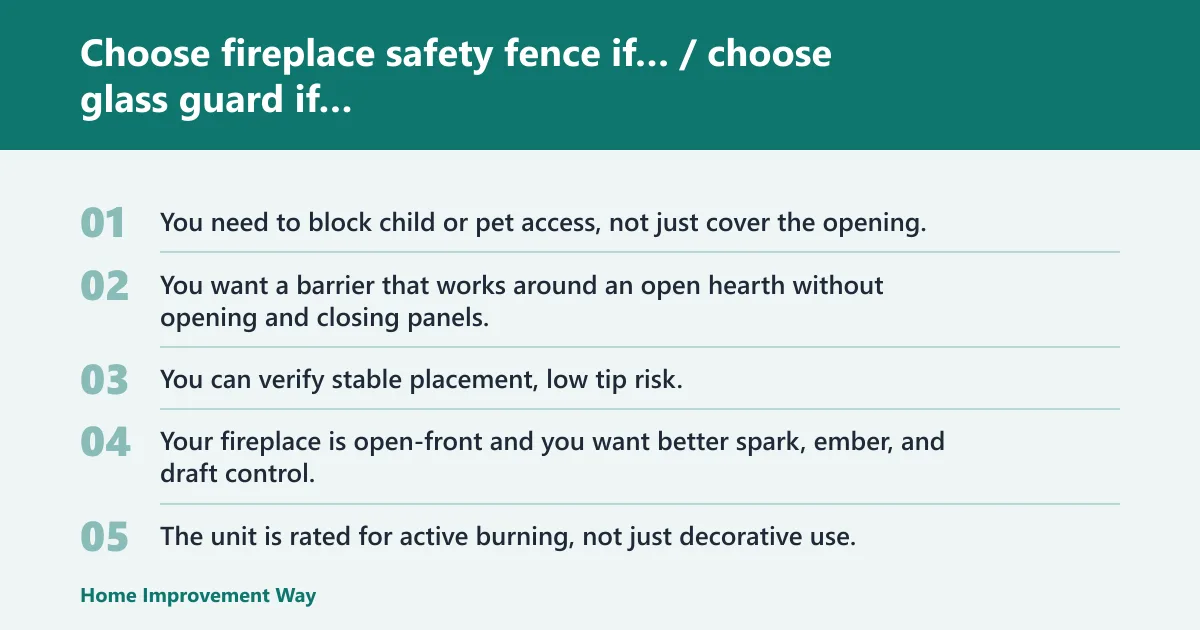
Choose a fireplace safety fence if your main hazard is toddlers or pets getting too close to the hearth, if you need a freestanding perimeter, or if you want a barrier that stays outside the hot zone. Choose a glass guard if your priority is closing the opening, reducing drafts, and containing heat or embers during active burning.
Choose fireplace safety fence if…
- You need to block child or pet access, not just cover the opening.
- You want a barrier that works around an open hearth without opening and closing panels.
- You can verify stable placement, low tip risk, and tight enough spacing to reduce reach-through contact.
Choose glass guard if…
- Your fireplace is open-front and you want better spark, ember, and draft control.
- The unit is rated for active burning, not just decorative use.
- You want to reduce chimney draft when the fire is out and keep the opening closed when allowed.
When neither option is enough on its own
If you have an open hearth, active wood fires, children, or pets, a single barrier may not solve every problem. In many homes, a layered setup works best: a screen or rated glass for spark control, plus a fence or other access barrier around the hearth area. The final check is always clearance to combustibles and supervision.
- Identify the main risk: access, sparks, drafts, or all three.
- Measure the opening, hearth depth, and nearby clearances.
- Check whether any glass guard is rated for active burning.
- Verify fence stability and opening sizes for reach-through risk.
- Keep furniture, rugs, and décor outside the required clearance zone.
Frequently asked questions
Is a fireplace safety fence better than a glass guard for kids and pets?
Yes, when the main concern is access. A fireplace safety fence creates a floor-standing perimeter that keeps toddlers and pets farther from the hearth, hot surround, and opening. A glass guard covers the opening, but it does not provide the same setback or perimeter control.
Do fireplace glass guards stop sparks and embers as well as a fence?
They can, if the glass guard is rated and fitted for active burning, but the comparison is really to a screen rather than a fence. A fence is for access control. Spark and ember control depends on the opening being covered and the unit being designed for that job.
Can glass fireplace doors stay closed while the fire is burning?
Only if the specific door set is rated for active burning. Some glass fronts are decorative or meant for use only when the fireplace is out. Check the manufacturer’s rating before leaving doors closed during a fire, because the wrong unit can overheat or restrict proper burning.
Sponsored / affiliate links. As an Amazon Associate I earn from qualifying purchases. I may earn additional commission from eligible campaigns.
 JONEYMECY 2Pack 6"x6" (Actual:5.5x5.5) Wood Fence Post Anchor Base Brackets,Wet Concrete Post Holder Ground Spike Use for Deck,U-Shaped Post Base 11-Gauge Heavy Duty Steel Black
 Rain Guard Wood Sealer Concentrate | Makes 2 Gallon | Protects Wood from Water Damage, Rotting, and Stains | Water Based Silane/Siloxane | Eco-Friendly | VOC-Free | Natural Finish