What Is a Power Door Lock Explained Simply
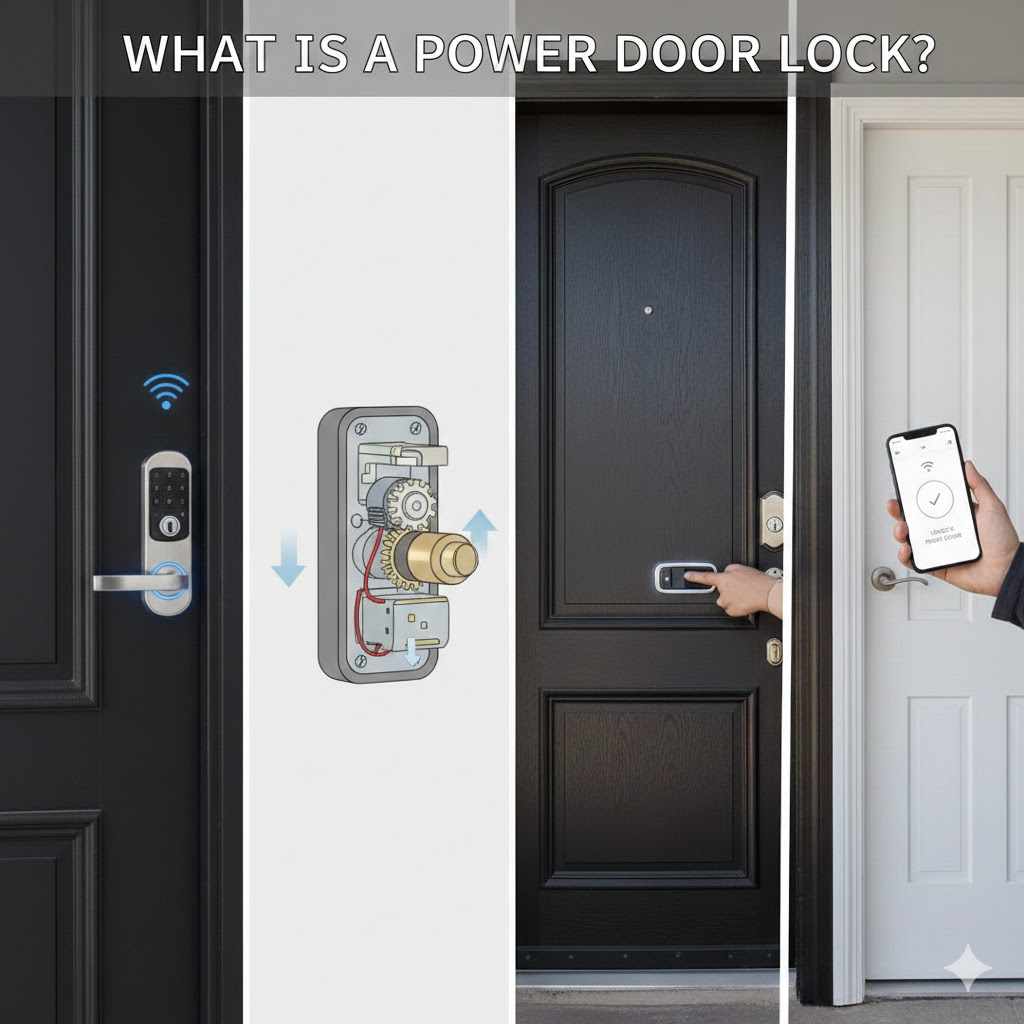
Ever wondered about those car doors that lock and unlock with the push of a button? You might be curious, What Is a Power Door Lock? Explained Simply.
It can seem a bit tricky at first, but it’s really straightforward. This guide will break it down step-by-step. We’ll explore how they work and why they are so handy.
Get ready to learn all about them without any confusing jargon.
Understanding Power Door Locks
Power door locks are a common feature in modern vehicles, offering convenience and security. They use an electric motor to operate the locking mechanism, unlike manual locks that require physical effort to turn a key or push a lever. This system allows you to lock and unlock all doors simultaneously from the driver’s seat or even remotely using a key fob.
They are a staple in car manufacturing for good reason.
Many people find the idea of “power” locks a bit mysterious. They might imagine complex wiring or delicate parts. However, the underlying principle is quite simple.
It’s all about using a small electric current to move a part that engages or disengages the door’s latch. This means you don’t need to struggle with stiff locks or reach over to each door individually.
The journey to understanding power door locks is quite simple. You don’t need to be a car expert. We will cover the basics of how they are powered, what parts are involved, and the benefits they bring.
By the end of this, you’ll have a clear picture of this handy automotive technology.
How Power Door Locks Work
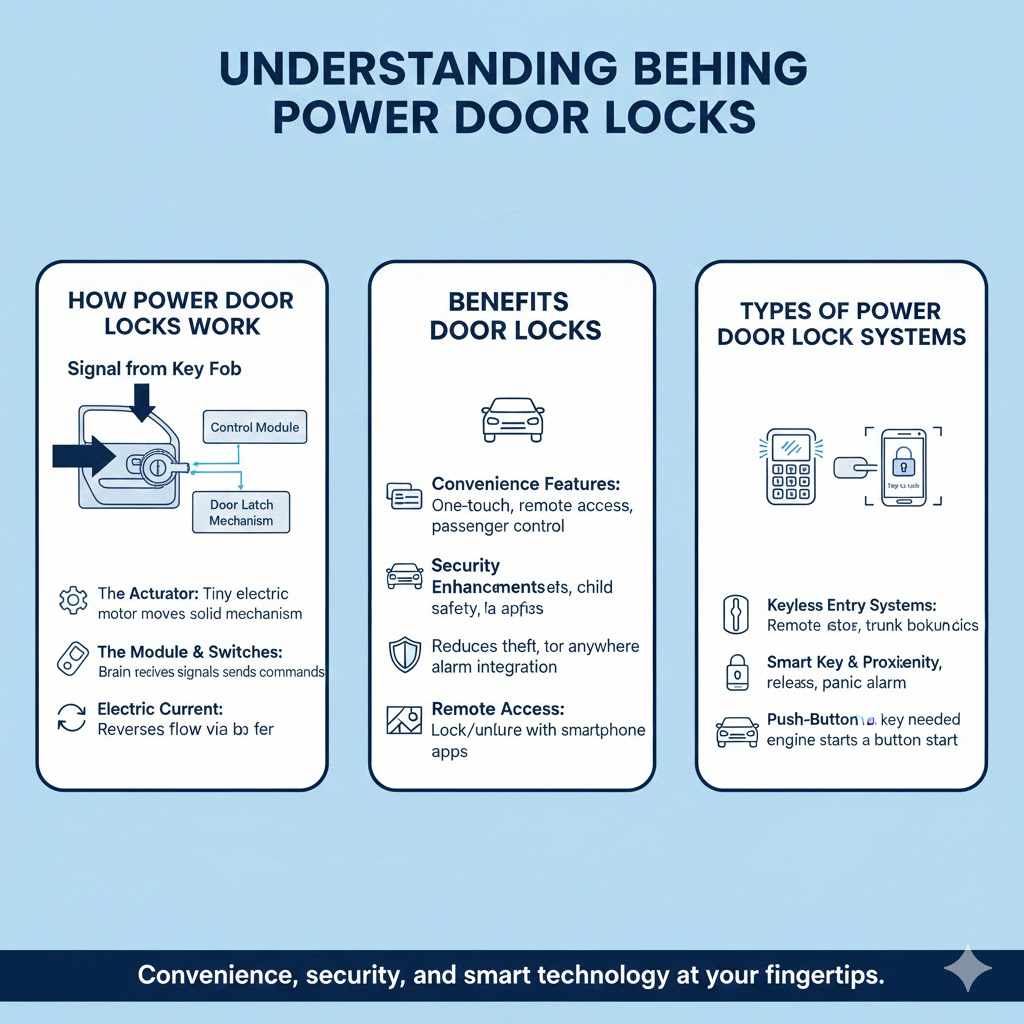
At its core, a power door lock system relies on a few key components working together. When you press a button or use a key fob, a signal is sent to a control module. This module then tells a specific actuator in each door what to do.
The actuator is the part that actually moves the lock mechanism.
Think of an actuator as a tiny electric motor specifically designed for locking doors. It has a small gear and lever system. When electricity flows through it in one direction, the lever moves to lock the door.
When the electricity flows the other way, it moves to unlock it. This is the magic behind the click you hear when your car doors lock.
The Actuator Explained
The actuator is the hero of the power door lock system. It’s a small electrical device found inside each door panel. It connects to the existing door lock linkage.
- The actuator contains a small electric motor. This motor is the driving force. When the car’s electrical system sends a current to it, the motor spins.
- This spinning motion is converted into linear motion by a series of gears and levers. This linear movement is what pushes or pulls on the rods connected to the lock mechanism.
- The direction of the current determines the direction of the motor’s rotation. This, in turn, determines whether the lock moves to the locked or unlocked position. It’s a simple reversal of flow.
Without the actuator, the electronic signals would have nowhere to go and nothing to control. It translates the electrical command into a physical action, making the lock engage or disengage. Its compact size allows it to fit neatly within the confines of a car door.
Control Module and Switches
The brain of the operation is the control module, often called the Body Control Module (BCM) in many cars. This module receives input from various sources. These include the door lock switches inside the car, the key fob receiver, and sometimes even the car’s alarm system.
The switches themselves are simple electronic buttons. Pressing the lock button on the driver’s door sends a signal to the BCM. The BCM then sends the appropriate current to all the door actuators to lock them.
The same process happens in reverse for unlocking.
- Input Signals: The control module constantly monitors signals from door lock switches, key fobs, and other security systems. It’s always ready to receive a command.
- Decision Making: Based on the input, the BCM decides whether to lock or unlock the doors. It ensures all actions are coordinated.
- Output Commands: The BCM then sends electrical pulses to the individual door actuators. The strength and duration of these pulses are precisely controlled.
This coordinated effort ensures that all doors respond uniformly to a single command, providing seamless operation. The technology has improved over the years, making these systems very reliable.
Benefits of Power Door Locks
Power door locks offer a significant upgrade in convenience and security for vehicle owners. They simplify the daily act of entering and exiting a car. The ability to lock all doors at once is a major advantage.
Beyond convenience, they also contribute to overall vehicle security. When you’re in a hurry or carrying items, you can quickly secure your vehicle with a press of a button. This reduces the chance of forgetting to lock a door.
Remote keyless entry systems further enhance this by allowing you to lock or unlock your car from a distance.
Convenience Features
The primary appeal of power door locks lies in their sheer convenience. Imagine arriving at your car with your hands full of groceries. Instead of fumbling for a key or walking to each door, you can simply press a button on your key fob.
Your car unlocks in an instant, allowing you to load your items with ease.
At night, when visibility might be lower, the illuminated lock buttons inside the car make operation simple. You don’t have to strain to find the lock switch. This ease of use extends to passengers as well, who can often control their own doors from their seats.
- One-Touch Operation: Lock or unlock all doors with a single press of a button on the dashboard or key fob. This saves time and effort.
- Remote Access: Keyless entry fobs allow you to operate the locks from a distance, often up to 50-100 feet away. This is incredibly useful in parking lots or during bad weather.
- Passenger Control: Many systems allow passengers to lock or unlock their doors from their side of the car, adding an extra layer of personalized control.
This level of convenience makes everyday driving much more pleasant and efficient. It’s a small feature that makes a big difference.
Security Enhancements
Power door locks significantly boost vehicle security. The ability to lock all doors simultaneously ensures that no door is accidentally left unlocked. This is crucial for preventing opportunistic theft.
Many modern power door lock systems are integrated with car alarm systems. When the alarm is armed, the doors automatically lock. If the alarm is triggered, the doors might also automatically unlock for emergency responders, depending on the system’s design.
This dual function of security and potential emergency access is a key benefit.
- Reduced Opportunistic Theft: A locked car is a much harder target for thieves. Power locks make it easy to ensure your vehicle is secured quickly.
- Child Safety Locks: Most power door lock systems include a child safety feature. This prevents children in the back seat from accidentally opening the doors while the car is moving.
- Integration with Alarms: When tied to an alarm, power locks provide an active deterrent. The visible act of locking doors can make a thief think twice.
The peace of mind that comes with knowing your vehicle is securely locked is invaluable. It’s a foundational aspect of modern car safety.
Types of Power Door Lock Systems
Power door lock systems can vary in their complexity and features. While the basic principle remains the same, there are different ways these systems are implemented. From basic electronic locks to advanced keyless entry and smart systems, the technology has evolved.
Understanding the different types can help you appreciate the range of options available. Some systems are very straightforward, while others offer a wealth of additional features. The core function, however, is always about electric control over the locking mechanism.
Keyless Entry Systems
Keyless entry is perhaps the most common advanced power door lock system. It allows you to unlock and lock your car doors without inserting a physical key into the lock cylinder. This is achieved through a radio frequency transmitter in your key fob.
When you press a button on the fob, it sends a coded radio signal to a receiver in your car. The car’s computer decodes this signal and activates the door lock actuators. This system is incredibly popular for its ease of use.
- Remote Locking/Unlocking: Lock or unlock all doors from a distance. This is a standard feature.
- Trunk Release: Many keyless entry fobs also include a button to electronically open the car’s trunk. This adds another layer of convenience.
- Panic Alarm: A dedicated button on some fobs can activate the car’s horn and flashing lights, useful for attracting attention in an emergency.
Keyless entry systems have become standard on most new vehicles, highlighting their widespread appeal and usefulness. They represent a significant step up from basic power locks.
Smart Key Systems and Proximity Entry
Smart key systems take keyless entry a step further. These systems often allow you to keep the key fob in your pocket or bag. The car can detect the presence of the authorized smart key nearby.
With a smart key system, you can often unlock the doors by simply touching a sensor on the door handle. Similarly, you can lock the doors by pressing a button on the handle or even by walking away from the vehicle (proximity locking). Some smart keys can also start the car’s engine with a push-button start, eliminating the need for a traditional ignition key.
- Passive Entry: Doors unlock automatically when the smart key is detected within a certain range of the vehicle. You don’t need to press any buttons.
- Proximity Locking: Some systems automatically lock the doors when the smart key moves out of range. This prevents accidental locking of the key inside the car.
- Push-Button Start: A common feature paired with smart keys, allowing the engine to be started without inserting a key into an ignition slot.
These systems offer the ultimate in convenience and are becoming increasingly common in higher-end vehicles, with more manufacturers adopting them across their model lines.
Troubleshooting Common Power Door Lock Issues
While power door locks are generally reliable, they can sometimes develop problems. These issues can range from a single door not locking to the entire system failing. Fortunately, many common problems have relatively simple solutions or can be diagnosed with a little troubleshooting.
It’s important to identify the exact nature of the problem to address it effectively. Is it a single door? Is it intermittent?
Does it happen only when it’s cold? These details can help pinpoint the cause.
When a Door Won’t Lock or Unlock
If one specific door isn’t responding to the power lock commands, the issue is often with that door’s actuator or wiring. The actuator might be faulty, or the wires connecting it to the control module could be damaged or disconnected.
Another possibility is a problem with the door lock switch for that specific door, if your car has individual switches. Sometimes, the linkage between the actuator and the lock mechanism can become loose or jammed.
- Check Fuses: A blown fuse related to the door locks is a common culprit for system-wide or individual door failures.
- Inspect Wiring: Wires passing through the door jamb can get frayed or broken due to repeated opening and closing of the door.
- Test the Actuator: With some technical knowledge, you can test the actuator directly to see if it’s receiving power and trying to move.
A visual inspection of the door’s interior panel can sometimes reveal loose connections or obvious damage. It’s worth checking before assuming a major component failure.
Key Fob Not Working
If your key fob is no longer unlocking or locking your car, the first thing to check is the battery inside the fob. These batteries have a limited lifespan and will eventually need replacement.
If the battery is good, the fob might have lost its programming to the car. Modern car systems often require the fob to be re-synchronized or reprogrammed to communicate with the vehicle. Extreme weather conditions or damage to the fob can also cause it to stop working.
- Replace Fob Battery: This is the most common and easiest fix. Use the correct type of battery for your fob.
- Reprogram the Fob: Most car manuals will explain how to reprogram your key fob. This often involves a specific sequence of actions.
- Check Fob Range: If the fob only works when you are very close to the car, it might indicate a weak transmitter or a problem with the car’s receiver.
Sometimes, interference from other electronic devices can temporarily disrupt the signal, so try moving to a different location if possible.
When the Entire System Fails
If your power door locks stop working entirely, meaning no doors respond to any commands, the issue is likely more systemic. This could point to a problem with the main control module (BCM), a blown main fuse, or a problem with the primary wiring harness that connects everything.
A sudden, complete failure often suggests a power supply issue or a failure of the central control unit. Diagnosing this type of problem usually requires specialized diagnostic tools that can read error codes from the car’s computer.
- Check Main Fuses: Locate and inspect the main fuses related to the central locking system or the body control module.
- Consult a Mechanic: For complete system failures, it’s often best to take your car to a qualified mechanic or dealership. They have the tools and expertise to diagnose complex electrical issues.
- Inspect Ground Connections: Poor ground connections can cause all sorts of electrical gremlins, including a non-functional door lock system.
While it can be frustrating when the whole system goes down, systematically checking the most common points of failure can help resolve the issue.
Power Door Lock Technology Evolution
The technology behind power door locks has come a long way since its inception. Initially, these systems were simple additions to luxury vehicles, offering basic remote locking. Today, they are integrated into sophisticated car security and convenience systems.
The evolution reflects a broader trend in the automotive industry towards greater automation and user-friendliness. What was once a novelty is now a fundamental expectation for most car buyers. This progress has brought about increased reliability and advanced functionalities.
From Basic Motors to Smart Systems
Early power door lock systems were essentially simple electric motors connected to the existing mechanical lock rods. These were powered directly by the car’s electrical system and operated by switches on the doors. The primary goal was to offer more convenience than manual locks.
The advent of microprocessors and more advanced electronics paved the way for keyless entry. This allowed for remote operation via radio signals, significantly enhancing user convenience and security. The development of integrated circuits made these systems smaller, more efficient, and more reliable.
- Early Electric Motors: Simple DC motors directly actuating lock rods. Limited range and functionality.
- Radio Frequency Transmitters: Introduction of key fobs and receivers for remote control. Increased convenience and security.
- Body Control Modules: Centralized computer systems managing various vehicle functions, including door locks. Allows for more complex programming and integration.
Each stage of development built upon the last, leading to the highly sophisticated systems we see today. This progression has made car ownership more accessible and comfortable.
Integration with Vehicle Security
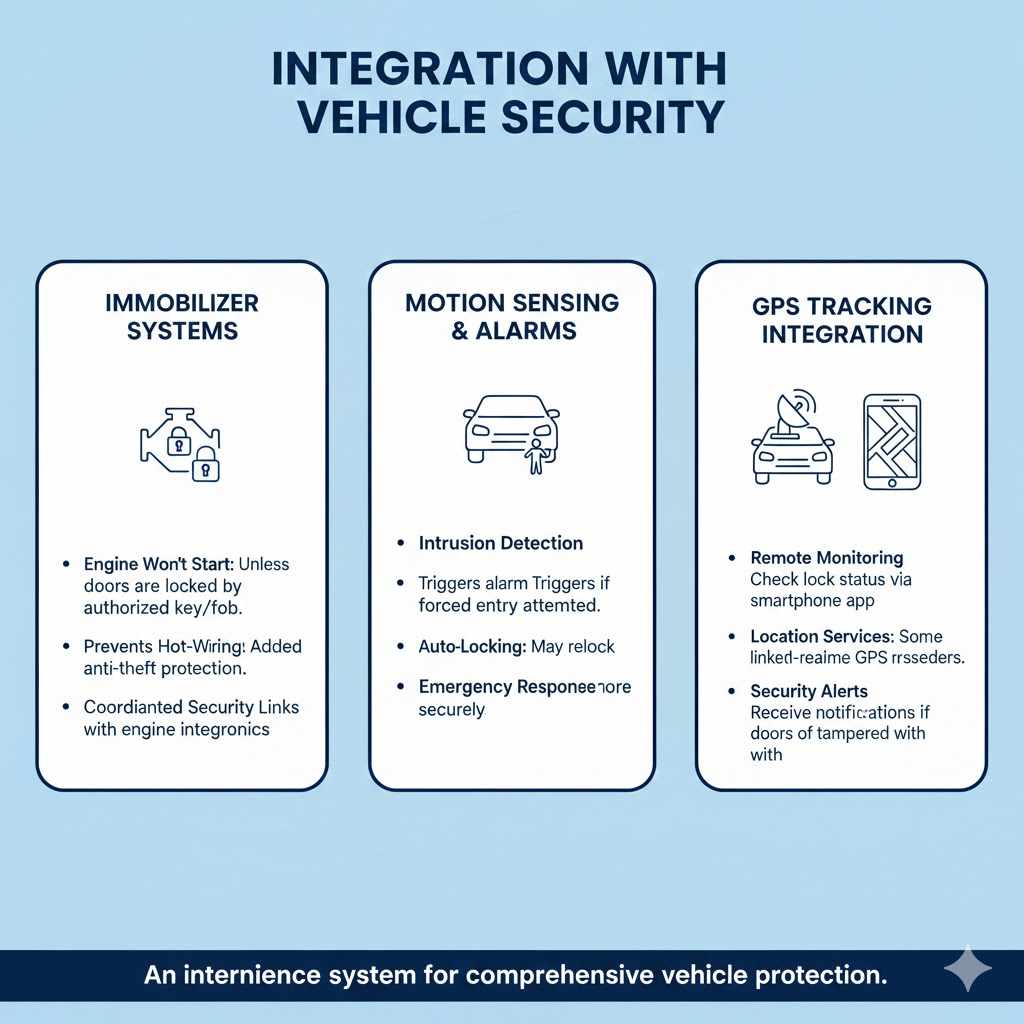
Modern power door lock systems are rarely standalone features. They are deeply integrated into the vehicle’s overall security network. This integration allows for advanced features like automatic locking and alarm system interaction.
When you arm your car’s alarm, the power door locks typically engage simultaneously. This provides an immediate layer of security. If the alarm is triggered, the system might be programmed to unlock the doors for emergency personnel, or conversely, to keep them locked for added security depending on the manufacturer’s design.
- Immobilizer Systems: Power locks often work in conjunction with engine immobilizers. The car won’t start unless the doors are properly locked or unlocked by an authorized key.
- Motion Sensing: Some advanced systems can detect if someone is attempting to force entry. They might trigger the alarm and lock the doors more securely.
- GPS Tracking Integration: In high-end vehicles, power lock status can sometimes be monitored remotely via a smartphone app, often linked with GPS tracking capabilities.
This interconnectedness makes vehicle security more comprehensive. It ensures that the locks are just one part of a larger protective strategy.
Frequently Asked Questions
Question: What is a power door lock?
Answer: A power door lock is an electronic system in a vehicle that uses an electric motor to lock and unlock the car doors, operated by switches or a remote key fob.
Question: How do I know if my car has power door locks?
Answer: Look for lock buttons on the inside of your car doors, especially on the driver’s side, and check if you have a key fob with lock and unlock buttons.
Question: Can I add power door locks to a car that doesn’t have them?
Answer: Yes, aftermarket power door lock kits are available that can be installed on older vehicles.
Question: What is an actuator in a power door lock system?
Answer: An actuator is a small electric motor within each door that physically moves the lock mechanism when it receives an electrical signal.
Question: Why does my key fob sometimes not work?
Answer: Common reasons include a dead battery in the fob, the fob needing to be reprogrammed to the car, or interference from other electronic devices.
Summary
Understanding what a power door lock is explained simply reveals a convenient and secure automotive feature. It uses electric actuators controlled by switches or key fobs to lock and unlock car doors. These systems enhance ease of use and vehicle safety.
From basic motors to smart key technology, evolution has made them indispensable. Troubleshooting often involves checking fuses, batteries, or reprogramming.