Which Wood Board Is Best for Speaker Cabinets?
Picking the right wood for your speaker boxes can feel a little tricky when you’re just starting out. There are so many choices, and it’s hard to know which one will sound best and be easiest to work with. But don’t worry!
This guide breaks it all down simply. We’ll help you figure out Which Wood Board Is Best for Speaker Cabinets? 2026 Guide so you can build great-sounding speakers without the stress.
Let’s find the perfect wood for your next project!
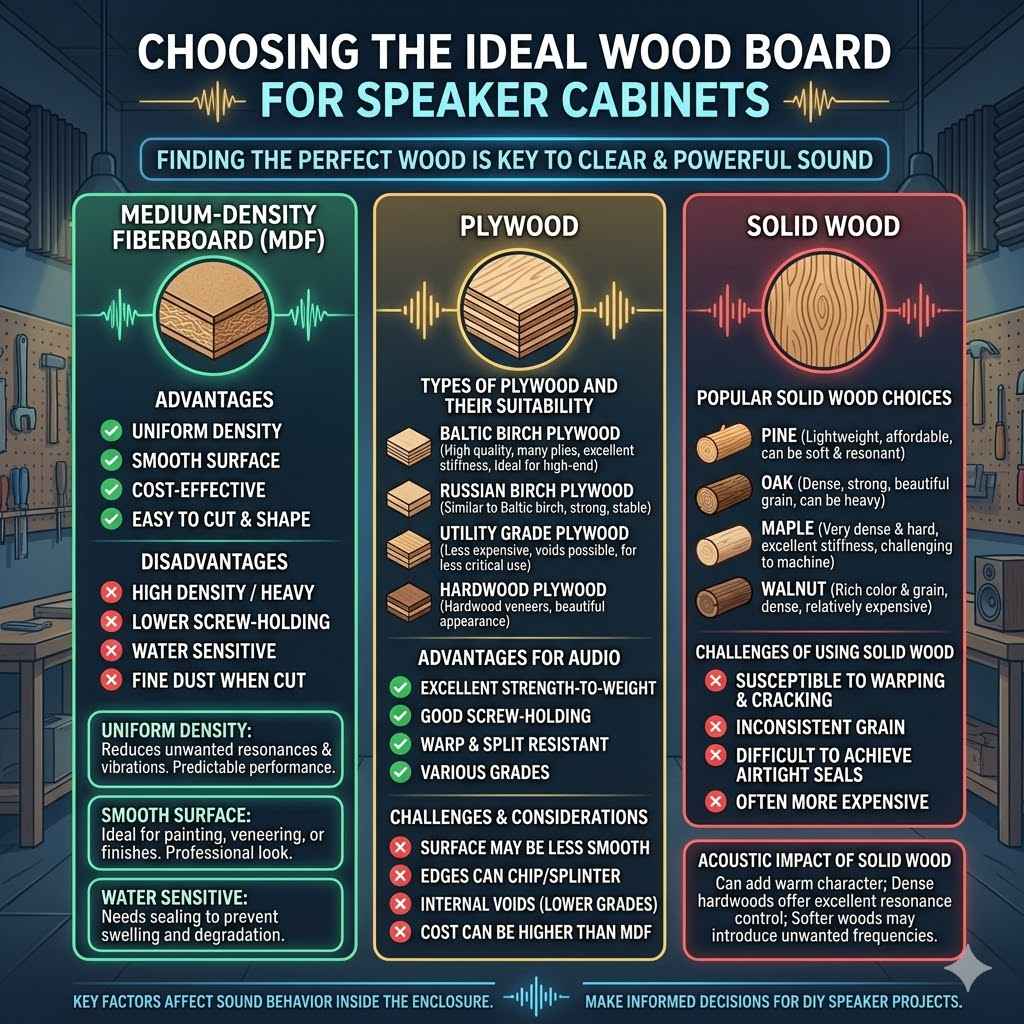
Choosing the Ideal Wood Board for Speaker Cabinets
Finding the perfect wood for your speaker cabinets is key to getting the best sound and a beautiful finished product. The right material affects how sound waves behave inside the box. It can make your speakers sound clear and powerful or muddy and weak. This section explores the main types of wood boards commonly used for speaker enclosures. We will look at their properties and why they are good choices. This will help you make an informed decision for your DIY speaker projects.
Medium-Density Fiberboard MDF Explained
Medium-Density Fiberboard, or MDF, is a very popular choice for building speaker cabinets. It’s made from wood fibers that are pressed together with resin under high heat and pressure. This process creates a dense, stable, and smooth material.
One of the biggest advantages of MDF is its uniform consistency. Unlike natural wood, it doesn’t have knots or grain patterns that can cause uneven density. This makes it very predictable when it comes to acoustic performance. MDF is also quite affordable compared to solid wood. It’s easy to cut and shape, making it a favorite for DIY builders and professionals alike.
However, MDF is not without its drawbacks. It’s quite heavy, which can be a factor if you need portable speakers. It also doesn’t hold screws as well as solid wood. You often need to pre-drill holes or use inserts. Another important point is that MDF can swell and degrade if it gets wet. So, it needs to be sealed properly, especially if your speakers will be used in humid environments.
Advantages of MDF
- Uniform density leads to predictable acoustic performance.
- Smooth surface is ideal for painting, veneering, or other finishes.
- Cost-effective compared to many other wood products.
- Easy to cut, rout, and shape with standard woodworking tools.
MDF’s uniform density is a huge benefit. It means the wood will absorb and reflect sound waves in a consistent way throughout the entire cabinet. This reduces unwanted resonances and vibrations that can color the sound. The smooth surface also makes it very easy to get a professional-looking finish. You can paint it, apply wood veneer, or cover it with fabric without issues. The affordability makes it accessible for hobbyists on a budget. Plus, its workability means you can create complex shapes and designs with relative ease.
Disadvantages of MDF
- High density makes it heavy, which can impact portability.
- Lower screw-holding power compared to solid wood.
- Susceptible to water damage and swelling if not properly sealed.
- Can create fine dust when cut, requiring good ventilation and dust masks.
The weight of MDF is a significant consideration. A large speaker cabinet made from MDF can be quite heavy to move around. While it holds screws decently, they can strip out more easily than in solid wood. This means you might need to be careful with screw placement and depth. Protecting MDF from moisture is crucial. Any water exposure can cause the material to expand and lose its structural integrity. Lastly, when cutting MDF, it produces very fine dust that can be irritating and harmful. Always use safety gear and good dust collection.
Plywood for Speaker Cabinets An In-Depth Look
Plywood is another excellent option for speaker enclosures. It’s made by layering thin sheets of wood veneer, called plies, and gluing them together with their grain direction alternating at each layer. This cross-graining technique gives plywood remarkable strength and stability.
Different types of plywood are used, with birch plywood and Baltic birch being particularly popular for audio applications. Birch plywood is known for its strength, stiffness, and attractive grain. Baltic birch, specifically, often has more plies and a more uniform construction, making it even more acoustically inert and strong.
Plywood’s layered structure offers good resistance to warping and cracking. It also holds screws better than MDF, making assembly a bit more straightforward. The weight of plywood can vary depending on the type and thickness, but it’s often lighter than MDF of comparable strength. This is a plus for portable speaker builds.
However, the quality of plywood can vary significantly. Cheaper grades might have voids inside, which can cause internal reflections and affect sound quality. The surface of some plywood can also be less smooth than MDF, sometimes requiring more preparation before finishing. The edges can also be prone to chipping if not handled carefully.
Types of Plywood and Their Suitability
- Baltic Birch Plywood High quality, many plies, excellent stiffness and stability. Ideal for high-end cabinets.
- Russian Birch Plywood Similar to Baltic birch, very strong and dimensionally stable.
- Utility Grade Plywood Less expensive, but may have voids and a rougher surface. Better for less critical applications.
- Hardwood Plywood Made with hardwood veneers for a better appearance. Can be pricier.
Baltic birch plywood is often considered the gold standard for speaker cabinets. Its construction with many thin, alternating-grain plies makes it exceptionally strong and resistant to warping. This structural integrity translates into an acoustically inert enclosure that doesn’t add its own unwanted coloration to the sound. Russian birch is a close second, offering similar benefits. Utility grade plywood is a budget-friendly option, but you need to inspect it carefully for internal flaws. Hardwood plywood offers a beautiful aesthetic if you plan on a natural wood finish.
Plywood Advantages for Audio
- Excellent strength-to-weight ratio.
- Good screw-holding capability.
- Resistant to warping and splitting compared to solid wood.
- Various grades and thicknesses available to suit different needs.
The strength-to-weight ratio of plywood is a major selling point for speaker builders. It allows you to create rigid cabinets that can withstand the powerful vibrations from the speakers without adding excessive bulk. This is especially important for larger PA speakers or home stereo subwoofers that need to be moved. Plywood’s ability to hold screws securely also simplifies the assembly process. You can rely on the joints to stay strong over time. The variety of plywood options means you can find a material that fits your budget and performance requirements.
Plywood Challenges and Considerations
- Surface may be less smooth than MDF, requiring more prep.
- Edges can chip or splinter if not cut carefully.
- Internal voids in lower grades can affect acoustic performance.
- Cost can be higher than MDF for comparable quality.
Preparing plywood for finishing can take a bit more effort. You might need to fill in any small imperfections or sand the surface extensively to get a perfectly smooth finish. Cutting plywood requires a sharp blade and proper technique to avoid chipping the edges, especially on the outer plies. For optimal sound, it’s best to use high-quality plywood that is free from internal voids. The price of good quality plywood, like Baltic birch, can indeed be more than MDF, so it’s a trade-off between material cost and performance benefits.
Solid Wood Considerations for Speaker Enclosures
While less common for modern mass-produced speakers, solid wood can still be a viable and attractive option for speaker cabinets, especially for audiophiles and custom builders who appreciate its natural beauty and unique acoustic properties. Using solid wood involves cutting boards directly from trees.
The main appeal of solid wood is its aesthetic. It offers a natural, warm look that can be enhanced with stains and finishes. Different wood species have distinct grain patterns and colors, allowing for a highly personalized appearance. However, working with solid wood presents its own set of challenges.
Solid wood expands and contracts with changes in humidity and temperature. This movement can lead to warping, cracking, or joint separation if not managed properly. To mitigate this, builders often use methods like internal bracing and careful joinery. The grain of solid wood also means its density can be inconsistent, which can subtly affect sound. Some types of solid wood are also quite expensive and can be harder to work with than MDF or plywood.
Popular Solid Wood Choices for Cabinets
- Pine Lightweight, easy to work with, and affordable. Can be a bit soft and resonant.
- Oak Dense, strong, and has a beautiful grain. Can be heavy and harder to work.
- Maple Very dense and hard, excellent for stiffness. Can be challenging to machine.
- Walnut Rich color and grain, beautiful appearance. Dense and relatively expensive.
Pine is a good entry point for solid wood projects because it’s readily available and inexpensive. However, its softness means it can vibrate more easily, potentially coloring the sound. Oak offers a great balance of hardness, density, and visual appeal. Its natural stiffness helps to create a rigid cabinet. Maple is extremely hard and dense, which is excellent for minimizing cabinet resonances, but it can wear down tools quickly. Walnut provides a luxurious look with a dense, acoustically suitable material.
Challenges of Using Solid Wood
- Susceptible to warping and cracking due to moisture changes.
- Inconsistent grain can lead to uneven density and sound.
- More difficult to achieve perfectly airtight seals.
- Often more expensive than MDF or plywood.
The biggest hurdle with solid wood is managing its natural tendency to move with the environment. This requires careful design and construction techniques. For example, using tongue-and-groove joints or splines can help accommodate movement. The natural variations in wood grain mean you might have slight differences in sound absorption or reflection across different parts of the cabinet. Achieving an absolutely airtight seal can also be trickier with solid wood compared to the flat, uniform surfaces of MDF or plywood.
Acoustic Impact of Solid Wood
- Natural wood can add a warm character to the sound.
- Certain dense hardwoods can offer excellent resonance control.
- Softer woods may introduce their own resonant frequencies.
- The type of joint and finish also play a role.
The acoustic impact of solid wood is often described as adding a certain “warmth” or “life” to the sound. This is because wood itself is not perfectly inert and can subtly vibrate and resonate. This isn’t always a bad thing; for some listeners, it adds a pleasing musicality. Dense hardwoods like maple or oak are excellent for creating rigid cabinets that vibrate less, leading to a cleaner, more accurate sound. Softer woods can be more prone to introducing their own unwanted resonances. The way the wood pieces are joined and how the cabinet is finished will also influence its acoustic behavior.
Which Wood Board is Best for Speaker Cabinets? Expert Weighs In
Deciding Which Wood Board is Best for Speaker Cabinets? 2026 Guide involves considering several factors. For most DIY builders and many professional applications, MDF and high-quality plywood, particularly Baltic birch, stand out as the top choices. They offer the best balance of acoustic properties, workability, stability, and cost.
MDF is often the go-to for its smooth, uniform surface and excellent density, making it easy to achieve a professional finish and predictable acoustic performance. It’s also very cost-effective. Plywood, especially Baltic birch, offers superior strength-to-weight ratios and better screw retention, making it ideal for robust and portable cabinets. The choice between them often comes down to specific project needs, budget, and desired finish.
Solid wood can be used, but it requires more specialized knowledge and techniques to manage its natural characteristics. It’s more about aesthetics and a particular sonic preference than practicality for general speaker building. For beginners, MDF is usually the easiest to start with. For those seeking a slightly lighter and stronger option, Baltic birch plywood is an excellent step up.
MDF vs. Plywood An Acoustic Comparison
When comparing MDF and plywood for speaker cabinets, the primary difference lies in their construction and how it affects their acoustic behavior. Both can produce excellent results, but they have distinct advantages and disadvantages.
MDF, being a composite material made from fine wood fibers, offers unparalleled uniformity. This means its density is consistent throughout, leading to predictable sound absorption and reflection. This consistency helps to minimize internal cabinet resonances, which are unwanted vibrations that can color the sound and reduce clarity. MDF is also very dense, which helps to dampen sound vibrations. However, this density also makes it quite heavy.
Plywood, on the other hand, is made from layered veneers. While high-quality plywood like Baltic birch has a very uniform construction with many plies, there can still be slight variations between the layers. This layered structure provides excellent strength and stiffness, which is crucial for preventing cabinet vibrations. The cross-graining also makes it more resistant to warping. The acoustic impact of plywood can be slightly different from MDF; some argue it can impart a subtle warmth or liveliness to the sound due to the inherent nature of wood.
Key Differences in Acoustic Properties
- MDF Uniform density leads to predictable sound, excellent damping.
- Plywood Layered structure offers stiffness, resistance to vibration.
- MDF Generally considered more acoustically inert due to uniformity.
- Plywood Can sometimes add a subtle, pleasing resonance.
MDF’s uniformity makes it a dream for acousticians. It’s like having a perfectly consistent wall inside your speaker box. This means the sound waves hit the walls and behave in a predictable manner, allowing the driver to perform its best without interference from the cabinet. Plywood, especially high-quality variants, is also very good at reducing unwanted resonances. However, the slight variations in density from ply to ply, and the way the wood itself can resonate, are sometimes credited with adding a pleasant “musicality” to the sound, which some listeners prefer.
Weight and Durability Considerations
- MDF Is heavy, making cabinets less portable.
- Plywood Generally lighter than MDF for comparable rigidity.
- MDF More susceptible to moisture damage.
- Plywood More resistant to impact damage and less prone to splintering on edges.
The weight difference between MDF and plywood is significant, especially for larger speaker enclosures. If you plan to move your speakers often, the lighter weight of plywood can be a major advantage. MDF’s susceptibility to water means it needs extra care in humid environments. Plywood, due to its layered construction, is often more resilient to physical abuse. Dropping a cabinet made of plywood is less likely to result in catastrophic damage compared to MDF.
Cost and Workability
- MDF Usually more affordable than high-quality plywood.
- MDF Easier to cut and shape cleanly, especially for complex designs.
- Plywood Higher grades can be more expensive.
- Plywood Requires careful cutting to avoid chipping edges.
For most projects, MDF presents a more budget-friendly option than premium plywood. Its consistent composition means that cutting MDF is straightforward; you can use standard blades, and it generally cuts cleanly. Plywood, particularly the multi-ply Baltic birch, can command a higher price. When cutting plywood, especially veneer-faced types, using a sharp blade and proper techniques like scoring the cut line first can prevent splintering and chipping, giving you cleaner edges.
Baltic Birch Plywood A Deep Dive
Baltic birch plywood is often highlighted as a premium material for speaker cabinets, and for good reason. It’s not your typical construction-grade plywood. It’s manufactured to a higher standard, typically in Eastern Europe, using all birch veneers.
What sets Baltic birch apart is its construction. It generally has more plies than standard plywood, and these plies are thinner. This results in a much more stable and rigid panel with fewer voids inside. The cross-laminated construction, where the grain of each ply alternates, provides exceptional strength and resistance to warping. This uniformity is crucial for creating acoustically inert speaker enclosures.
When it comes to sound, Baltic birch plywood is prized for its stiffness. A stiff cabinet is less likely to vibrate and color the sound. This means the sound you hear comes more purely from the speaker drivers themselves, leading to clearer, more accurate audio reproduction. It also holds screws very well, which is beneficial during assembly. The edges, while still needing care, are generally more stable than those of standard plywood.
Manufacturing and Construction
- Made exclusively from birch veneers.
- Typically has more plies than standard plywood.
- All plies run the full length and width of the panel.
- Uses strong, water-resistant glues for durability.
The all-birch construction of Baltic birch is key to its superior properties. Birch is a hardwood known for its strength and density. Having more plies, and often all of them running the full length and width of the panel, means the wood’s natural tendency to expand and contract is greatly minimized. This structural integrity is what makes it so effective at preventing cabinet resonance. The high-quality glues used ensure that the plies remain bonded together even under stress.
Acoustic Benefits of Baltic Birch
- High stiffness minimizes cabinet resonances.
- Uniform construction leads to predictable acoustic performance.
- Strong construction resists flexing and vibration.
- Contributes to a cleaner, more accurate sound reproduction.
The stiffness of Baltic birch is its primary acoustic advantage. Imagine a drum shell – a stiff shell vibrates less, allowing the drumhead to produce a purer tone. The same principle applies to speaker cabinets. A stiff Baltic birch cabinet doesn’t absorb or color the sound as much as a less rigid material. This results in a sonic output that is closer to what the audio engineer intended. The uniformity also ensures that the entire cabinet behaves consistently, preventing localized resonances from interfering with the audio.
Practical Advantages for Builders
- Excellent screw-holding power.
- More stable and less prone to warping than many woods.
- Can be finished to a very high standard.
- Available in various thicknesses for different applications.
For the builder, Baltic birch offers a rewarding experience. Its ability to hold screws securely means you can assemble strong, reliable joints without worrying about them stripping out easily. This stability also means that once built, the cabinet is likely to remain dimensionally stable, even with changes in humidity. The smooth, consistent surface of Baltic birch takes finishes exceptionally well, allowing for beautiful painted or veneered cabinets. You can choose from different thicknesses, from 1/4 inch for smaller speakers to 3/4 inch for larger cabinets, to suit your design.
Choosing Thickness and Bracing Strategies
The thickness of the wood board you choose is critical for speaker cabinet performance. It directly impacts the cabinet’s rigidity and its ability to minimize unwanted vibrations. Generally, thicker panels are more rigid and less prone to resonance.
For smaller bookshelf speakers or satellite speakers, 1/2 inch to 3/4 inch thick material is often sufficient. For larger bookshelf speakers, floorstanding speakers, or subwoofers, 3/4 inch or even 1 inch thick material is recommended. Using a thicker material, especially for bass-heavy applications like subwoofers, helps contain the powerful low-frequency waves and prevents the cabinet walls from “flexing.”
Bracing is another essential technique to enhance cabinet rigidity. Bracing involves adding internal supports, usually made from the same wood or plywood, to connect opposite walls or reinforce specific areas of the cabinet. This significantly increases the cabinet’s resistance to vibration.
Recommended Thickness by Speaker Type
| Speaker Type | Recommended Thickness (MDF/Plywood) |
|---|---|
| Small Satellite/Bookshelf Speakers | 1/2 inch to 3/4 inch |
| Medium Bookshelf/Small Floorstanding Speakers | 3/4 inch |
| Large Floorstanding Speakers/Subwoofers | 3/4 inch to 1 inch (or thicker for very large subwoofers) |
The table above gives a good starting point. For very small speakers, where bass output is minimal, 1/2 inch might be acceptable, but 3/4 inch will always provide better rigidity and sound. For medium-sized speakers, 3/4 inch is a solid choice that balances performance and weight. When you get into larger speakers or anything designed to produce significant bass, like subwoofers, using 3/4 inch material is a minimum, and 1 inch or even double 3/4 inch layered construction can be used for ultimate rigidity.
Types of Cabinet Bracing
- Shelf Bracing Horizontal or vertical panels connecting opposite walls.
- Window Bracing Openings in the bracing panels to reduce weight while maintaining support.
- Corner Bracing Triangular blocks added to internal corners.
- Dowel/Rod Bracing Using wooden dowels or metal rods to connect panels.
Shelf bracing is the most common type. Imagine adding shelves inside your speaker box that connect the front and back panels or the side panels. This makes the whole structure much more resistant to flexing. Window bracing is a smart way to get the benefits of shelf bracing without adding too much unnecessary weight. By cutting out sections of the bracing panels, you create a lighter but still very effective support structure. Corner bracing is simple but effective for reinforcing the most stressed points. Dowel or rod bracing can be used for very specific reinforcement needs.
Bracing Placement and Design Tips
- Place braces strategically to connect panels that are far apart.
- Avoid placing braces directly behind speaker drivers.
- Ensure braces do not impede airflow inside the cabinet if it’s a ported design.
- Use a dense wood for bracing to maximize its effectiveness.
The goal of bracing is to create a rigid box. This means connecting the panels that are most likely to vibrate. Think about the largest unsupported surfaces and add braces there. It’s important not to put braces in places where they will obstruct the sound waves from the speaker driver itself, especially for the woofer, and also not to block the port if your design has one. Using a dense, stiff wood for your braces, like hardwood or a thicker piece of plywood, will give you the best resonance control.
Which Wood Board is Best for Speaker Cabinets? 2026 Guide
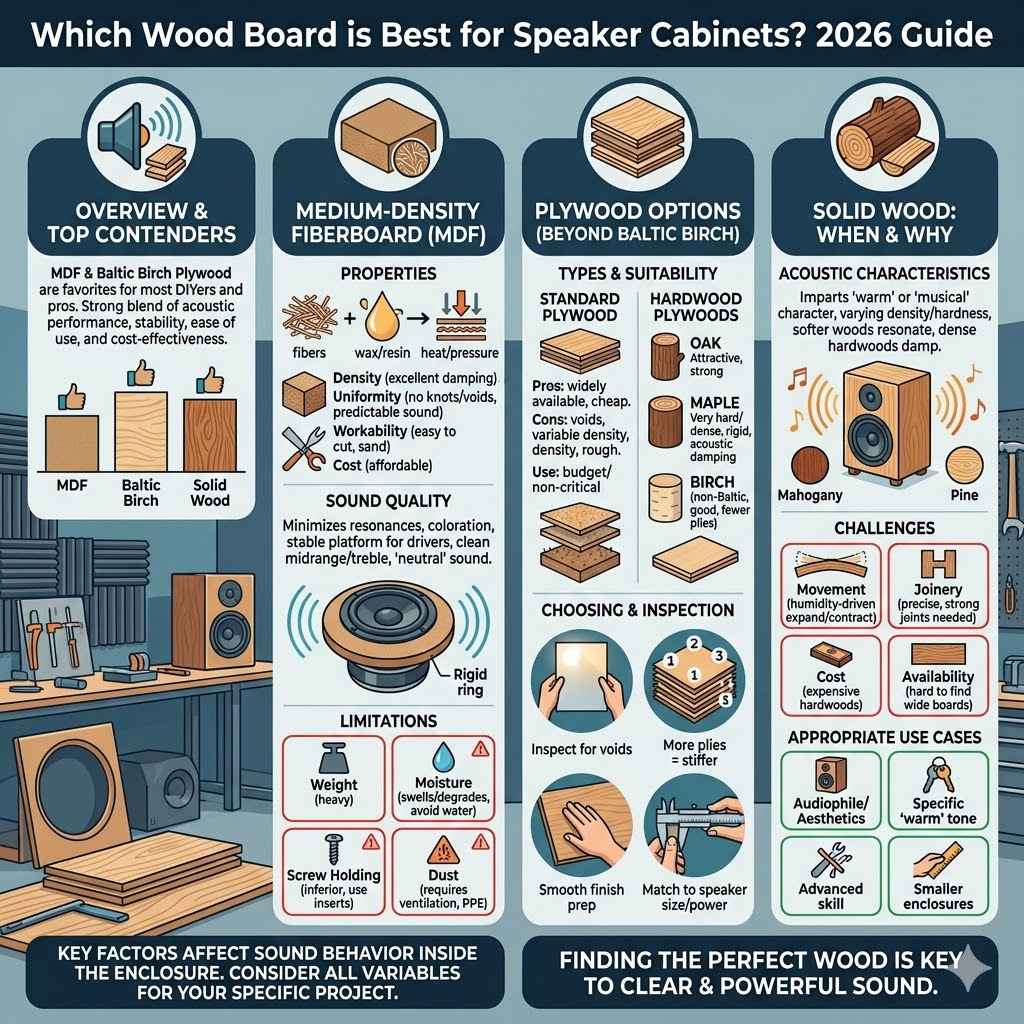
When considering Which Wood Board is Best for Speaker Cabinets? 2026 Guide, the choices boil down to a few key materials, each with its own strengths. For most DIYers and many professional manufacturers, MDF and high-quality plywood, especially Baltic birch, are the top contenders. These materials offer a strong blend of acoustic performance, stability, ease of use, and cost-effectiveness.
MDF is often favored for its uniform density, which leads to predictable sound and a smooth surface for finishes. Plywood, particularly Baltic birch, offers superior strength-to-weight ratios and better screw retention, making it excellent for robust and portable cabinets. Solid wood, while aesthetically appealing, presents greater challenges in terms of stability and workability for speaker enclosures. Understanding these differences helps you choose the best wood for your specific speaker project.
MDF A Detailed Look
Medium-Density Fiberboard (MDF) is a manufactured wood product that has become a staple in the speaker industry. It’s created by breaking down hardwood or softwood into wood fibers, then combining them with wax and a resin binder. These components are then pressed into panels under high temperature and pressure.
The result is a very dense and stable material that is remarkably uniform throughout. Unlike natural wood, MDF has no knots, grain patterns, or internal voids. This consistency is a major advantage for speaker cabinet construction, as it means the material will behave in a predictable manner acoustically. It absorbs sound well and has excellent damping properties, which helps to minimize unwanted cabinet resonances.
MDF is also very easy to work with. It cuts cleanly, routes smoothly, and takes finishes beautifully. This makes it a favorite among both professional cabinet makers and hobbyists. It is also generally more affordable than high-quality plywood or solid wood, making it an accessible choice for many projects. However, MDF is quite heavy, which can be a drawback if portability is a concern. It also does not hold screws as tenaciously as solid wood or plywood and can be susceptible to damage from moisture if not properly sealed.
Properties of MDF
- Density High density contributes to excellent sound damping.
- Uniformity Consistent throughout, with no grain or knots.
- Workability Easy to cut, route, sand, and finish.
- Cost Generally more affordable than premium plywood or solid wood.
The high density of MDF means it’s very effective at absorbing and dissipating sound energy. This is vital for preventing the cabinet walls from vibrating and coloring the sound produced by the speaker drivers. Its uniformity is a key acoustic advantage; there are no weak spots or variations in density that could lead to unpredictable resonances. This makes it easier to design cabinets with predictable acoustic behavior. The ease of working with MDF means that complex shapes and precise cuts are achievable for builders of all skill levels.
MDF and Sound Quality
- Minimizes cabinet resonances and coloration.
- Provides a stable platform for speaker drivers.
- Its damping properties contribute to a cleaner midrange and treble.
- Can result in a more ‘neutral’ or ‘transparent’ sound.
By minimizing cabinet resonances, MDF allows the speaker drivers to perform at their best. This means you hear more of the intended sound from your audio source and less of the cabinet’s own “voice.” The stable nature of MDF ensures that the drivers are securely mounted and won’t cause the cabinet to flex excessively, which can degrade sound quality. The damping effect of MDF is particularly beneficial in the midrange and treble frequencies, helping to produce clearer vocals and sharper transients.
MDF Limitations for Builders
- Weight Significantly heavier than plywood or solid wood.
- Moisture Sensitivity Can swell and degrade if exposed to water.
- Screw Holding Inferior to plywood and solid wood.
- Dust Fine dust created during cutting requires good ventilation and PPE.
The weight of MDF is a practical concern for many. If you’re building large tower speakers or portable PA systems, the sheer mass of MDF can be a significant factor. Protecting MDF from moisture is also critical; spills or high humidity can cause it to swell and lose its structural integrity. When fastening components, you may need to use longer screws, more screws, or consider using threaded inserts to ensure a secure connection. The fine dust generated by MDF cutting is an irritant and requires proper dust collection and personal protective equipment.
Plywood Options Beyond Baltic Birch
While Baltic birch plywood is often considered the best, other types of plywood can also be suitable for speaker cabinets, depending on your budget and performance requirements. Understanding the differences can help you make a more informed choice.
Standard plywood, often found in construction grades, is made from various wood species and may have fewer plies than Baltic birch. The quality can vary greatly. Cheaper utility grades might contain voids between the plies, which can negatively impact acoustic performance by causing internal reflections and reducing rigidity.
Hardwood plywoods, such as oak or maple plywood, are another option. These are typically made with a softwood core and hardwood veneer faces. They offer a more attractive appearance than utility grades and can be more rigid than some standard plywoods. However, they can also be more expensive. The key to using any plywood for speakers is to select a product with good quality, minimal voids, and sufficient stiffness for the application.
Utility Grade Plywood
- Pros Inexpensive, widely available.
- Cons Prone to voids, less uniform density, rougher surface.
- Best for Budget projects, non-critical applications, or where appearance is secondary.
Utility grade plywood is often the most budget-friendly option. It’s great if you need to construct a cabinet for a project where absolute sonic perfection isn’t the main goal, or if you plan to cover the cabinet with fabric or carpet. However, you must inspect it carefully. If you can see large gaps or voids between the wood layers, it’s best to avoid it for speaker building as these will compromise sound quality.
Hardwood Plywood Varieties
- Oak Plywood Attractive grain, good strength.
- Maple Plywood Very hard and dense, excellent for rigidity.
- Birch Plywood (non-Baltic) Good quality, usually with fewer plies than Baltic birch.
Oak plywood offers the look of solid oak without the cost and stability issues of solid wood. Its moderate density makes it a decent choice for cabinets. Maple plywood is exceptionally hard and dense, providing excellent stiffness and acoustic damping. This makes it a very capable material for high-performance speakers. Standard birch plywood, when it’s not the multi-ply Baltic grade, is still a very good material, offering a good balance of strength and workability.
Choosing Plywood for Your Build
- Inspect for internal voids.
- Consider the number of plies for stiffness.
- Evaluate the surface finish for ease of preparation.
- Match thickness to speaker size and power handling.
When selecting plywood, holding a sheet up to the light can help reveal internal voids. More plies generally mean a stronger and stiffer panel. Look at the face veneer – if it’s smooth and consistent, it will be easier to finish. Always consider the thickness. A thin panel, even if it’s good quality, may not be rigid enough for larger or more powerful speakers.
Solid Wood: When and Why
Using solid wood for speaker cabinets is a more traditional approach. Before the widespread availability of MDF and plywood, most speakers were made from solid wood. Today, it’s often chosen for its aesthetic appeal and the unique sonic character it can impart.
Different species of wood have different densities, hardness, and resonant frequencies. Some, like mahogany or walnut, are dense and offer good damping properties, similar in some ways to MDF or dense plywood. Others, like pine, are softer and lighter, and can contribute more of their own resonance to the sound, which some listeners find desirable for a “warm” or “natural” tone.
However, solid wood expands and contracts significantly with changes in humidity and temperature. This is its biggest challenge. Without proper bracing and joinery, solid wood cabinets can warp, crack, or develop air leaks. This makes them less predictable and often more difficult to build than cabinets made from engineered wood products. For beginners, solid wood is generally not recommended due to these complexities.
Acoustic Characteristics of Solid Wood
- Can impart a “warm” or “musical” character to the sound.
- Density and hardness vary greatly by species.
- Softer woods may resonate more, potentially coloring the sound.
- Dense hardwoods can offer good acoustic damping.
The idea of “warmth” in audio is often associated with subtle harmonic distortions or resonances introduced by the playback equipment, including the speaker cabinet. Solid wood, being a natural material, can contribute these subtle resonances. This isn’t always a negative; for some, it adds a pleasing richness to the sound. Dense hardwoods are favored when the goal is to minimize any inherent coloration from the cabinet material itself, allowing the drivers to speak more clearly.
Challenges of Building with Solid Wood
- Movement Wood expands and contracts with humidity.
- Joinery Requires precise, strong joints to accommodate movement.
- Cost High-quality hardwoods can be very expensive.
- Availability Finding consistent, wide boards can be difficult.
The natural movement of wood is the primary obstacle. Builders must account for this. This often involves using internal bracing extensively to keep panels flat and rigid. Joints like mortise and tenon, or well-glued butt joints with internal cleats, are essential. Some of the most attractive hardwoods are also among the most costly lumber options. Finding long, wide boards of consistent quality can also be a challenge, often requiring joining smaller pieces together.
When Solid Wood Might Be Appropriate
- For high-end audiophile systems where aesthetics are paramount.
- When a specific “warm” or “natural” sonic signature is desired.
- For builders with advanced woodworking skills and experience.
- For smaller enclosures where movement is less of a factor.
If you are aiming for a visually stunning speaker that becomes a piece of furniture as well as an audio device, solid wood shines. If you’ve heard systems with solid wood speakers and appreciate their unique sound, then it’s worth considering. However, it’s best to have solid woodworking experience to tackle the challenges of wood movement and joinery. For smaller speakers, like small satellite speakers, the amount of wood movement is less impactful on the overall cabinet integrity compared to large floorstanding speakers.
Frequently Asked Questions
Question: Is MDF or Plywood better for speaker cabinets
Answer: For most applications, both MDF and high-quality plywood like Baltic birch are excellent. MDF is dense, uniform, and easy to finish but heavy. Plywood is lighter, stronger, and holds screws better, especially Baltic birch.
Question: Can I use regular plywood for speaker boxes
Answer: You can, but choose a good quality plywood with minimal internal voids. Utility grades may compromise sound quality due to inconsistent density and internal air pockets.
Question: Is solid wood a good choice for DIY speaker cabinets
Answer: Solid wood can be beautiful and sound unique, but it’s challenging. It expands and contracts with humidity, requiring careful joinery and bracing to prevent warping or cracking.
Question: How thick should the wood be for speaker cabinets
Answer: For bookshelf speakers, 3/4 inch is common. For subwoofers or larger tower speakers, 3/4 inch to 1 inch or even thicker is recommended for rigidity.
Question: Does wood type really affect speaker sound
Answer: Yes, absolutely. Different woods have different densities and resonant frequencies. They can absorb or reflect sound waves differently, influencing clarity, warmth, and overall sonic character.
Final Thoughts
Choosing the right wood board is crucial for speaker cabinet construction. MDF offers density and uniformity for predictable sound, while Baltic birch plywood provides strength and stability. Both are excellent choices for achieving great audio. Consider your project’s needs, budget, and desired finish to make the best selection. Happy building!