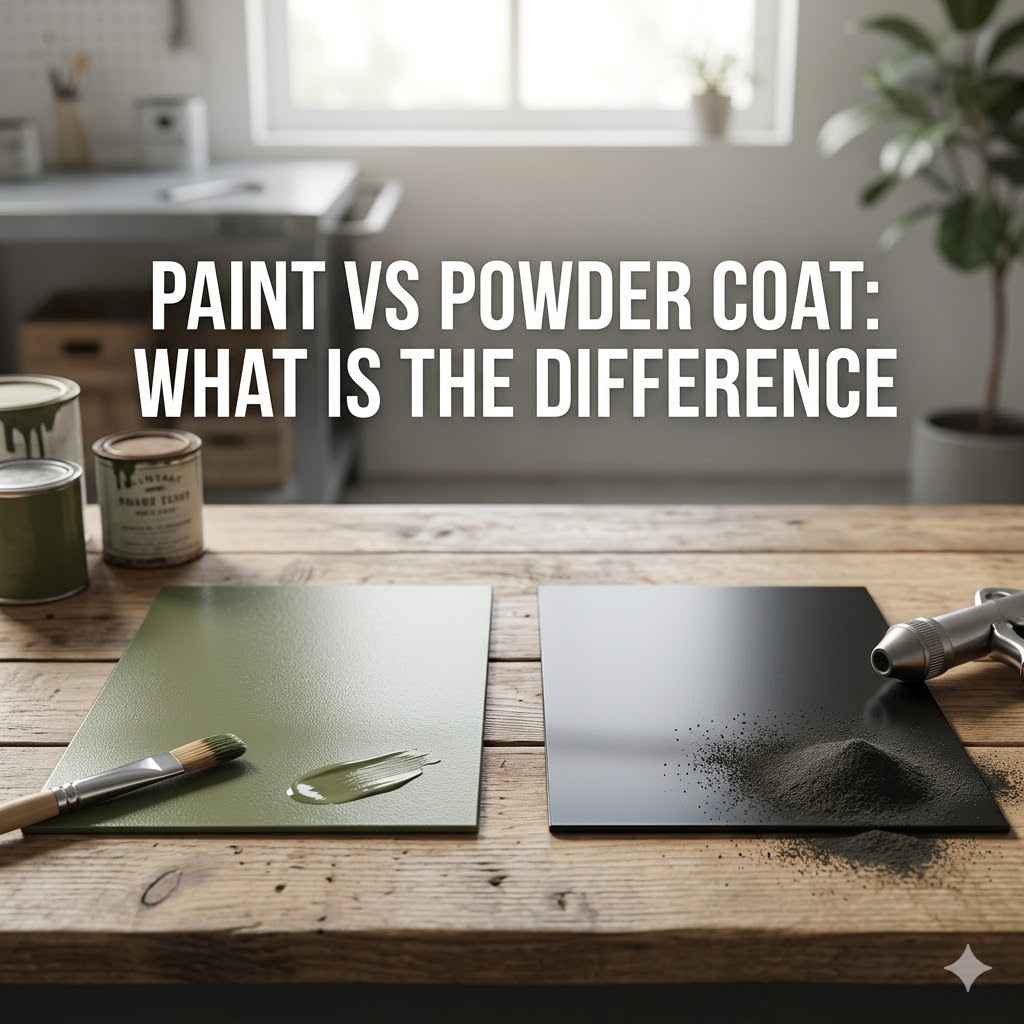
Paint vs Powder Coat What is the Difference
Deciding between paint and powder coat can feel tricky, especially when you’re new to finishing projects. You see both used everywhere, and they look great, but what really sets them apart? It’s a common question, and thankfully, understanding the difference is simpler than you might think.
This guide breaks down exactly what you need to know so you can choose the best option for your needs. We’ll explore what makes each one special and how to tell them apart easily.
Many people wonder about the core differences between paint and powder coating, often seeing them used for similar purposes like protecting and beautifying metal parts. This common question arises because both are applied as coatings, but the methods, materials, and final results vary significantly. For beginners, the technical jargon and application processes can seem overwhelming, leading to confusion about which is superior or more suitable for a given task.
This section aims to demystify these coatings, highlighting their fundamental distinctions in a clear and accessible way. We will explain how they are made and applied to give you a solid foundation for understanding their unique properties and benefits.
What Is Paint
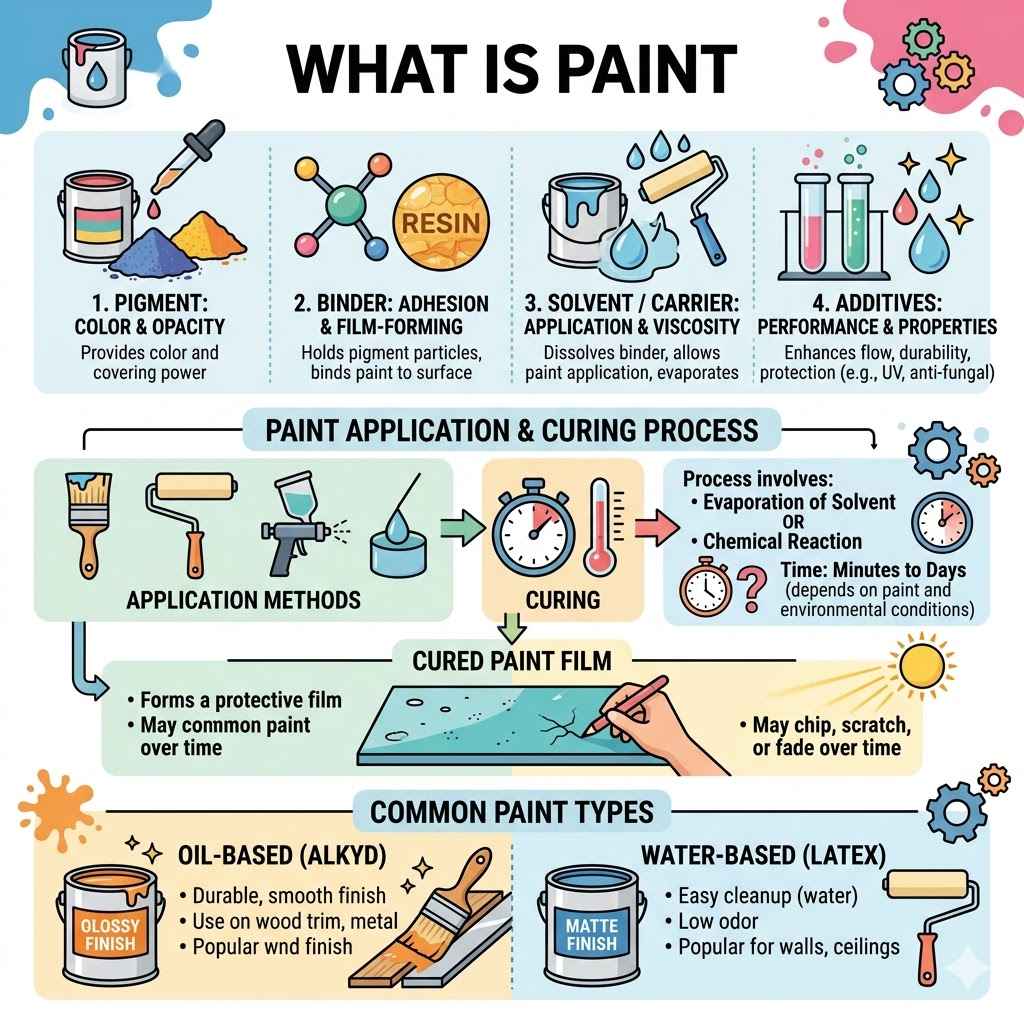
Paint is a liquid substance that, when applied to a surface, dries to form a protective and decorative film. It is a versatile coating that has been used for centuries to protect and beautify everything from walls to vehicles. The basic components of paint include a pigment, which provides color and opacity, a binder, which holds the pigment particles together and adheres the paint to the surface, a solvent or carrier, which dissolves the binder and allows the paint to be applied, and additives, which improve performance characteristics like flow and durability.
Paint can be applied using a wide variety of methods, including brushing, rolling, spraying, and dipping. The curing process for paint typically involves evaporation of the solvent or a chemical reaction. This process can take anywhere from a few minutes to several hours or even days, depending on the type of paint and environmental conditions.
Once cured, paint forms a relatively thin layer that can be susceptible to chipping, scratching, and fading over time, especially when exposed to harsh elements.
There are many types of paints, each designed for specific applications and surfaces. For instance, oil-based paints, also known as alkyd paints, are known for their durability and smooth finish, often used on wood trim and metal. Water-based paints, or latex paints, are popular for walls and ceilings due to their easy cleanup and low odor.
For outdoor applications and demanding environments, specialized paints with added UV protection, anti-corrosion agents, and flexibility are often used. The choice of paint depends heavily on the substrate, the intended use of the object, and the desired aesthetic outcome.
What Is Powder Coat
Powder coating is an advanced finishing process that uses dry powder, rather than a liquid. This powder is electrostatically charged and sprayed onto a surface. The charged powder particles are attracted to the grounded object, creating an even, durable coating.
Once applied, the coated object is cured in an oven at a specific temperature. During this curing process, the powder melts and fuses together, forming a smooth, continuous, and resilient finish.
The key advantage of powder coating lies in its durability and the quality of the finish it produces. It is known for being significantly more resistant to chipping, scratching, fading, and corrosion than traditional liquid paint. This is due to the thicker application and the thermosetting nature of the powder, meaning it undergoes a chemical change when heated and does not re-melt.
The absence of solvents in powder coating also makes it an environmentally friendly option, as there are no volatile organic compounds (VOCs) released into the atmosphere.
The application of powder coating requires specialized equipment, including a powder coating gun and a curing oven. The powder is typically applied to clean, pre-treated surfaces to ensure proper adhesion and a flawless finish. Pre-treatment often involves degreasing and phosphating to remove contaminants and create a surface that the powder can bond to effectively.
The thickness of the powder coat can be controlled by adjusting the spray parameters and the amount of powder applied.
The Application Process
The way paint and powder coat are applied highlights one of the most significant differences between them. Paint is typically applied wet, meaning it contains solvents that evaporate as it dries. This wet application allows for a wide range of application methods, from brushing and rolling for DIY projects to sophisticated spraying techniques used in factories.
The consistency of liquid paint means it can be easily adjusted with thinners to achieve the desired viscosity for spraying or brushing.
In contrast, powder coating is a dry process. Fine particles of powder are electrostatically charged and then sprayed onto the object. This electrostatic attraction ensures that the powder adheres to the surface evenly, even on intricate shapes and edges.
Because it is a dry powder, it cannot be thinned or diluted. The application requires specialized equipment like a powder coating gun and an enclosed booth to contain the powder overspray. Once the powder is applied, the item must be heated in an oven to melt and cure the coating into a solid, durable layer.
The preparation for each process also differs. While both require a clean surface, powder coating often necessitates more rigorous pre-treatment, such as sandblasting or chemical washing, to ensure optimal adhesion of the powder. Paint preparation can range from a simple wipe-down to light sanding, depending on the paint type and surface condition.
The application environment is also a factor; painting can be done in more open areas, whereas powder coating requires a controlled environment to prevent contamination and ensure proper electrostatic application.
Paint vs Powder Coat Durability and Performance
When comparing paint and powder coat, durability is often the most critical factor for many applications. The longevity and resilience of a finish against everyday wear and tear, environmental factors, and chemical exposure are paramount. This section delves into how each coating performs under stress, helping you understand which will last longer and withstand tougher conditions.
We will examine their resistance to impact, abrasion, corrosion, and weathering, providing insights into their practical performance.
Resistance to Wear and Tear
Powder coating generally offers superior resistance to wear and tear compared to traditional liquid paint. The curing process for powder coating creates a hard, cross-linked molecular structure that is inherently tougher. This means it is much less likely to chip, scratch, or flake when subjected to physical stress, such as impacts from tools, stones, or everyday handling.
The uniform thickness achieved through electrostatic application also contributes to its overall resilience, preventing thin spots that can be weak points.
Liquid paint, while it can be formulated for good durability, often relies on a solvent-based binder that, once evaporated, leaves a film that can be more brittle. Even high-performance automotive paints can be susceptible to minor scratches from car washes, door dings, or road debris. The flexibility of some paints can help prevent cracking, but they may not offer the same level of impact resistance as a well-applied powder coat.
Over time, exposure to sunlight (UV radiation) can also degrade the binders in paint, leading to fading and chalking.
For applications that demand high resistance to abrasion and impact, such as automotive wheels, bicycle frames, industrial machinery, and outdoor furniture, powder coating is often the preferred choice. Its ability to withstand harsh environments and frequent handling makes it a long-term solution that requires less maintenance. While some specialized paints can offer good protection, powder coating typically provides a more robust and consistent level of protection against physical damage.
Corrosion Protection
Corrosion protection is a vital aspect of any coating, especially for metal parts exposed to moisture, salt, or other corrosive elements. Powder coating excels in this area due to its non-porous nature and the ability to form a continuous, thicker barrier. When applied properly, powder coating creates a seamless seal that prevents moisture and corrosive agents from reaching the substrate, thus inhibiting rust and other forms of degradation.
Liquid paint can offer good corrosion protection, particularly when combined with primers specifically designed for rust prevention. However, the effectiveness of paint depends heavily on the number of coats applied and the integrity of the film. If the paint layer is breached by a scratch or chip, moisture can penetrate to the metal surface, leading to corrosion that can spread beneath the paint layer, causing it to peel or bubble.
Some paints are formulated with anti-corrosive pigments, which can offer additional protection, but the physical barrier integrity remains key.
A significant advantage of powder coating is its inherent resistance to under-film corrosion. Because the coating is applied in a single, uniform layer that fuses into a solid film, it creates a more robust barrier against moisture ingress. This makes powder coating an excellent choice for items used in marine environments, outdoor structures, and automotive components that are constantly exposed to road salt and moisture.
The thicker application possible with powder coating further enhances its protective capabilities against corrosion.
Environmental Resistance Weathering and UV
Both paint and powder coating are designed to withstand environmental factors, but their performance against weathering and UV radiation can differ. Powder coatings are generally very resistant to fading and degradation from sunlight. Many powder coating formulations include UV inhibitors and stabilizers that protect the coating from the damaging effects of ultraviolet rays, helping to maintain color and gloss over extended periods.
Liquid paints vary widely in their resistance to weathering. Exterior paints are formulated with UV-resistant pigments and binders to combat fading and chalking. However, even the best exterior paints can eventually show signs of wear from prolonged sun exposure, especially in harsh climates.
The binders in some paints can degrade, leading to a loss of gloss and a chalky residue that can be wiped away. The flexibility of certain paint formulations can also help them expand and contract with temperature changes, reducing the risk of cracking.
Powder coating often provides a more consistent and long-lasting defense against UV exposure and other weathering elements like rain and temperature fluctuations. The cured powder film is less prone to the molecular breakdown that can affect paint binders over time. This means that powder-coated items, when exposed to the elements, tend to retain their original appearance and protective qualities for a longer duration than many painted surfaces.
This makes powder coating ideal for outdoor furniture, automotive parts, architectural elements, and anything else that will be exposed to the sun and weather.
Paint vs Powder Coat Aesthetics and Customization
While durability is a major consideration, the visual appeal and options for customization are also important when choosing a coating. Both paint and powder coating offer a wide array of colors and finishes, but there are distinct advantages to each in terms of aesthetic possibilities and how they can be applied to achieve specific looks.
Color and Finish Options
The world of color and finish for both paint and powder coating is vast, offering endless possibilities. Liquid paint provides an unparalleled range of hues, including custom color matching services that can replicate almost any shade imaginable. You can achieve a wide spectrum of finishes, from high-gloss and satin to matte and textured.
The ability to intermix paints and apply special effects like metallics, pearls, and candies offers immense creative freedom.
Powder coating also boasts an extensive selection of colors, including solid colors, metallics, and iridescent finishes. Increasingly, manufacturers are offering more unique textures, hammertones, and satin finishes. While custom color matching is available for powder coating, it might involve higher minimum order quantities or costs compared to paint.
The finish of powder coating is often described as having a slightly different sheen or texture than paint, which some find more appealing due to its depth and uniformity.
The key difference often lies in the consistency and depth of the finish. Powder coating, when applied correctly, can achieve a very smooth, uniform, and deep-looking finish that is difficult to replicate with paint. However, paint allows for more subtle variations in sheen and texture, and the layering of different effects can create sophisticated visual depth.
For sheer volume of readily available colors and ease of custom mixing, paint often has an edge, but powder coating excels in providing a consistent, high-quality finish across a broad spectrum.
Application for Complex Shapes
When dealing with complex shapes and intricate geometries, the application methods of paint and powder coating present different advantages and challenges. Liquid paint can be applied to virtually any shape using various techniques, including advanced spraying systems that can reach into tight corners and crevices. The fluidity of paint allows it to flow and conform to the contours of an object, ensuring even coverage.
Powder coating’s electrostatic application is particularly effective on complex shapes. The charged powder particles are drawn to all surfaces of the object, including hidden areas and sharp edges, due to the electrostatic field. This can result in more uniform coverage on intricate parts compared to some spraying methods for paint, where it might be challenging to achieve consistent film thickness in all areas.
The ability of the powder to “wrap around” edges is a significant benefit for items with complex designs.
However, it’s important to note that both processes require proper technique and equipment to achieve optimal results on complex geometries. For extremely intricate or hollow parts, specific application strategies might be needed for both paint and powder coating to ensure complete coverage and avoid issues like “Faraday cage” effects, where the electrostatic charge cannot reach deep into enclosed spaces for powder coating. For painted items, achieving uniform coverage on internal surfaces might require multiple spraying angles and techniques.
Multi-Color and Graphic Applications
Applying multiple colors or intricate graphics to a surface is generally easier and more cost-effective with liquid paint. This is because paint can be masked off and reapplied in layers or stencils. Techniques like airbrushing, custom hand-painting, and the use of decals allow for highly detailed and complex graphic designs that can be difficult or impossible to achieve with powder coating.
Multi-color powder coating is possible, but it typically involves multiple application steps with curing in between each color layer, or careful masking and precise application. This can be more time-consuming and expensive than applying multiple colors with paint. While some advanced techniques exist for powder coating graphics, such as using special powders or transferring designs, it’s not as straightforward as with liquid paint.
The ability to easily mask and re-coat makes paint the preferred choice for intricate artwork, logos, and detailed pinstriping.
For simple two-tone finishes or large, block color designs, powder coating can be efficient. However, for anything requiring fine lines, gradients, or detailed imagery, paint offers far greater flexibility and accessibility. Many high-end custom finishes on vehicles and high-value items that feature detailed graphics are achieved through painting because of its versatility in artistic application.
Paint vs Powder Coat Cost and Environmental Impact
When making a decision between paint and powder coat, cost and environmental considerations are often significant factors. While the upfront cost might seem straightforward, the long-term value and the ecological footprint of each process are important to weigh.
Cost Comparison
Generally, liquid paint tends to be less expensive upfront than powder coating, especially for smaller projects or DIY applications. The materials themselves, such as cans of spray paint or gallons of house paint, are readily available and relatively affordable. Application equipment for painting, like brushes, rollers, and basic spray guns, is also widely accessible and less costly than specialized powder coating equipment.
Powder coating, however, often requires a larger initial investment in equipment, including a powder coating gun, a curing oven, and a spray booth. The powder itself can also be more expensive per pound than many types of paint. For professional applications, the cost of powder coating might be higher due to the specialized labor and equipment involved.
However, this higher initial cost can often be offset by the superior durability and longevity of the powder coating, leading to lower maintenance and replacement costs over time.
For large production runs where efficiency and durability are key, powder coating can become more cost-effective in the long run due to its faster application rates (once set up) and reduced need for re-coating. For very small, one-off projects where cost is the absolute primary concern, paint might be the more economical choice. The overall cost comparison is heavily dependent on the scale of the project, the required finish quality, and the expected lifespan of the coating.
Environmental Impact
Powder coating is widely considered more environmentally friendly than traditional liquid paint due to its lack of volatile organic compounds (VOCs). VOCs are chemical compounds that can evaporate into the atmosphere and contribute to air pollution and smog. Liquid paints, especially solvent-based ones, release significant amounts of VOCs during application and curing.
This has led to increasing regulations on VOC emissions in many regions.
Powder coating, being a dry powder process, does not contain solvents. This means that during application, there are virtually no VOC emissions. Any overspray powder that is not applied to the object can often be collected and reused, minimizing waste.
This makes powder coating a much cleaner process for the environment and for the health of those applying it, as it reduces exposure to harmful airborne chemicals.
While powder coating has a clear advantage in terms of VOC emissions, the energy consumption for curing in an oven is a factor. However, advancements in oven technology and energy-efficient curing cycles are helping to reduce this impact. When considering the entire lifecycle, the reduced waste, lack of VOCs, and the extended lifespan of powder-coated items (meaning less frequent reapplication and disposal) often position it as the more sustainable choice over time compared to many traditional paint systems.
Waste Reduction
Waste reduction is another area where powder coating often has an edge. In liquid painting, overspray can lead to significant waste, and solvents used for cleaning equipment also need proper disposal. While some paint overspray can be managed, the liquid nature means it can be harder to contain and reuse effectively.
Powder coating technology allows for high transfer efficiency, meaning a large percentage of the powder sprayed actually adheres to the part. Any overspray powder can typically be vacuumed up and, in many systems, reclaimed and reused. This significantly reduces material waste compared to painting.
The minimal use of cleaning solvents, if any, also contributes to less hazardous waste generation.
The durability of powder coating also plays a role in waste reduction over the long term. Because powder-coated items last longer and are more resistant to damage, they require less frequent re-coating or replacement. This means fewer resources are consumed in manufacturing new items and applying new finishes over the lifespan of the product, contributing to a more sustainable approach and less overall waste.
Real-Life Applications and Choosing the Right Finish
Understanding the practical differences between paint and powder coating becomes clearer when looking at how they are used in everyday life and deciding which one is best suited for specific needs. This section will explore common scenarios and provide guidance on making the right choice for your projects.
Automotive Industry
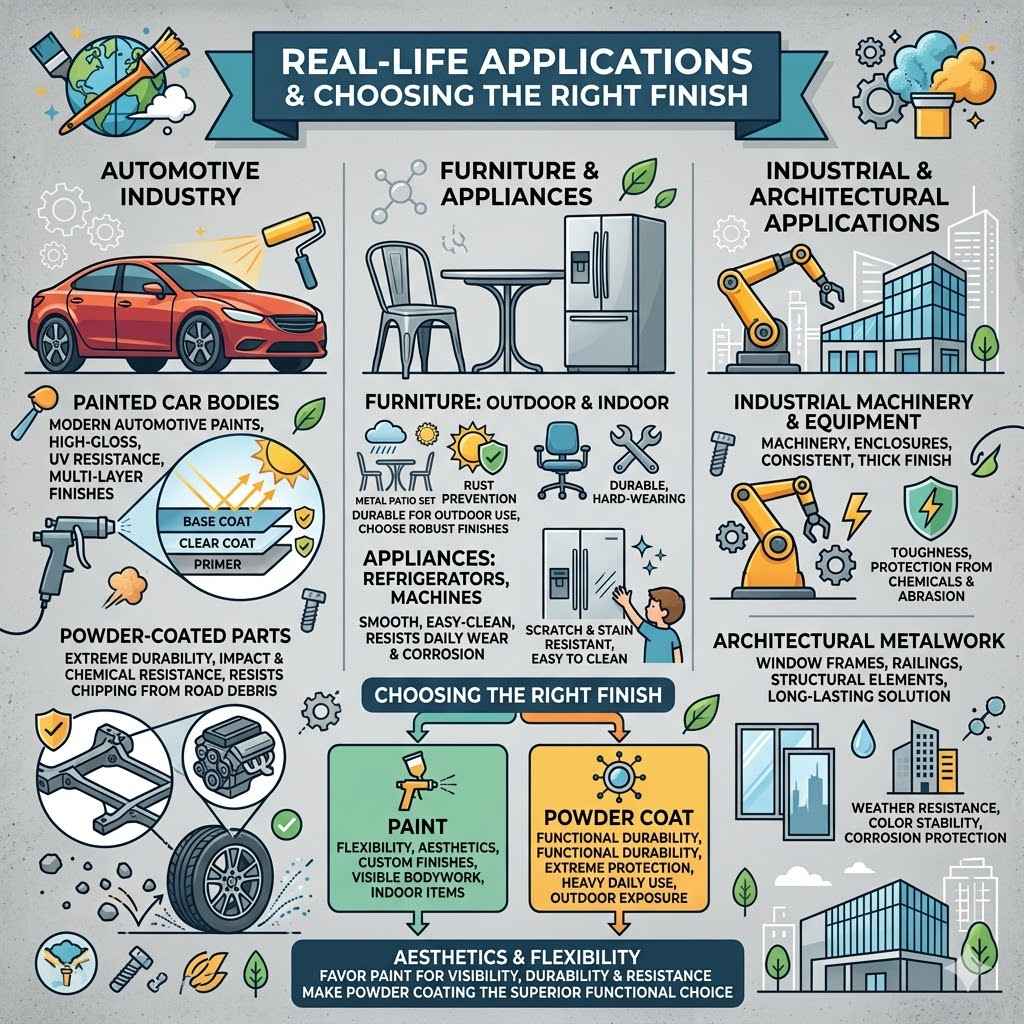
In the automotive industry, both paint and powder coating are extensively used, but for different components and purposes. Car bodies are almost exclusively painted. Modern automotive paints are highly advanced, offering excellent protection, a wide range of aesthetic options, and sophisticated finishes.
The application process for car bodies involves multiple layers, including primers, base coats, and clear coats, all designed to provide durability, UV resistance, and a high-gloss appearance.
Powder coating, on the other hand, is commonly used for automotive parts that require extreme durability and resistance to harsh conditions. This includes wheels, suspension components, chassis parts, exhaust systems, and engine components. For example, powder-coated wheels are popular because they resist chipping from road debris and corrosion from salt and grime.
The thick, hard finish of powder coating provides superior protection against impacts and chemicals encountered on the road, making it ideal for these demanding applications.
The choice between paint and powder coat in the automotive sector depends on the specific requirements of the part. Aesthetics and design flexibility often favor paint for visible bodywork, while functional durability and resistance to wear and tear make powder coating the superior choice for under-the-hood or chassis components.
Furniture and Appliances
For furniture, especially outdoor or commercial-grade pieces, powder coating is often the preferred choice for its durability and resistance to the elements. Metal patio furniture, chairs, tables, and shelving units that are exposed to sun, rain, and temperature changes benefit greatly from the protective qualities of powder coating, which prevents rust and fading.
Indoor furniture can be finished with either paint or powder coating. High-end furniture might use specialized paints for unique finishes or custom effects. For durable, hard-wearing furniture like metal office chairs, industrial-style tables, or children’s furniture, powder coating provides a robust and safe finish that can withstand frequent use and potential impacts.
Appliances, such as refrigerators, washing machines, and ovens, also frequently use powder coating for their exterior surfaces. This provides a smooth, easy-to-clean, and durable finish that resists scratches, stains, and corrosion, essential for items that are used daily.
In summary, for items that face outdoor exposure or heavy daily use, powder coating offers superior longevity and protection. For indoor items where a wider range of aesthetic finishes or simpler application for smaller batches is desired, paint remains a popular and effective option.
Industrial and Architectural Applications
In industrial settings, powder coating is a common choice for a vast array of products due to its toughness and protective properties. Machinery, metal frameworks, electrical enclosures, and heavy equipment are often powder coated to protect them from harsh operating environments, chemicals, and abrasion. The ability of powder coating to provide a consistent, thick, and impact-resistant finish is invaluable in these demanding applications.
Architectural metalwork, such as window frames, door hardware, railings, and structural elements, frequently utilizes powder coating. It offers excellent weather resistance, color stability, and protection against corrosion, which are critical for building exteriors. This ensures that these components maintain their appearance and structural integrity over many years, even when exposed to challenging climatic conditions.
The wide range of available colors and finishes also allows architects and designers to achieve specific aesthetic goals.
While paint is also used in industrial and architectural applications, powder coating often provides a more durable and long-lasting solution for many exposed metal components. The reduced maintenance requirements and extended lifespan of powder-coated parts can make them a more cost-effective choice for large-scale projects and critical infrastructure where reliability and longevity are paramount.
Frequently Asked Questions
Question: Is powder coating better than paint for outdoor use?
Answer: Yes, powder coating is generally better for outdoor use because it offers superior resistance to rust, chipping, scratching, and fading from UV exposure compared to most paints.
Question: Can I powder coat over existing paint?
Answer: It is not recommended to powder coat directly over existing paint. The surface needs to be thoroughly cleaned and often stripped of old paint to ensure proper adhesion of the powder coating.
Question: Which is more expensive powder coating or painting?
Answer: For small projects or DIY, painting is usually less expensive upfront. However, for larger or industrial applications, powder coating can be more cost-effective long-term due to its durability and lower maintenance needs.
Question: How long does powder coating last compared to paint?
Answer: Powder coating typically lasts much longer than paint, often 15-20 years or more with proper application and maintenance, while painted surfaces may need reapplication within 5-10 years depending on exposure.
Question: Is powder coating toxic?
Answer: Powder coating itself is not toxic during its application phase because it contains no VOCs. However, the materials used in powder coatings and the heating process should be handled with appropriate safety precautions.
Final Thoughts
Paint and powder coat offer distinct benefits. Paint provides a vast array of colors and easy application for many projects. Powder coating excels in durability, corrosion resistance, and environmental friendliness.
Choose powder coat for tough, long-lasting finishes and paint for easier application and more intricate color effects.
Sponsored / affiliate links. As an Amazon Associate I earn from qualifying purchases. I may earn additional commission from eligible campaigns.