Best Toilet Plunger for Homeowners: We Compared
For most toilets, a flange plunger is the better buy because its soft skirt seals the recessed drain opening and clears standard bowl clogs more reliably than a flat cup. Choose a cup plunger for sinks or tubs, where flat drain openings give it a better seal. Buy the wrong type and you waste time, splash dirty water, and may still need a snake or plumber. This guide gives a simple decision tree for toilet shape, clog severity, and common failure modes.
| Factor | cup | flange | Winner |
|---|---|---|---|
| Toilet seal | Poor on curved bowls and recessed openings | Soft flange reaches into the drain opening for a tighter seal | flange |
| Best use | Sinks, tubs, showers | Standard household toilet clogs | flange |
| Emergency backup on a toilet | Possible, but weak and messy | Made for the job | flange |
| Control and splash risk | Can slip on a toilet bowl and spray dirty water | Better contact means less wasted motion | flange |
| Need for a separate tool | Often still ends with an auger for toilet clogs | Usually handles the common case before an auger is needed | flange |
Quick comparison
| Product | Badge | Best for | Price | ||
|---|---|---|---|---|---|
 |
SOFINNI Heavy Duty Toilet Plunger Clogged, Unclog SinkSOFINNI | Also consider | 17" handle · 5" cup · dual purpose | $13.99
Price as of 19 Oct 2026
|
View |
 |
Get Bats Out Heavy Duty Toilet Plunger for Bathroom –Get Bats Out | Also consider | Heavy-duty · commercial grade · flange | $26.45
Price as of 19 Oct 2026
|
View |
Here is the core trade-off: a cup plunger works on flat drain openings, while a flange plunger is shaped to seal a toilet bowl drain opening. That difference matters because the toilet trapway is curved and needs a stronger hydraulic seal, not more brute force.
Say your toilet has low water in the bowl and a paper clog near the outlet. A flange plunger is the first tool to try. A cup plunger may sit too high on the porcelain and move water without building enough pressure.
How we chose
The comparison focuses on seal quality at the toilet bowl drain opening, handle comfort during repeated plunging, rubber durability, and when the design still calls for a closet auger. Those are the factors that decide whether a clog clears on the first round or turns into a mess.
We also weighed toilet geometry. The drain opening is recessed and curved inward, so the plunger head has to reach into the opening instead of resting on top of it.
Finally, keep storage and hygiene in view. A plunger that gets splashed during an overflow needs to be easy to rinse, dry, and keep separate from other household tools.
 As an Amazon Associate we earn from qualifying purchases. Prices and availability are accurate as of the date shown and are subject to change.
SOFINNI heavy duty toilet plunger: best for value-minded homeowners
The SOFINNI plunger is a reasonable pick if you want a toilet-ready tool with a wooden handle and a large reinforced cup at a lower price point. Based on the product details, it is aimed at general drain clogs and gives you a 17-inch handle with a 5-inch cup, which should make it easier to store and handle than bulkier heavy-duty options.
Its main drawback is the cup shape. That design helps on flat drains, but it is not as well matched to the curved toilet bowl and recessed drain opening as a true flange plunger.
Use it if you want one tool that can pull double duty for sinks and some bathroom clogs. For a toilet-only purchase, the seal shape is the limit.
As an Amazon Associate we earn from qualifying purchases. Prices and availability are accurate as of the date shown and are subject to change.
Get Bats Out heavy duty toilet plunger: best for stubborn toilet clogs
The Get Bats Out model is the stronger toilet-first choice here. Its product details point to a commercial-grade flange design, an ergonomic red handle, and a high-grade suction cup, which are the features that matter when you need a tighter seal on a toilet bowl and less strain during repeated plunging.
The drawback is simpler: it is more specialized, and that usually means less usefulness at sinks or tubs. It also sits at a higher price than the other option, at $26.45.
If a homeowner wants one plunger to keep near the toilet and use only for toilet clogs, this is the more direct fit.
Flange plunger: best for standard toilet clogs
A flange plunger is the default choice for toilets because the soft rubber flange, or lip, reaches into the recessed bowl opening and creates a tighter seal. That seal matters more than raw force when the clog sits in the toilet trapway, where curved geometry can defeat a flat cup.
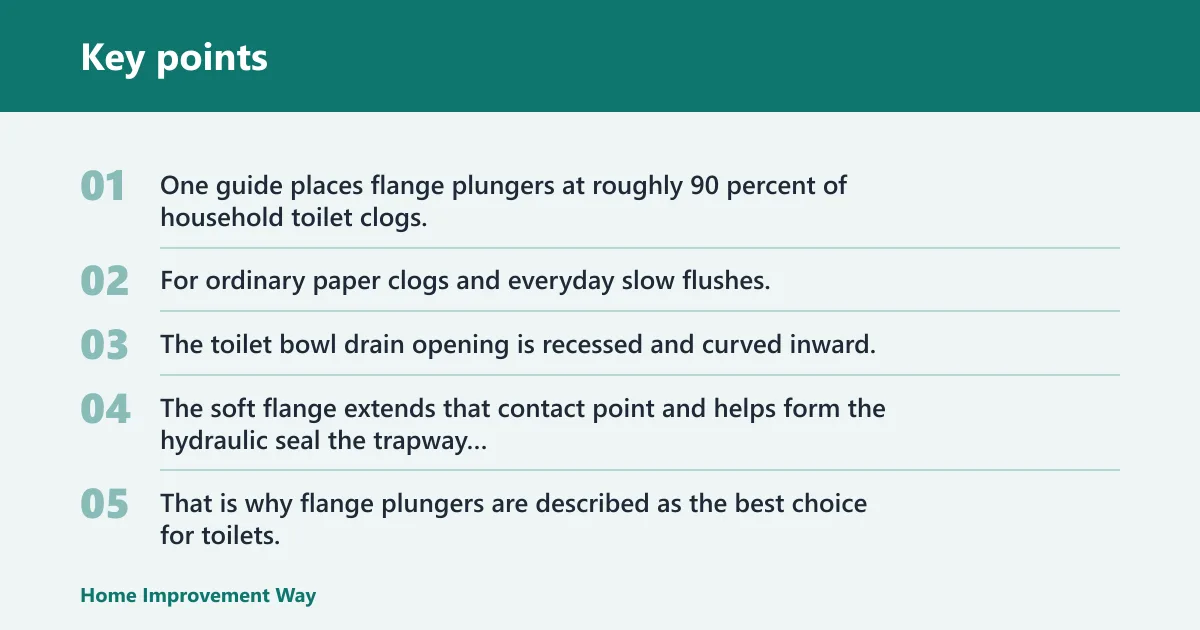
One guide places flange plungers at roughly 90 percent of household toilet clogs, which is a useful way to think about the job. For ordinary paper clogs and everyday slow flushes, it is the one most homeowners should buy first.
Why the soft flange improves the seal
The toilet bowl drain opening is recessed and curved inward, so a plunger has to seat into the opening rather than hover over it. The soft flange extends that contact point and helps form the hydraulic seal the trapway needs.
That is why flange plungers are described as the best choice for toilets. The design matches the fixture instead of fighting it.
What to look for in handle material and grip
Handle material matters because plunging is a control task, not just a force task. Wood feels classic, plastic is easy to rinse, and stainless steel can feel sturdier; an ergonomic grip helps when you need a tighter hold with wet hands.
Choose a handle that stays steady when the bowl is moving water back and forth. A slipping grip wastes pressure and increases splash risk.
When a flange model is not enough
A flange plunger can still fail on deep obstructions, repeated clogs, or an overflow-prone toilet where the water level keeps dropping back and the seal keeps breaking. In those cases, the problem may be past the point of pressure alone.
That is when a closet auger becomes the next tool. It reaches into the trapway to break up or retrieve the obstruction instead of relying on repeated plunging.
Cup plunger: best for sinks and tubs
A cup plunger is better kept for sinks, tubs, and showers because its flat-bottomed rubber cup is built for flat drain surfaces. On a toilet bowl, that flat base often cannot seal against the curved porcelain, so the force goes into the water instead of the clog.
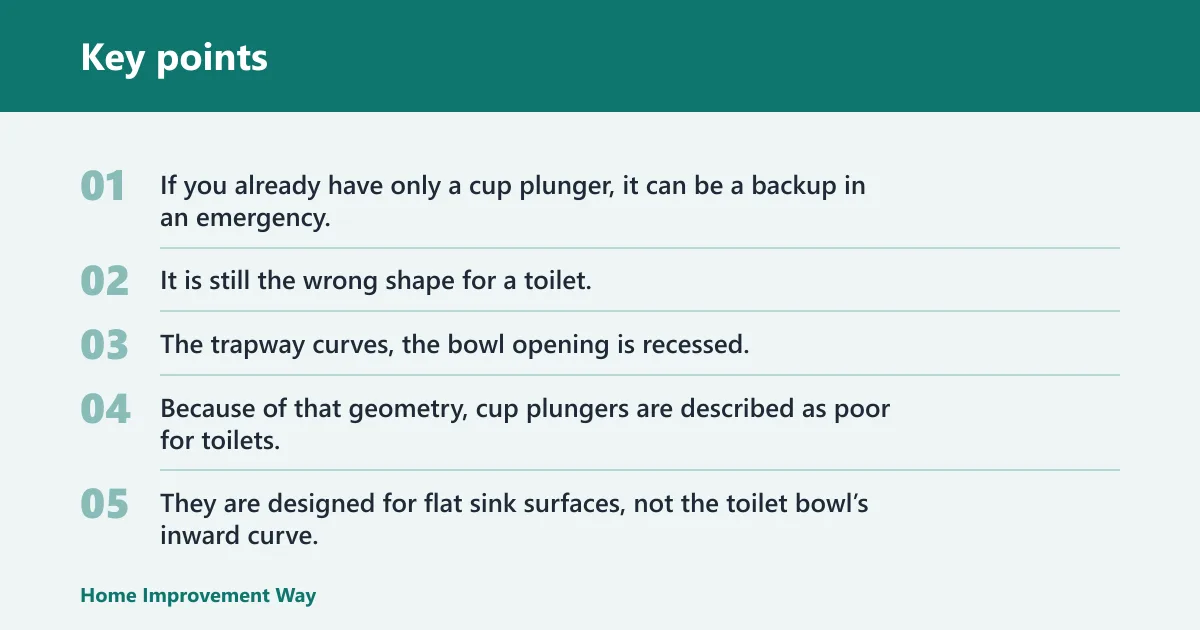
If you already have only a cup plunger, it can be a backup in an emergency. It is still the wrong shape for a toilet, and the seal is weak enough that the job may turn messy fast.
Why the flat cup struggles on a toilet bowl
Toilets are not flat drains. The trapway curves, the bowl opening is recessed, and the plunger has to reach into that opening to make contact.
Because of that geometry, cup plungers are described as poor for toilets. They are designed for flat sink surfaces, not the toilet bowl’s inward curve.
Can you use one on a toilet if you have nothing else?
Yes, but only as a stopgap. If the bowl has enough water to cover the cup, you may get a partial seal, though it is often weak and more likely to splash dirty water than to clear the clog.
A common first-timer mistake is pressing harder after the seal fails. That usually pushes water out around the cup and makes cleanup worse.
What this design is actually
Use a cup plunger on sinks, tubs, and shower drains where the flat base can sit flush against the drain opening. Those fixtures reward broad surface contact.
For toilets, a cup plunger is not the normal choice. It is a backup only when you have nothing else at hand.
Accordion plunger: best for stubborn clogs
An accordion, or bellows, plunger is the heavy hitter for stubborn toilet clogs because its rigid body can deliver very high pressure output. That extra pressure can help when a flange plunger is not enough, especially on a hard-packed paper mass or a clog that sits deeper in the trapway.
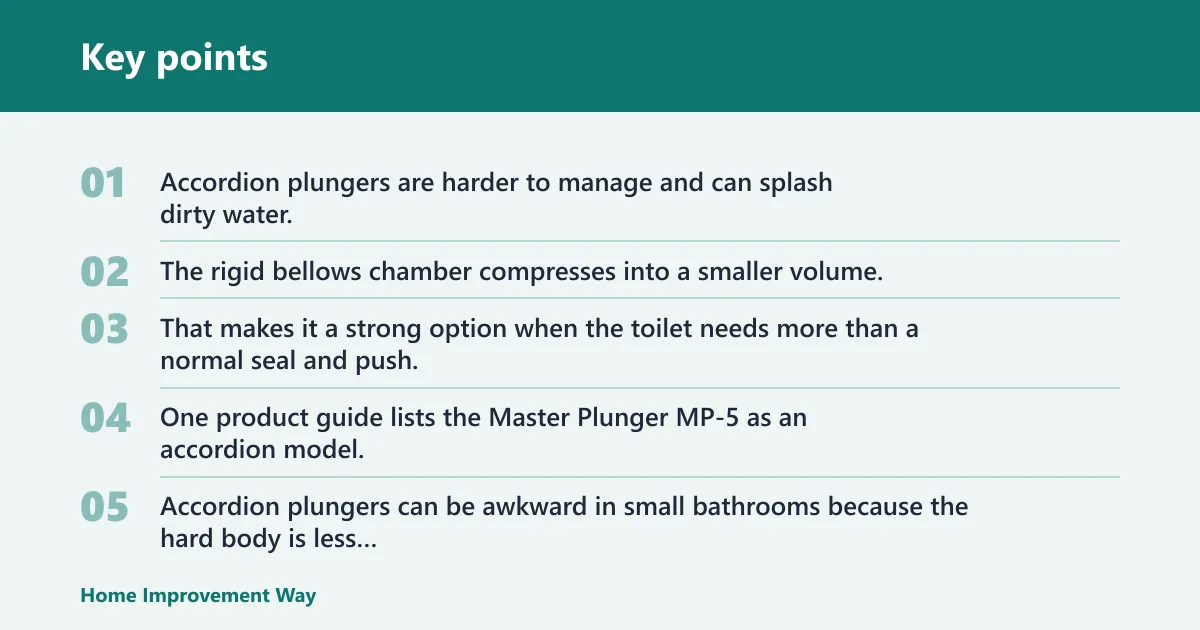
The trade-off is control. Accordion plungers are harder to manage and can splash dirty water, so they are best reserved for tougher jobs rather than routine use.
Why bellows-style bodies create high pressure
The rigid bellows chamber compresses into a smaller volume, which increases the force delivered to the blockage. That makes it a strong option when the toilet needs more than a normal seal and push.
One product guide lists the Master Plunger MP-5 as an accordion model, which shows how these tools are positioned: not as a first buy, but as a more forceful fallback.
Trade-offs: control, splash risk, storage
Accordion plungers can be awkward in small bathrooms because the hard body is less forgiving against porcelain. If the seal breaks, the spray can be worse than with a flange design.
They also take up more storage space than a simple cup or flange plunger. That matters if you plan to keep it near the toilet and out of sight.
When the extra force is worth it
Choose this style when a flange plunger has already failed on the same clog and the blockage still seems close enough to respond to pressure. It can also make sense for a low-flow toilet that tends to hold paper at the trapway.
For anything deep, hard, or repeated, move to an auger instead of cycling through more plunging.
Toilet plunger decision matrix
| clog severity | toilet condition | recommended tool |
|---|---|---|
| Paper clog | Normal water level, fresh blockage, bowl still drains slowly | flange plunger |
| Recurring clog | Same toilet keeps slowing down after flushing | accordion plunger or closet auger if repeat failure continues |
| Low-flow toilet | Limited water volume and a trapway that resists movement | flange plunger |
| Partial seal failure | Cup does not sit tight on the curved bowl opening | flange plunger |
| Overflow-prone toilet | Water rises fast and splashes risk is high | stop plunging and use closet auger |
| Stop and use auger | Repeated plunging does not move the blockage, or the clog feels deep | closet auger |
This matrix is the easiest way to avoid buying the wrong tool once. Match the clog, the toilet, and the failure mode before you force the issue.
Suppose a toilet has a paper clog, but the bowl water is low and the seal keeps slipping. That still points to a flange plunger first, not a cup plunger, because the problem is the seal, not the amount of pressure.
Which one should you buy?
Buy a flange plunger if you want one toilet-ready default. It is the safer first purchase for most households and the best fit for the toilet’s curved drain opening.
Choose a beehive plunger if you want a toilet-specific seal and are comparing it with regular flange plungers. Competitors often place the Korky 99-4A Beehive Max as a quick pick, and that style is designed for a strong seal on toilet bowls.
Choose an accordion plunger if prior clogs keep coming back and you need more pressure than a standard flange model can give. Treat it as a heavy-duty option, not the first buy for most homes.
Use a closet auger when plunging fails or the clog feels deep in the trapway. One competitor example uses a 3-foot cable, which is the kind of reach that makes sense when pressure alone is not moving the blockage.
Choose cup if… / Choose flange if…
Choose cup if you need a plunger for sinks, tubs, or showers, or if this is only a temporary backup and you have nothing else available. Choose flange if the clog is in a toilet, the bowl shape is curved and recessed, or you want one tool that handles the standard household toilet clog without wasted motion.
Choose cup if you are dealing with a flat drain opening and want a simple, broad contact surface. Choose flange if you want a tighter seal in the toilet bowl drain opening, less splash risk, and a better chance of clearing the clog before you reach for an auger.
Frequently asked questions
Should I buy a cup plunger or a flange plunger for a toilet?
For a toilet, buy a flange plunger. The soft flange is made to reach into the recessed bowl opening and seal the curved trapway better than a flat cup. A cup plunger is better reserved for sinks, tubs, and shower drains where the surface is flat.
What is the difference between a flange plunger and a cup plunger?
A flange plunger has a soft rubber lip that extends from the cup and helps it seal toilet bowls. A cup plunger has a flat-bottomed cup that works better on flat drains. The shape difference is why one is toilet-first and the other is not.
Do accordion plungers work better than flange plungers for toilets?
Accordion plungers can move more force and are often called the heavy hitter for stubborn toilet clogs. They are not the default choice, though. For standard household toilet clogs, a flange plunger is easier to control and less likely to splash dirty water.
Which plunger is best for a standard household toilet clog?
A flange plunger is the best all-around choice for a standard household toilet clog. It creates the seal a toilet needs without the extra bulk of an accordion model. If the clog is deep or keeps returning, a closet auger is the better next step.
Can I use a cup plunger on a toilet if I have nothing else?
You can try, but only as a backup. The flat cup does not match the curved toilet bowl well, so the seal is weak and the water can splash. If the clog does not move after a few controlled strokes, stop and switch tools.
What should I look for when buying a toilet plunger?
Look for seal quality, handle comfort, and rubber durability. For durability, focus on tear resistance, chemical resistance, and shape memory so the rubber keeps its form after repeated use and cleaning. If the plunger is for toilets, make sure the head is designed to reach into the drain opening.
When should I use a closet auger instead of a plunger?
Use a closet auger when plunging fails, when the clog feels deep in the trapway, or when the toilet is close to overflowing. A plunger depends on pressure and seal. An auger is better when the blockage needs to be broken up or retrieved instead.
Are beehive plungers better than regular flange plungers?
Beehive plungers can be better if you want a toilet-specific seal and a design aimed at strong contact in the bowl. They are often positioned as top picks by competitors. For most homes, though, a regular flange plunger already covers the standard toilet clog well.
Sponsored / affiliate links. As an Amazon Associate I earn from qualifying purchases. I may earn additional commission from eligible campaigns.
 Toilet Plunger Drain Clog Remover: High Pressure Air Drainage Blaster Clog Remover Tool- Stainless Steel White Air Plunger for Bathroom, Sink, Floor, Kitchen Clogged
 Diversey CREW 04560 Heavy Duty Toilet Bowl Cleaner & Disinfectant, 23% HCI removes Rust Stains, Lime Scale with Mint Scent, Ready-to-Use, 32-Ounce