How to Tie down Mattress in Truck Bed: Securely Transport
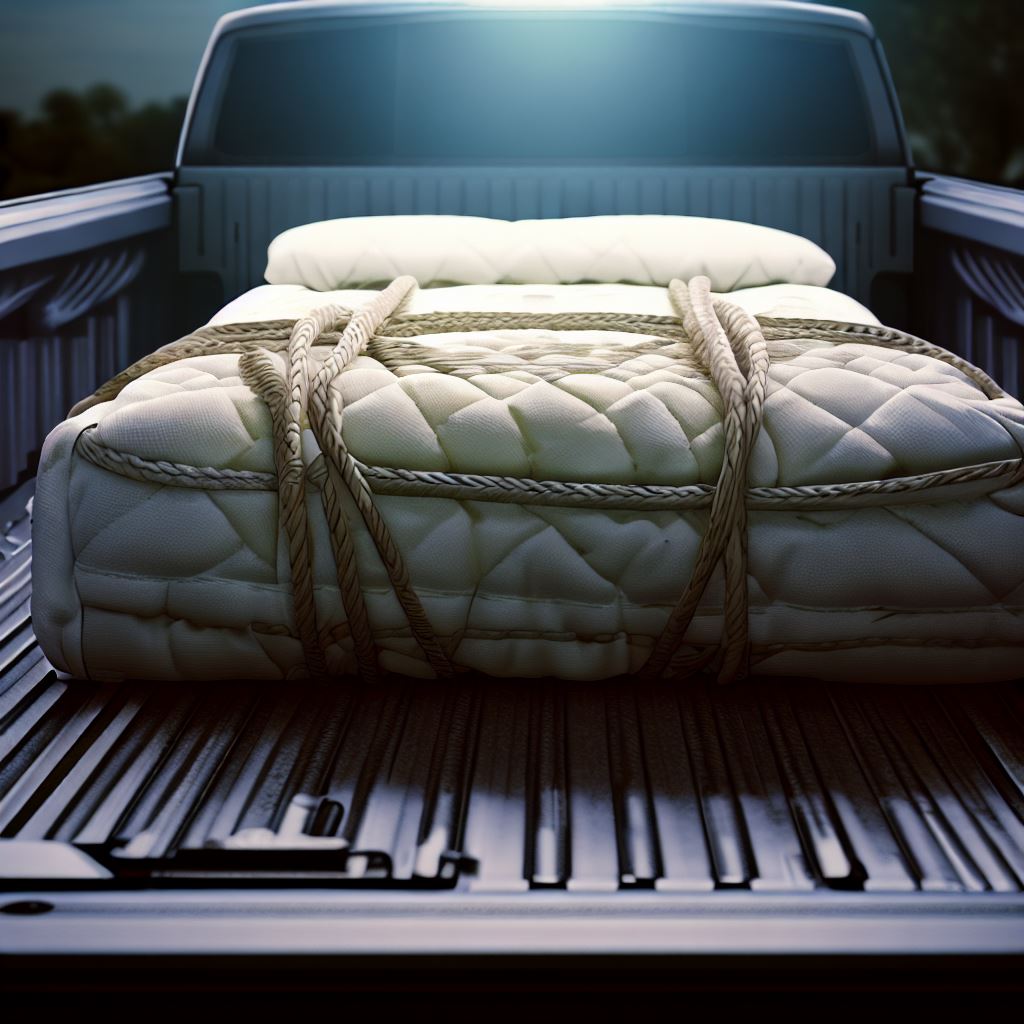
Use at least two ratchet straps crossed over the mattress and one front-to-back strap or anchor point set, then add a tarp only if it stays tight and does not billow; for tall foam or pillow-top mattresses, use four straps and keep the mattress flat. If you secure it badly, wind can lift the mattress, straps can cut the cover, and the mattress can slide out or fold. This guide covers the safest strap layout by mattress type and truck-bed setup, plus the failure points that make a load shift or tear loose.
What you need before loading the mattress


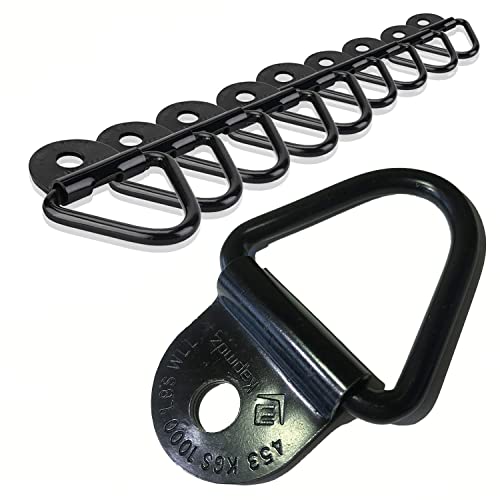
Start with ratchet straps, not bungee cords. Ratchet straps hold tension better and stay tighter on a mattress load. Check each strap’s working-load rating against the mattress and the tie-down load before you use it. Put the straps on a truck bed with factory anchor points, corner cleats, or other rated tie-down points already checked for your specific truck.
Use ratchet straps, work gloves, and tarps or plastic wrap as needed, but keep the mattress dry if you can because moisture can damage many mattresses even when covered. Ratchet tie downs are polyester straps with hooks or loops at the ends, which is the style to look for when you want a strap that can be cinched with a ratchet mechanism instead of stretched like a bungee cord.
Truck bed anchor points to check first
Look for factory anchor points in the bed, corner cleats, and any rear tie points built into the truck. These are the places to use for diagonal and cross-strap routing. Anchor layouts vary by truck model, so do not assume the rear cleats and front anchors are in the same place on every pickup.
If the bed has no useful rear tie points, you may need a different routing plan or a different vehicle setup. A weak hook angle invites strap slip, especially if the mattress sits high or if the tailgate stays down.
Cover, rope, and basic padding
A protective cover or tarp can help keep out dirt, but avoid transporting the mattress in rain if you can because moisture can damage it even under a cover. If you do use a cover, it should stay tight enough that it does not balloon in the wind. Rope can secure the cover, but the cover should stay tight enough that it does not balloon in the wind.
Optional padding matters when hard hardware might touch the mattress edge. A folded blanket, moving pad, or cardboard spacer can reduce edge wear at contact points, but it should not be used in a way that hides a loose strap or blocks a tie-down point.
How should a mattress sit in the bed?
Lay the mattress flat when the bed length allows it, or put it on its side only when space is tight and the strap plan still keeps it stable. A flat mattress catches less wind and is less likely to fold under pressure. On its side, the mattress catches more air and needs tighter control.
Keep the mattress as low as you can. A tall stack creates more wind force and more strap slack over bumps.
When the tailgate can stay down
Use the tailgate down only when the mattress is too long for the bed and the load still sits securely on the deck. If the mattress does not extend past the bed, close the tailgate. If the mattress overhangs, the tailgate-down setup needs tighter control and better rear visibility planning.
Queen-size mattresses are a common problem case. A queen mattress is commonly about 80 by 60 inches, which is wide enough to make angle loading and tailgate-down transport common in midsize beds. If the mattress hangs past the tailgate, confirm that lights and plate visibility stay legal in your area.
Why height affects wind lift
Wind pushes on a tall mattress like a sail. The higher the mattress sits above the bed floor, the more likely the straps are to loosen from bounce, stretch, or corner compression. High winds can create lift, and highway speed increases that effect.
Suppose a foam queen sits on edge in a short-bed pickup with the tailgate down. The bed may fit the footprint, but the upright shape catches wind at the rear corner. That is the kind of setup where a cross-strap alone is usually not enough.
Mattress transport checklist
| Mattress type | Truck bed fit risk | Minimum strap count | Best strap pattern | Tailgate position | Weather risk | Stop-to-check interval | Failure modes to watch |
|---|---|---|---|---|---|---|---|
| Foam twin or full | Low in a full-size bed; medium in a short bed | 2 | X pattern over the center, plus one front-to-back hold if the bed is long enough | Up if the mattress stays inside the bed; down only if needed for length | Medium in wind; low in light rain with full cover | After 5 to 10 miles, then at each stop | Sliding, strap stretch, edge compression, tarp flutter |
| Queen foam | Medium to high in short beds; may need angle loading | 4 | Two crossed straps plus two horizontal or vertical straps | Often down if the mattress overhangs | High in crosswinds and at highway speed | After 5 miles, then every 15 to 20 miles | Lift, sliding, corner tear-out, blocked plate or lights |
| Pillow-top queen or king | High; tall profile and softer edges shift easily | 4 | X pattern with extra vertical restraint near the ends | Usually down if the bed is short | High in wind; very high if rain soaks the cover and adds drag | After 5 miles, then every 10 to 15 miles | Lift, edge damage, strap cut-in, visibility issues |
| Hybrid mattress | Medium; heavy enough to stay put, but still prone to lift | 3 | Cross straps with one front-to-back strap set | Up if fully contained; down if the bed is short | Medium to high | After 5 to 10 miles | Sliding, strap creep, corner compression |
| Box spring with mattress | Very high; bulky, tall, and awkward together | 4 | Cross straps plus side-to-side restraint and rear tie points | Usually down; secure the rear edge carefully | Very high in wind | After 3 to 5 miles, then often | Lift, sliding, frame shift, visibility blockage |
How many straps do you need?
Plan on at least two ratchet straps. For a larger, taller, or softer mattress, use three or four. The number matters, but the layout matters more. A bad angle with four straps can still let the mattress creep rearward or lift at the corners.
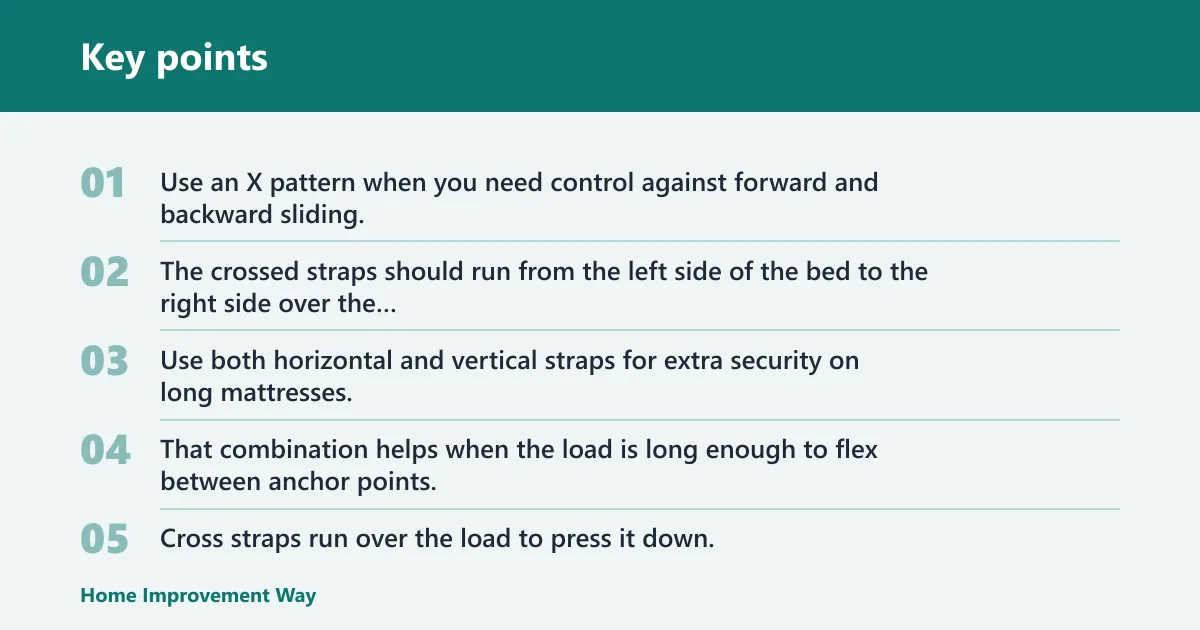
Use an X pattern when you need control against forward and backward sliding. The crossed straps should run from the left side of the bed to the right side over the mattress, with the front pair pulling slightly forward and the rear pair pulling slightly rearward so the load is pressed down and kept from sliding. Use both horizontal and vertical straps for extra security on long mattresses. That combination helps when the load is long enough to flex between anchor points.
Cross straps versus diagonal straps
Cross straps run over the load to press it down. Diagonal straps tie from one side of the truck bed to the opposite side, which helps resist sideways motion and keeps the mattress from shifting toward a bed wall or tailgate corner. A forum reply recommends rope or ratchet straps to keep the mattress from sliding or lifting.
Use diagonal tie-downs when the mattress sits high or when the anchor points are not directly across from each other. The strap should leave one anchor, cross over the mattress, and pull down to the opposite side so the mattress is held both down and inward.
Why the strap layout matters more than force alone
Ratchet force without a good route can crush one edge while leaving another edge loose. Corner compression is a real failure point. If the strap bites too hard at one end, the mattress cover can tear while the opposite end still shifts in the bed.
Say your queen mattress sits flat in a short bed with the tailgate down. Two straps may stop it from bouncing, but without a front-to-back hold the mattress can creep rearward over rough pavement. One extra strap often does more than simply tightening the first two harder.
Where should the straps attach?
Attach straps to the truck bed tie-down points first: factory anchor points, corner cleats, or other rated anchors that can handle load tension. Use the bed structure, not loose rails or anything that can flex. The goal is to build a low, stable triangle or X between the mattress and the bed corners.
Front-to-rear routing helps stop fore-and-aft motion. Side-to-side routing helps stop a tall mattress from leaning or rolling. Use both when the mattress is on its side, when wind is strong, or when the bed is long enough that the mattress can move in more than one direction.
Front-to-rear routing
Front-to-rear straps should run from a front anchor point near the cab, up and over the mattress, and down to a rear anchor point near the tailgate. Use one strap near the front third of the mattress and another near the rear third so the load is pulled toward both ends of the bed and held from bouncing fore and aft. If the mattress is long enough to flex between anchors, add a center strap or a second pair.
Side-to-side routing for tall loads
When the mattress sits on its side, side-to-side routing is what keeps it from tipping. Use the bed’s corner cleats or rear anchors so the strap path presses the mattress inward and down. Do not let the load rest on a single strap edge; that invites tear-out and cover damage.
How do you keep it from moving?
Tight straps are only part of the job. After tightening, do a tug test by hand and push the mattress from several sides. It should not slide, rock, or lift at the corners. Repeat the tug test before departure, then again after the first few miles.
Watch for three signs of trouble: the mattress shifts when you push it, the strap loses tension, or the tarp billows enough to act like a sail. If you can see the cover rising in the wind, the setup is too loose for road speed.
The tug test before departure
- Press on the mattress at the front, middle, and rear.
- Check that the ratchet handles are locked and fully seated.
- Look for strap tails hanging near wheels, lights, or the tailgate.
- Re-tighten any strap that moves under hand pressure.
- Repeat the push check from the opposite side of the truck.
How to keep the mattress from rubbing or tearing
Keep strap hardware away from the mattress corners. Use padding where a hook or buckle could rub the edge. Edge tear-out often starts where a strap rides over a sharp bend or where a corner gets pinched against the bed wall.
A common first-timer mistake is tightening the nearest strap until it looks secure, then skipping the far side. That can flatten one corner and leave the opposite corner loose enough to creep. A mattress that looks tight from one side can still be unstable from the rear.
Weather and speed limits for the trip
Rain and wind should change the plan. Avoid transporting the mattress in rain if you can because moisture can damage many mattresses even if they are covered. If a cover is used, it must stay tight. If the cover balloons, it increases drag and can add lift. In strong wind, the mattress should stay flatter, lower, and more tightly strapped than on a calm day.
Hunker advises driving slowly with a mattress in a pickup truck, and that is the right approach. Avoid highways when possible, especially with a queen mattress, a tall pillow-top, or any load that sits on its side. Shorter trips are safer than long fast runs when the load is marginal.
When to avoid highways
Avoid highway speeds if the mattress sits above the bed rails, if the tailgate is down, if rain is steady, or if the cover is loose. Those are the conditions that turn small movement into lift. Puffy says high winds can create lift, and that risk rises with speed.
If the trip is long, use more stops and slower roads. A slower route gives you time to catch strap slack before it becomes a shift. That matters more than trying to save a few minutes on the drive.
Common mistakes and safety checks
Do not rely on bungee cords as the main restraint. They can bounce and lose tension. Use ratchet straps for the primary hold, and keep the mattress covered without letting the tarp act like a sail. Check local regulations for large-object transport before you leave.
Also check visibility. A mattress or cover that blocks tail lamps or the license plate can create a legal problem and a safety problem. If the load extends past the bed, mark the farthest rear edge with a red flag and confirm that rear lighting and plate visibility are not hidden by the mattress edge or by loose fabric.
Loose strap tails and buckle position
Trim or secure loose strap tails so they do not whip in the wind or drift near a tire. Keep buckle handles where you can inspect them quickly at a stop. A buckle that has rotated or crept toward an edge can cut into the cover or loosen during the drive.
Recheck intervals after the first few miles
Recheck straps after the first 5 to 10 miles. After that, stop every 15 to 20 miles on a normal trip, or sooner if wind picks up, rain starts, or the mattress sits high. The first stop matters most because that is when stretch and settling usually show up.
If the mattress is still moving after the first recheck, stop and reset the load. Do not keep driving on a questionable setup. A slightly longer loading session is safer than trying to force a bad tie-down to work at road speed.
Frequently asked questions
How do you tie down a mattress in a truck bed?
Lay the mattress flat if possible, place it against the bed floor, and use at least two ratchet straps in an X or cross pattern over the center. Attach the straps to factory anchor points or corner cleats, then do a tug test before driving and recheck after the first few miles.
Can you transport a mattress in a pickup truck safely?
Yes, if the mattress is kept low, tightly strapped, and covered against weather. The main risks are wind lift, sliding, and blocked visibility. Safe transport depends on bed size, mattress height, anchor points, and how well the load stays flat and tight at the route you choose.
Do you need ratchet straps for a mattress in a truck bed?
Ratchet straps are the better choice for the main restraint because they hold tension better than bungee cords. Use at least two, and add more for larger or taller mattresses. A strap that can be tightened with a ratchet mechanism is far more reliable for preventing shifting and lift.
Should a mattress lay flat or on its side in a truck bed?
Flat is usually better because it lowers wind exposure and reduces the chance of bending or folding. On its side can work when space is tight, but it raises the load and makes wind lift more likely. If you go on its side, use more straps and tighter routing.
How many straps do you need to secure a mattress in a truck bed?
Plan on at least two ratchet straps for a basic load. Use three or four when the mattress is queen size, pillow-top, tall, or partly over the tailgate. The safest count depends on bed length and load height, not just mattress size alone.
Can you haul a queen mattress with the tailgate down?
Yes, if the mattress does not fit fully inside the bed and the load is still secured at the rear edge. A queen mattress, commonly about 80 by 60 inches, may need tailgate-down transport in a shorter bed. Check lights, plate visibility, and strap tension before driving.
Do you need a tarp when moving a mattress in a truck bed?
A tarp or protective cover is a good idea for dirt protection, but avoid rain if you can because moisture can damage many mattresses even under a cover. If you use a cover, it should cover the full mattress and be secured so it cannot billow in the wind. If the cover flaps, it can add drag, create lift, and loosen the tie-downs.
Sponsored / affiliate links. As an Amazon Associate I earn from qualifying purchases. I may earn additional commission from eligible campaigns.