Types of Metal Finishes for Home Fixtures
For home fixtures, common metal finishes include polished chrome, brushed nickel, stainless steel, matte black, oil-rubbed bronze, and brass. The best rule is to match the finish to touch frequency and moisture, not color. Choose poorly, and you can end up with water spots, worn edges, faster corrosion, or hardware that looks tired long before it should. This guide compares the common types of metal finishes for home fixtures by durability, maintenance, and where each one makes the most sense.
Common fixture finish types
Metal finish names on labels usually describe the surface treatment, not the metal underneath. A faucet can be brass, zinc, or stainless steel underneath, then plated, coated, brushed, polished, or patinated on top. That difference matters because durability depends on the finish system as much as the base metal.
What finishes can be applied to metals?
Common fixture finishes include brushed, polished, satin, matte, plated, coated, and patinated looks. Wayfair lists five common types of metal finishes in the home, and those broad families cover most labels you will see. The same metal can also receive a lacquer, clear coat, powder coating, or PVD finish.
Finish names homeowners see on labels
Retail labels can be inconsistent. “Brushed nickel,” “satin nickel,” and “matte nickel” are often close cousins, but they do not always share the same coating system or wear behavior. “Polished” usually means shiny and reflective. “Brushed” usually means directional lines or faint brushstroke marks.
Base metal vs surface finish
Do not treat the finish name and the base metal as the same thing. A stainless steel fixture can still have a plated or coated surface. A brass fixture may be polished, brushed, or darkened with an oil-rubbed look. The base metal affects corrosion risk; the finish affects appearance and upkeep.
Brushed, polished, and satin finishes
These three finish families solve different problems. Brushed finishes mute glare and often hide small marks better. Polished finishes reflect more light and usually show smudges faster. Satin sits between them, with a smoother surface than brushed but less shine than polished. The same source says brushed metal has faint brushstroke marks, while satin is smoother and usually without brushstroke marks.
What brushed metal looks and feels like
Brushed metal has visible directional lines and a soft matte appearance. Haus & Hand describes brushed nickel as matte and slightly textured. Color Cord Company says brushed metal resists stains, spots, fingerprints, and smudges. The same source says brushed finish works great in modern and industrial spaces.
What polished metal looks and feels like
Polished metal is bright, reflective, and smooth to the eye. Mor Furniture notes that polished metal finishes appear on all different types of metal. The same source says polished metal shows smudges and fingerprints more readily than other finishes. That tradeoff is most noticeable on kitchen pulls and bathroom faucets.
Where satin falls between them
Satin is the middle ground. It has less shine than polished and less texture than brushed, so it tends to read calm without looking flat. The same source says satin finish looks great in modern and mid-century modern homes. It is a useful choice when you want a softer look without the upkeep of high gloss.
Which finishes hide wear best?
Brushed, satin, and some matte-coated finishes usually hide wear best because they interrupt reflections and make small marks less obvious. The most forgiving choice depends on whether your main problem is fingerprints, water spots, or scratches. In hard-water homes, spotting matters more than the catalog description.
Fingerprint visibility
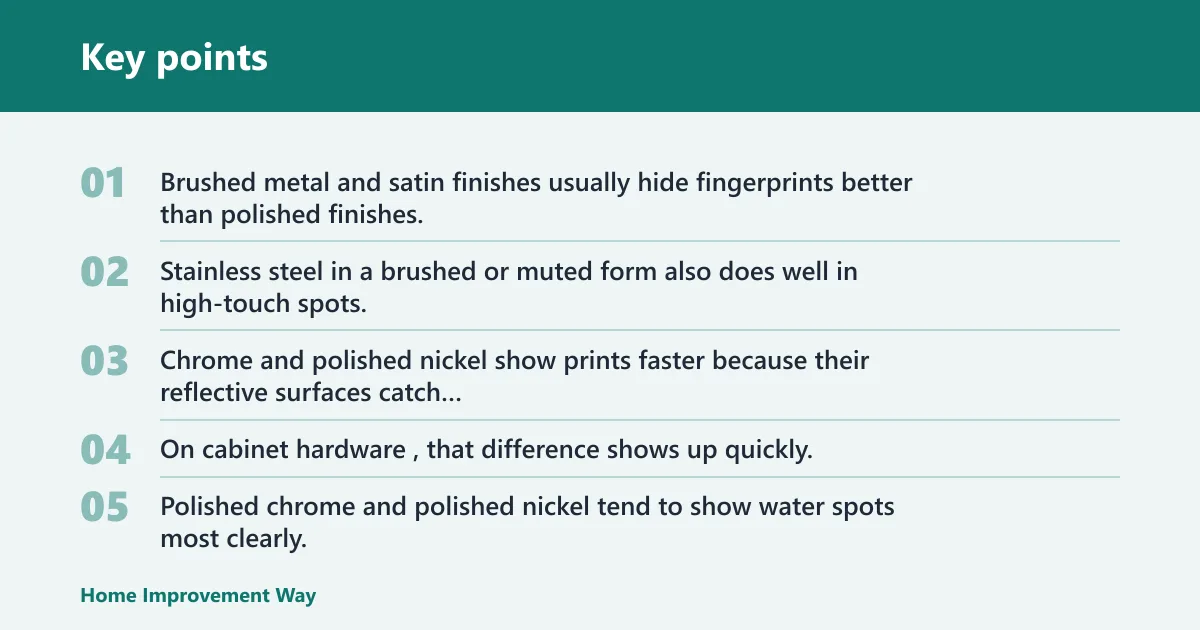
Brushed metal and satin finishes usually hide fingerprints better than polished finishes. Stainless steel in a brushed or muted form also does well in high-touch spots. Chrome and polished nickel show prints faster because their reflective surfaces catch oils and hand marks. On cabinet hardware, that difference shows up quickly.
Water-spot visibility
Polished chrome and polished nickel tend to show water spots most clearly, especially around sinks and shower trim. That does not make them bad choices, but it does make them less forgiving in hard-water bathrooms. Brushed and satin surfaces soften the look of spotting because the reflection is less mirror-like.
Scratch visibility and cleaning effort
Scratches stand out more on mirror-like finishes than on brushed or satin ones. For cleaning effort, the easiest finishes are usually the ones that do not demand perfect drying after every use. A common first-timer mistake is choosing a glossy faucet for a family bath and then expecting low upkeep.
Say your kitchen has a prep sink used all day, plus a pull-down faucet that gets touched with wet hands. A brushed or satin finish will usually stay looking even longer than polished chrome because it hides small smears and splash marks between cleanings.
Polished nickel vs chrome
Polished nickel and chrome can look similar at a glance, but they are not the same choice. Polished nickel usually reads warmer and less blue, while chrome is cooler, shinier, and more mirror-like. Chrome tends to show water spots and fingerprints more readily, while polished nickel softens the reflection a bit.
Warm undertone versus cool undertone
Polished nickel has a warm undertone and a softer glow. Chrome has a cool undertone and a brighter mirror effect. That difference matters if you are pairing fixtures with warm woods, creamy tile, or cool gray surfaces. Polished nickel usually feels gentler in transitional spaces.
Reflective level and maintenance
Chrome is usually the more reflective of the two. Haus & Hand says chrome is shiny and sometimes mirror-like. Because of that, chrome often makes fingerprints, mineral spots, and smudges easier to see. Polished nickel still needs wiping, but it usually looks less stark between cleanings.
When to pick one over the other
Choose chrome when you want a crisp, bright look and do not mind frequent wiping. Choose polished nickel when you want a similar shine with a warmer tone and slightly softer visual maintenance. In humid bathrooms or hard-water homes, polished nickel often feels more forgiving.
Fixture finish decision matrix

This matrix compares common finishes by the problems homeowners notice first: fingerprints, water spots, scratches, humidity, and cleaning effort. Scores run from 1 to 5, where 5 is the most forgiving for that category. The recommendation column points to typical room use, not a universal winner.
| Finish | Fingerprint visibility | Water-spot visibility | Scratch visibility | Humidity tolerance | Cleaning effort | Kitchen | Bathroom | Door hardware | Best for | Avoid if |
|---|---|---|---|---|---|---|---|---|---|---|
| Brushed nickel | 4 | 4 | 4 | 4 | 4 | Good | Very good | Very good | Busy bathrooms and family homes | You want a bright mirror finish |
| Polished nickel | 2 | 2 | 2 | 3 | 2 | Good | Good | Fair | Warm shine with classic style | You want low-wipe upkeep |
| Chrome | 1 | 1 | 2 | 3 | 1 | Good | Good | Fair | Bright, economical, easy to match | You hate spotting and prints |
| Stainless steel | 4 | 4 | 3 | 5 | 4 | Excellent | Good | Good | Kitchens and coastal homes | You want a warm brass tone |
| Polished brass | 2 | 2 | 2 | 3 | 2 | Good | Fair | Fair | Formal accents and warm interiors | You want a low-maintenance utility finish |
| Brushed brass | 4 | 3 | 4 | 4 | 4 | Very good | Very good | Good | Warm tone with less glare | You want a highly reflective look |
| Satin brass | 4 | 4 | 4 | 4 | 4 | Very good | Very good | Very good | Modern brass without heavy shine | You need a true mirror brass finish |
| Oil-rubbed bronze | 3 | 4 | 4 | 4 | 3 | Good | Good | Very good | Traditional hardware and darker palettes | You want a light, bright room feel |
| PVD finish | 4 | 4 | 5 | 5 | 5 | Excellent | Excellent | Excellent | High-touch fixtures and long service life | Your budget favors basic plated hardware |
| Brushed metal finish | 5 | 4 | 4 | 4 | 5 | Excellent | Very good | Excellent | Low-stress upkeep on active surfaces | You want a glossy statement piece |
PVD deserves special attention because it is not just a look. It is a premium finish system with high durability, and it often outperforms basic plating or lacquered coatings on wear resistance. For high-touch fixtures, the extra cost can make sense when replacement labor matters more than the sticker price.
Which finishes work best by room?
Room conditions should come first, then maintenance tolerance, then color family, then sheen. Kitchens face grease, fingerprints, and constant handling. Bathrooms add humidity and spotting. Door hardware gets repeated touch without the benefit of sink-side rinsing. That is why one finish rarely wins everywhere.
Kitchen fixtures
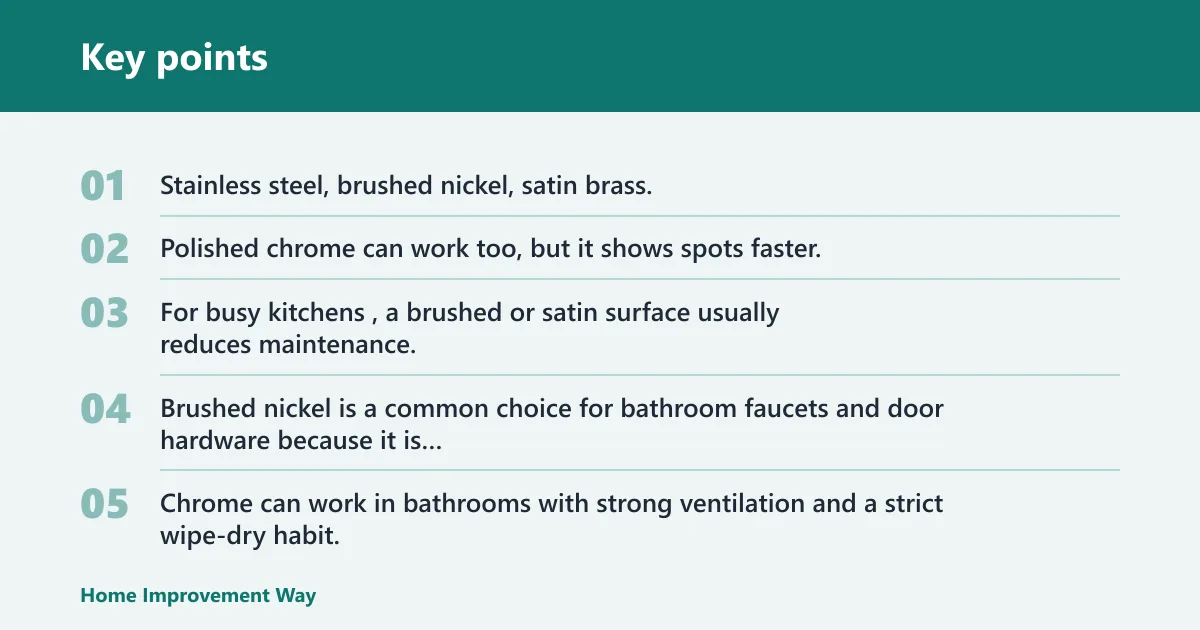
Stainless steel, brushed nickel, satin brass, and PVD finishes tend to work well in kitchens because they tolerate daily contact and are easier to keep presentable. Polished chrome can work too, but it shows spots faster. For busy kitchens, a brushed or satin surface usually reduces maintenance.
Bathroom faucets and shower trim
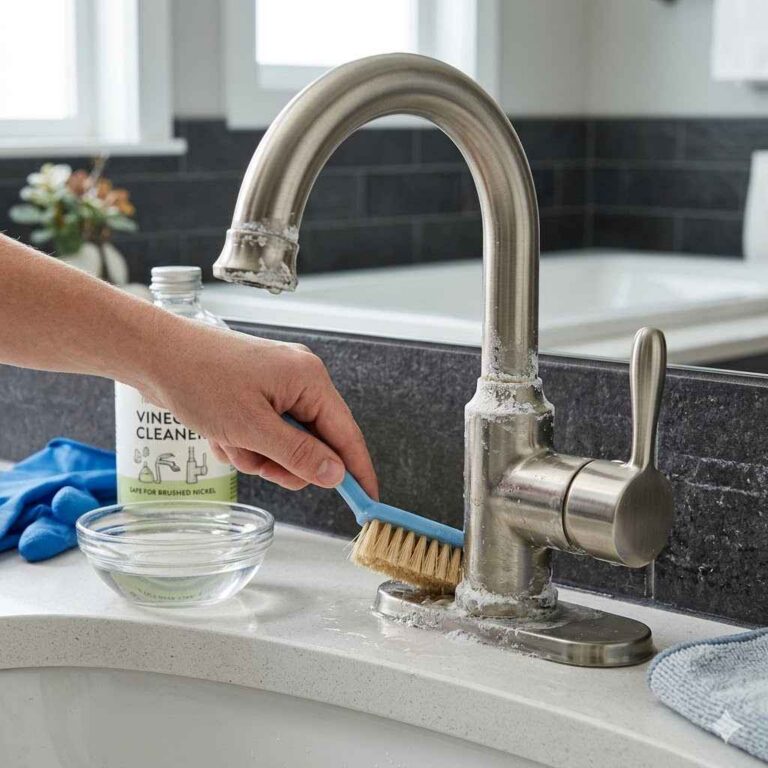
Brushed nickel is a common choice for bathroom faucets and door hardware because it is matte and slightly textured. Chrome can work in bathrooms with strong ventilation and a strict wipe-dry habit. In humid homes or hard-water baths, brushed nickel, satin brass, or PVD usually feels safer than a bright polish.
Door hardware and high-touch points
Door levers, cabinet pulls, and towel bars need finishes that hide repeated handling. Brushed metal finish, brushed nickel, brushed brass, and PVD do well here. If the house has children or frequent guests, choose a finish that does not punish every handprint. In rentals, that matters even more.
Suppose a rental bathroom has a 48-inch vanity, a mirror above the sink, and a small window that leaves the room humid after showers. Polished chrome may look bright on install day, but brushed nickel or PVD will usually keep the hardware looking cleaner between turnovers.
Mixing metals without clashing
Mixed metals can work if the finish family and undertone are intentional. Keep one dominant finish for most hardware, then use a second finish as an accent. Warm undertones pair more easily with brass and oil-rubbed bronze, while cooler undertones fit chrome and many stainless looks.
Matching undertones
Warm brass, polished nickel, and oil-rubbed bronze can live together if the room repeats the same warmth in cabinets, tile, or lighting. Chrome and stainless steel usually read cooler. If you mix them, keep the contrast deliberate rather than accidental. Random mixing looks mismatched fast.
Using one dominant finish
A simple approach is one main finish for faucets and most hardware, then one accent finish on lighting or a mirror frame. That keeps the eye from chasing too many reflective surfaces. In a kitchen, a brushed main finish with a small polished accent is easier to manage than the reverse.
Keeping sheen levels intentional
Mixing works best when the sheen levels still make sense together. A polished faucet beside flat black cabinet pulls can look sharp; a polished faucet beside three other shiny metals may look busy. Consistency in undertone matters more than perfect sameness in every fixture.
Frequently asked questions
How durable is the metal finish?
Durability depends on the finish system, not just the base metal. PVD, good plating, and quality clear coats usually last longer than thin decorative coatings. Humid bathrooms, hard-water exposure, and repeated hand contact shorten finish life. For high-touch fixtures, durability should be judged by both coating type and room conditions.
What are the most common types of metal finishes for home fixtures?
The most common home-fixture finishes are chrome, brushed nickel, stainless steel, brass, and oil-rubbed bronze, with satin and polished variations on several of them. The same source lists five common types of metal finishes in the home, and those five families cover most of the labels you will compare in stores.
Which metal finish hides fingerprints and water spots best?
Brushed and satin finishes usually hide fingerprints and water spots better than polished ones. Brushed metal has directional texture, and Color Cord Company says it resists stains, spots, fingerprints, and smudges. For hard-water bathrooms and active kitchens, brushed nickel, satin brass, brushed brass, and PVD are usually easier to live with.
What is the difference between brushed and polished metal finishes?
Brushed metal has faint brushstroke marks and a matte look, while polished metal is smooth, shiny, and reflective. The same source says polished metal shows smudges and fingerprints more readily than other finishes. Brushed finishes usually hide wear better; polished finishes usually create a brighter, more formal look but need more wiping.
How do polished nickel and chrome differ?
Polished nickel is usually warmer and less mirror-like than chrome. Haus & Hand describes chrome as shiny and sometimes mirror-like, while polished nickel reads softer. Chrome tends to show water spots and fingerprints more readily. Polished nickel is often the better pick when you want shine without a cold, bright finish.
Sponsored / affiliate links. As an Amazon Associate I earn from qualifying purchases. I may earn additional commission from eligible campaigns.