Metal finishes for home hardware: room-by-room guide
Choose metal finishes for home hardware by scoring five things first: the room, how often the item is touched, how much moisture or splash it sees, how aggressive your cleaning routine is, and which finish will serve as the anchor. In many homes, one main finish and one secondary finish, used consistently, creates a cohesive look. Get that sequence wrong and you can end up with spotted faucets, chipped pulls, awkward room transitions, and a house that feels pieced together despite the budget. I have seen that happen in otherwise well-planned remodels, including one kitchen where a beautiful living brass faucet was paired with easy-care brushed pulls and the mismatch in aging was obvious within months. This guide maps the best finish choices by kitchen, bath, laundry, entry, and other spaces, plus coordination rules for faucets, lighting, hardware, and door sets.
My quick framework looks like this: start with the room, then rate touch frequency, then rate moisture, then be honest about cleaning tolerance, then choose the anchor finish from the hardest-working item. In a kitchen, that is usually the faucet. In a primary bath, it is often the vanity faucet or shower trim. At the front door, it is the handleset or lockset.
- Dry, low-touch rooms can use more decorative finishes without much penalty.
- Humid, high-touch rooms reward tougher systems like quality PVD, stainless steel, and well-executed plated finishes.
- If you dislike wiping spots, choose brushed or satin textures over mirror-polished ones.
- Pick the anchor finish from the workhorse piece first, then coordinate pulls, levers, and nearby trim around it.
- Before buying, confirm whether the look is solid metal, plated, coated, lacquered, or a living finish that will change color over time.
How to choose a metal finish by room and hardware type



Start with touch frequency, not color
High-touch hardware wears differently from decorative pieces. Door levers, cabinet pulls, faucets, and bathroom fittings collect skin oils, cleaner residue, and abrasion every day, so finish performance matters more there than on a chandelier canopy or an occasional-use hinge.
I use a simple order: decide which items get handled most, then narrow the finish family, then pick the sheen. That keeps a delicate look off the hardest-working parts of the room. When I help someone choose between two similar silvers, I do not start with “which one looks better in the showroom.” I start with “which one will still look good after toothpaste, dish soap, and a year of fingerprints?”
Rate the room for moisture, soap film, and splash risk
Kitchens and baths punish finishes in different ways. Kitchens bring grease haze, food acids, and hard-water spotting near sinks. Bathrooms add standing humidity, soap film, toothpaste flecks, and daily splash around faucets and shower trim.
Laundry rooms sit in the middle. Entry doors and interior doors are usually drier, but they see heavy hand contact. If you want more room-specific help, see Cabinet pulls for kitchen cabinetry planning, Match cabinet hardware with faucets for bath and kitchen coordination logic, and Interior doors for lever and hinge decisions.
Separate statement pieces from workhorse hardware
Visible pieces do not all need the same finish grade. A pendant over an island can carry a finish chosen mainly for appearance, while the faucet below it needs better scratch and corrosion resistance. The same room can support both, if the hierarchy is clear.
That is where many finish plans go off track. Homeowners often match every item by color card, even when one part is plated, another is coated, and another is solid metal. Similar color does not mean similar construction, and similar construction does not guarantee similar aging.
Choose one anchor finish and one supporting finish
Pick the anchor from the hardest-working item in the room. In most kitchens, that means the faucet. In bathrooms, it is usually the faucet or shower trim. In an entry, it is the lockset and lever.
Then add one supporting finish for lighting, mirror frames, or occasional accents. Keeping the palette to two finish families helps the contrast read as planned instead of random. In my own selections, I have had the best results when the anchor finish covers every item people touch daily, while the second finish stays on lights, mirrors, or decor that can be more style-led.
- Choose the workhorse item first.
- Check moisture and spotting risk.
- Pick a finish family that fits maintenance tolerance.
- Repeat that finish on the most visible touchpoints.
- Use a second finish only where it has a clear role.
What are the most common metal finishes for home hardware?
The most common finish families homeowners shop are brass, bronze, chrome plating, stainless steel, nickel finishes, oil-rubbed bronze, and matte black. Each behaves differently under fingerprints, water spots, abrasion, and aging, so the right choice depends less on trend and more on where the hardware sits and how often it is touched.
Brass and aged brass
Brass for home hardware is usually a copper-zinc alloy, and changing that alloy and the top finish shifts the color from a softer yellow to a deeper gold. Hardware sold as brass may be solid brass, brass-plated, brass-look PVD, lacquered brass, unlacquered brass, or chemically aged brass. Those are not interchangeable terms.
Brass can stay bright if sealed, or it can develop patina if left to age. That surface color change can look intentional on cabinet hardware or a decorative sconce, but homeowners who want stable color need to check whether the finish is living, lacquered, plated, or PVD-coated. I have seen “warm brass” products from different brands land in three totally different buckets: one stayed nearly unchanged, one slowly dulled, and one developed dark touch points within a season.
Bronze and oil-rubbed bronze
Bronze is an alloy family usually built around copper, often with tin and sometimes other elements depending on the product. It reads darker and browner than brass and is often chosen where a richer, lower-reflective look is wanted. Solid bronze can develop patina over time, which can deepen color or expose lighter highlights on edges.
Oil-rubbed bronze is different. In home hardware, it is usually the name of a dark decorative finish, not proof that the item is solid bronze or literally oil-rubbed. Color varies a lot by maker. Some versions read warm brown. Others are close to black with coppery rub-through. It is best treated as a finish style label, not a metallurgy label.
Chrome, nickel, stainless steel, and matte black
Chrome plating puts a thin chromium layer over a prepared base, commonly brass or zinc die cast in residential hardware, and the polished underlayer is what gives it a hard, bright reflection. Decorative chrome systems are widely used in faucets and trim because they are hard, corrosion resistant in indoor service, and easy to clean. The tradeoff is that mirror surfaces show fingerprints and water spots fast.
Nickel finishes sit in a warm-to-neutral silver family. Brushed nickel, satin nickel, and polished nickel differ in both texture and reflectivity. Brushed nickel usually has a visible directional brushing under a clear topcoat or sealing system; satin nickel is often smoother and more muted, though naming varies by manufacturer and there is no single industrywide visual standard between those retail labels. Stainless steel hardware is built from a corrosion-resistant iron alloy with enough chromium to form a passive film, with common architectural grades such as 304 used indoors and 316 favored for harsher or coastal exposure. Matte black is usually a painted, powder-coated, e-coated, anodized, or PVD-applied black finish rather than a distinct metal type, so performance depends heavily on the finish system and the base underneath.

Base metal vs finish: what you are actually buying
Solid brass, stainless steel, and other substrates
Shoppers often compare solid brass, stainless steel, plated steel, and coated zinc parts as if they were the same thing. They are not. The base metal is the actual body of the item. The finish is the outer treatment that sets color, sheen, and part of the wear behavior.
Metals are grouped into ferrous, non-ferrous, alloys, and precious metals in that guide, and metals are typically ductile and malleable. For home hardware, the useful takeaway is simpler: substrate affects strength, corrosion behavior, and what happens if the top layer gets damaged. (en.wikipedia.org) For more authoritative buying signals, pay attention to product specs that disclose substrate and grade, such as stainless 304 versus 316, solid brass versus zinc die cast, or forged brass versus plated steel. Those details tell you more than a finish name alone.
Plated, painted, powder-coated, and PVD-applied finishes
Chrome is usually a plated finish over another base metal. Matte black is often a coating. Nickel finishes may be plated, brushed after plating, lacquered, or otherwise sealed. Oil-rubbed bronze is usually a decorative top finish rather than a description of the full part underneath.
PVD coating stands for physical vapor deposition. In plumbing and architectural hardware, it is a controlled vacuum deposition process used to create very thin, tightly adhered decorative and protective layers. Reputable manufacturers commonly use PVD for brass-look, bronze-look, black, and stainless-look finishes because it can improve abrasion and corrosion performance compared with basic decorative coatings. ASTM test methods and manufacturer finish literature are the right place to verify performance claims: ASTM B117 is commonly used for salt-spray corrosion testing, ASTM D3359 for coating adhesion, and stainless sheet and plate grades are covered under ASTM A240/A240M. Those standards do not guarantee identical real-world results across brands, but they are far more meaningful than broad marketing language.
Why substrate and top finish both affect wear
A durable topcoat over a weak base is still limited by the base. A strong base with a soft decorative finish can still show early wear on corners, knob necks, and lever return points. This is why blanket statements about the “best finish” often disappoint.
For humid rooms, stainless steel and high-grade coated hardware have an edge. For dry rooms, a wider range of plated and decorative finishes can hold up well if traffic is moderate. If you are comparing two similar-looking pulls, one on solid brass and one on light zinc die cast, that difference may matter more at the screw bosses and edges than on day one in the showroom.
Which finish traits matter most in real rooms?
The finish traits that matter most are abrasion resistance on high-touch pieces, visibility of fingerprints and water spots, warmth versus coolness in room lighting, and whether the finish is meant to stay stable or age with patina. Those four traits do more to predict satisfaction than the color chip alone.
Durability on high-touch hardware
Door levers, cabinet pulls, faucets, and bath accessories need tougher choices than low-touch pieces. PVD-coated hardware, stainless steel, and well-executed plated finishes generally hold up better on these parts than decorative finishes chosen only for color.
Chrome does well against wear in many applications. Stainless steel also performs well in humid, busy areas. Matte black can be excellent or mediocre depending on the coating system. That spread is why I am comfortable recommending black for lights before I recommend it blindly for shower trim or a front door set.
Fingerprint and water-spot visibility
Mirror-bright chrome and polished nickel show spots first. Brushed nickel and stainless steel hide them better. Brass sits in the middle because it depends on sheen and sealant. Matte black varies widely: some powdery-looking versions hide well, while smoother black surfaces can show soap streaks badly.
Bathrooms punish glossy finishes more than dry hallways do. Kitchens punish the area around the sink more than the pantry side of the room. In one family bath I worked on, polished chrome looked great for the first week, but the owner immediately noticed dried drips around the faucet base. A switch to brushed nickel in the next bathroom solved the complaint without changing the overall style direction.
Warmth, formality, and how a finish reads in light
Warm finishes include brass, aged brass, bronze, and many oil-rubbed bronze options. Cooler finishes include chrome and many stainless steel looks. Nickel spans the middle, which is one reason it works in many remodels.
Chrome reads more formal because of its reflectivity. Brushed surfaces read quieter. That is less about trend than light behavior: smooth, reflective finishes bounce sharp highlights, while textured finishes diffuse them. In practical room design, that is why the same vanity can read crisp in chrome and calmer in brushed nickel even when the shape never changes.
Patina, color drift, and maintenance expectations
Patina is the surface color change that develops over time, often with brass and bronze. Some homeowners want that lived-in change. Others want the fixture to look the same in five years as it did on install day.
Those are two different buying goals. A living brass faucet and a PVD-coated brass-look faucet may start in a similar color family, but they will age very differently. Living finishes are supposed to change. Sealed, plated, and PVD-applied finishes are usually sold for color stability. It helps to decide which story you want before you fall in love with the showroom sample.
Room-and-use-case finish matrix
How to read the matrix
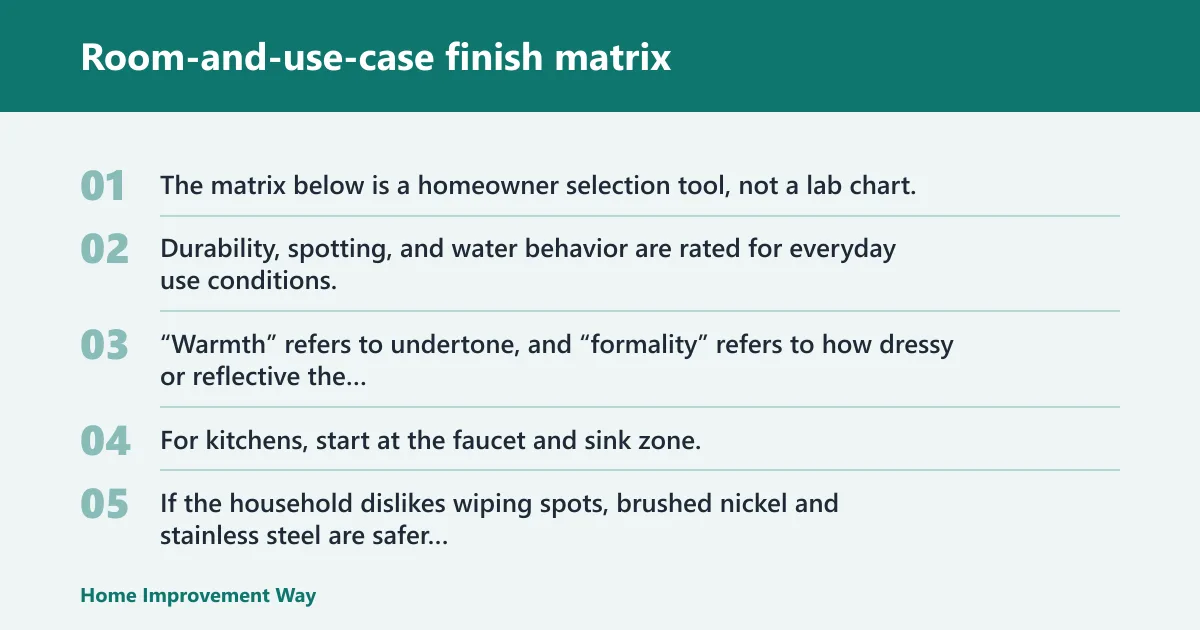
The matrix below is a homeowner selection tool, not a lab chart. Durability, spotting, and water behavior are rated for everyday use conditions. “Warmth” refers to undertone, and “formality” refers to how dressy or reflective the finish tends to look in a room.
| Room/use case | Recommended finish family | Durability | Fingerprint visibility | Water-spot resistance | Warmth | Formality | Best-fit hardware type |
|---|---|---|---|---|---|---|---|
| Kitchen faucet at busy sink | Brushed nickel or PVD brass-look | High | Low to medium | Medium to high | Neutral to warm | Medium | Faucets, soap dispensers, pot fillers |
| Kitchen pulls near range and sink | Brushed nickel or stainless steel | High | Low | High | Neutral | Low to medium | Cabinet pulls, appliance pulls |
| Primary bath vanity | Satin/brushed nickel | High | Low | High | Neutral-warm | Medium | Faucets, towel bars, hooks |
| Shower trim | Chrome plating or stainless-look PVD | High | High | Low to medium | Cool | Medium to high | Shower trim, controls, hand shower fittings |
| Secondary bath with lighter use | Chrome plating | High | High | Low | Cool | High | Faucets, accessories, light bars |
| Entry door exterior side | PVD bronze, stainless steel, or quality matte black | High | Medium | High | Neutral to warm | Medium | Locksets, handlesets, escutcheons |
| Interior passage doors | Satin nickel or matte black | Medium to high | Low to medium | High | Neutral or cool | Low to medium | Levers, knobs, visible hinges |
| Laundry room sink area | Stainless steel or brushed nickel | High | Low | High | Neutral | Low | Faucets, utility pulls, hooks |
| Lower-use powder room | Aged brass or polished nickel | Medium | Medium to high | Medium | Warm | High | Vanity hardware, sconces, mirror details |
Kitchen and laundry recommendations
For kitchens, start at the faucet and sink zone. If the household dislikes wiping spots, brushed nickel and stainless steel are safer than chrome. For brass looks in a busy kitchen, a PVD-coated faucet and pulls usually make more sense than a living finish. If you are choosing cabinetry at the same time, Cabinet pulls is the more precise companion read for kitchen hardware color decisions.
Laundry rooms are practical spaces. Stainless steel and brushed nickel fit that use well because they resist humidity and hide handling marks better than polished finishes. This is one of those rooms where I would almost always choose easy-care performance over a specialty finish, because utility sinks and detergents are not gentle.
Bathroom recommendations
Primary baths need finish discipline. Vanity faucets, shower trim, robe hooks, and toilet paper holders should be chosen as one working set, even if the light fixtures use a supporting finish. Brushed and satin nickel are forgiving here.
Chrome works well where a bright, clean look is wanted and daily wiping is acceptable. Brass and bronze can look excellent in lower-use baths, especially when aging is part of the plan. For coordination with mirrors and sconces, Match cabinet hardware with faucets is the closest related guide because it covers how visible clusters should line up.
Doors, cabinets, and lighting recommendations
Interior doors benefit from finishes that hide skin oils. Satin nickel and some matte black options do that well. Entry hardware should get the toughest finish in the house because weather joins hand contact.
Cabinet pulls need more durable surfaces than upper-cabinet knobs in a formal pantry. Lighting can flex more. A room can carry a mixed-metal light fixture if the hard-working hardware still follows a clear anchor finish. For example, I like a brass picture light over a vanity mirror when the faucet and towel hardware stay in nickel, but I would not reverse that hierarchy and make the faucet the experimental piece.
Is brushed nickel better than chrome for home hardware?
Brushed nickel can be a better choice than chrome when a room calls for less visible spotting, softer reflectivity, and a warmer silver tone. Chrome is better when a cleaner, brighter, more reflective look is wanted and daily wipe-downs are acceptable. Neither wins everywhere; the room, fixture type, and maintenance tolerance decide it.
Appearance and undertone differences
Chrome is crisp and mirror-bright because the chromium layer follows the smooth polished metal under it and throws back a sharp reflection. It reads cool. Brushed nickel softens reflections and usually reads slightly warmer, which helps next to painted cabinets, wood floors, and warmer stone tops.
Polished nickel sits between them in color warmth but behaves closer to chrome in reflectivity. Satin nickel usually lands closer to brushed nickel in maintenance feel, though one brand’s satin can look smoother and slightly grayer than another’s brushed. That is why I always compare actual samples side by side instead of trusting the finish name alone.
Cleaning burden and spotting
Chrome shows hard-water marks, fingerprints, and dried drips quickly. Brushed nickel disguises them better because the directional texture breaks reflections. In a child bath or busy kitchen, that difference is obvious in day-to-day use.
For homeowners who rarely squeegee or wipe faucets, brushed nickel is often the safer choice. If your water is hard, this difference matters even more than it does in the showroom.
Best uses for each in kitchens, baths, and doors
Use chrome where brightness is part of the look and the room is cleaned often, such as a guest bath or a simple modern vanity. Use brushed nickel on kitchen faucets, family bath fittings, and many interior door levers where reduced spotting matters more than shine.
What metal finish works best in kitchens and bathrooms?
In kitchens and bathrooms, the best finish is usually one that balances corrosion resistance with low visible spotting on the most-used fixtures. Brushed nickel, satin nickel, stainless steel, and quality PVD-applied finishes usually give the best mix of day-to-day durability, while chrome works best for homeowners who accept more wiping.
Best bets for faucets and sink hardware
For faucets, coating method matters as much as color. PVD-coated brass-look and nickel-look faucets are strong options when brass warmth is wanted without rapid patina. Stainless-looking and brushed nickel faucets are practical, especially around hard water.
Chrome remains a common pick for trim and fixtures because of its hard surface and bright look, but it asks for more maintenance. If you are comparing products at a similar price, I would rather see clear disclosure of substrate, finish method, and testing than an extra trend color.
Cabinet pulls near water and grease
Pulls next to the sink and range collect the most residue. Brushed nickel, stainless steel, and some textured black finishes hide that buildup best. Polished brass and chrome can still work, but they make missed wipe-downs visible.
Shower, vanity, and bath accessory picks
In showers, avoid choosing by style photo alone. High humidity and repeated cleaning can make weaker decorative coatings disappoint. Chrome, stainless-look finishes, and quality coated nickel tend to be safer on shower trim than specialty dark finishes of unknown build.
How do I match cabinet hardware with faucets and light fixtures?
Match cabinet hardware with faucets and light fixtures by choosing the faucet or door set as the anchor, carrying that finish to the most visible touchpoints, and allowing a secondary finish on lighting or decor. Exact matching matters most on clustered functional pieces, less on separate decorative pieces across the room.
Pick the visual anchor first
In kitchens and baths, the faucet is usually the anchor because it sits near eye level and gets daily use. In an entry, the front door hardware is the anchor. Once that is chosen, cabinet pulls and visible accessories should support it before any decorative fixture gets a vote.
For room-by-room support, use Cabinet pulls when the kitchen is driving the choice and Interior doors when lever sets or passage hardware are part of the same project.
Where finishes should match closely
Keep faucets, shower trim, sink drains, exposed supply trim, and nearby cabinet hardware close in finish family. The eye reads those parts as one working zone. A polished chrome faucet next to warm brushed brass pulls can work, but only if a second item repeats each finish and the contrast is deliberate.
Visible door hinges matter less than levers. On a vanity, the faucet body matters more than a concealed mounting plate.
Where slight variation still looks intentional
Satin nickel and brushed nickel are often close enough to coexist, because naming varies by maker and there is no strict universal standard between those labels. Slight texture or tone shifts are usually acceptable if the finish family is consistent and the sheen is in the same range.
Lighting can drift farther than plumbing trim can. Homeowners usually buy lighting by style first and touch hardware by performance first, and that is a sensible way to prioritize. The mistake is not variation itself. The mistake is letting the most heavily used piece be the least durable one.
Rules for mixing brass, chrome, nickel, black, and bronze
- Pair warm with cool only when each finish appears at least twice in the room.
- Use one finish for all plumbing trim when possible.
- Let cabinet hardware either match the faucet or bridge the faucet to the lighting.
- Use matte black as an outline finish for lights or mirrors, not as a random extra.
- Mix brass and chrome by giving one the lead role and one the accent role.
Brass and chrome can share a room if the room has a clear structure. For example, brass sconces and pulls can sit with a chrome faucet if the faucet is repeated at the shower trim and the brass is repeated at the lights. One-off contrast looks accidental.
Best finish choices for specific hardware categories
Door levers, knobs, and hinges
For busy interior doors, satin or brushed nickel is a strong all-around pick because it hides handling marks. Matte black works well if the coating is good, but smoother black finishes can show oily prints. For exterior entry sets, stainless steel or PVD-coated hardware is often the safer long-term choice.
Which metal finish is most durable for door hardware? Usually the answer is stainless steel or a high-quality PVD-coated finish on a solid, well-built substrate, especially on entry hardware. In lower-stress interior rooms, plated nickel and chrome can also last well. If door hardware is your main project, Interior doors is the closest matching guide.
Cabinet knobs and pulls
Cabinet pulls take more abuse than knobs because users hook fingers behind them. In kitchens, brushed nickel, stainless steel, and durable brass-look PVD finishes are easy choices. In dry rooms, aged brass, bronze, or matte black open up more style range without the same moisture penalty.
Faucets, shower trim, and bath fittings
Choose these as performance items first. Chrome plating is common and wear resistant, but very revealing of spots. Nickel finishes are more forgiving. Stainless steel is a practical fit in humid rooms. Brass and bronze finishes can be beautiful, but check whether the product is designed to patina or stay sealed.
For bathrooms specifically, keep faucet, drain, and shower trim in the same finish family even if the sconces or mirror frame shift. That one decision does more to make a bath look deliberate than chasing a perfect color match on every accessory.
Light fixtures and exposed accessories
Lighting sees less abrasion, so it can carry the supporting finish more easily than faucets or pulls can. That is where polished brass, aged bronze, or mixed-metal combinations often make sense, especially in powder rooms and dining areas.
Aluminium resists corrosion by forming a thin oxide layer, and many light fixtures use aluminum parts under decorative finishes. That matters less to the eye than the top finish, but it explains why two fixtures with similar color can age differently. This is another reason I separate “touch hardware” from “look-only hardware” early in the process.
Frequently asked questions
What finish hides fingerprints and water spots best?
Brushed nickel, satin nickel, and many stainless steel finishes hide fingerprints and water spots best in active kitchens and bathrooms. Textured surfaces scatter reflections, so residue stays less visible. Chrome and polished nickel show spots fastest, while matte black ranges from forgiving to streaky depending on coating and texture.
Can you mix brass and chrome in the same room?
Yes, brass and chrome can work together if one finish leads and the other repeats in a smaller supporting role. Keep all plumbing trim in one family, then repeat the second finish on lighting or mirror details so the contrast looks planned instead of scattered.
What is the difference between satin nickel and brushed nickel?
Satin nickel and brushed nickel are close relatives, not strict universal standards. Brushed nickel usually shows a clearer directional texture, while satin nickel often looks smoother and softer. In practice, maker naming varies, so compare undertone and sheen rather than relying on the label alone.
Which metal finish is most durable for door hardware?
For door hardware, stainless steel and quality PVD-coated finishes are usually the strongest choices, especially on entry doors and other high-touch locations. The base metal still matters, though. A durable surface over a weak build can still fail sooner than a better-made plated lever in a calmer room.
How do I match cabinet hardware with faucets and light fixtures?
Start with the faucet as the anchor in kitchens and baths, then match or closely coordinate cabinet hardware with it. Let lighting carry either the same finish or a repeated secondary finish. Exact matching matters most within one working zone, less across decorative fixtures elsewhere in the room.
What metal finish works best in kitchens and bathrooms?
For most homes, brushed nickel, satin nickel, stainless steel, and strong PVD-applied finishes are the easiest kitchen and bathroom choices because they balance corrosion resistance with lower visible spotting. Chrome still works well for a bright, crisp look, but it rewards households willing to wipe fixtures more often.
Sponsored / affiliate links. As an Amazon Associate I earn from qualifying purchases. I may earn additional commission from eligible campaigns.