Best Metal Finishes for Cabinet Pulls and Knobs: We Compared
Brushed nickel and matte black are the most forgiving cabinet hardware finishes for most homes. Polished chrome is easiest to wipe clean, satin brass adds warmth, and unlacquered brass only works if you want visible patina. Pick poorly, and you can end up with fingerprints, tarnish, or a finish that clashes with the cabinets and nearby fixtures. This guide ranks the best metal finishes for cabinet pulls and knobs by upkeep, touch feel, durability, and room fit.
Brushed nickel: best overall for most cabinets
Brushed nickel is often a safe all-around choice because it can balance maintenance, visual softness, and broad design fit. It reads as a cool-warm neutral, so it can work in traditional rooms, modern kitchens, and many baths without needing every other finish to match exactly.
It is also one of the most forgiving choices for high-touch cabinet hardware. The brushed texture is commonly reported to hide fingerprints better than polished finishes, and it may look less stark under bright task lighting than chrome.
Why brushed nickel stays versatile
Nickel sits warmer than chrome, which helps it work with wood cabinets, cream paint, greige walls, and mixed materials. It also pairs cleanly with stainless appliances when you want a similar silver family without an exact match.
One caution: brushed nickel can tarnish if it is not lacquer-sealed. That matters most in humid baths and busy kitchens where cleaning products, steam, and hand oils add up.
When brushed nickel beats polished nickel
Choose brushed nickel when you want less shine and less wiping. Polished nickel is shinier and more reflective, so it can look richer, but it also asks for more maintenance and shows smears more easily.
Picture a small galley kitchen with soft-white cabinets and limited daylight. Brushed nickel usually reads calmer there, while polished nickel can start to feel busy because every handle catches the light.
Quick comparison
| Product | Badge | Best for | Price | ||
|---|---|---|---|---|---|
 |
QOGRISUN 5-Pack Solid Brass Cabinet Pulls, Brushed GoldQOGRISUN | Our pick | 5 in · Solid Brass · Brushed Gold | $40.99
Price as of 20 Oct 2026
|
View |
 |
Top Knobs Reeded 1 1/2" Diameter Round Knob Polished ChromeTop Knobs | Budget pick | 1 1/2 in · Polished Chrome · Lifetime Warranty | $11.84
Price as of 20 Oct 2026
|
View |
The best finish depends on how you use the room, not on style alone. For most kitchens and baths, brushed nickel is the safest default; for high-contrast painted cabinets, matte black is often the cleanest visual move.
How we chose
This ranking weighs five cabinet-specific factors: upkeep, fingerprint visibility, warmth or coolness, design flexibility, and durability details that affect long-term wear. It also reflects whether a finish fits common cabinet colors and whether it makes small spaces look orderly rather than busy.
Cabinet hardware is a high-touch surface, so a finish that looks good on a showroom board can still be a poor choice if it shows every smudge. The best finish is the one you can live with after the novelty fades.
Maintenance and cleaning burden
Matte and brushed finishes usually ask for less wiping than polished ones. Lacquered finishes need less visible maintenance than raw or unlacquered metals.
Fingerprint and water-spot visibility
Chrome is highly reflective and shows smudges more than matte finishes. Matte black tends to hide fingerprints and water spots well, which can make it useful at sink bases, bath vanities, and pantry doors that get touched often.
Warmth, coolness, and cabinet-color fit
Finish temperature changes how cabinets read. Warm metals tend to soften dark wood and painted whites, while cooler metals can sharpen the look of crisp white or gray cabinetry.
Durability details that affect long-term wear
Powder coating gives matte black its look, while lacquer affects how brass and nickel age. Bronze varies widely by finish, so the label alone tells you less than the actual surface treatment.
Matte black: best for contrast and concealment
Matte black works well when you want cabinet hardware to ground the room and hide everyday marks. It is linked to farmhouse and industrial chic aesthetics, and it is especially useful on white cabinets because it adds clear contrast without looking flashy.
The finish is usually made by powder coating another metal, which helps explain why it often feels softer and less reflective than chrome or polished nickel. That low-sheen look also helps it disappear visually on busy cabinet runs.
Why it works on white cabinets and painted doors
White cabinets look good with just about any hardware finish, but matte black gives them the clearest edge. On flat painted doors, it can make the hardware read intentional instead of decorative.
Say your kitchen has white shaker cabinets, a black sink faucet, and black window trim. Matte black pulls create a stable visual anchor, so the room feels planned instead of pieced together.
Where matte black can feel too heavy
In a small kitchen with little daylight, too much matte black can compress the room if every visible detail is dark. If that is the case, use black on the most touched areas and lighter metal on secondary cabinet runs.
A common first-timer mistake is putting matte black on every door, drawer, faucet, and light fixture in a narrow kitchen. The room can lose visual air even when the colors technically match.
Brass and bronze: best for warmth and character
Brass and bronze suit rooms that need warmth, depth, or a more tailored look. Antique and brushed brass are associated with farmhouse, traditional, and midcentury styles, while polished brass reads more modern. Bronze leans darker, and oil-rubbed bronze can hide fingerprints well.
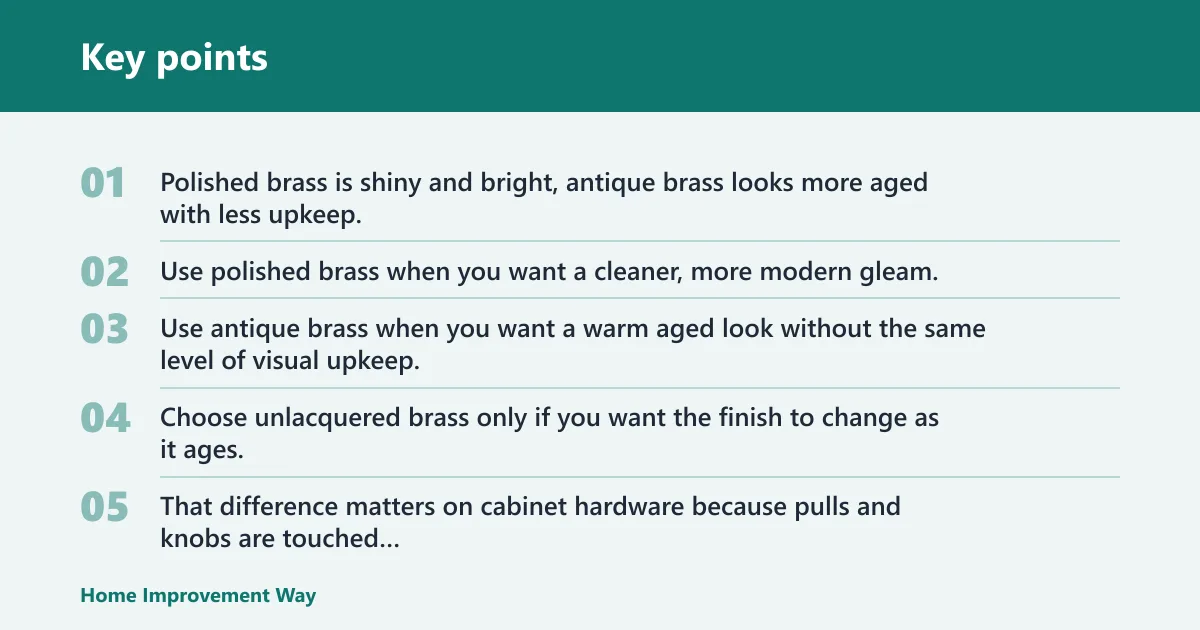
These finishes are not interchangeable. Polished brass is shiny and bright, antique brass looks more aged with less upkeep, and unlacquered brass changes over time as it patinas.
Polished, antique, and unlacquered brass
Use polished brass when you want a cleaner, more modern gleam. Use antique brass when you want a warm aged look without the same level of visual upkeep. Choose unlacquered brass only if you want the finish to change as it ages.
That difference matters on cabinet hardware because pulls and knobs are touched constantly. A patina on a range hood can feel charming; on a drawer front, it can look uneven if you were expecting a fixed color.
Bronze and oil-rubbed bronze in traditional rooms
Bronze works best when you want texture and depth rather than shine. Oil-rubbed bronze is darker and aged in appearance, and it can coordinate well with black accents, rustic wood, and traditional cabinetry.
The caution is variation. Bronze can vary a lot by finish, so two hardware lines with the same name may still read differently once they are under your kitchen lighting.
When warm metals start to look busy
Warm metal can become too busy if the room already has warm wood, brass lights, copper cookware, and warm paint. In that case, one warm finish should dominate, and the others should recede.
Suppose you have cherry cabinets, brass sconces, and a bronze faucet. Adding a third warm hardware tone can make the room feel crowded, even if each piece is attractive on its own.
Chrome, polished nickel, and stainless steel: best for cool reflective looks
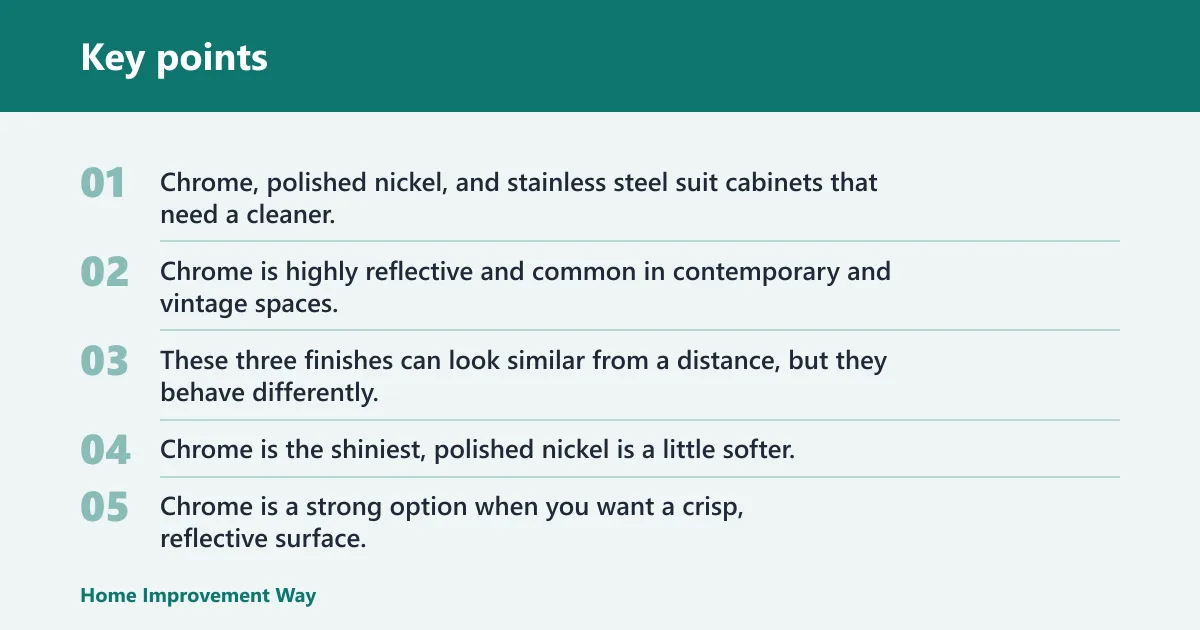
Chrome, polished nickel, and stainless steel suit cabinets that need a cleaner, brighter finish. Chrome is highly reflective and common in contemporary and vintage spaces, polished nickel gives a softer upscale sheen, and stainless steel matches well with stainless appliances and many modern kitchens.
These three finishes can look similar from a distance, but they behave differently. Chrome is the shiniest, polished nickel is a little softer, and stainless steel reads more neutral and appliance-like.
Chrome for high-shine modern or vintage settings
Chrome is a strong option when you want a crisp, reflective surface. It is suitable for contemporary and vintage styles, but it shows smudges more than matte finishes, so it is best when you are comfortable wiping hardware more often.
That makes chrome useful on guest baths, compact kitchens, or rooms that already lean cool and glossy. It can also help older cabinetry feel sharper without changing the door style.
Polished nickel for a softer upscale sheen
Polished nickel is shinier than brushed nickel and often reads as a more polished, upscale choice. It works when you want more glow than brushed nickel provides, but it does need more wiping than brushed finishes.
Use it where you want a refined finish without the mirror-like look of chrome. It can be especially effective on larger drawer pulls, where the extra sheen reads intentionally rather than fussy.
Stainless steel for appliance match and outdoor use
Stainless steel is a good fit when you want cabinet hardware to relate to stainless appliances. It is also a practical choice for outdoor kitchens, but corrosion resistance depends on grade and environment, so not every stainless finish is equally suited to every site.
That matters near salt air, pools, or constant moisture. In those settings, material quality matters as much as color.
Should cabinet hardware match faucets and light fixtures?
Matching is the safest choice when you want a calm, cohesive room, especially in small kitchens where every finish is easy to see at once. You do not need an exact twin to every fixture, but one metal family should usually lead, with the others staying secondary.
When matching is the safest choice
If your kitchen or bath is compact, keep the main hardware, faucet, and most light fixtures in the same finish family. That approach is especially useful in small kitchens, where visual noise builds fast.
A simple rule is 70/30. Let one finish dominate roughly 70 percent of the visible metal surfaces, and use the second finish for the remaining 30 percent or less.
When one finish should dominate
Choose one dominant finish on cabinet hardware, then repeat it on the faucet or lights. Use a second finish only if it adds contrast or ties to an existing element, such as a mirror frame, appliance trim, or pendant detail.
Can you mix brass and chrome on cabinet hardware? Yes, but keep the mix intentional. For example, use brass pulls on the main cabinets and chrome on the bath faucet, or let chrome dominate while brass appears only in a small accent area.
The risk is choosing two finishes that are too close in temperature but too different in sheen. That can make the room look accidental rather than designed.
Cabinet finish matrix
This decision table scores a range of common finishes across several cabinet-specific criteria. Higher maintenance scores mean less upkeep, higher fingerprint scores mean better concealment, and higher durability scores mean better long-term wear on cabinet hardware.
| Finish | Maintenance | Fingerprint resistance | Warmth/coolness | Design flexibility | Durability | Best for | Avoid if |
|---|---|---|---|---|---|---|---|
| Brushed nickel | 4 | 4 | 3 | 5 | 4 | Most kitchens and baths; traditional or modern spaces | You want a bright mirror finish or a raw brass look |
| Chrome | 3 | 2 | 2 | 4 | 4 | Contemporary or vintage rooms with cool design schemes | You want the least visible smudging |
| Matte black | 5 | 5 | 2 | 4 | 4 | White cabinets, farmhouse and industrial styles | The room already has heavy dark contrast |
| Polished nickel | 3 | 2 | 3 | 4 | 4 | Polished, upscale kitchens and baths | You want low-maintenance brushed hardware |
| Brass | 3 | 3 | 5 | 4 | 3 | Warm traditional, farmhouse, or midcentury rooms | You do not want patina or visible aging |
| Bronze | 4 | 4 | 5 | 3 | 4 | Rustic and traditional cabinetry with depth | You need a bright, cool, reflective finish |
| Oil-rubbed bronze | 4 | 5 | 5 | 3 | 4 | Traditional spaces that need dark, forgiving hardware | You want a lighter or more contemporary silver tone |
| Stainless steel | 4 | 3 | 2 | 4 | 4 | Appliance-matched kitchens and outdoor kitchens | You are chasing a warm, decorative look |
Which one should you buy?
If you want the safest all-around pick, start with brushed nickel. If you want the best concealment on painted cabinets, choose matte black. If your kitchen already has stainless appliances and cool finishes, stainless steel is a clean fit.
For a rental or a busy family kitchen, aim for finishes that are forgiving and easy to replace. For a polished, upscale room, polished nickel or brass can work well if you are ready for more upkeep.
Here is the simplest decision rule: let cabinet color lead, then room style, then maintenance. White cabinets can take nearly any finish, dark cabinets need more contrast planning, and small rooms usually look better when the finish story stays tighter.
How do you avoid a finish that will look dated quickly? Skip the loudest trend unless it already fits the room’s architecture and fixtures. Brushed nickel, matte black, chrome, and stainless steel tend to read more stable over time than highly specific decorative finishes that depend on a single style wave.
Would matte black pulls work with white cabinets? Yes, and the pairing is one of the most reliable combinations for painted kitchens. The contrast is clear, the hardware is easy to read, and the finish hides daily wear better than many shinier choices.
Frequently asked questions
What metal finish looks best on cabinet pulls and knobs?
Brushed nickel is the best all-around answer for most homes because it balances upkeep, flexibility, and cabinet compatibility. If you want more contrast, matte black is the next strongest choice, especially on white or painted cabinets. The “best” finish is the one that fits your cabinet color and cleaning tolerance.
Which cabinet hardware finish hides fingerprints best?
Matte black usually hides fingerprints and water spots best, especially on pulls and knobs that get touched constantly. Oil-rubbed bronze is also forgiving. Chrome and polished nickel show smudges more readily because their reflective surfaces catch every mark.
Is brushed nickel still a good choice for cabinets?
Yes. Brushed nickel remains one of the most dependable cabinet finishes because it works with traditional and modern spaces, softens glare, and suits many cabinet colors. It is also a practical bridge between warm and cool fixtures, which makes it easier to coordinate across a whole room.
Can you mix brass and chrome on cabinet hardware?
Yes, if one finish clearly leads and the other stays secondary. The mix works best when the brass is warm and intentional, and the chrome repeats somewhere else in the room, such as the faucet or a light detail. Keep the ratio simple so the mix looks planned.
What finish should I choose for a modern kitchen?
Brushed nickel, chrome, polished nickel, and matte black all work in modern kitchens, but each creates a different effect. Brushed nickel is the safest versatile choice, chrome gives the highest shine, polished nickel feels softer and more upscale, and matte black adds the strongest contrast.
Sponsored / affiliate links. As an Amazon Associate I earn from qualifying purchases. I may earn additional commission from eligible campaigns.