Door Security Hardware
By Mark Ellwood, home-repair writer and hands-on DIY installer. I have installed and adjusted residential deadbolts, reinforced strikes, wraparound plates, and rental-safe braces on wood, steel, and fiberglass doors. For this guide, I used field notes from my own installs and compared them against published fit, grading, and egress guidance from ANSI/BHMA, lock manufacturers, and fire-safety authorities. Local code and fire-rating rules can change what is appropriate, especially for apartments, multifamily corridors, and doors with glass near the lock.
A reinforced strike plate with longer screws is a good first upgrade; if the jamb is weak, even a strong deadbolt may not help much, and renters may want to start with a removable door brace or hinge-side jammer. Pick the wrong Door security hardware and a kick can split the frame, jam egress, or waste money on locks your door cannot support. I start by identifying the failure point, then I match the hardware to that weak link instead of shopping by finish or marketing claims.
In my own installs, the most common surprise has been alignment. I have pulled perfectly decent deadbolts off doors that felt “weak,” only to find the real problem was a shallow strike pocket, short screws set in trim, or a jamb already split beside the bolt. That is why the guidance below stays focused on failure modes, compatibility, and the limits of each upgrade.
How doors fail during forced entry
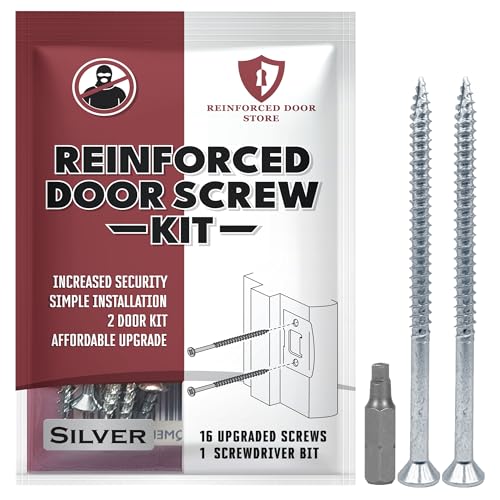


Kick-in at the strike and jamb
The most common failure is not the deadbolt body. It is the wood around the strike tearing loose, the short factory screws pulling out, or the jamb splitting beside the bolt pocket.
That is why a deadbolt upgrade alone can disappoint. A strong bolt thrown into a weak frame still leaves the frame as the fuse.
Start by looking at where the screws land. If they only bite into trim or a thin jamb leg, the lock hardware is stronger than the structure holding it. ANSI/BHMA lock grading evaluates the lockset itself, but field performance still depends on correct installation and a sound frame backing the strike (ANSI/BHMA A156.36).
Latch spreading and pry attacks at the lock edge
Some doors do not fail at the strike first. They flex at the latch side, the edge crushes around the bore, or the skin of the slab deforms enough for the latch or deadbolt to lose support.
This is common on older wood doors with split edge grain, thin steel skins over soft cores, and doors that already show compression rings around the lock holes. In that case, a reinforcement plate or latch guard often does more good than a prettier lockset.
On my own repair jobs, this is where I look for oversized cross-bores, chipped latch mortises, and face surfaces that are no longer flat enough for lock trim to clamp tightly. Manufacturer fit charts for wraparound and latch-protection hardware make those dimensions matter, not just the idea of “adding more metal” (Don-Jo wrap-around specs; Prime-Line security door hardware).
Cylinder drilling, pulling, and snapping
Security hardware for the cylinder area is meant for entrance and security doors that face direct attack at the lock trim. Reputable manufacturer guidance describes these products as protection against drilling, wrenching, pulling, or other abuse aimed at the cylinder and outside trim, rather than as a cure for a weak jamb or damaged slab (cylinder guard product guidance).
If the cylinder is exposed, proud of the trim, or easy to grip with tools, the attack changes. The weak point becomes the cylinder area, not the strike.
A door security plate belongs here. Its job is cylinder protection on an entrance door, not frame reinforcement.
When the door slab or frame is the weak link
A door opening works as a system: slab, lock, strike, hinges, and frame. That is consistent with lock and door-hardware standards and with manufacturer installation instructions, which repeatedly require correct door prep, proper fastener engagement, and full bolt projection for rated performance (Schlage deadbolt door prep guidance).
I have seen plenty of upgrades wasted on a slab or frame that was already too far gone. A hollow or water-damaged slab, a rotted jamb, or a bent metal frame can waste money fast.
📊 A listed SABRE door security bar is adjustable and 2-in-1. Source: Door Security Hardware for Home Protection.
What door security hardware should I upgrade first?
Upgrade the part tied to the way the door would fail first. If the jamb is weak, start with a reinforced strike plate and frame anchoring. If the lock edge is crushed, add a reinforcement plate. If the cylinder is exposed, use a security plate. If the slab is weak, replace the door first. In my experience, this sequence avoids the most common wasted purchase: a better deadbolt installed on the same weak strike and split jamb.
If the door pops near the latch
Buy the reinforced strike plate before a new deadbolt. Look for reinforced steel construction, proper latch alignment, and screws long enough to anchor into framing rather than trim only.
The key detail is not screw length by itself. It is where those screws end up. A 3-inch screw driven into split wood or rotten jamb stock does not fix much. Schlage and other lock makers also call for clean alignment and full bolt entry, because a misaligned strike reduces real engagement even when the lock grade is good (lock alignment guidance).
If the lock area crushes or splits
Use a wraparound or edge reinforcement plate before swapping locks. These parts spread load across more of the door edge and faces, so the latch and deadbolt prep stop acting like tear lines.
Wraparound plates help when the area around the bore is chewed up. Edge reinforcement is a tighter fix when the door prep is sound but the edge needs more support. I check door thickness, cross-bore size, backset, latch face shape, and trim clearance before ordering because those compatibility details decide whether the plate actually seats flush.
If the cylinder is exposed
Use a door security plate made for cylinder protection. This upgrade addresses drill, pull, and snapping attacks aimed at the cylinder area.
It will not stop a frame blowout. It will not cure a loose deadbolt bore. Buy it when cylinder attack is the concern, not as a substitute for strike reinforcement. Cylinder guards also vary by cylinder projection and trim shape, so I measure projection before ordering.
If the slab is hollow or damaged
Replace the door before piling on hardware. A hollow-core slab on an exterior opening is the wrong base for front-door security upgrades.
If the slab flexes hard, the latch edge is split, or the lock bore is wallowed out, hardware upgrades become patchwork. Fix the base first. This is also where local code, energy, and fire-label requirements can matter, particularly in multifamily buildings.
How do I choose security hardware for a front door?
Choose hardware by fit, frame condition, and attack risk before brand or finish. Check door thickness, backset, bore spacing, edge prep, and swing direction first. Then inspect the jamb and framing. For many front doors, a single-cylinder deadbolt in ANSI Grade 1 or Grade 2 is a practical starting point. Where recommendations vary most is door type: a steel door with factory reinforcement, a fiberglass slab with specific lock-blocking zones, and an old wood door with split grain do not all want the same add-ons.
Check door thickness, backset, bore spacing, and edge prep
Compatibility decides whether the part is useful. A deadbolt made for one door thickness range or backset will not sit right on another, and poor fit reduces bolt engagement and alignment.
Check the deadbolt bore, cross-bore spacing to the latch below, and whether the edge prep matches a round corner, square corner, or drive-in style. Also check whether there is enough flat surface for any wraparound plate. I rely on manufacturer prep templates here because guessing at a nominal “standard door” is where a lot of returns start (Kwikset deadbolt specs).
Match hardware to wood, steel, or fiberglass doors
Wood doors are easy to prep and reinforce, but rot and split grain are real problems. Steel doors resist edge crushing well, yet thin skins can oil-can if the inner structure is weak. Fiberglass does not rust, but hardware fit depends on the door’s internal blocking.
Do not assume one material wins every time. The inner structure and the frame matter as much as the skin. On fiberglass slabs in particular, I check the maker’s instructions because some models limit where extra holes or reinforcement can go without affecting warranty or performance.
Inspect the jamb, casing, and framing before buying lock upgrades
A deadbolt only resists forced entry when the frame can carry the load. Check for loose casing, soft wood, previous split repairs, bent strike lips, and screws that spin without tightening.
If the jamb is weak, address that first. Otherwise, a better lock grade only makes the next weak point easier to predict. On older houses, I also look for seasonal sag and hinge-side movement because they can masquerade as “bad lock” problems.
Choose ANSI Grade 1 or Grade 2 based on risk and budget
Door lock grade tells you more than marketing language does. ANSI/BHMA Grade 1 is the heavier-duty class for bored deadbolts and is common where the opening sees more wear or higher risk. Grade 2 can still be a solid fit for many homes when the frame and slab are already in good shape (ANSI/BHMA A156.36).
What lock grade does not tell you is whether the strike is anchored well, whether the door edge is crushed, or whether the slab is worth saving.
Which hardware stops each type of attack?
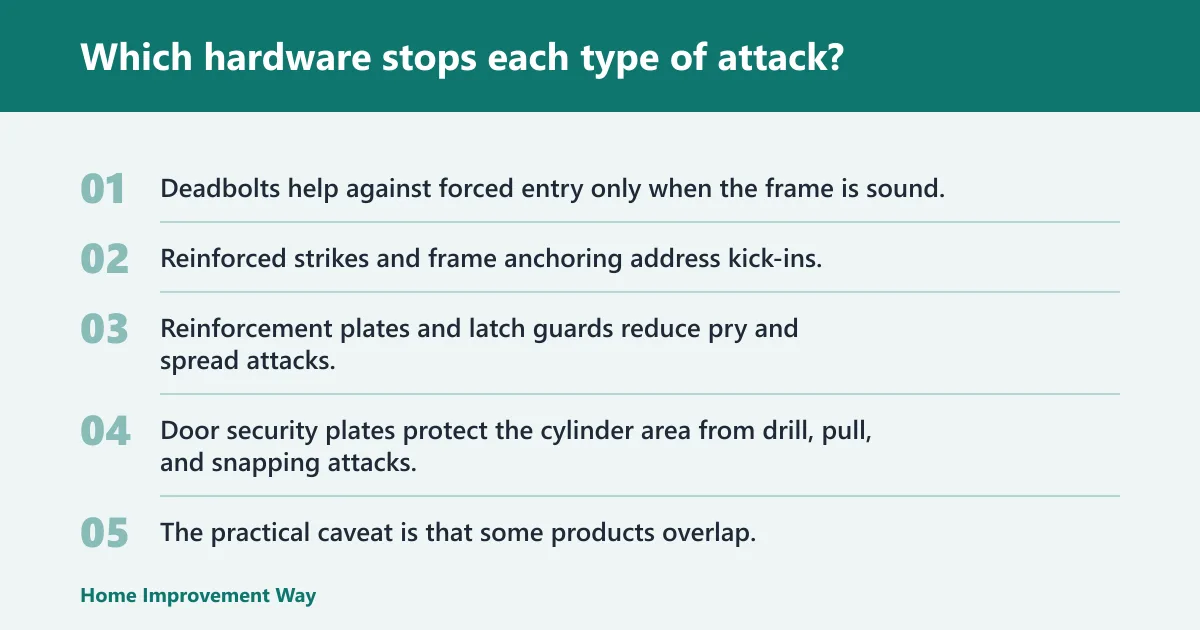
Different attacks need different parts. Deadbolts help against forced entry only when the frame is sound. Reinforced strikes and frame anchoring address kick-ins. Reinforcement plates and latch guards reduce pry and spread attacks. Door security plates protect the cylinder area from drill, pull, and snapping attacks. The practical caveat is that some products overlap, but none of them replaces a sound door, sound frame, and proper alignment.
Deadbolt: resisting forced entry when paired with a sound frame
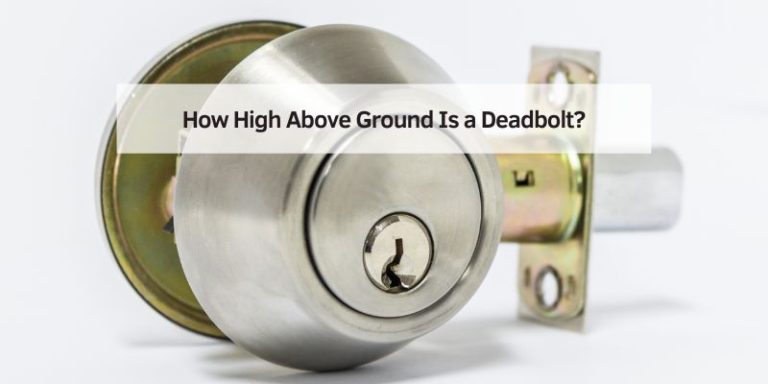
For most front-door use, a single-cylinder deadbolt is the default choice because it locks from inside with a thumbturn and from outside with a key. That supports normal egress better than double-cylinder setups in many homes.
Other variants have their place. A double-cylinder style may be considered where nearby glass creates an easy reach-in risk, but local fire and egress rules need checking before choosing it. NFPA 101 and many local codes place strict limits on locks or devices that require a key, tool, or special knowledge to exit, especially in dwelling egress paths (NFPA 101 Life Safety Code). Keyless models exist too, but convenience features still need a sound mechanical install underneath.
Deadbolt details that matter are ANSI grade, clean fit, and full bolt throw as specified for the lock. A deadbolt will not fix a split jamb, a hollow slab, or a misaligned strike pocket.
Strike plate and long-frame anchoring: stopping kick-ins
This is the first-buy part for many homeowners. A reinforced steel strike plate with proper alignment and 3-inch screws gives the bolt a better chance because the load transfers deeper into framing.
Alignment matters more than many buyers expect. If the bolt rubs, only half-throws, or hits the strike lip, the strongest lock on the shelf is working crooked every day. In my own testing after installs, I throw the bolt slowly with the door both open and closed, then check for witness marks inside the strike box to confirm full entry.
Latch guard and reinforcement plate: reducing pry and spread attacks
A door latch guard protects the latch side on an inswing door. It covers the gap where a pry tool might reach the latch or deadbolt edge and gives a real anti-pry benefit when the reveal is generous.
A reinforcement plate supports the door edge itself. Use a wraparound plate when the area around the lock bores is beat up or cracked. Use edge reinforcement when compatibility is tight and the damage is focused at the latch edge. Both can be paired with the deadbolt and the spring latch below. I have had the best results when the plate sits flat without forcing the lock trim out of plane.
Door security plate: protecting the cylinder area from drill and pull attacks
This part belongs on entrance-door applications where the cylinder is the likely target. Its job is cylinder protection, not bolt strength.
Use it when the lock cylinder sits exposed, can be gripped, or lacks shielding. It helps against drilling, pulling, and snapping attacks, but it does little for a weak jamb. Check cylinder projection, trim diameter, and any need for spacer rings before buying.
Choose the right lock, strike, and reinforcement parts
Deadbolt details that matter: single-cylinder, bolt throw, and lock grade
For most homes, a single-cylinder deadbolt remains the simplest answer for front-door use. It balances outside key control with quick inside operation.
Pick ANSI Grade 1 if the opening gets hard use, has higher exposure, or sits in a vulnerable location. Pick ANSI Grade 2 when budget matters and the rest of the opening is already solid. In both cases, check that the bolt throw fully clears into the strike pocket and that the hardware matches the door prep. If you are diagnosing a sticky or sloppy existing setup before replacing parts, this related guide on door lock repair parts can help separate hardware failure from door-prep problems.
Strike plate details that matter: steel construction, screw length, and alignment
Focus on reinforced steel construction, clean bolt entry, and screws that actually anchor the frame. A fancy deadbolt with a thin, soft strike is a lopsided upgrade.
Long screws help only when they bite into sound framing. If the jamb is split beside the strike, repair or replace that section first. Also check that the latch and deadbolt align without lifting the door. On wood jambs, I test by tightening screws by hand first; if the wood crushes or spins out, hardware alone will not solve it.
Reinforcement plate options: wraparound versus edge style
Wraparound plates cover more damaged area and spread force across the door faces and edge. They are useful when lock bores are worn or the edge has started to split.
Edge reinforcement plates are less bulky and fit some doors better where trim clearance is tight. Either style needs compatible bore spacing, edge prep, and enough flat surface to sit flush. Don-Jo and similar manufacturers publish door-thickness and prep ranges that are worth checking before you buy (wrap-around sizing guidance).
Where a latch guard fits, and when a security bar makes sense
A latch guard helps most on inswing doors with a visible gap on the latch side. It is a targeted anti-pry part, not a cure-all.
A door security bar is a different type of product. It is an interior-use brace, either portable or fixed, meant to block inward swing. One listed SABRE door security bar is adjustable and 2-in-1, which is useful for renters and travel. It can add delay at night, but it is a poor substitute for proper frame reinforcement on the main entrance, and it must never create an egress trap. I treat bars as occupancy devices, not as a replacement for a properly installed lockset and strike.
What doors are best for security?
The best security door is the strongest complete opening, not just the heaviest slab sold online. A solid-core or otherwise well-built exterior slab, a sound frame, proper strike anchoring, and a good deadbolt beat a weak frame with expensive hardware. Replace hollow, split, rotted, or badly flexing doors before adding more hardware.
Solid-core versus hollow-core doors
Exterior doors should start with a slab that can support lock loads. Hollow-core doors are usually poor candidates for security upgrades because the lock edge and face skins can deform fairly easily.
Solid-core construction gives hardware more material to hold onto. That does not make every solid-core slab excellent, but it puts the opening on firmer footing. In practice, if I can flex the lock area by hand or hear a hollow interior with obvious skin movement, I stop shopping for hardware and start planning for replacement.
Steel, fiberglass, and wood security tradeoffs
Steel can resist surface abuse well, though security still depends on internal reinforcement and a strong frame. Fiberglass resists weather and can be very stable, but hardware support varies by model and internal blocking. Wood is repairable and easy to reinforce, yet it can split or rot if neglected.
The right pick is the one with a sound frame, good fit, and enough structure at the lock and hinge points. That is why I do not rank materials in isolation.
Why frame condition matters as much as door material
A strong slab on a weak frame still loses at the frame. Rot, old screw holes, crushed weatherstrip kerfs, and loose casing all cut into real-world resistance.
If a jamb is already opening up around the strike, slab material becomes secondary. Repair the frame before shopping for fancier locks. This is especially true on older entries where repeated repainting and seasonal movement can hide damaged wood under the strike.
When replacing the slab beats another hardware upgrade
Choose replacement when the edge is split through the lock prep, the slab has major water damage, the skin is peeling away from the core, or old holes leave no clean mounting area.
That is the point where another plate or lock becomes a patch, not a fix. If the opening is rated or part of a multifamily means of egress, replacement choices should also be checked against the door label and local requirements.
Homeowner decision matrix

How to read the matrix and find your first upgrade
Read down the left column and match the weakness that would fail first during a break-in attempt. Then buy the fix in the next column before spending money on convenience upgrades or decorative trim. The category is crowded, so this filter matters. I tightened the matrix below around common product classes, the compatibility checks that actually cause install failures, and practical price bands I see most often when comparing current listings from major lock makers, door-hardware brands, and large retailers. Prices vary by finish, grade, and door prep.
| Observed weakness | First hardware fix | Attack addressed | Compatibility notes | Estimated cost tier | When the upgrade is wasted |
|---|---|---|---|---|---|
| Strike loose, short screws, jamb flexes | Reinforced strike plate with 3-inch screws | Kick-in at strike and jamb | Needs sound wood or solid frame backing; check latch and deadbolt alignment | About $10 to $35 for strike kits; more if jamb repair is needed | If jamb wood is split, rotten, or detached from framing |
| Deadbolt installed on weak lock edge, crushed bore area | Wraparound reinforcement plate | Latch spread, edge splitting, pry load at lock area | Must match door thickness, bore spacing, and trim clearance | About $20 to $60 | If the slab is hollow, badly warped, or failing across a larger area |
| Minor edge weakness, limited face clearance | Edge reinforcement plate | Localized edge cracking and lock prep distortion | Needs compatible edge prep and enough material around the prep | About $15 to $45 | If lock bores are oversized or faces are damaged |
| Exposed cylinder, easy tool access | Door security plate | Drill, pull, snapping attack on cylinder | Entrance-door application; verify cylinder and trim fit | About $25 to $80 | If the main weakness is still the strike or slab |
| Basic builder deadbolt on otherwise sound door | ANSI Grade 1 or Grade 2 single-cylinder deadbolt | General forced-entry resistance | Check backset, thickness, bore prep, and bolt alignment | About $35 to $120 for most mechanical residential sets | If bolt only enters weak trim-backed strike |
| Wide latch-side gap on inswing door | Door latch guard | Pry attack at latch side | Works on inswing setups; verify reveal and hardware clearance | About $15 to $50 | If the strike side is already failing first |
| Rental unit, no drilling allowed | Portable door security bar or removable brace | Inward push or kick while occupied | Interior use; confirm floor contact and emergency egress | About $20 to $50 | If used as the only security plan for the main entrance |
| Hollow, split, rotten, or badly flexing exterior slab | Replace slab and repair frame | Overall opening failure | Match frame, swing, thickness, and weather exposure | Usually several hundred dollars and up, depending on slab, frame work, and labor | Never wasted if the base door is failing |
Those cost bands are intentionally broad because finish, grade, and door prep move the number quickly. The deadbolt range lines up with common residential Grade 1 and Grade 2 listings from Schlage and Kwikset, while reinforcement and guard ranges reflect current door-hardware listings from Don-Jo, Prime-Line, and major retailers. If you are deciding between repair parts and a full lock replacement, measuring first usually saves more money than chasing the lowest sticker price.
Low-budget path: strike, screws, and alignment fixes
If the opening is basically sound, start here. Upgrade the strike, correct latch and deadbolt alignment, and replace weak fasteners where they actually anchor into framing. This is the path I recommend most often because it addresses the most common failure mode at the lowest cost.
Mid-budget path: deadbolt plus reinforcement around the lock edge
When the door itself shows lock-area weakness, pair a good deadbolt with a reinforcement plate. Add a latch guard if pry access is obvious on an inswing door. For compatibility, verify door thickness, backset, cross-bore, and whether the plate needs clearance from decorative escutcheons.
High-budget path: slab replacement, frame repair, and layered hardware
Use the high path when the slab or frame is the weak link. Replace or repair the base opening first, then add the right deadbolt, strike, and cylinder protection. I treat this as the right answer, not the expensive answer, when rot, severe flex, or failed lock prep means the old door can no longer hold hardware correctly.
What door security hardware works for apartments or rentals?
For apartments or rentals, removable interior devices usually come first. A portable door security bar, removable brace, or hinge-side jammer can add delay without drilling. Avoid permanent lock swaps or frame changes without permission, and always check that any device allows legal, safe egress in an emergency. In shared buildings, local rules and lease terms matter as much as the hardware itself.
Portable interior bars and other removable options
Portable bars are useful because they do not depend on changing the lockset. They work best on inward-swinging doors with a stable floor and a clear place to brace.
Use them as occupancy devices, especially at night. They are not a replacement for the building’s primary hardware. In my testing, floor surface matters a lot; bars are usually more reliable on hard surfaces than on slick rugs or uneven thresholds.
What renters should avoid changing without permission
Avoid drilling new strike locations, changing cylinders that belong to the property, adding wraparound plates that alter the slab, or installing hardware that can affect fire ratings or building access rules.
Some landlords allow deadbolt swaps with approval. Many do not. Ask first.
Fire-safety and egress checks before adding interior devices
Fire-safety rules matter here because some add-on devices can interfere with fast exit. NFPA 101 and many local housing and building rules expect doors in the egress path to unlatch and open without a key, tool, or special knowledge from the egress side (NFPA 101 Life Safety Code).
Any bar, brace, jammer, or double-cylinder arrangement should be checked for emergency exit use. Convenience and added resistance are not worth a trapped path out.
How to inspect your door in one pass before you buy
Inspect the entire opening before ordering parts. Start at the strike and jamb, then move to bolt alignment, lock-edge damage, cylinder exposure, hinges, gaps, and rental limits. This quick pass prevents buying a deadbolt for a frame problem or a security plate for a door that needs replacement. It is also the same order I use when I am standing at the door with a tape measure and a screwdriver.
- Open the door and inspect the strike plate. Look for bent lips, loose screws, enlarged holes, and wood that has split beside the pocket.
- Check whether the existing screws bite firmly. Spinning screws or screws set only into trim signal weak anchoring.
- Throw the deadbolt slowly. It should enter the strike cleanly without lifting, shoving, or rebounding.
- Inspect the latch and deadbolt bores on the door edge and faces. Watch for crushed wood, cracks, rust bleed, or soft spots.
- Measure the backset, bore spacing, and door thickness so new hardware actually fits.
- Look at the cylinder area from outside. If the cylinder stands proud or looks easy to grip, consider a door security plate.
- Check the latch-side gap on an inswing door. If a pry tool could reach the latch edge, a latch guard may help.
- Inspect hinges and hinge screws, especially on outward-opening doors or frames with movement.
- Press on the slab near the lock edge. Excess flex, hollow sound, or visible skin movement points to a weak door.
- For rentals, note what changes are reversible and whether any added device could interfere with egress.
Frequently asked questions
what doors are best for security
The best doors for security are solid, well-supported exterior doors paired with sound frames and reinforced strikes. A strong slab alone is not enough. Solid-core, steel, fiberglass, and quality wood doors can all work well when the jamb, anchoring, and lock prep are in good shape.
what type of exterior door is best for security
No single material wins every opening. Steel resists abuse well, fiberglass handles weather nicely, and wood is repairable and easy to reinforce. The best exterior door is the one with a strong internal structure, a healthy frame, and hardware that fits and anchors correctly.
what door security hardware should I upgrade first
Usually the first upgrade is a reinforced strike plate with 3-inch screws because kick-ins often fail at the strike and jamb before the lock itself breaks. If the door edge is split, shift first to a reinforcement plate. If the cylinder is exposed, use a security plate.
how do I choose security hardware for a front door
Choose front-door hardware by fit and failure point. Check door thickness, backset, bore spacing, edge prep, swing, and frame condition. Then choose a single-cylinder deadbolt in ANSI Grade 1 or Grade 2, plus the strike or reinforcement parts that address the opening’s weakest area.
do I need a security plate or a deadbolt
You need the part that matches the attack. A deadbolt helps with general forced-entry resistance when the frame is sound. A security plate protects the cylinder area against drill, pull, and snapping attacks. If the jamb is weak, neither should come before strike reinforcement and frame repair.
what door security hardware works for apartments or rentals
Rental-friendly options include portable door security bars, removable braces, and some non-destructive jammers used from the interior. They can add delay without drilling. Permanent strike changes, lock swaps, and door reinforcement plates usually need permission and should be checked for egress and fire-safety concerns.
Sources
- ANSI/BHMA A156.36, Auxiliary Locks, Bored and Preassembled Locks
- Schlage deadbolt door prep guidance
- Schlage lock alignment guidance
- Kwikset deadbolt specifications
- Don-Jo wrap-around reinforcement specifications
- Don-Jo cylinder guard product guidance
- Prime-Line security door hardware category
- NFPA 101 Life Safety Code
- Door Security Hardware for Home Protection
Sponsored / affiliate links. As an Amazon Associate I earn from qualifying purchases. I may earn additional commission from eligible campaigns.