Door Chain vs. Swing Bar Lock: Which Is Better for Entry Control?
Swing Bar Lock is better for controlled partial opening because its rigid arm resists twisting and shove force, while Door Chain is better if you want a simpler, less permanent option; either choice depends on a reinforced frame and longer screws. Skip that upgrade, and the hardware can rip out of weak trim or soft wood during a forced-entry attempt. This guide compares strength, convenience, installation, and best uses for homes, rentals, hotels, apartments, and caregiving situations.
| Decision factor | Door Chain | Swing Bar Lock | Winner |
|---|---|---|---|
| Partial-opening control | Variable gap; can slack before it holds | Fixed gap; stops the door at a set opening | Swing Bar Lock |
| Kick and shove resistance | Lower if mounted in trim or weak wood | Higher when the bar and frame are mounted well | Swing Bar Lock |
| Installation difficulty | Simpler two-part layout | Still simple, but the alignment must be exact | Door Chain |
| Rental-friendliness | Good when you need easy removal later | Good only if the lease allows clean, reversible mounting | Door Chain |
| Visibility from inside | Less tidy to judge at a glance | Easy to see whether the bar is engaged | Swing Bar Lock |
How the opening gap and use cases compare
A door chain uses a chain fixed to the frame and a slide head on the door. A swing bar lock uses a rigid hinged bar that lets occupants open the door a narrow gap and stop it there. Both are partial-opening devices, not primary locks, and neither replaces a deadbolt.
How the opening gap differs
A chain’s gap depends on chain length, and slack can show up before it holds. That makes the opening less predictable than a swing bar, which gives a more repeatable stop. For conversation, a delivery handoff, or checking who is outside, both can work.
A common first-timer mistake is choosing the hardware first and the gap second. If the chain travel is too long, the door opens farther than intended. A practical target is two to three inches of travel for a chain when the door and frame allow it.
Where each one is commonly used
Door chains are still a familiar choice on apartment and house entry doors. Swing-bar guards are commonly seen on hotel guestroom doors because they give a tidy, repeatable release and a fixed opening gap. Renters often favor the chain when they want a simpler, less permanent fit.
Door hardware decision matrix
The better choice depends on the use case. Swing bars win on controlled rigidity and shove resistance when the frame is reinforced, while chains win on simpler use and easier removal. If the frame is weak, both can fail the same way.
| Use case | Door Chain | Swing Bar Lock | Best pick |
|---|---|---|---|
| Home entry door | Useful for quick partial opening | Better if you want firmer control | Swing Bar Lock |
| Rental door | Fits lease-aware, removable installs well | Works only when clean mounting is allowed | Door Chain |
| Hotel guestroom door | Less common for this setting | Common choice for a neat, repeatable stop | Swing Bar Lock |
| Elderly resident door | Simple release can be easier to manage | Simple too, but the fixed stop is more obvious | Door Chain |
Partial-opening control
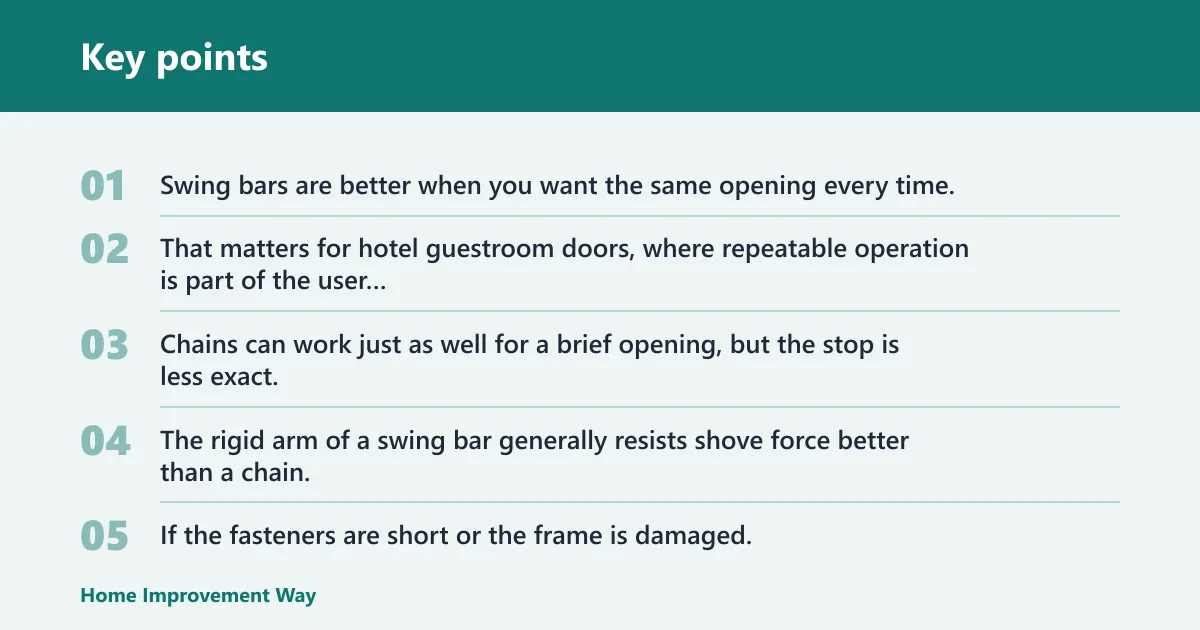
Swing bars are better when you want the same opening every time. That matters for hotel guestroom doors, where repeatable operation is part of the user experience. Chains can work just as well for a brief opening, but the stop is less exact.
Kick and shove resistance
The rigid arm of a swing bar generally resists shove force better than a chain. That does not make it a forced-entry lock. If the fasteners are short or the frame is damaged, either device can tear out under force.
Say your front door has a painted pine jamb with short trim screws. A hard push can pull the guard out of the lining before the chain or bar does its job. The metal part is only as strong as the wood or steel behind it.
Installation and rental friendliness
Door chains are usually the easier choice when you want a less permanent change. Renters often prefer hardware that comes off cleanly at move-out. Swing bars can also be removed, but they demand neater alignment and are less forgiving on sloppy framing.
Visibility from inside
A swing bar is easier to inspect at a glance because the bar must line up with its catch. A chain can be harder to judge if there is slack or if the slide head sits oddly in the track. For someone who wants a quick visual check before opening, the bar is simpler.
Which is stronger?
Swing Bar Lock is usually stronger against shove force because the rigid bar creates a more controlled interlock between the door and frame. Door Chain is more likely to fail if it is mounted poorly, because the load concentrates on small screws and on the frame lining. Stronger hardware still needs a strong substrate.
Why the frame changes the result
A guard fixed with short screws into a thin frame lining can pull out. Long screws into the structural stud improve the result a lot, and that matters more than the metal shape alone. The comparison changes again on hollow metal doors, where self-tapping screws may be used instead of wood screws.
Picture a hotel door with a pressed-steel frame and a proper swing bar mounted into the stud or steel reinforcement. That setup holds up far better than a chain anchored to trim alone. On the same door with weak fastening, the advantage shrinks fast.
Can you install either without damaging the door?

Yes, but the answer depends on the surface and the lease. Door Chain is usually the easier path for a rental because it can be removed later with less fuss. Swing Bar Lock can also be installed cleanly, and one comparison page says swing bar locks are easy to install and won’t leave scratch marks on the doorframe.
Rental-aware mounting
For rentals, use the least invasive mounting that still reaches solid material. If the lease allows only minor changes, choose hardware that aligns with existing trim or prior holes. Keep the removed parts and fill only what the lease requires.
When short screws are a problem
Short screws in trim are weak. They may hold the hardware during normal use, but they can fail under shove force because the screws never reach the structural substrate. That is the main reason partial-opening hardware disappoints people who expect real resistance.
Hollow-core or hollow metal doors
Hollow-core doors need extra care because the skin alone is not a sound anchor point. Hollow metal doors are different: self-tapping screws are commonly used there, but the installer still needs to find suitable backing or reinforcement. If a door or frame is damaged, repair that first.
What mounting hardware matters most?
Long screws into framing or stud matter most for wood construction. Through-bolting is often preferred where possible because it secures the hardware through the door or frame instead of relying only on surface wood. On hollow metal doors, self-tapping screws may be a practical fit.
Long screws into framing or stud
The best security setup includes long screws into the structural stud. That is the point where the guard starts to act like a real restraint instead of a trim accessory. If the installer cannot reach the stud, the resistance drops.
Self-tapping screws for metal doors
Self-tapping screws can work on hollow metal doors when the metal is the correct gauge and the manufacturer approves the method. They are useful because they bite into metal without a wood-thread pilot. They still need enough material behind them to matter.
Through-bolting when possible
Through-bolting gives the most secure fastening when the door and frame allow it. It spreads load across the assembly instead of concentrating it in thin trim. That is the right answer when the goal is real resistance, not just a visual barrier.
Choose Door Chain if… / Choose Swing Bar Lock if…
Choose Door Chain if you want a simpler, less permanent option for a rental, guest room, or older resident who wants an easy release. Choose Swing Bar Lock if you want a fixed, repeatable opening gap and better shove resistance, especially on a reinforced hotel-style or homeowner entry door.
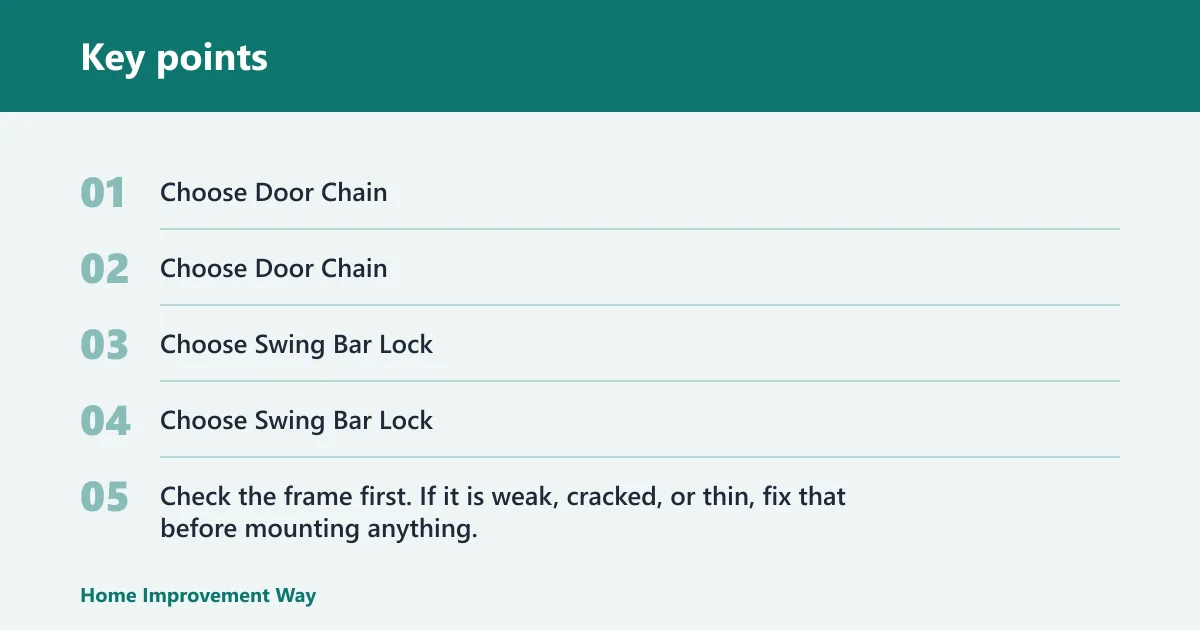
- Choose Door Chain if you need a less permanent install for a rental door.
- Choose Door Chain if the main goal is brief conversation or delivery interaction.
- Choose Swing Bar Lock if you want a controlled opening gap every time.
- Choose Swing Bar Lock if the door frame can take long screws into structural material.
- Check the frame first. If it is weak, cracked, or thin, fix that before mounting anything.
- Confirm the door type. Hollow-core, hollow metal, and fire-rated doors each need different care.
- Use the longest approved fasteners for the substrate you actually have.
- Test the gap with the door closed, then verify the guard holds without slack.
- A common approach is to pair the guard with a deadbolt and a peephole or door viewer for full-door use.


Deadbolt, peephole, and frame checks
A deadbolt often does the main job because it works when the door is closed. Door Chain and Swing Bar Lock are for partial opening only. They should sit beside the deadbolt, not in place of it.
Why a deadbolt still matters
Neither device is a substitute for a deadbolt or main lock. Their job is to let you talk, inspect, or accept a delivery with the door slightly open. They are visibility and control aids, not primary entry resistance.
How a peephole helps
A peephole or door viewer pairs well with either guard because it lets you check identity before you open the door. That matters in apartments, homes, and hotel-like settings where you may want to verify the caller before releasing the guard.
How to spot weak trim and damaged frames
Look for split trim, loose jambs, crushed screw holes, and frame sections that flex when pressed. Timber frames and pressed-steel or metal frames fail in different ways, but both can be too weak for partial-opening hardware if they are already damaged. Repair the substrate before mounting the guard.
Frequently asked questions
Is a door chain or swing bar lock better for security?
Swing Bar Lock is usually better for security because the rigid bar gives more controlled resistance to shove force. That advantage shrinks if the frame is weak or the screws are short. Door Chain still helps with partial opening, but it is more dependent on installation quality.
Will a swing bar lock stop someone kicking the door in?
No partial-opening guard should be treated as kick-proof. A swing bar can resist shove force better than a chain, but it can still fail if the frame is weak or the fasteners are short. Use it as a supplement to a proper deadbolt and sound framing.
Can I install a door chain without damaging the door frame?
Usually yes, if you keep the work clean and use the right fasteners for the substrate. Renters often choose Door Chain because it is easier to remove later. The risk rises when installers rely on trim instead of solid framing.
Which is better for rentals: a chain lock or swing bar lock?
Door Chain is usually better for rentals because it is simpler to mount and easier to remove at move-out. Swing Bar Lock can also work in a rental if the lease allows it and the frame is sound. Either way, the mounting should be reversible and secure.
How much door opening does a chain or swing bar allow?
A swing bar gives a narrow, fixed gap. A chain’s gap depends on chain length, and slack can show up before it holds. For chains, keeping the travel to two to three inches is a practical target when the door and frame support it.
What type of screws matter most for a door guard or chain?
Long screws into framing or stud matter most on wood-framed doors. Short screws into trim are weak and can pull out. On hollow metal doors, self-tapping screws may be used, and through-bolting is preferred where the door construction allows it.
Sponsored / affiliate links. As an Amazon Associate I earn from qualifying purchases. I may earn additional commission from eligible campaigns.