Deadbolt vs. Door Lever: Security Differences That Matter
A deadbolt is the stronger exterior-door security choice; use a lever only with a strong latch, reinforced strike plate, and 1-inch deadbolt for real resistance. Skip that hardware, and a lever door can be pried or forced open fast, raising break-in risk and repair costs. This guide compares the security differences that matter and shows when a lever is acceptable on an exterior door.
This guide is part of our Door security hardware series.
Deadbolt vs. door lever: what actually changes security


| Decision factor | Deadbolt | Door Lever: Security Differences That Matter | Winner |
|---|---|---|---|
| How it resists force | Solid bolt locks into the frame and is built for forced-entry resistance. | Spring latch can be pushed back if the door, frame, or hardware is weak. | Deadbolt |
| Everyday convenience | Requires key outside and thumbturn or key inside, depending on type. | Lever handle is easy to operate, especially for frequent in-and-out use. | Door lever |
| Exteriors with real security needs | Best as the primary lock on entry doors. | Acceptable only with a separate deadbolt and a solid strike setup. | Deadbolt |
| Exit speed from inside | Single-cylinder models allow fast exit with a thumbturn. | Lever is quick and simple from inside. | Tie |
| Installation sensitivity | Depends heavily on strike reinforcement and proper door fit. | Also depends on latch alignment, but the lock body itself offers less resistance. | Deadbolt |
Why the deadbolt wins the security row
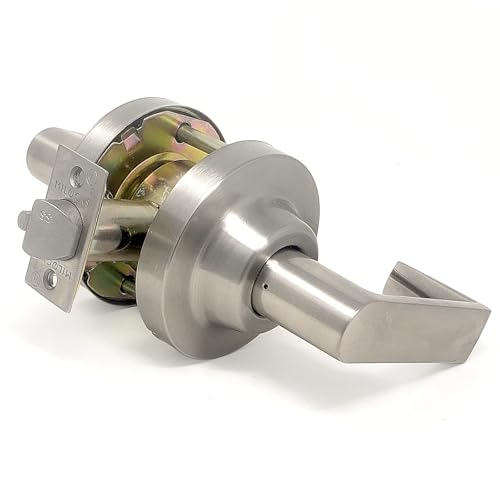
A deadbolt uses a solid bolt, while a lever lock uses a spring latch paired with a lever handle. That difference matters because the deadbolt is built to resist forced entry, while the lever latch is designed mainly for convenience and everyday access.
F1 matters here: a deadbolt is distinct from a spring bolt lock because it can only be opened by a key or handle. F2 also matters, because a deadbolt is often used to complement a spring-bolt lock on an entry door.
Why the lever wins convenience
A lever is easier to operate, especially when hands are full or mobility is limited. That is why lever locks are often used on interior doors and in commercial settings, where ease of use often matters more than maximum resistance to forced entry.
Easy use is not the same as security. On an exterior door, a lever by itself is the weaker option.
Where the comparison becomes practical
Handle shape does not control security. The full setup does, lock body, latch or bolt, strike plate, frame strength, and door alignment.
Picture a side entry door with a loose frame and a shallow strike plate. The lock type matters, but the weak frame becomes the easier failure point.
Which lock resists forced entry better?
The deadbolt resists forced entry better than a door lever because its solid bolt is built to keep the door shut under pressure. A lever lock can fail when the spring latch is pushed or the door is forced against a weak strike plate, which makes it a poorer primary security lock.
Why the deadbolt resists kick-in force better
A deadbolt extends into the frame instead of relying on a spring-loaded latch. That gives it much better resistance to kick-in force, especially when the door frame and strike plate are reinforced.
F7 gives a practical benchmark: a deadbolt should have a bolt that extends at least one inch into the frame. That depth gives the bolt more purchase and reduces the chance of a shallow engagement failure.
How a lever latch can fail under pressure
A lever lock uses a spring latch. Under force, the latch can retract if the door is flexed, the strike opening is worn, or the latch and strike are poorly aligned.
A common first-timer mistake is assuming a keyed lever is the same as a deadbolt. It is not. The handle style may change convenience, but the latch mechanism still leaves a smaller security margin than a proper deadbolt.
Why the strike plate matters as much as the lock body
The strike plate is the frame-mounted metal plate that receives the bolt or latch. If that plate is thin, loose, or held by short screws, the frame can fail before the lock body does.
F8 recommends a reinforced strike plate secured with 3-inch screws. That upgrade matters because the fasteners reach deeper into the framing, which is where the door’s strength actually lives.
What type of deadbolt is best for home security?
For most homes, a single-cylinder deadbolt is the best balance of security and emergency exit. It uses a key outside and a thumbturn inside, which keeps exit quick while still adding real resistance at the exterior door.
Single-cylinder deadbolt: the common exterior-door choice
F3 says a single-cylinder deadbolt accepts a key on one side and uses a twist knob on the other. F12 states that a single-cylinder deadbolt has a thumbturn inside.
That inside thumbturn is the practical advantage. You can leave quickly without searching for a key, which matters for bedrooms, family entries, and most front doors.
Double-cylinder deadbolt: better near glass, higher egress risk
A double-cylinder deadbolt accepts a key on both sides. That can help when glass is close to the lock, because a reach-through or broken-pane entry is less useful if there is no interior thumbturn to turn.
But F5 says double-cylinder locks can be banned because they are difficult to open from the inside. F6 also notes that some fire safety rules do not allow a locked exit. That makes local code and room use the deciding factors, not just security. (en.wikipedia.org)
Thumbturn placement and everyday exit use
Thumbturn placement matters because it controls how fast you can exit from inside. A reachable thumbturn is usually what makes a single-cylinder deadbolt the safer daily choice in occupied spaces.
Say your front door has sidelites and a narrow hallway inside. A keyed exterior plus inside thumbturn setup usually gives the right mix of security and fast exit. A double-cylinder model may add resistance near glass, but only if your local rules allow it and you can still exit safely.
How much throw, grade, and strike reinforcement should you look for?
A secure deadbolt should have a throw of about 1 inch, and many people look for a Grade 1 or Grade 2 lock for residential use. Pair that with a reinforced strike plate and 3-inch screws, because the frame connection often fails before the deadbolt does.
1-inch throw as a practical benchmark
F7 gives the key benchmark: a deadbolt should have a bolt that extends at least one inch into the frame. That distance helps the bolt stay engaged if the door shifts or is forced.
Short throws do not provide the same margin. If the bolt barely enters the strike, the frame side becomes the weak point.
ANSI/BHMA grade in plain language
F9 says Grade 1 or Grade 2 is the suggested ANSI/BHMA range for a good deadbolt. F10 says Grade 1 is the highest residential rating, while F11 says Grade 3 is the minimum residential standard.
Use the grade as a quality filter, not a guarantee. A high rating does not fix a weak frame, poor alignment, or a bad strike plate.
Reinforced strike plates, box strikes, and 3-inch screws
Strike reinforcement is not optional on an exterior door that needs real resistance. A reinforced strike plate or box strike spreads force into the framing, and 3-inch screws help anchor that metal into solid wood instead of thin trim or soft framing material.
F8 is the clean rule to remember: reinforced strike plate secured with 3-inch screws is recommended. That single upgrade often gives more real-world benefit than swapping one midrange lock body for another.
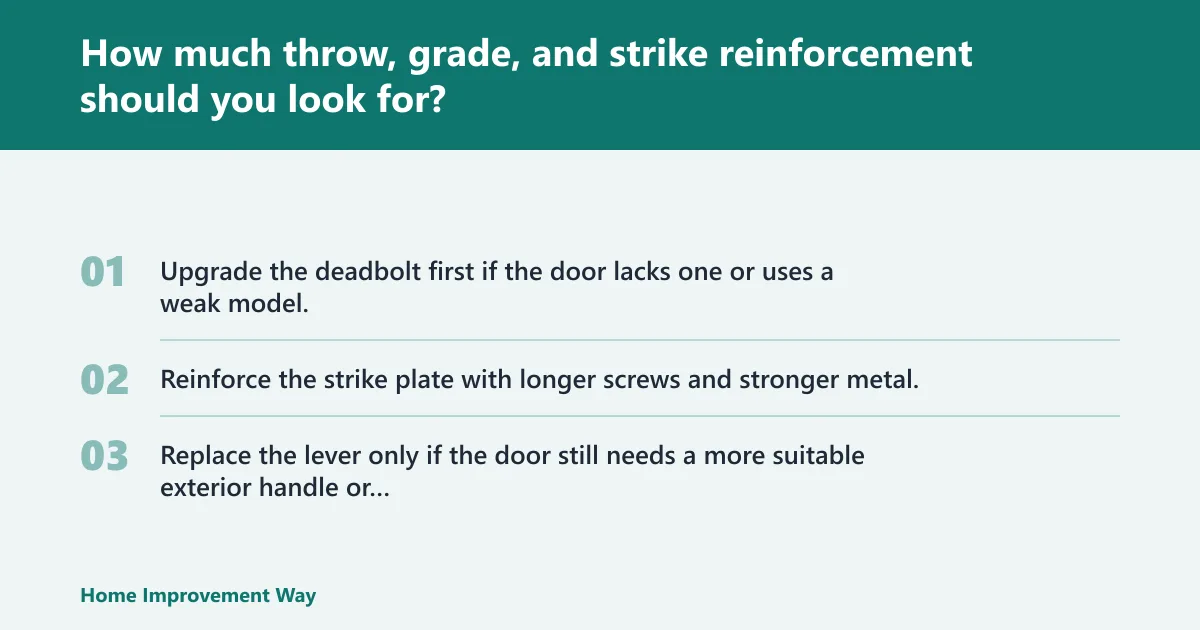
- Upgrade the deadbolt first if the door lacks one or uses a weak model.
- Reinforce the strike plate with longer screws and stronger metal.
- Replace the lever only if the door still needs a more suitable exterior handle or accessibility fit.
Can a door lever be used on an exterior door?
Yes, a lever can be used on an exterior door if it is paired with a separate deadbolt and the strike setup is strong. A lever alone is not the right security choice for an entry door, but it can work as the convenience part of a two-lock system.
When a lever is acceptable with a separate deadbolt
A lever is acceptable when the deadbolt does the security work and the lever mainly provides everyday access. That setup is common on exterior doors where convenience matters, but only if the deadbolt, strike plate, and frame are up to the task.
F14 says lever locks use a spring latch paired with a lever handle, and F15 says they are common on interior doors and in commercial settings. That fits the job: the lever is about access ease, not primary forced-entry resistance.
Accessibility and convenience reasons homeowners choose levers
Levers are easier for children, older adults, and anyone with limited grip strength. They also reduce fumbling when your hands are full.
That convenience can be valuable, but it should sit beside a real deadbolt on an exterior door. It should not replace one.
Where a lever alone is the wrong choice
A lever alone is the wrong choice for front doors, garage-to-house entries, and any door with a meaningful security role. It is also a poor fit where the frame is weak or the door has a history of misalignment.
A lever is a bad stand-alone choice near glass, because the latch is easier to defeat if an intruder can reach the hardware or work the door edge.
Use the decision matrix to choose the right setup

The right setup depends on location, nearby glass, exit needs, code risk, and what you can upgrade first. Use this matrix to decide whether to keep a lever, add a deadbolt, or move to a stronger deadbolt and strike package.
| Scenario | Nearby glass | Egress need | Code risk | Upgrade cost | Recommended hardware setup |
|---|---|---|---|---|---|
| Front door with no sidelites | Low | High | Low | Medium | Single-cylinder deadbolt, reinforced strike, lever only if you want easier access |
| Side door beside a pane or sidelite | High | High | Medium | Medium | Single-cylinder deadbolt plus reinforced strike; consider double-cylinder only if local rules allow it |
| Bedroom or sleeping room exit door | Varies | Very high | High | Low to medium | Single-cylinder deadbolt only if permitted; avoid double-cylinder where fast exit is required |
| Rental unit entry | Low to medium | High | High | Medium | Single-cylinder deadbolt, Grade 1 or 2, reinforced strike with 3-inch screws |
| Interior utility door | Low | Moderate | Low | Low | Door lever only is usually fine |
Door location and nearby glass
Glass near the lock changes the risk profile. If someone can break glass and reach the hardware, a double-cylinder deadbolt may reduce that reach-through risk, but the exit and code tradeoffs become more serious.
For most exterior doors, the safer default is still a single-cylinder deadbolt with a strong strike plate. That gives you resistance without making inside exit harder than it needs to be.
Egress needs, code risk, and rental considerations
Egress means how quickly you can get out. That matters in bedrooms, rental units, and doors that may be used in an emergency.
F6 is the rule to keep in mind: some fire safety rules do not allow a locked exit. If the room is part of a sleeping area or rental, check local code before choosing a double-cylinder deadbolt.
Upgrade cost and the best first fix
If you are choosing what to fix first, start with the deadbolt, then the strike plate, then the lever. That order targets the biggest security gain first.
A lever replacement alone rarely solves a forced-entry problem. A stronger deadbolt with a better strike often does much more for the same effort.
Choose deadbolt if… / Choose door lever if…
Choose a deadbolt if the door is outside the living space and security matters. Choose a lever if the opening is mainly for convenience, or if you need easier operation but already have a separate deadbolt handling the security role.
Choose deadbolt if…
- The door is a front, side, or garage-to-house entry.
- You need real resistance to kick-in or pry attacks.
- You want the common, balanced setup: a single-cylinder deadbolt with a thumbturn inside.
- You can upgrade the strike plate with 3-inch screws and proper frame reinforcement.
Choose door lever if…
- The door is interior or low-risk.
- You need easier operation for frequent use or accessibility.
- The lever is paired with a separate deadbolt on an exterior door.
- The room does not require a more restrictive exit setup under local code.
For most homeowners, the right answer is not deadbolt or lever as an either-or choice. It is a deadbolt for security and a lever for convenience, with the strike plate and frame doing the hidden work that keeps the door closed.
What are the fire-safety risks of double-cylinder deadbolts?
Double-cylinder deadbolts can slow exit because they require a key on both sides, and that creates a problem during a fire or other emergency. F5 says these locks can be banned because they are difficult to open from the inside, and F6 says some fire safety rules do not allow a locked exit.
That is why they are a special-case choice, not a default one. They may make sense near glass in some settings, but only if local code allows them and everyone who uses the door can still exit safely and quickly.
Frequently asked questions
Is a deadbolt more secure than a door lever?
Yes. A deadbolt is the stronger exterior-door security choice because it uses a solid bolt rather than a spring latch. A lever mainly improves convenience and access ease. On an exterior door, a lever should be treated as the everyday handle, not the main security device.
Can a lever lock be used on an exterior door?
Yes, but only with a separate deadbolt and a solid strike plate. A lever by itself is not a strong exterior security solution. It is most useful when you want easy operation and the deadbolt handles the actual resistance to forced entry.
What type of deadbolt is best for home security?
For most homes, a single-cylinder deadbolt is the best choice because it gives strong exterior security with fast exit from inside. It uses a key outside and a thumbturn inside. A double-cylinder model is only worth considering in special cases, such as nearby glass, and only if code allows it.
Do I need a single-cylinder or double-cylinder deadbolt?
Choose single-cylinder for most exterior doors, bedrooms, and rental entries because it balances security and egress. Choose double-cylinder only when glass near the lock creates a real reach-through risk and local fire or building rules allow it. The exit tradeoff is the key issue.
How much throw should a secure deadbolt have?
A secure deadbolt should have at least a 1-inch throw into the frame. That gives the bolt a more secure bite and helps it resist forced entry. Shorter engagement is weaker, especially if the door shifts or the frame flexes under load.
Should the strike plate be upgraded with the lock?
Yes. A reinforced strike plate should be part of the upgrade, not an afterthought. The frame side is often the first weak point in a forced entry. A reinforced or box strike with 3-inch screws helps transfer force into the framing instead of the thin jamb surface.
Are 3-inch screws really better for door security?
Yes. F8 specifically recommends a reinforced strike plate secured with 3-inch screws. Longer screws anchor the strike deeper into the framing, which is much stronger than short screws biting only into trim or a shallow jamb. That upgrade is one of the most cost-effective security fixes available.
What are the fire-safety risks of double-cylinder deadbolts?
They can delay exit because you need a key on both sides, which is a real problem during an emergency. Some fire safety rules do not allow a locked exit, and double-cylinder locks can be banned for that reason. They need careful code checking before you install them.
Sponsored / affiliate links. As an Amazon Associate I earn from qualifying purchases. I may earn additional commission from eligible campaigns.