Door Reinforcement Plate vs. Strike Plate: Which First?
Upgrade the door reinforcement plate first if the jamb is splitting or the frame is weak; upgrade the strike plate and its screws first if the hardware is just pulling loose. Ignore the failure point, and a deadbolt can keep working while the frame keeps breaking. This guide compares both parts, shows how to spot each problem, and helps you choose the faster, smarter repair.
This guide is part of our Door security hardware series.
Door reinforcement plate vs. strike plate: which upgrade should come first?


Start with the part that matches the failure. A strike plate is the latch or deadbolt receiver in the door jamb, so it is the first fix when screws are loose, the hole is worn, or alignment is off. A door reinforcement plate is the better first move when the frame around that opening is splitting, crushed, or too thin to hold fasteners.
A door’s main job is to control access. Doors are commonly hung on hinges, and the door jamb is the frame side that holds the strike hardware. If that jamb is weak, stronger hardware alone will not stop the damage.
| Decision factor | Door Reinforcement Plate | Strike Plate | Winner |
|---|---|---|---|
| Best use case | Splitting jamb, crushed wood, shallow anchor depth, weak frame around latch or deadbolt | Loose receiver, worn screw holes, minor alignment issues, sound jamb | Depends on failure point |
| Force handling | Spreads force across more of the jamb or frame | Receives the latch or bolt and holds it in place | Door Reinforcement Plate |
| Install effort | Usually more work because fit around the lockset and door prep matters | Usually simpler if the existing cutout and alignment are already close | Strike Plate |
| Lowest-cost first step | Usually higher than a basic plate swap | Often a small step if you only need a stronger plate or longer screws | Strike Plate |
| Kick-in resistance gain on a sound frame | Moderate to high if the jamb is intact and fasteners reach framing | Moderate, especially when paired with 3-inch wood screws | Door Reinforcement Plate |
Best-fit use case
The strike plate wins when the frame is still sound and the main problem is under-anchored hardware. The reinforcement plate wins when the jamb itself is the weak link, because spreading force matters more than simply replacing the receiver piece.
Cost and effort
A strike plate change can be the cheaper, faster repair, especially if you are correcting loose screws or a worn latch opening. A reinforcement plate can take a little more time because it has to fit around the deadbolt or latch area and work with the existing lockset.
Security payoff
On a solid, stud-backed frame, a reinforcement plate can do more than a basic plate swap because it spreads force across a larger area. On a frame that is intact but loosely fastened, the biggest jump often comes from longer screws and a properly aligned strike plate.
📊 The door history section notes gates at Balawat were 2.54 m wide and 8.2 m high each leaf. Source: Door.
What does a door reinforcement plate do compared with a strike plate?
A strike plate is the metal piece fastened to the door jamb that receives the latch bolt or deadbolt. A door reinforcement plate adds support around the opening and spreads force over more of the frame. One holds the lock hardware; the other helps the surrounding wood survive attack and wear.
That difference matters because doors are built for different jobs, and exterior doors need more security than interior doors. A reinforcement plate is most useful where the jamb has a weak point near the strike area, especially around a deadbolt.
Strike plate: receiver first
The strike plate must line up with the latch bolt or deadbolt. If the door rubs, rattles, or only catches when pushed hard, the issue may be alignment or screw length rather than the plate shape itself.
Reinforcement plate: frame support first
A reinforcement plate is the better answer when the jamb is splitting, the wood is crushed, or the anchor depth is poor. It works with many existing locksets, but it does not replace the need for a clean cutout and correct engagement depth.
How to inspect the door jamb and frame before you buy
Check the frame first, because the jamb condition decides the upgrade. If the wood is sound and stud-backed, a stronger strike plate and longer screws may be enough. If the jamb is hollow-backed, rotted, or already split, a reinforcement plate or repair work comes first.
The doorway is the opening created in a wall by a door, and the strike area is where force concentrates. Look for loose hardware, enlarged screw holes, soft wood, and any sign that the deadbolt or latch is not entering cleanly.
- Open and close the door slowly. Watch whether the latch bolt enters the strike opening without rubbing.
- Check for side-to-side play. Rattle often points to misalignment or shallow screw hold.
- Inspect the jamb around the strike. Splits, crushed fibers, and rot point to frame repair, not just a plate swap.
- Remove one strike screw if needed and judge anchor depth. A longer wood screw that reaches framing or stud backing is different from a short screw in soft trim.
- Test both latch and deadbolt separately. A deadbolt that throws poorly may need alignment before any new part goes in.
Signs the jamb needs reinforcement, not just new hardware
If the screw holes are elongated, the wood is crumbling, or the area around the strike feels soft, start with reinforcement. A door frame that is hollow or damaged cannot hold fasteners well enough to make a plain strike plate the whole solution.
Signs the strike plate is the first fix
If the frame looks intact and the problem is loose screws, light movement, or a latch that needs better capture, the strike plate is the cleaner first step. Proper alignment still matters, because a plate that sits off-center can make the lock feel weak even when the wood is fine.
Will longer screws be enough, or do you need a plate?
Longer screws are often the cheapest meaningful upgrade when the frame is still sound. A common move is replacing short factory screws with longer wood screws that can reach framing or stud backing instead of stopping in thin jamb material. If the wood has already split, though, screws alone are not enough.
1-inch screws versus 3-inch wood screws
Short screws hold the strike plate in the jamb only. Longer wood screws can pull deeper into the framing stud, which improves holding strength when the door frame is stud-backed. Fastener diameter, head type, and pilot holes matter too, because splitting often starts with oversized or poorly driven screws.
When longer screws help most
Use longer screws when the strike plate is loose but the jamb is not damaged. They can buy a lot of resistance for little cost, especially on an exterior door where the frame is otherwise intact.
When longer screws are not enough
They cannot rebuild rotted wood or stop a split jamb from opening farther. If the anchor depth is shallow or the frame is already crushed near the deadbolt, a reinforcement plate or repair work is the better first fix.
Decision matrix: choose the first upgrade by failure state
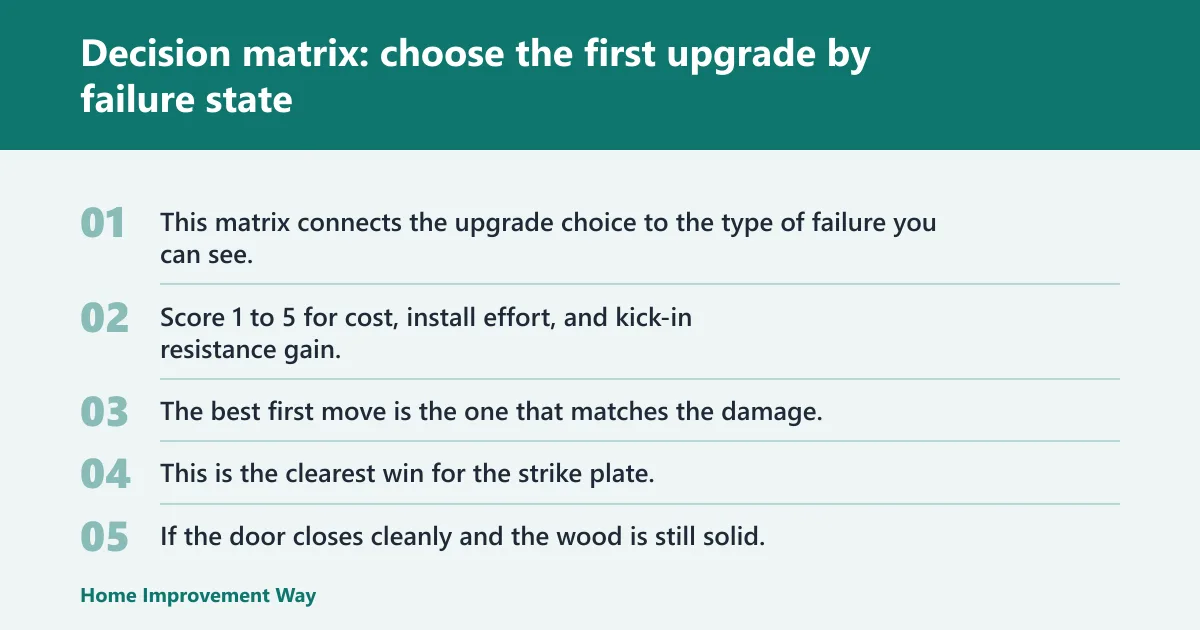
This matrix connects the upgrade choice to the type of failure you can see. Score 1 to 5 for cost, install effort, and kick-in resistance gain, with higher numbers meaning more of that trait. The best first move is the one that matches the damage, not the one with the flashier name.
| Failure state | Best first upgrade | Cost score | Install effort score | Kick-in resistance gain | Winner |
|---|---|---|---|---|---|
| Loose strike plate, sound jamb | Strike plate plus 3-inch wood screws | 5 | 4 | 3 | Strike Plate |
| Split jamb or crushed frame near the strike | Door reinforcement plate, then correct fasteners | 3 | 3 | 5 | Door Reinforcement Plate |
| Misaligned deadbolt or latch on an older exterior door | Realign hardware, then upgrade the strike plate | 4 | 3 | 3 | Strike Plate |
| Hollow-core or weak frame with minimal anchor depth | Frame repair or reinforcement before a plate swap | 2 | 2 | 5 | Door Reinforcement Plate |
Loose strike plate, sound jamb
This is the clearest win for the strike plate. If the door closes cleanly and the wood is still solid, longer screws and a better plate usually solve the immediate problem with low cost and modest effort.
Split jamb or crushed frame near the strike
This is the clearest win for reinforcement. The plate has to spread force over more of the door jamb, or the split will keep growing and the hardware will keep loosening.
Misaligned deadbolt or latch, older exterior door
Alignment comes first, then hardware. A deadbolt with poor throw length or shallow bolt engagement depth can feel weak even if the plate is new, so correct the fit before blaming the receiver.
Hollow-core or weak frame with minimal anchor depth
Here, plain screws have little to bite into. A reinforcement plate may help, but the door frame may also need repair if the structure is too thin to support reliable anchoring.
Choose strike plate if… / Choose reinforcement plate if…
Choose a strike plate if the hardware is loose but the jamb is intact. Choose a reinforcement plate if the jamb is splitting, crushed, or too weak to hold screws well. Choose both when the frame is weak and the hardware is under-anchored.
Choose a strike plate if…
The door closes cleanly and the only problems are loose hardware, worn screw holes, or a latch that needs a cleaner target. This is common on doors where the frame is still sound and the lockset prep is standard.
Choose a reinforcement plate if…
The strike area is the failure point, especially around a deadbolt on an exterior door. If the wood is splitting or the anchor depth is poor, force spreading matters more than simply replacing the receiver piece.
Choose both when…
Both parts matter when the plate is weak and the surrounding wood is weak. A reinforcement plate may still need better screws, and a stronger strike plate will still fail early if the jamb cannot hold it.
Do you need both a reinforcement plate and a strike plate?
Often, yes. The strike plate and reinforcement plate work together when the door is secure but the frame area needs more support. If the jamb is damaged or the hardware is only lightly fastened, one part alone may leave the same weak point in place.
Exterior doors matter more than interior doors for security, so this pairing makes the most sense there. For renters or older homes, the best first move is usually the least invasive change that still addresses the failure point and stays within lease or repair limits.
When a plate upgrade still needs better screws
A reinforcement plate does not help much if the fasteners miss the framing stud or the pilot holes are poor. Longer wood screws, driven into solid backing, are often the difference between a cosmetic fix and a useful one.
When damaged jambs need repair first
If the door jamb is rotten, split deep, or badly crushed, replace or repair that wood before judging the hardware. A new plate on failing material can look tidy and still leave the door easy to force.
Exterior doors versus interior doors
Interior doors can use simpler hardware because their job is privacy and room separation. Exterior doors carry the real security load, and that is where reinforcement, screw length, and alignment matter most.
What door parts fail first when someone forces entry?
The first failure is often not the lock itself. The strike area, screw hold, and jamb wood usually give way before the deadbolt is fully defeated. If the frame is weak, even a decent lock can lose because the surrounding material fails first.
Deadbolts vary by throw length and security grade, but bolt engagement depth only helps if the frame can hold the bolt’s receiver. A single-cylinder or double-cylinder choice matters less than the condition of the frame around the strike.
Deadbolt factors that matter here
Check whether the bolt fully engages the strike and whether the plate sits square in the jamb. A deadbolt that binds or barely catches is a frame and alignment problem before it is a lock problem.
Latch bolt factors that matter here
The spring-loaded latch bolt depends on backset and door alignment. If it rattles or does not seat cleanly, a strike plate may solve the fit issue, but a split jamb needs stronger support.
Which upgrade helps most on a hollow-core or older exterior door?
An older exterior door usually benefits more from frame-side reinforcement than a hollow-core interior door does, because the security load is higher. On a weak or hollow-backed frame, a reinforcement plate or repair work matters more than swapping the plate alone. If the jamb is sound, longer screws may still be the best cheap first step.
Suppose an exterior side door closes with a deadbolt that only catches on one corner of the strike. In that case, alignment and screw length come first. Suppose the same door has a split around the deadbolt opening; then the reinforcement plate belongs ahead of a cosmetic hardware swap.
Frequently asked questions
Should I upgrade the strike plate or the reinforcement plate first?
Upgrade the strike plate first if the jamb is intact and the problem is loose hardware or poor alignment. Upgrade the reinforcement plate first if the frame around the strike is splitting, crushed, or too weak to hold fasteners reliably. The failure point decides the order.
Will longer strike plate screws make my door harder to kick in?
Often, yes, if the frame is still sound and the screws can reach framing stud backing. A 3-inch wood screw usually holds better than a short factory screw. Longer screws will not fix split or rotted wood, though, so frame condition still matters.
How do I tell if my door frame needs reinforcement instead of new hardware?
Look for split wood, soft spots, enlarged screw holes, or a strike area that feels loose when the door is closed. If the frame is hollow-backed or damaged, a new strike plate alone is usually not enough. Reinforcement or repair comes first.
Sponsored / affiliate links. As an Amazon Associate I earn from qualifying purchases. I may earn additional commission from eligible campaigns.