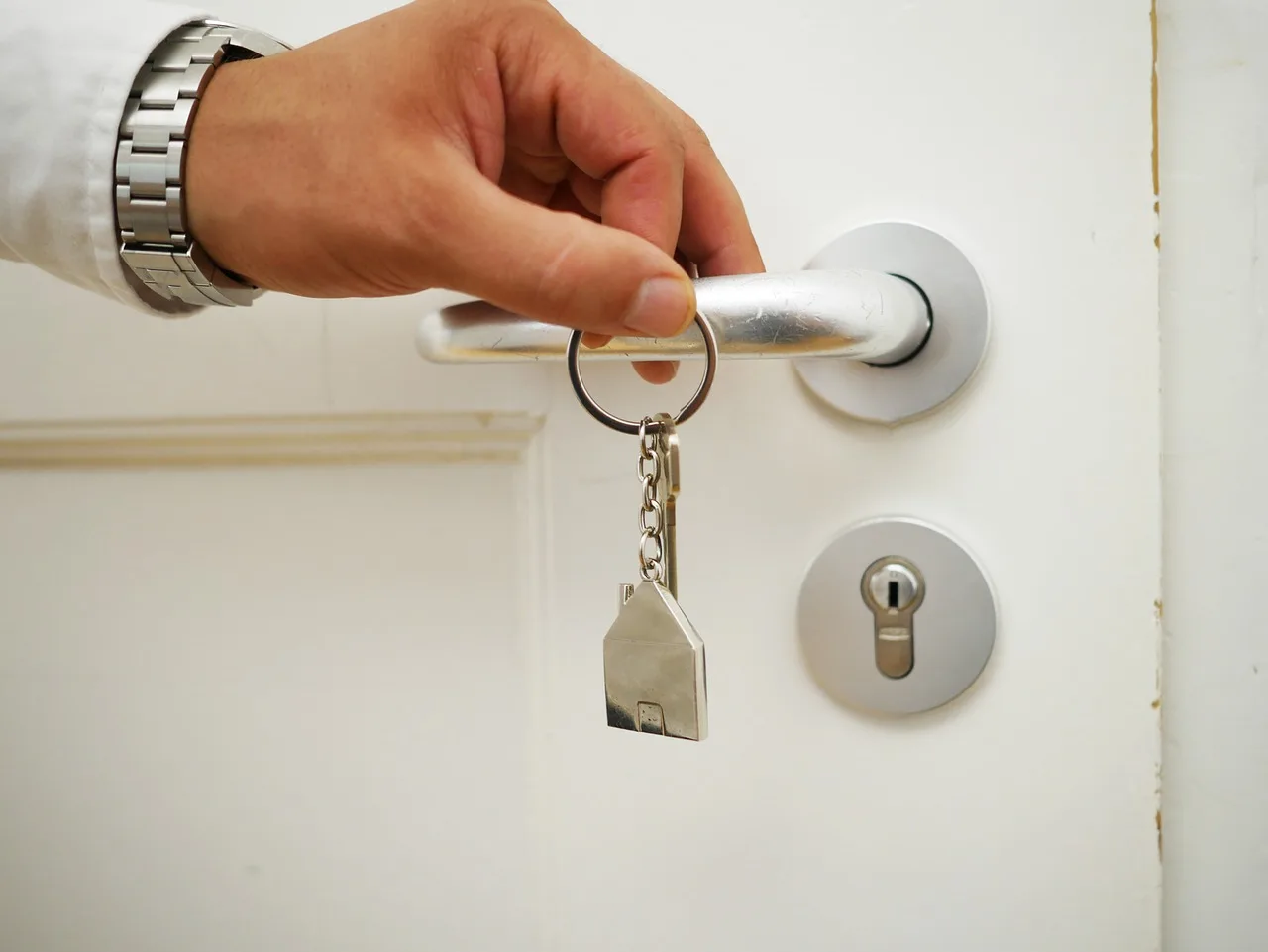
Best Security Hardware for French Doors (2026): We Compared
The best security hardware for French doors is often a layered set: about 3- or 4-inch hinge screws, a keyed or mortise multipoint lock, and a top-and-bottom flush bolt or concealed slide bolt matched to the door’s main failure point. Weak hardware can let the inactive door shift, split, or pry open, turning a deadbolt into wasted money. This guide shows how to choose the right French door security stack by failure mode, not by looks.
Quick comparison
| Product | Badge | Best for | Price | ||
|---|---|---|---|---|---|
 |
WANLIAN 6 inch Door Bolts,Door Slide Bolt Lock Door FlushWANLIAN | Our pick | 6 inch · stainless steel · door bolts | $17.58
Price as of 20 Oct 2026
|
View |
 |
High-Quality Aluminum T-Astragal for Your DoubleInbar Hardware | Upgrade pick | 96 inch · aluminum · T-astragal | $238.95
Price as of 20 Oct 2026
|
View |
 |
BUYYAH 2Pcs Door Security Bar, French Security Door BraceBUYYAH | Also great | 2pcs · adjustable · door security bar | $129.99
Price as of 20 Oct 2026
|
View |
 |
MOSECYOU French Door Lock, Double Door Security BarricadeMOSECYOU | Budget pick | Adjustable · all-metal · French door lock | $19.59
Price as of 20 Oct 2026
|
View |
The strongest choice depends on where the door fails first. For kick-ins, a floor-anchored bar or brace matters more than a decorative lock. For glass-heavy doors, reach-through risk changes the decision, and the inactive leaf often needs its own locking hardware before any main lock can work well.
How we chose
This roundup is organized around failure mode, not brand style. The main filters are center-seam resistance, handle manipulation resistance, glass reach-through protection, inactive-leaf control, and how much drilling or permanent change the hardware typically requires.
Compatibility matters just as much. French door handle spacing can vary a lot between lever and knob sets, and inswing versus outswing orientation changes whether a bar, brace, or inside-handle device will fit at all.
Safety also matters. A double-cylinder deadbolt can help against glass reach-through, but it creates a fire-safety and egress tradeoff that deserves a real decision, not a default yes.
For renters and families, removable or no-drill options get extra weight. Portable security can be enough for an apartment lease or a temporary setup, but it usually works best as a secondary layer rather than the only lock.
French door security matrix
Use this table to match the weak point first, then choose the hardware. That order matters more than choosing the heaviest-looking device.
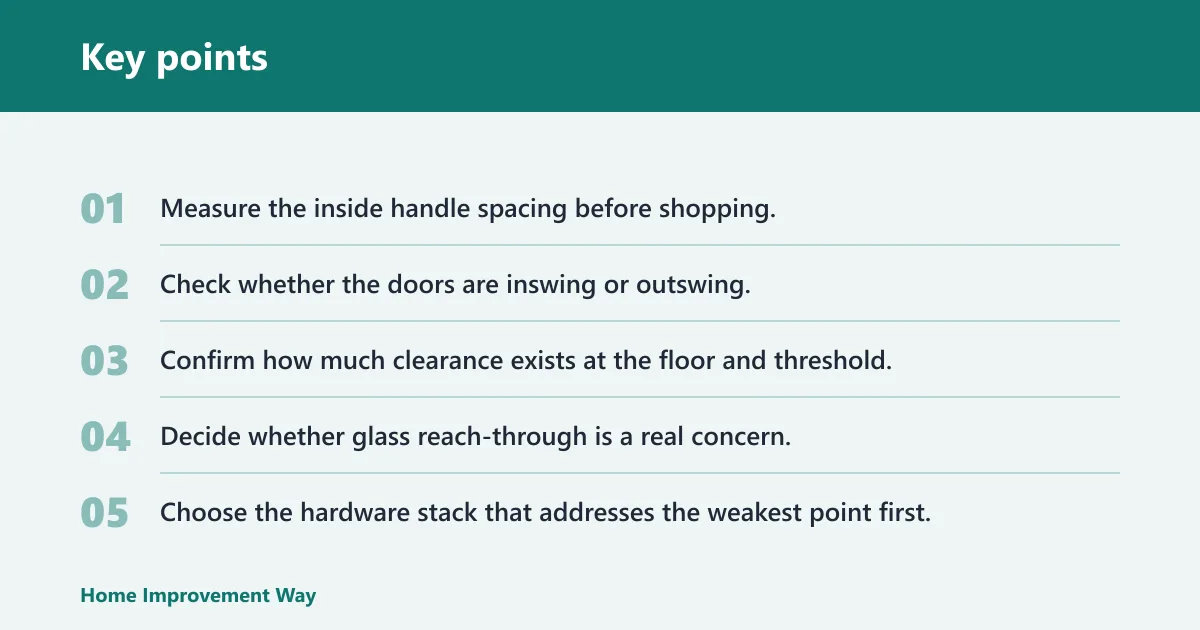
| Failure mode | Best hardware type | Key compatibility check | Main tradeoff |
|---|---|---|---|
| Kick-in resistance | Master Lock 270EC Security Bar or a door brace barricade | Floor-to-handle distance and bottom clearance | Needs manual setup and storage after each use |
| Handle manipulation | Patlock Security Lock or double-door reinforcement lock | Inside handle shape, spacing, and whether the device fits over the handleset | Convenience can be better than brute-force resistance, depending on the model |
| Glass reach-through | Double-cylinder deadbolt | Code compliance, key access, and egress plan | Better defense through glass, but slower emergency exit |
| Inactive-leaf wobble | Flush bolts | Mortised edge space, door thickness, and enough room for top and bottom bolts | Works best only when the active leaf already has a strong primary lock |
| Rental constraints | Patlock Security Lock or portable reinforcement lock | No-drill requirement and removal in an emergency | Usually less rigid than mortised hardware |
| Child safety | Keyless interior device or removable bar with supervised use | Can children access the release, and can adults exit quickly | More access control can conflict with fast evacuation |
Say your French doors have a weak center seam and an inactive leaf that rattles when pushed. Flush bolts solve the wobble first, then a floor brace or bar stops the push at the bottom rail. A main deadbolt on the active leaf alone will not fix the loose second door.
- Measure the inside handle spacing before shopping.
- Check whether the doors are inswing or outswing.
- Confirm how much clearance exists at the floor and threshold.
- Decide whether glass reach-through is a real concern.
- Choose the hardware stack that addresses the weakest point first.
Patlock Security Lock: best for daily convenience
Patlock is the best fit when you want a tool-free handle lock that stays simple for daily use. It fits over inside handles, needs no keys or code, and can be removed quickly in an emergency. That makes it a practical secondary layer for homeowners who use the doors every day.
Based on the published product details and buyer feedback, the appeal is convenience. It is also portable, which matters if you want to secure a rental door without drilling. Dad Improvement also describes PATLOCK as needing no keys or codes, which aligns with the main convenience case.
The drawback is straightforward: convenience is not the same as brute-force resistance. If the issue is a hard kick-in or a loose inactive leaf, Patlock is better as part of a stack than as the only defense.
Master Lock 270EC: best for kick-ins
The Master Lock 270EC Security Bar is aimed at kick-in resistance. It uses 20-gauge steel bracing, adjusts telescopically, and braces from the floor to the handle area. That floor-to-handle support is exactly the kind of load path that helps when a door is shoved inward.
The non-slip rubberized base is important because a floor brace only works if it stays planted. This model does require manual setup and removal, so it is better for nighttime use, vacant hours, or a routine where you are willing to place it each time.
The tradeoff is storage and repeat handling. If you want one-touch convenience, a fixed lock may feel easier. If kick-in resistance is the priority, this kind of brace usually matters more than another keyed latch alone.
Flush bolts: best for the inactive leaf
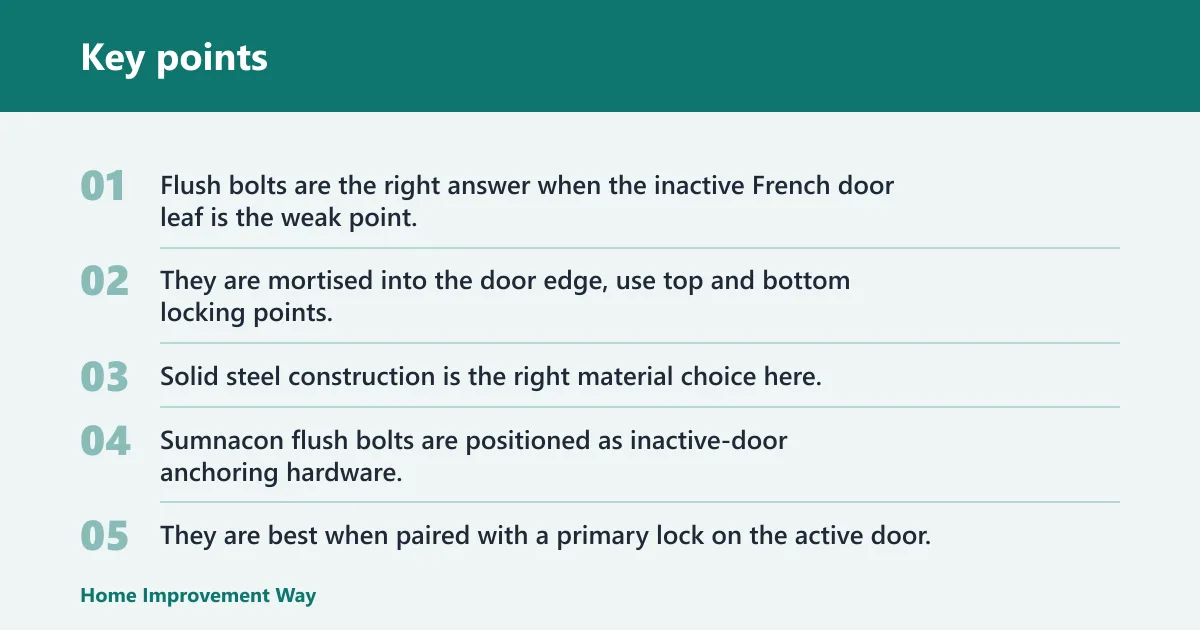
Flush bolts are the right answer when the inactive French door leaf is the weak point. They are mortised into the door edge, use top and bottom locking points, and help anchor the inactive leaf so the active side is not doing all the work. Solid steel construction is the right material choice here.
Sumnacon flush bolts are positioned as inactive-door anchoring hardware, which matches the job they are supposed to do. They are best when paired with a primary lock on the active door, because they stabilize the pair rather than replace the main latch.
The drawback is installation and fit. Mortising requires enough edge space and proper door thickness, so this is not a universal no-drill answer. It is a better long-term fix than a quick add-on, but it is not the simplest one.
Which one should you buy?
Start with the failure mode, then choose the least complicated hardware that directly blocks it. If the door already closes well and the issue is daily convenience, Patlock is the cleanest option. If kick-in force is the main concern, a security bar or barricade should move to the top of the list.
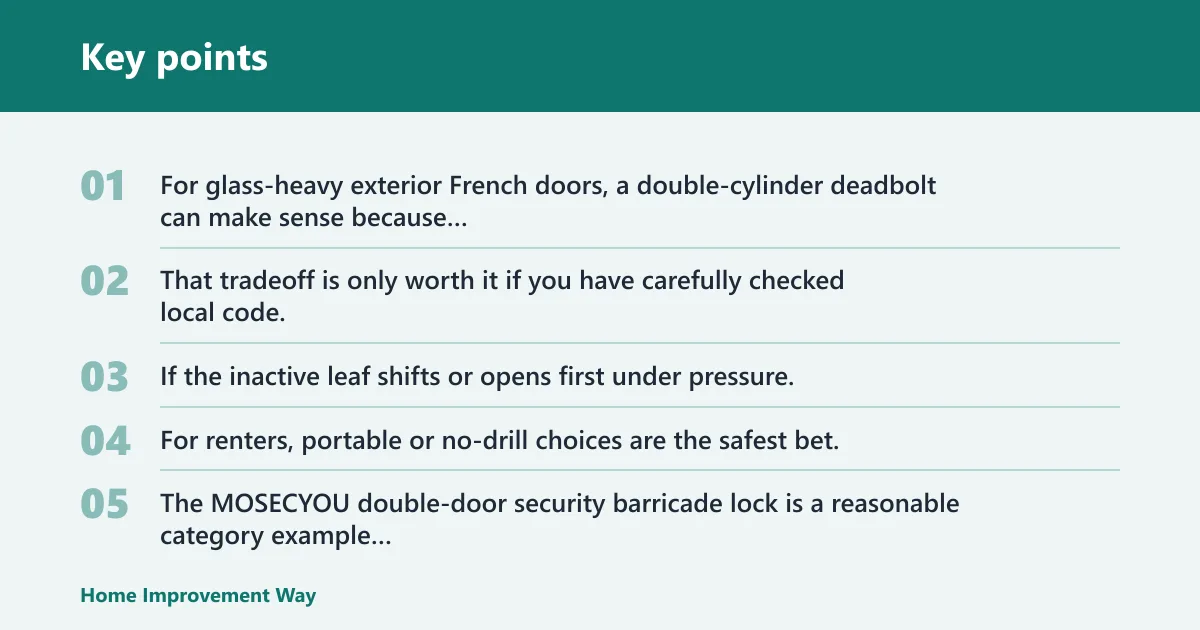
For glass-heavy exterior French doors, a double-cylinder deadbolt can make sense because it helps resist glass reach-through. That tradeoff is only worth it if you have carefully checked local code, emergency exit needs, and how adults will leave the room fast in an emergency.
If the inactive leaf shifts or opens first under pressure, flush bolts matter more than a stronger-looking main lock. That is where many shopping lists go wrong.
For renters, portable or no-drill choices are the safest bet. The MOSECYOU double-door security barricade lock is a reasonable category example because it is described as adjustable, all-metal, and available for double handles, knobs, and levers. Portable reinforcement locks and Patlock-style devices usually fit rental rules better than mortised hardware.
For families with children, choose the option that adults can release quickly while children cannot easily tamper with it. A removable bar can work well if adults remember to set it every time, but a keyed inside solution may slow emergency exit too much unless the household has a clear plan.
Best for renters
Choose a no-drill or portable device first. Patlock is the simplest daily-use option, and a portable reinforcement lock is the next step up if your handleset and spacing allow it. Avoid permanent mortising unless the lease clearly allows it.
Best for glass-heavy exterior doors
Choose a double-cylinder deadbolt only if the glass reach-through risk is real and the egress tradeoff is acceptable. Pair it with flush bolts if the inactive leaf is also unstable. Glass does not make every door need the same answer.
Best for families with children
Choose hardware that adults can release fast without a tool. A bar or brace can help, but it should not block fast exit or create a complicated sequence during a fire alarm. Key control, child access, and nighttime use all matter here.
Best for the most secure layered setup
Use a layered stack: strong hinges, a primary lock, flush bolts on the inactive leaf, and a kick-in device if the entry is exposed. That combination addresses the center seam, the inactive side, and the shove at the same time.
Patlock Security Lock details
Patlock is a better fit for handle-based daily convenience than for brute-force defense. It is a tool-free handle lock that fits over inside handles, needs no keys or code, and can be removed in an emergency. That makes it useful when you want speed and simplicity.
Check the inside handle style before buying. Lever and knob sets do not always present the same clearance, and French door handle spacing can vary enough to make a portable lock feel loose or not fit at all.
The main drawback is that a portable handle lock is not the same thing as anchoring the door slab. It can help with casual tampering and everyday peace of mind, but it does less against a hard shove than a floor brace does.
Master Lock 270EC details
The Master Lock 270EC Security Bar is a kick-in resistance tool built around 20-gauge steel and a floor-to-handle brace. The adjustable telescoping length is the key feature because French doors vary, and the bar has to land where the floor and handle geometry allow it.
Look at the floor-to-handle distance before you buy. If the base cannot sit flat or the handle is too high or too low for the bar’s working range, the device loses much of its value. The non-slip rubberized base helps only when the geometry is correct.
The tradeoff is practical, not theoretical. You need to place it, remove it, and store it each time. That is a fair trade if kick-in resistance is the top priority and convenience is secondary.
Flush bolt details
Flush bolts belong on the inactive leaf. They are mortised into the door edge and use top and bottom locking points to keep the second door from drifting, rattling, or prying open under pressure. Solid steel construction is the typical material choice for this job.
Measure the mortised edge space and the door thickness before you commit. Those dimensions decide whether the bolt will fit cleanly and whether both ends can seat properly. Best Home Tools also frames French doors as needing specialized locks and bars, and adjustable fit is one of the buying criteria that matters most in real use.
The drawback is simple: flush bolts help most when they are part of a stack. On their own, they do not solve a weak primary lock or a glass reach-through problem.
How to choose
Choose by failure mode first, then by convenience. If the door is kicked, pick a brace or bar. If the handle can be manipulated from outside, choose a handle lock or reinforcement lock. If someone can reach through glass, a keyed both-sides deadbolt may be the better fit, if egress rules allow it.
Then check three dimensions before you buy: handle spacing, floor clearance, and door swing direction. Those are the practical fit checks that decide whether a device works at all. Inswing versus outswing orientation is especially important because it changes which inside-access devices can be used.
A common first-timer mistake is buying a “strong” lock for the active leaf while ignoring the inactive leaf. If the second door still moves, the security upgrade only changed where the attack starts.
Another common mistake is assuming all French doors need the same hardware. A glass-heavy pair on a front entry, a rental patio door, and a child-accessible side entry each need a different tradeoff.
Frequently asked questions
How do I make French doors more secure?
Start with the weak point, not the product. Reinforce the hinge side, anchor the inactive leaf with flush bolts, and add a brace or bar if kick-in force is the main concern. If the doors have glass near the handle, consider a keyed both-sides lock after checking exit requirements.
What are the best security locks for French doors?
The best lock depends on the failure mode. Patlock is strong for daily convenience, flush bolts are best for the inactive leaf, and a double-cylinder deadbolt helps where glass reach-through is the issue. For kick-ins, a bar or brace is usually more relevant than another latch.
Should I use a deadbolt or a security bar on French doors?
Use a deadbolt when you need a permanent lock solution, especially if the issue is reach-through through glass. Use a security bar or brace when kick-in resistance matters most. Many French doors need both, because a deadbolt does not stop a strong shove by itself.
Do French door locks work on both inswing and outswing doors?
Not automatically. Inswing versus outswing orientation changes which devices fit and where they can brace. Inside-handle devices, floor braces, and some portable locks are orientation-sensitive, so you need to verify the swing before buying anything that mounts or wedges inside the room.
Can I secure French doors without drilling?
Yes. Patlock-style handle locks, portable reinforcement locks, and some bars or braces can work without drilling. They are especially useful for renters or temporary setups. The tradeoff is usually less permanence and, in some cases, more setup each time you use the door.
Is a double-cylinder deadbolt safe for French doors with glass?
It can be the right choice for glass-heavy doors because it helps resist glass reach-through. The tradeoff is fire safety and emergency egress, since a key is needed on both sides. Only use it after checking code, escape needs, and who will be inside the room.
Sponsored / affiliate links. As an Amazon Associate I earn from qualifying purchases. I may earn additional commission from eligible campaigns.
 U 9585 Stainless Steel Lock and Door Reinforcement Plate for 1-3/8 in Thick Doors, Stainless Steel Finish for Reinforcing and Repairing Doors - 4 Pack
 Kwikset Casey Interior Privacy Door Handle with Lock, Door Lever For Bathroom and Bedroom, Satin Nickel Reversible Keyless Turn Lock, with Microban Protection