Security Hinge Pins vs. Standard Hinge Pins: What Matters
Security hinge pins matter on outward-swinging doors with exposed, removable pins. If the hinge knuckles or frame are weak, the better fix is a non-removable hinge, longer screws, or frame repair. Miss that split, and the door can still lift, sit out of line, or stay loose after a pin swap. This guide compares Security Hinge Pins vs. Standard Hinge Pins and shows when the hardware matters, and when the hinge or frame does.
| Decision factor | Security Hinge Pins | Standard Hinge Pins | Winner |
|---|---|---|---|
| Anti-removal protection | May be non-removable, capped, peened, welded, or set-screwed when the exact hinge assembly supports it. | Often removable unless the hinge itself is fixed-pin by design. | Security Hinge Pins |
| Compatibility risk | Higher, because the pin must match the exact hinge assembly. | Lower for like-for-like replacement in the same hinge size and style. | Standard Hinge Pins |
| Best use case | Outward-opening exterior doors with exposed knuckles and a removable pin threat. | Routine wear replacement, light-duty service, or any hinge where pin removal is not the real issue. | Security Hinge Pins |
| Serviceability | Can be harder to remove later, depending on the retention method. | Usually easier to service, clean, or replace. | Standard Hinge Pins |
| Cost-to-fix logic | Worth it when the pin is the actual failure mode and the rest of the hinge is sound. | Cheaper when you only need maintenance, not security. | Tie |
Security hinge pin basics
A standard butt hinge has two hinge arms and one hinge pin. That pin may be removable or fixed, and the same general pin idea shows up in doors, hatches, covers, cabinets, enclosures, and industrial equipment.
Security-oriented hinge pin styles sit in that same family, but they are not a universal swap. They may be non-removable, capped, peened, welded, or set-screwed, and they have to match the exact hinge assembly you already have.
What makes a security pin different
The difference is not the metal alone. It is how the pin is retained and whether the hinge was built for that retention method in the first place.
That is why a pin replacement can be a maintenance fix on one door and a poor fit on another. If the hinge leaf design, knuckle size, or pin stop does not match, the “upgrade” can turn into a noisy, loose, or unusable hinge.
Which hinge types can accept a pin change?
Some standard butt hinges accept a like-for-like pin change. Others use a fixed-pin path, where the pin is not meant to come out cleanly. Non-removable-pin hinges are a design choice, not a universal pin swap.
Factory replacement pins exist for residential doors and commercial openings, including 3-1/2 inch stainless steel hinge pins, 4 inch steel hinge pins, and 4 inch stainless steel barrel pins for a specific hinge. That range shows the main point: fit and hinge model matter more than the label on the package.
Can someone remove a standard hinge pin from outside?
Sometimes yes, if the door swings outward and the hinge knuckles and pin heads are reachable from the exterior. But access alone does not make the door easy to defeat; the hinge may still be protected by fixed pins, interlocking hardware, closer action, or a frame that resists lift-out.
What exposed knuckles mean on outward-opening doors
On outward-opening exterior doors, exposed hinge knuckles raise the stakes because the pin may be reachable from outside. EnduraPin notes that an outward-opening exterior door may expose hinge knuckles, which is why pin security gets more attention on that swing direction.
Still, the whole door setup matters. Egress rules, closer force, and weather sealing can all affect what hardware is sensible, and a pin swap should not create a new problem with closing, sealing, or inspection.
When a removable pin is a real risk
A removable pin matters most when the hinge side is the weak link and the door can be lifted after the pin comes out. That is the case homeowners usually mean when they ask about exterior-door security.
Picture a side door that opens out toward a narrow porch. If the pin heads are exposed and the door already has a little lift in the hinge side, a non-removable pin or interlocking hinge design is a better answer than a cosmetic pin change.
When the pin is not the weak point
Sometimes the pin is not the problem at all. Loose hinge leaves, stripped screws, a sagging frame, or a misaligned strike can leave the door hard to latch and easy to pry even if the pin itself is “secure.”
A common first-timer mistake is to replace the pin after noticing a gap at the top latch corner. If the door drags or needs a shoulder push to close, the real fix is usually fit, fasteners, or frame repair.
When a pin-only upgrade is enough
A pin-only upgrade makes sense when the hinge body is sound, the pin is the actual risk, and the door does not need a different hinge design. That is a narrow but real use case, especially on outward-opening exterior doors with exposed hardware and otherwise solid alignment.
Good cases for a non-removable-pin hinge
Choose a non-removable-pin hinge when the hinge is otherwise in good shape and the goal is to stop pin withdrawal. That is the closest match to the problem when the door is already aligned and the frame is healthy.
Security Hinge Pins win here because they address the failure mode directly. Standard Hinge Pins win only when the door needs ordinary service, not pin security.
When capped, peened, welded, or set-screwed pins make sense
Those retention styles can make sense when the hinge family supports them and the door owner wants a stronger pin-retention path without changing the whole opening. They are still hinge-specific, so compatibility comes first.
Use them when the pin is the issue and the hinge leaves, knuckles, and fasteners are otherwise acceptable. If the door is already sagging or the strike is off, that is a different repair.
Limits of pin-only protection
Pin-only protection does not fix a weak latch side, a soft frame, or a loose hinge leaf. It also does not improve load transfer if the door is hanging poorly or the screws have wallowed out the substrate.
If the door has a fire rating, pin changes can raise inspection risk unless the parts are listed-compatible and the assembly still closes properly. On regulated openings, verify the approved hardware before changing anything.
Security hinge pins vs Standard hinge pins decision table
Use the table below by matching the door type, outside access, and failure mode first. Then choose the remedy that fixes the actual problem with the least hardware change.
| Door type | Outside access / code or rental constraint | Failure mode | Recommended next step |
|---|---|---|---|
| Inward-opening exterior door | No exterior hinge access; no special constraint | Normal wear, no lift risk | Standard pin replacement |
| Outward-opening exterior door | Exposed knuckles; owner can modify hardware | Removable pin is the main concern | Security pin / non-removable pin |
| Outward-opening apartment or rental door | Exterior access plus rental or code limits | Security concern, but hardware changes may be limited | Use approved replacement only; confirm lease and building rules first |
| Outward-opening exterior door with good hinges but release risk | Outside access exists | Door could be lifted if the pin comes out | Security studs or interlocking tabs, or a non-removable hinge |
| Heavy exterior door with sag, drag, or repeated adjustment | Any access situation | Load and alignment problem, not just pin removal | Continuous hinge or frame/strike repair, depending on condition |
| Fire-rated assembly | Listed hardware required; inspection matters | Any hole, swap, or hardware change could affect rating | Frame/strike repair or listed-compatible hinge service only |
How to read the table
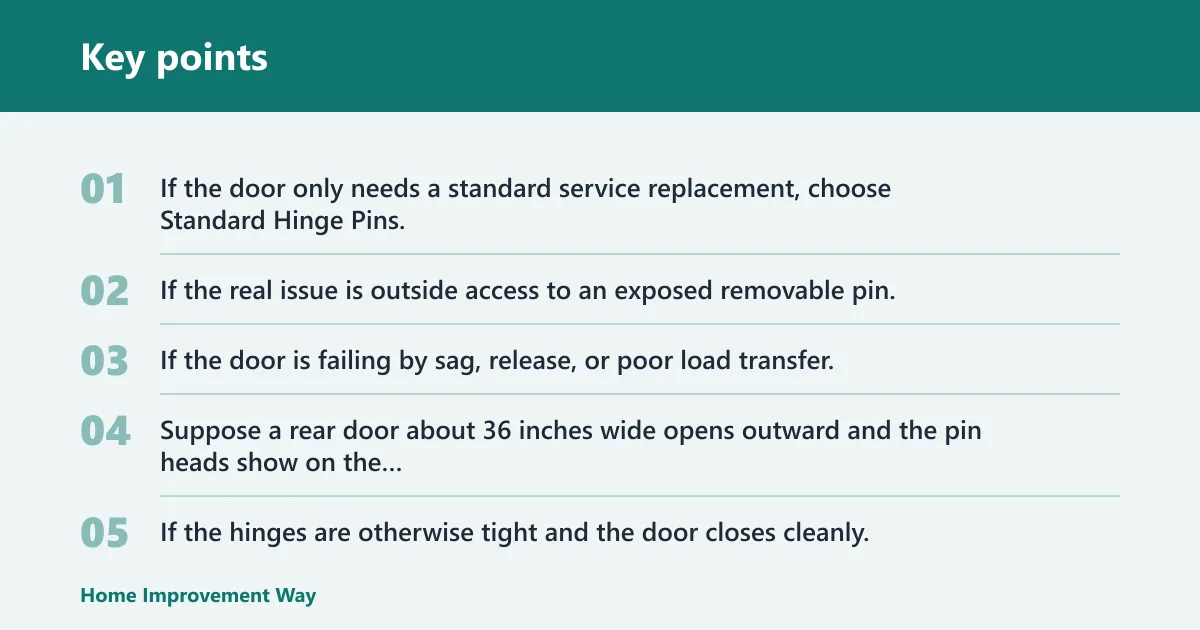
If the door only needs a standard service replacement, choose Standard Hinge Pins. If the real issue is outside access to an exposed removable pin, choose Security Hinge Pins. If the door is failing by sag, release, or poor load transfer, the stronger answer is usually a different hinge design or a frame repair.
Suppose a rear door about 36 inches wide opens outward and the pin heads show on the exterior side. If the hinges are otherwise tight and the door closes cleanly, a non-removable pin is a reasonable next step. If the top corner already rubs and the strike barely catches, the pin is not the main issue.
Should you replace the whole hinge?
Yes, when the hinge design is the problem, not just the pin. Security studs, interlocking tabs, and continuous hinges solve different failure modes than a pin swap, and they can be the better choice when you need to stop door release or correct load and alignment.
When security studs or interlocking tabs are better
Security studs and interlocking tabs connect the hinge leaves when the door closes, helping keep the door from simply coming free if the pin is removed. They require correct alignment and enough material in both leaves, which makes them a fit-only solution rather than a universal add-on.
Choose them when the goal is release prevention and the hinge body can support that design. A pin change alone does less when the assembly is already a lift-out risk.
When a continuous hinge is the smarter upgrade
A continuous hinge can change load transfer, preparation, clearances, and weathering, and it may affect the door’s rating. That makes it a smarter choice for doors that are heavy, abused, or repeatedly out of alignment.
Trans-Technik separates hinge products into hinges 180°, hinges 270°, and running continuous hinges, which is a reminder that the hinge system itself can be the fix. If the existing butt hinges are beyond simple repair, a continuous hinge may be the cleaner long-term answer.
Load, clearance, and rating tradeoffs
Full hinge replacement usually takes more prep than a pin swap. It can also change clearances, swing behavior, and the way the door seals against weather.
For fire-rated assemblies, that tradeoff is not optional. Use only listed-compatible parts, and treat holes or hardware changes as a potential inspection issue until verified.
Do the screws matter more than the pin?
Often, yes. A long enough screw in the right substrate can do more for door security and alignment than a pin change, but only when the frame material and cavity conditions are known. Wrong screw length can create a new hazard.
Choosing screw length and thread for wood, metal, or unknown frames
Hinge fasteners need the right length and thread for the substrate. A screw that is too short will not hold well; a screw that is too long can reach wiring, plumbing, glass, metal reinforcement, or an empty cavity.
That is why “just use longer screws” is not a universal rule. EnduraPin warns that longer screws can reach those hidden hazards, so you should confirm what the frame is made of before changing fasteners.
What to do about stripped holes and loose hinge leaves
If the holes are stripped or the hinge leaf is loose, repair comes first. Bigger screws are not the right fix when the substrate is damaged, because they can hide the problem until the leaf loosens again.
Use proper hole repair or a hinge system that matches the frame condition. If the hinge is moving on the frame, the door will keep sagging no matter how good the pin looks.
Why a bad frame can defeat a good hinge
A sound pin cannot save a weak frame. If the strike is loose, the jamb is split, or the hinge side is out of plumb, the door can still bind, fail to latch, or leave a gap that reduces security.
That is why the latch side matters as much as the hinge side. A good hinge hardware choice still has to work with the strike, deadbolt, and frame.
What to check before changing exterior door hardware
Before replacing any pin, hinge, or screw, check the whole opening. The right remedy depends on the latch side, the swing direction, the frame condition, and any code or rental limits that apply.
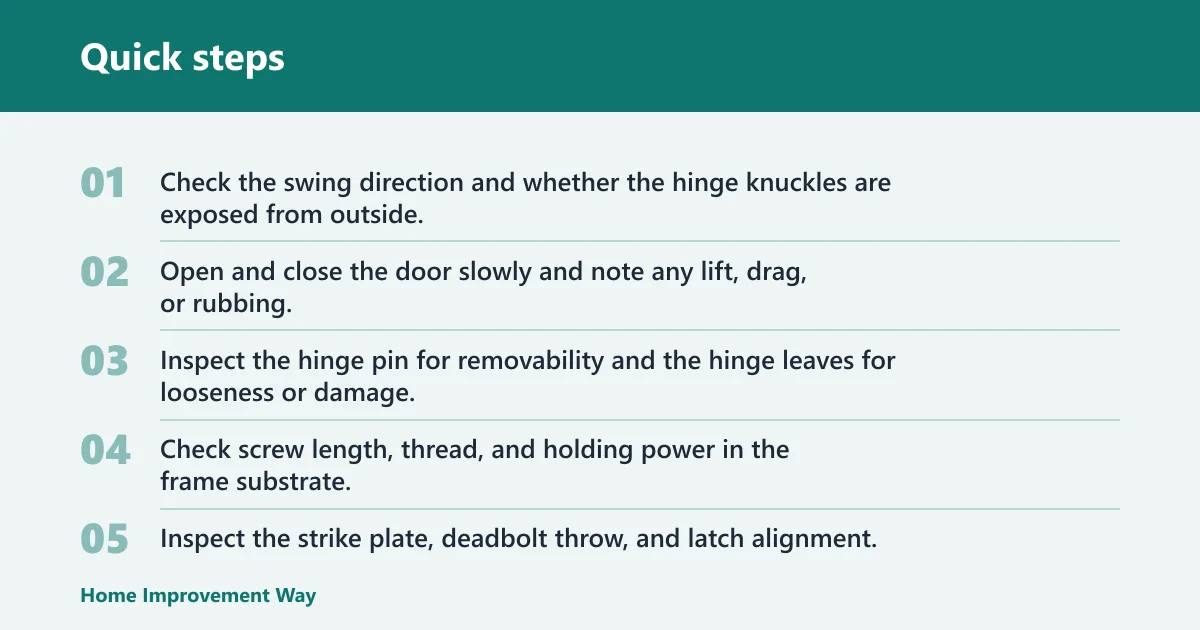
- Check the swing direction and whether the hinge knuckles are exposed from outside.
- Open and close the door slowly and note any lift, drag, or rubbing.
- Inspect the hinge pin for removability and the hinge leaves for looseness or damage.
- Check screw length, thread, and holding power in the frame substrate.
- Inspect the strike plate, deadbolt throw, and latch alignment.
- Confirm whether the opening is fire-rated, rented, or otherwise regulated.
Latch side, strike, and deadbolt alignment
Hinge reinforcement does not fix weak latch-side hardware. If the strike is worn, the deadbolt does not fully engage, or the door needs pressure to latch, that is part of the repair plan.
Choose the fix that addresses the side failing first. Otherwise, the door may still be easy to force even with a better pin.
Egress, closer, and weathering on outward-opening doors
Outward-opening exterior doors may need protected hardware rather than a simple pin swap. The closer must still shut the door properly, and the weather seal has to hold after any hinge change.
If the door opens and closes properly now, avoid a hardware change that changes sweep, clearance, or closing force without a reason. Security should not break egress or weather protection.
Fire-rated and rental constraints
Fire-rated assemblies require approved parts only. Holes or hardware changes can affect the listing, closing behavior, and inspection outcome, so compatible listed hardware and qualified service matter more than convenience.
Rental and apartment doors may also have limits. Check the lease, building rules, or property manager’s requirements before changing hinge hardware on an exterior door.
Choose security hinge pins if…
Choose Security Hinge Pins if the door swings outward, the hinge knuckles and pin are exposed, and the hinge is otherwise sound. That is the best fit when pin removal is the actual concern and you want a matched, non-removable-style fix without changing the whole hinge system.


Choose Standard hinge Pins if…
Choose Standard Hinge Pins if you are replacing worn hardware on a hinge that is already working as intended, or if the door does not have an outside-access pin problem. They are the better pick when you need straightforward serviceability and the security risk is coming from the frame, strike, or alignment instead.
Frequently asked questions
Are security hinge pins better than standard hinge pins?
Security hinge pins are better only when the door can be compromised by removing the pin from outside, usually on an outward-opening exterior door with exposed knuckles. Standard Hinge Pins are better for normal service work, because they are easier to replace and less likely to create compatibility trouble.
What is the difference between a security hinge pin and a regular hinge pin?
A regular pin is a pivot part for a standard butt hinge. A security hinge pin adds retention or non-removable features such as capped, peened, welded, or set-screwed construction, but it still has to match the exact hinge assembly.
Do outward-opening doors need security hinges?
Not always. They need security-oriented hinge hardware when the pin is exposed and removable, or when the assembly allows the door to lift off after pin removal. If the door is already sagging or the strike is weak, a different repair may matter more.
Should I replace hinge pins or the whole hinge for security?
Replace only the pin when the hinge body is sound and pin removal is the real issue. Replace the whole hinge, or move to security studs or a continuous hinge, when the problem is door release, sag, load transfer, or repeated alignment trouble.
When does a longer screw help more than a security pin?
A longer screw helps more when the hinge leaf is loose because the fastener is not holding in the frame substrate. It does not help if the frame is damaged, the cavity is unknown, or the door needs a different hinge design to correct sag or release risk.
Sponsored / affiliate links. As an Amazon Associate I earn from qualifying purchases. I may earn additional commission from eligible campaigns.