Smart Lock vs. Deadbolt: Which Is More Secure for Real Homes?
For pure physical security, a high-quality mechanical deadbolt usually wins; a smart lock can match it only if the lock, strike, frame, battery, and account security all hold up. Miss those weak points, and a break-in gets easier, a lockout gets costlier, or remote access fails when you need it. This guide compares kick-in resistance, access control, battery dependence, and account risk so you can choose the better exterior-door lock for a real home.
Method and sourcing: This comparison is built around ANSI/BHMA residential hardware grades, BHMA cycle ratings, published smart-lock battery and temperature specifications, and common door-failure points cited in security guidance from the U.S. Department of Justice COPS Office and the National Crime Prevention Council (NCPC). In field installs, the most common problems are not exotic hacks; they are misaligned strikes, weak jamb anchoring, and doors that no longer latch cleanly after seasonal movement.
| Decision factor | Smart Lock | Deadbolt | Winner |
|---|---|---|---|
| Physical strength | Can be built on a solid deadbolt body, but electronics add parts that must keep working | Simple bolt-and-cylinder design with no software layer | Deadbolt |
| Access control | Temporary or scheduled guest codes, remote changes, and revocation | Spare keys and rekeying only | Smart Lock |
| Power dependence | Battery dependent; low power can affect keypad, app, or auto-lock features | No batteries or software | Deadbolt |
| Account and setup risk | Exposure to weak passwords, poor configuration, firmware support endings, or app lockouts | No account, app, or cloud dependency | Deadbolt |
| Maintenance burden | Battery changes, code management, firmware updates, and support monitoring | Minimal upkeep beyond fit and lubrication | Deadbolt |
The real security trade-off
The stronger choice depends on the whole door system, not the smart label. Most smart locks are deadbolts underneath, so the lock grade, strike plate, and frame decide more of the outcome than the electronics badge.
What this comparison measures
This comparison looks at forced-entry resistance, access control, power dependence, and maintenance. That matters because many break-ins exploit the weakest part of the door assembly, not the lock cylinder alone.
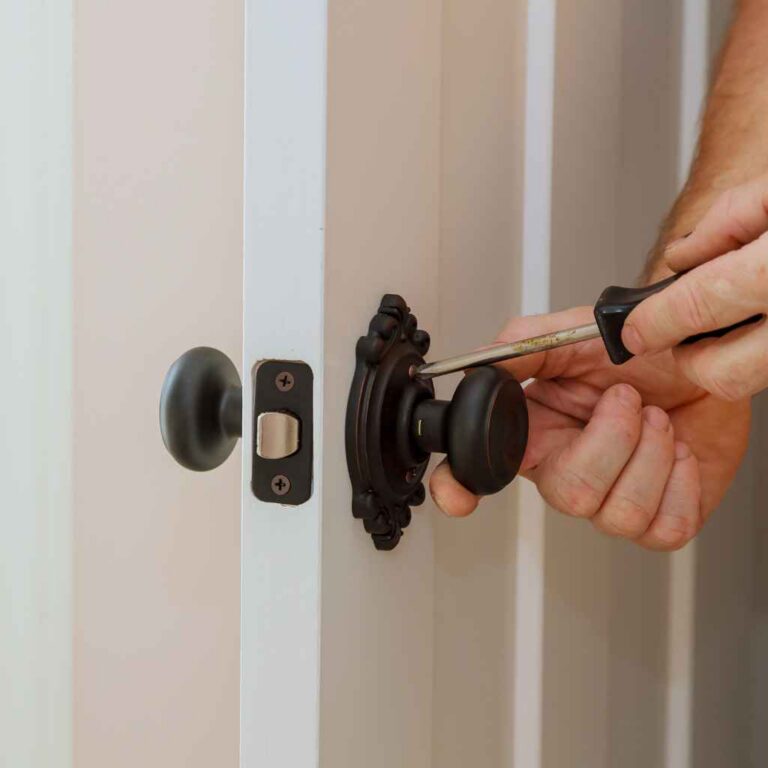
A connected lock is not automatically stronger. A smart deadbolt can be a better access tool, but physical security still comes down to the bolt, the strike plate, and whether the frame is anchored well enough to hold the load. COPS Office guidance consistently emphasizes the door, frame, strike plate, and hinges as the true security system, not the lock body alone.
Smart lock vs. deadbolt comparison
Physical security
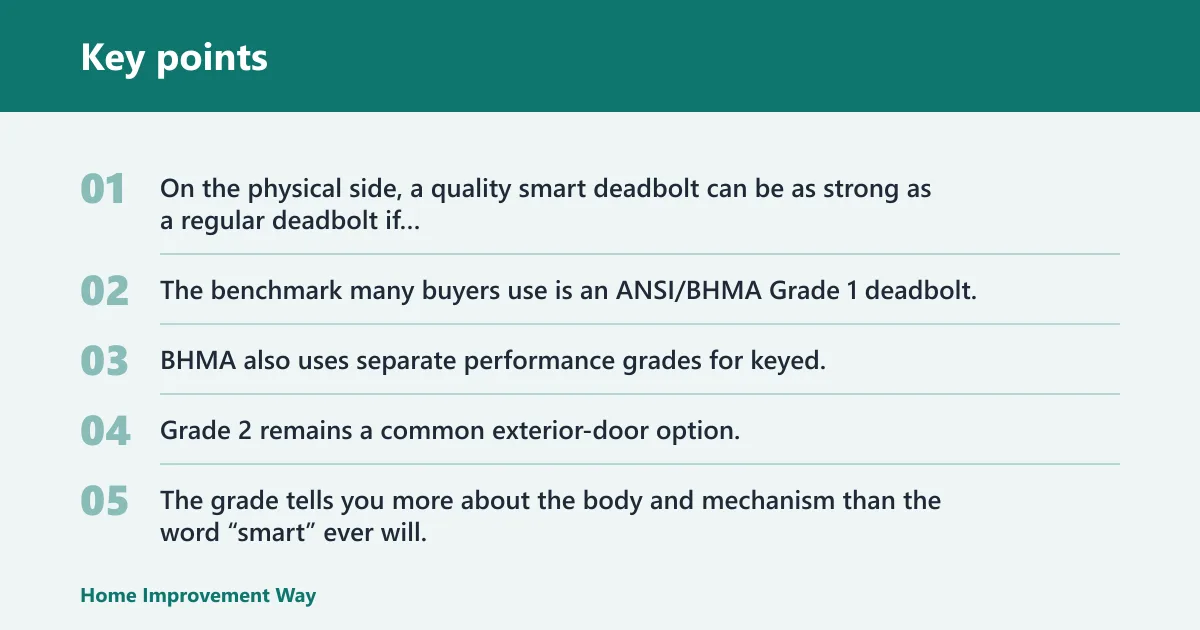
On the physical side, a quality smart deadbolt can be as strong as a regular deadbolt if the hardware and installation are comparable. The benchmark many buyers use is an ANSI/BHMA Grade 1 deadbolt, the highest residential rating, which is defined by BHMA testing and typically associated with 250,000 cycles; Grade 2 is commonly listed at 150,000 cycles, and Grade 3 at 100,000 cycles. BHMA also uses separate performance grades for keyed, electronic lock functions and durability in locksets, so the smart features have their own rating path rather than inheriting the deadbolt grade automatically.
Grade 2 remains a common exterior-door option, but Grade 1 is the safer benchmark when you want the toughest residential hardware. The grade tells you more about the body and mechanism than the word “smart” ever will.
Digital and account risk
Smart locks add a digital attack surface. Real-world consumer risk is more often weak passwords, exposed accounts, poor setup, or unsupported firmware than movie-style remote break-ins through Wi‑Fi or Bluetooth.
That does not make the digital side trivial. If an account gets compromised, if support ends, or if the device stops receiving updates, the lock can fail in ways a mechanical deadbolt never can.
Access control and guest codes
Smart locks are better when you need guest access codes. Temporary or scheduled codes are useful for cleaners, contractors, family, and short-term rentals because you can grant access without handing out spare keys and then revoke it later.
A mechanical deadbolt can work well for simple key control, but it cannot offer code management. For homes with frequent turnover, that gap is often the biggest practical advantage.
Power and maintenance
Battery dependence is the clearest weakness in a smart deadbolt. Manufacturers commonly rate smart-lock batteries in months of normal use, but battery life falls faster with heavy use, wireless features, and cold weather. Published temperature ranges also matter: many consumer smart locks specify operating limits around standard indoor-outdoor residential conditions, and cold can reduce battery output before the lock fully dies.
Mechanical deadbolts are generally simpler and can be more predictable. No batteries. No software. No cloud account to lock you out.
Which is harder to force open?
A Grade 1 or well-installed Grade 2 deadbolt is harder to force open than a weaker setup, but the strike plate and frame often decide the result. If the frame splits, the lock grade matters far less than the anchoring behind it.
ANSI/BHMA Grade 1 vs. Grade 2
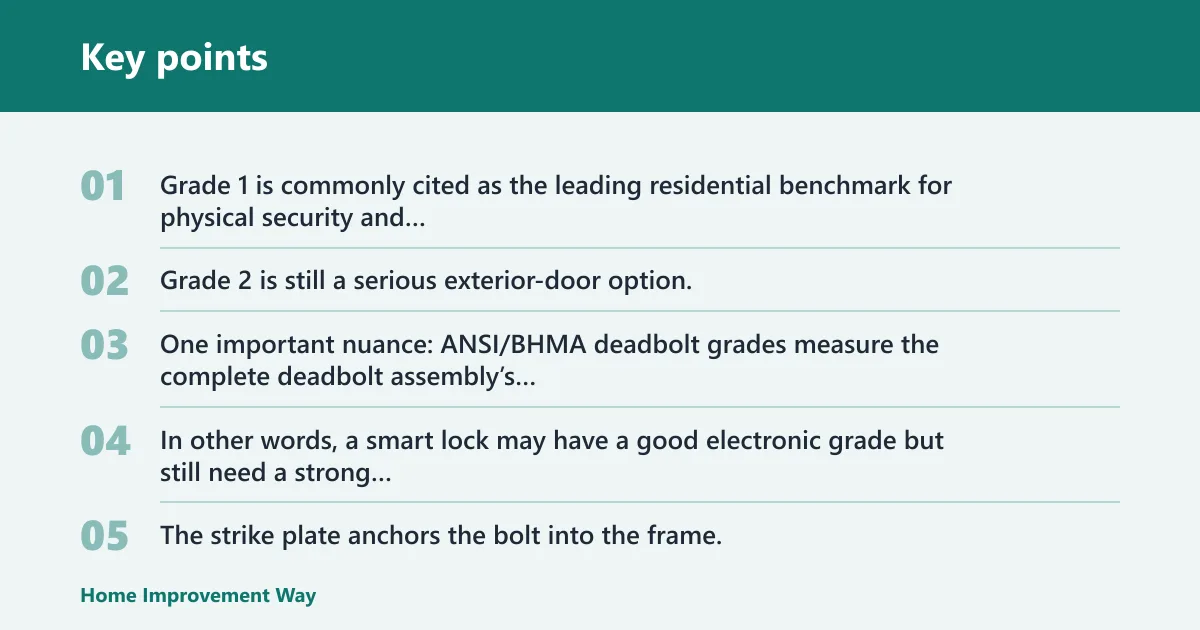
Grade 1 is commonly cited as the leading residential benchmark for physical security and durability. Grade 2 is still a serious exterior-door option, but it sits below Grade 1 in strength and cycle rating, so it is the lesser pick when the goal is maximum resistance.
One important nuance: ANSI/BHMA deadbolt grades measure the complete deadbolt assembly’s resistance and durability, while smart-lock function grades address lock/unlock performance, electronics endurance, and related tests. In other words, a smart lock may have a good electronic grade but still need a strong mechanical deadbolt rating to protect the door.
Why the strike plate and frame often decide the result
The strike plate anchors the bolt into the frame. A reinforced version with roughly 3-inch screws ties into structure better than short screws, which is why a better strike plate can improve kick-in resistance more than a fancier lock body.
A weak door frame is a frequent failure point in forced entry. If the frame is flimsy or poorly anchored, even a strong lock cannot do much. Security guidance from the DOJ COPS Office and NCPC repeatedly points to the jamb, strike, and hinge side as the parts that need reinforcement first.
When a reinforced frame matters more than the lock body
Say your front door already has a Grade 1 deadbolt but the strike plate uses short screws into a soft jamb. In that case, the lock is not the weak point; the frame is. Upgrading the strike plate and anchoring the frame can change the outcome faster than replacing the entire lock.
Which gives better access control?
Smart locks win on access control because they can issue guest codes, scheduled codes, and revocable entry without passing around keys. A backup key override helps with emergencies, but it also keeps a key cylinder in the system, with the same physical vulnerabilities that keyed locks always have.
Guest access codes for contractors, cleaners, and short-term rentals
Guest codes are the strongest smart-lock advantage for many homes. They reduce key duplication, let you set time limits, and give you a clean record of who can enter when, which is especially useful for rentals and service visits.
Suppose a cleaner arrives every Thursday at 10 a.m. and a contractor needs a one-time afternoon entry. A smart deadbolt can handle both without spare keys, and the code can be changed right after the job.
Backup key override and its trade-offs
Backup key override is useful when batteries die or a keypad stops responding. It lowers lockout risk, but it also means the system still depends on a key cylinder, so it does not remove the physical risks of a keyed entry point.
What smart locks do better than keyed deadbolts
Smart locks are better at changing access fast. If your household has rotating visitors, kids who lose keys, or a rental calendar that changes often, code control is more practical than replacing locks or collecting copies.
Which is more reliable long term?
Mechanical deadbolts are more reliable long term because they have fewer failure points. Smart deadbolts can work very well, but their batteries, firmware, apps, and account access can all become maintenance items.
Battery dependence and low-battery behavior
Battery failure is a real operational risk for smart locks. Even before total failure, low power can make the lock sluggish, disable features, or create behavior that feels unreliable in cold weather or heavy-use homes. Manufacturer specs often note reduced performance as batteries age and temperatures drop.
App, firmware, and account lockouts
Smart locks can fail at the account layer. A forgotten password, a phone issue, an app problem, or expired firmware support can block access to settings or remote functions even if the bolt itself still moves.
Why mechanical deadbolts are simpler to maintain
Mechanical deadbolts need less attention. If the fit is right and the hardware is decent, the main tasks are occasional lubrication and checking that screws, strike plate, and door alignment stay tight.
Real-home security checklist
| Door/frame condition | Lock grade | Power dependence | Guest access needs | Internet reliability | Maintenance tolerance | Recommendation |
|---|---|---|---|---|---|---|
| Solid frame, reinforced strike plate, good alignment | Grade 1 or strong Grade 2 | Comfortable with batteries | Frequent codes for guests or workers | Reliable or not needed for core use | Okay with battery and app upkeep | Smart Lock |
| Solid frame, good hardware, simple exterior door | Grade 1 preferred | No batteries desired | Rare guest turnover | Not important | Low tolerance for upkeep | Deadbolt |
| Weak frame, loose strike, poor anchoring | Any grade | Either | Any | Any | Any | Upgrade-first |
| Older door with no reinforced strike and uncertain screws | Grade 2 or lower | Either | Some guest access helpful | Spotty internet | Moderate upkeep okay | Upgrade-first |
If the door frame is weak, the right answer is not a smarter lock. It is a stronger frame connection, a reinforced strike plate, and then the right lock grade on top of that.
Choose Smart Lock if… / Choose Deadbolt if…
Choose smart lock if…
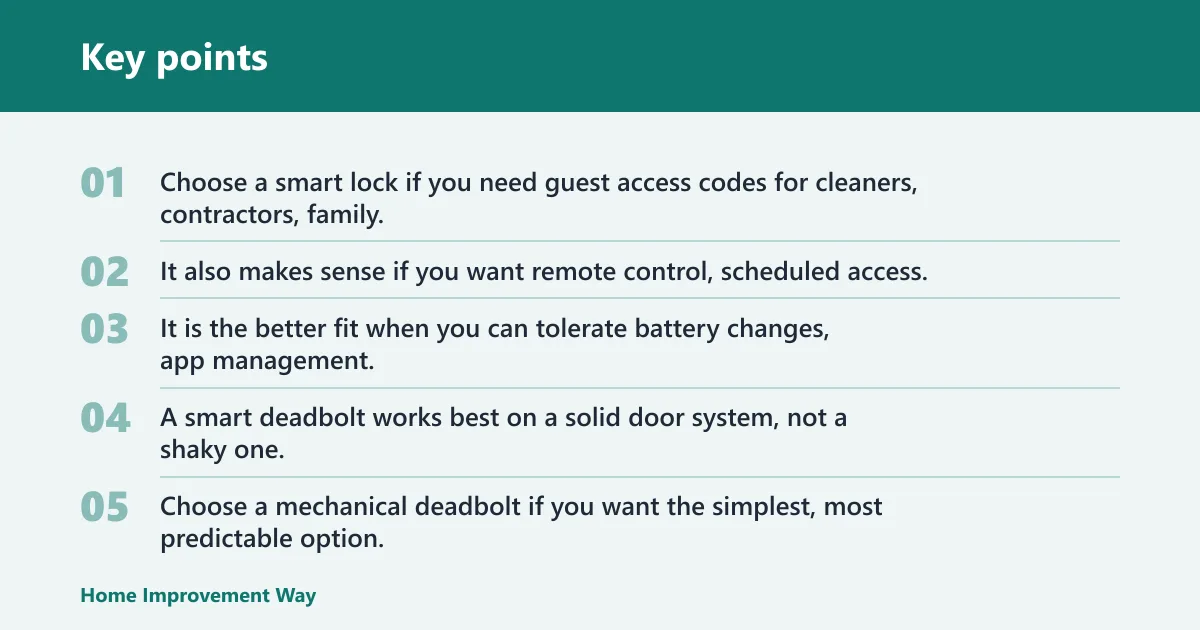
Choose a smart lock if you need guest access codes for cleaners, contractors, family, or rental turnover. It also makes sense if you want remote control, scheduled access, or a cleaner way to revoke entry without collecting keys.
It is the better fit when you can tolerate battery changes, app management, and occasional software-related maintenance. A smart deadbolt works best on a solid door system, not a shaky one.
Choose Deadbolt if…
Choose a mechanical deadbolt if you want the simplest, most predictable option. It is the better call for low-maintenance homes, weak internet, or anyone who does not want batteries, apps, or account recovery in the path to the front door.
It is also the safer default when physical security matters more than code management. A Grade 1 deadbolt with a reinforced strike plate and solid frame is a strong residential baseline.
Choose Upgrade-first if…
Choose upgrade-first if the frame is weak, the strike plate is light-duty, or the door does not close cleanly. A better lock cannot rescue a poor anchor point, and a reinforced strike plate with proper 3-inch screws often gives the biggest security gain per dollar.

Frequently asked questions
Is a smart lock more secure than a deadbolt?
Not by default. A smart lock can be just as secure as a mechanical deadbolt if the grade, strike plate, frame, and setup are strong, but it also adds battery, app, and account risks that a plain deadbolt does not have.
Do smart locks have the same physical strength as regular deadbolts?
They can. Most smart locks are built around a deadbolt mechanism, but the smart features have separate ratings and failure points. The real difference is whether the lock, installation, and door structure are all built to the same standard.
What ANSI grade should I buy for a front door lock?
Grade 1 is the top residential benchmark and the safest default for a front door. Grade 2 is still common and acceptable on many exterior doors, but it is a step down in durability. Grade 3 is the lightest option of the three.
What is the BHMA AAA rating and how is it different from a deadbolt grade?
BHMA AAA refers to a smart lock’s electronic-function and durability performance in categories such as lock/unlock operation and cycles, not to the deadbolt cylinder alone. ANSI/BHMA deadbolt grades, by contrast, rate the mechanical deadbolt assembly itself for security and durability. A smart lock can have strong AAA-style function ratings and still need a separately strong deadbolt grade.
Can smart locks be hacked through Wi‑Fi or Bluetooth?
That risk exists, but the more common consumer problems are weak passwords, poor setup, exposed accounts, or outdated firmware. The bigger practical threat in many homes is still forced entry through the door, strike plate, or frame rather than a remote attack.
Do deadbolts fail more often because of batteries or software?
No. Mechanical deadbolts do not use batteries or software, so those failure modes do not apply. Smart deadbolts can fail because of batteries, app problems, or support ending, which is why they need more upkeep than a simple keyed lock.
What matters more for door security: the lock, strike plate, or frame?
The whole chain matters, but the frame and strike plate often decide whether the lock can do its job. A strong deadbolt on a weak frame is still a weak door. Reinforced strike plates and solid anchoring are essential.
Sources
- ANSI/BHMA A156 series residential hardware standards and BHMA product listings for deadbolt grades, cycle performance, and electronic lock function classifications.
- U.S. Department of Justice, COPS Office: home security guidance emphasizing door frames, strike plates, hinges, and screw length as key resistance points.
- National Crime Prevention Council: door security guidance on reinforced strike plates, longer screws, and solid door/frame anchoring.
- Manufacturer installation and specification sheets for smart locks, including battery-life estimates and operating-temperature ranges.
Sponsored / affiliate links. As an Amazon Associate I earn from qualifying purchases. I may earn additional commission from eligible campaigns.