Best Gate Hardware for Chain Link Fences (2026): research shows
Choose gate hardware as a matched set: size the post for the gate width and weight, then buy strap hinges and a latch that match the post diameter, gate frame, and latch height within a small adjustment range. Poor matches lead to sag, drag, and latch misalignment. This guide shows how to pair posts, straps, and latches for common chain link gate setups.
Quick comparison
| Product | Badge | Best for | Price | ||
|---|---|---|---|---|---|
 |
Fencer Wire 6 FT Galvanized Chain Link Fence Terminal Post,Fencer Wire | Our pick | 6 ft · 2-3/8" OD · galvanized steel | $94.99
Price as of 12 Oct 2026
|
View |
 |
Wmebee 6" Sliding Gate Hardware Kit for Chain Link FenceWmebee | Upgrade pick | Sliding gate kit · galvanized steel · heavy-duty | $168.40
Price as of 12 Oct 2026
|
View |
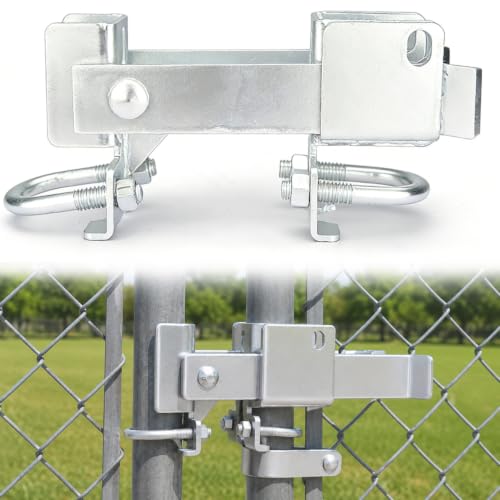 |
Chain Link Double Gate Latch for 1-3/8" Gate Frames –Emeyakoi | Budget pick | Double gate latch · 1-3/8" frames · galvanized steel | $22.99
Price as of 12 Oct 2026
|
View |
 |
Adjust-A-Gate Chain Link Round Gate Kit, Silver, 24-72 in,Fit-Right | Also great | Adjustable width kit · 24-72 in · 70 in tall | $128.99
Price as of 12 Oct 2026
|
View |
Use the comparison table to match gate width, swing load, and latch tolerance before you buy. For chain link, the best hardware is the one that fits at the post, hinge, and latch, not the heaviest label.
How we chose
The main filters were gate width, swing load, post diameter and wall thickness, latch alignment tolerance, and corrosion-resistant materials. Fastener size and band compatibility mattered too, because a good hinge or latch still fails if the bolts, washers, or bands do not match the tube and frame.
We also separated walk gates from driveway and double-swing gates. They are different jobs, and they should not use the same support plan.
Heavy-duty terminal-post kit: best for wider or busier gates
- Reinforced support for chain link fence ends
- Hot-dip galvanized for outdoor durability
- Compatible with standard chain link terminal hardware
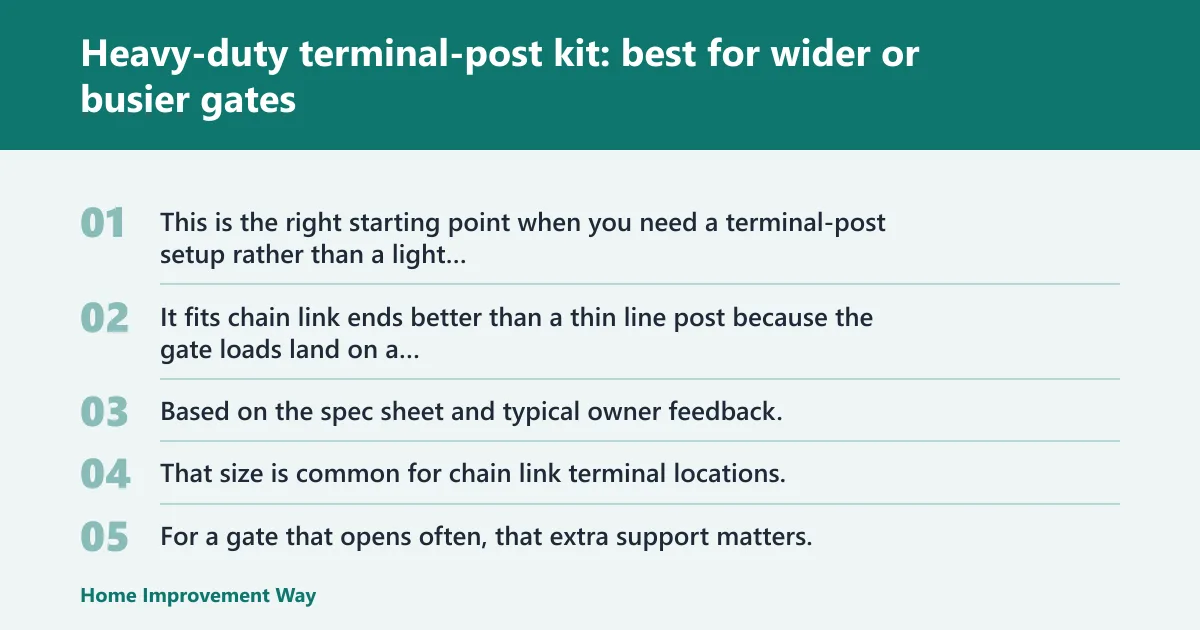
This is the right starting point when you need a terminal-post setup rather than a light line-post mount. It fits chain link ends better than a thin line post because the gate loads land on a stronger tube with more bearing area for hinge bands and latch bands.
Based on the spec sheet and typical owner feedback, the main strength is the 2-3/8 inch outside diameter galvanized steel post. That size is common for chain link terminal locations, and the 6-foot length gives room for embedment plus height above grade. For a gate that opens often, that extra support matters.
The drawback is simple: a terminal post is only one part of the system. You still need the right hinge band size, the correct fasteners, and a gate frame that matches the opening. A post alone will not fix a weak or poorly braced gate leaf.
Adjustable strap hinge set: best for easier alignment
- Telescoping frame for custom gate openings
- Includes lockable latch, hinges, and wire ties
- Powder-coated steel resists rust and corrosion
This fits a lot of walk-gate jobs because the telescoping frame and included hinges give you adjustment room. That matters when a gate opening is not perfectly square or the latch height needs a little correction after the post is set.
It is a strong option when you want a chain link round-gate kit that includes more than just the hinges, because you are pairing frame, latch, and hinge hardware as one system. The powder-coated steel is a practical corrosion barrier, and the 24 to 72 inch width range covers many common pedestrian openings.
The drawback is that an adjustable kit is still not a cure for a soft post. If the terminal post is undersized, the gate can still sag or shift, and then the latch will drift out of alignment.
Gravity latch kit: best for simple walk gates
- Fits double gates with 1-3/8" round frames
- Padlock hole for added security
- Easy installation with U-bolt attachment
This latch style is a good fit for a simple swing gate where you want a straightforward close-and-drop action. Gravity latches work best when the gate hangs square, the latch arm can fall freely, and the post spacing stays consistent from top to bottom.
The padlock hole is a useful feature for a pedestrian gate that needs occasional locking, and the U-bolt attachment makes the hardware easier to mount on round 1-3/8 inch frames. That said, the real limit is alignment tolerance. If the gate sags, a gravity latch can start missing the keeper or dragging on the strike side.
For windy sites, a gravity latch is not always the best answer. Wind blow-open is a real failure mode on chain link, especially if the latch arm is light or the keeper is set too loose.
Double-swing gate hardware: best for driveway openings
- Complete kit with double wheel carriage included
- Single-molded rollers for smoother operation
- Designed for rolling/sliding gates with track compatibility
This kit is for sliding gates, so it belongs in the driveway category only if your opening actually uses a track and rolling leaf, not a swing gate. That distinction matters. Sliding hardware and double-swing hardware solve different problems and use different support points.
The double wheel carriage and track-compatible rollers are useful where a rolling gate is the right design, especially for wider openings that would be hard to manage with a single swing leaf. The heavy-duty galvanized steel construction is also a sensible choice outdoors.
The drawback is compatibility. If your project is a standard chain link swing gate, this is the wrong system. A rolling gate needs track, grade control, and space for the slide path, so do not buy it as a substitute for strap hinges and a latch post.
What gate hardware do I need for a chain link fence?
You need a matched set of gate post hardware, hinges or straps, and a latch that all fit the same gate width and frame size. For many chain link walk gates, that usually means a terminal post, two hinges or strap bands, a latch set, and galvanized fasteners sized to the tube and bands. The post has to carry the load first.
For a standard single-swing gate, start with the opening width, then match the gate frame tube diameter, post diameter, and latch height. A common mistake is buying a latch that fits the frame but not the post band, or a hinge that bolts on but cannot handle the gate weight.
What a complete chain link gate hardware system includes
- Gate post: terminal post for the gate side, not a light line post in most cases.
- Gate hinges or straps: clamp-on, bolt-on, or band-style hardware sized to the round post.
- Gate latch: gravity, thumb, or fork latch matched to the closing direction.
- Fasteners: carriage bolts, nuts, washers, and sometimes self-tapping screws.
- Support parts: brace band, truss rod, turnbuckle, anti-sag support, or drop rod as needed.
What size gate post should I use for a chain link fence gate?
Use a terminal post, not a line post, for most chain link gates. The post should match the gate width and expected load, usually with a round steel tube size that accepts standard hinge and latch bands, enough wall thickness to resist bending, and embed depth deep enough to keep the gate plumb under repeated swing force.
For many residential gates, the post is set in concrete below frost-sensitive soil when local practice calls for it, with enough height above grade to carry the hinge placement and latch height. A gate post that is too short above grade can force awkward latch geometry, while a shallow set can let the post lean over time.
Post selection points that matter
- Line post vs terminal post: terminal posts carry gate loads; line posts usually do not.
- Round steel tube size: must accept the chosen hinge band and latch band.
- Wall thickness: thicker wall resists bending at the bolt holes.
- Set depth: deeper embedment improves stability, especially on wider gates.
- Concrete anchoring: useful for keeping a post plumb under swing load.
- Height above grade: must allow hinge spacing, latch height, and ground clearance.
Do chain link fence gates use hinges or straps?
They can use either, but the practical choice is usually a strap-style hinge set or a band-style hinge made for round posts. The key is fit: the hinge must clamp or bolt to the post without slipping, and it must carry the weight of the frame without twisting the tube. That is why load rating matters.
Clamp-on hardware is easier to adjust, while bolt-on or band-style fittings are often stiffer once tightened. Round-post fit matters more than style. A strap that looks strong on paper can still bind if the band size is wrong or the carriage bolts do not pull the band evenly.
Hinge and strap fit points
- Strap type: long straps spread load better than short light-duty pieces.
- Clamp-on vs bolt-on: clamp-on helps with adjustability; bolt-on can be stiffer.
- Load rating: should suit the gate width and how often it swings.
- Round-post fit: the band must match the post diameter closely.
- Fork latch compatibility: some latch styles need a specific hinge and strike setup.
What latch works best on a chain link gate?
The best latch depends on alignment tolerance and security needs. Gravity latches are simple for walk gates, thumb latches are easier to operate from both sides when mounted correctly, and fork latches can work well when the post and frame stay square. For windy sites, a latch with better closing control helps prevent blow-open.
If the gate can drift a little, choose a latch with more forgiving adjustment. If the gate must lock, check for padlock provision. If you want the gate to close on its own, confirm self-closing compatibility before you buy, because not every latch works with a spring hinge or closing assist.
Latch selection points
- Gravity latch: good for simple walk gates with decent alignment.
- Thumb latch: useful when you want a hand-operated release and a cleaner strike.
- Fork latch: can suit chain link gate hardware that needs a positive catch.
- Self-closing compatibility: needed if the gate uses a closer or spring hinge.
- Padlock provision: important when security is part of the job.
- Alignment tolerance: low tolerance means the gate must be hung very accurately.
How do I stop a chain link gate from sagging?
Start with the post, then add support hardware that matches the gate size. Sag usually comes from an underbuilt terminal post, weak hinges, poor brace placement, or a frame that is too light for the opening width. If the gate is wider or used many times per day, anti-sag support becomes more important.
Truss rods, turnbuckles, top rail braces, and drop rods on double gates are all part of the fix, depending on the layout. A common first-timer mistake is hanging a wide gate on a marginal post and then blaming the latch when the real problem is frame deflection.
Anti-sag and support hardware
- Truss rod: helps pull a sagging frame back into square.
- Turnbuckle: allows tension adjustment in the support system.
- Top rail brace: adds stiffness near the top of the gate frame.
- Anti-sag support: useful for heavier or wider single-swing gates.
- Drop rod: essential on many double-swing driveway gates.
Say your 4-foot walk gate drags after rain and the latch no longer lines up. The first place to check is the terminal post plumb, then the hinge band tightness, then whether the frame needs an anti-sag brace or a better latch strike location.
Can I put gate hardware on a round chain link post?
Yes, if the hardware is made for the post diameter and wall thickness. Round chain link posts are common, and many hinge bands, latch bands, and brace bands are made for them. The important part is not the shape alone, but whether the band clamps tightly without crushing the tube or slipping under load.
Clamp-on, bolt-on, and band-style fittings are not interchangeable in practice. A clamp that works on a 2-3/8 inch terminal post may not fit a smaller tube, and a latch band sized for one frame diameter may leave too much play on another. Check the actual dimensions before buying.
Round-post fit checks
- Post diameter: match the band opening to the tube size.
- Band size: hinge band, latch post band, and brace band may differ.
- Carriage bolt sizing: must match the band holes and clamp load.
- Finish: galvanized or stainless finish helps with weather resistance.
What tools do I need to install chain link gate hardware?
The basic tool list is short: a wrench set, level, tape measure, post hole digger, drill, and socket set. Those cover layout, hole depth, alignment, and fastener tightening. For chain link gate hardware, a square setup matters more than speed, because small errors show up at the latch first.
Use the level to set the post plumb, the tape measure to confirm opening width and hinge spacing, and the socket set or wrench set to snug carriage bolts without over-torquing the bands. A drill helps when the hardware uses pilot holes or self-tapping screws.
Installation checklist
- Measure the opening width and confirm the gate swing direction.
- Set the terminal post at the right depth and keep it plumb.
- Attach hinge bands or straps at the planned heights.
- Hang the gate frame and check ground clearance.
- Mount the latch and confirm alignment at close position.
- Install support hardware if the gate shows sag or twist.
How do I choose hardware for a walk gate versus a driveway gate?
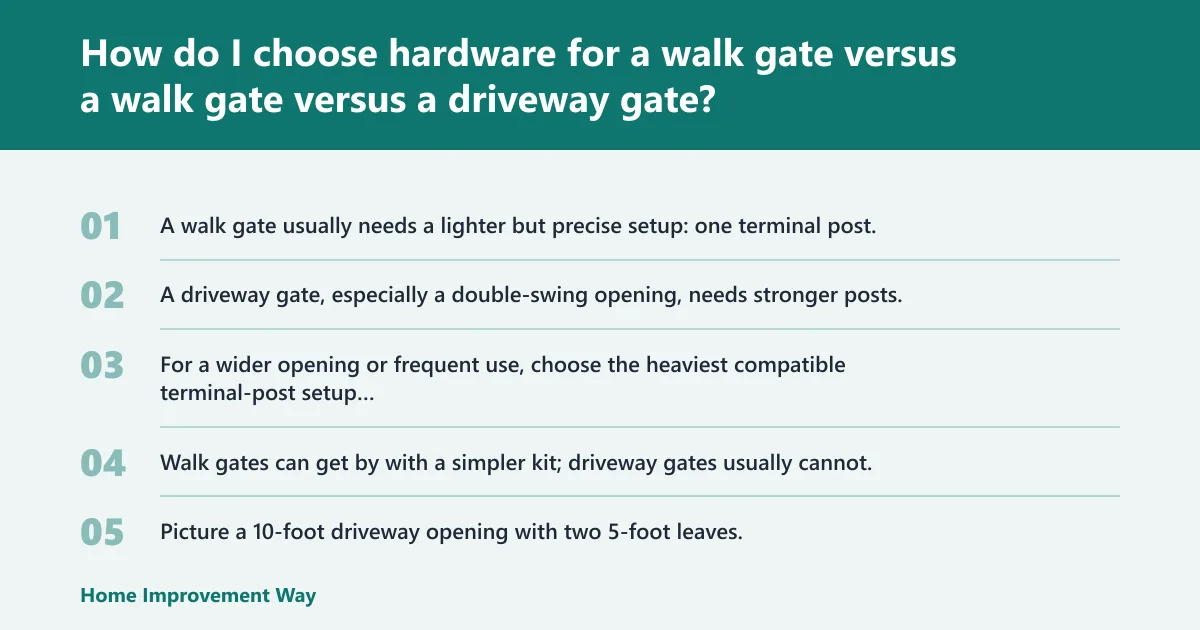
A walk gate usually needs a lighter but precise setup: one terminal post, two hinges or straps, and a latch with enough adjustment to tolerate minor settling. A driveway gate, especially a double-swing opening, needs stronger posts, more brace hardware, and often a drop rod or center support so the two leaves meet cleanly.
For a wider opening or frequent use, choose the heaviest compatible terminal-post setup that fits the gate width and latch plan. That reduces sag, drag, and latch failure. Walk gates can get by with a simpler kit; driveway gates usually cannot.
Picture a 10-foot driveway opening with two 5-foot leaves. If the center meet point shifts even a little, the latch may miss the keeper or the leaves may rub. In that case, the post spacing, brace placement, and latch post band matter as much as the hinge style.
Walk gate versus driveway gate
| Gate type | Post | Hinge / strap | Latch | Support hardware | Fastener priority |
|---|---|---|---|---|---|
| Walk gate | Terminal post, often 2-3/8 inch OD round steel | Adjustable strap or band hinge | Gravity, thumb, or fork latch | Anti-sag support if wide or used often | Carriage bolts, washers, galvanized finish |
| Driveway gate | Heavier terminal post with deeper embed | Heavier band-style hinges or swing hardware | Latch post band, keeper, often padlock-ready | Truss rod, turnbuckle, top rail brace, drop rod | Stiffer bolts and fully matched bands |
| Double-swing gate | Two end posts plus center support plan | Matched hinge sets on both leaves | Center latch or locking post setup | Drop rod on inactive leaf, brace at both frames | Galvanized or stainless hardware throughout |
Compatibility checklist: posts, straps, latches, and fasteners
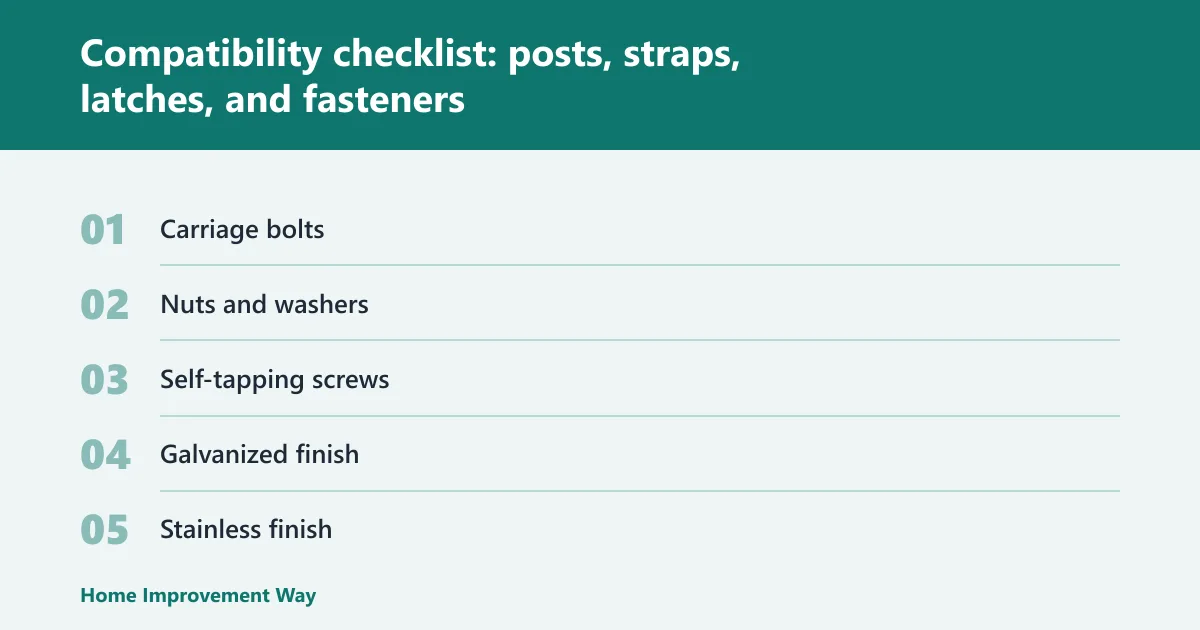
This checklist is the buying decision in one place. Match the gate width first, then confirm post diameter, hinge style, latch type, and fasteners. If one part is off, the whole gate can swing crooked or fail to latch cleanly.
| Gate width | Post choice | Hinge / strap style | Latch type | Required fasteners | Notes |
|---|---|---|---|---|---|
| Up to about 4 ft walk gate | Terminal post, commonly 2-3/8 inch OD | Adjustable strap or clamp-on hinge | Gravity or thumb latch | Carriage bolts, nuts, washers | Good fit when alignment is fairly square |
| About 4 to 6 ft walk gate | Heavier terminal post, deeper set | Band-style or bolt-on strap hinge | Fork latch or more adjustable latch | Longer carriage bolts, washers, possibly self-tapping screws | Anti-sag support becomes more important |
| Wide single gate or frequent-use opening | Heavier terminal post with concrete anchoring | Heavier load-rated hinge set | Latch with padlock provision and higher tolerance | Galvanized or stainless fasteners, larger bands | Check frame tube diameter and brace placement carefully |
| Double-swing driveway gate | Two terminal posts plus center support plan | Matched hinge sets on both leaves | Latch post band, keeper, drop rod, padlock-ready if needed | Full band set with matched carriage bolt sizing | Brace both leaves and confirm closing alignment before tightening |
Fastener and finish checks
- Carriage bolts: common for hinge bands and latch bands.
- Nuts and washers: spread load and reduce loosening.
- Self-tapping screws: used on some frame or accessory parts.
- Galvanized finish: common for outdoor durability.
- Stainless finish: useful where corrosion exposure is higher.
Which one should you buy?
For a standard walk gate, buy the adjustable strap hinge set and pair it with a gravity or thumb latch that matches your post diameter. That gives you the most alignment room for a typical pedestrian opening.
For a wider or heavier gate, start with the heavy-duty terminal-post setup and add a load-rated hinge system plus anti-sag support. For a driveway or double gate, choose hardware built around the actual opening style, including drop rods, latch post bands, and center support planning.
If latch alignment is tight, favor the most adjustable hinge set and a latch with a wider strike tolerance. If the gate sees wind, choose a latch less likely to blow open and make sure the post is set deep enough to stay plumb.
Do not buy the sliding gate kit for a swing gate. It solves a different problem.
Sponsored / affiliate links. As an Amazon Associate I earn from qualifying purchases. I may earn additional commission from eligible campaigns.