Trex Decking Samples: Visualize Your Dream Patio Fast
Trex decking samples let you compare color, texture, heat feel, and house match before buying. Narrow choices to a small handful of samples and check them outdoors at different times of day. Skip that step, and you can end up with a deck that looks washed out, runs hot, or clashes with siding you already own. This guide shows how I test Trex samples like a buying checklist and pick the right board with less guesswork.
How Trex decking samples help you choose


Photos can help, but they flatten color. A screen cannot tell you how a gray shifts under full sun, how a brown warms beside brick, or how a textured board reads next to smooth siding. Trex decking samples are more than swatches; I use them as a decision tool for color, sheen, and fit.
Trex composite decking also changes the buying talk because it does not need seasonal painting, sealing, or staining. Trex says its composite decking won’t rot, splinter, or crack, and won’t fade or stain. That makes the sample step about choosing the right look and feel, then matching that choice to your home and budget.
What a sample can tell you about tone, sheen, and grain
A sample can show undertones that photos hide. A board that looks neutral online may read green in shade, purple at dusk, or red beside warm brick. Sheen matters too. A more reflective surface can make the board feel hotter and can also make small color shifts more obvious.
Texture is part of the decision. A deeper grain may look more natural, while a smoother surface can read cleaner and more modern. Hold samples beside the wall, trim, roof edge, and railing, then step back. The board should support the house, not compete with it.
When samples should come before design software
Order samples before you commit to a layout or board count. Software helps with planning, but it cannot fix a poor color choice. Trex recommends seeing samples in person to compare colors, and that is the right place to start when the house exterior, sun exposure, and railing finish all matter.
Use the tools in order. First, narrow the field with samples. Then confirm the layout in the Trex Deck Designer Tool on a laptop or desktop. After that, run the numbers through the Trex Cost Calculator so the final plan matches both the look and the budget.
📊 Trex says SunComfortable™ Technology reduces heat buildup by up to 35°F versus original boards. Source: TREX.
How do you order Trex decking samples?
Start in the Trex Color Selector, narrow the shades, then order the samples you want to compare. Trex says the Color Selector compares shades and shows them in real spaces, and it also lets you shop samples in one place. Trex decking samples ship free to your door, and the order limit is up to 4 free samples per order.
Use the Trex Color Selector to narrow the field
The Color Selector is the first filter. It helps compare shades in real spaces, which is more useful than staring at isolated chips. Begin with your siding, trim, roof, and any fixed stone or masonry. Then choose the closest matches and one or two contrast options.
Order single shades or a curated sample kit
Trex sample shopping is set up for either targeted testing or broader comparison. Single shades work when you already have a clear favorite. A curated sample kit makes sense when the house style is still open, or when two similar colors both seem possible.
Watch the free shipping and up to 4 free samples per order limit
Trex says sample shopping ships free to your door. The sample limit is up to 4 free samples per order, so use that cap carefully. Do not waste a slot on a “safe” option that only repeats a color family you already know you dislike. Use the four spots to compare useful near-matches.

Which Trex color should you sample first?
Start with colors that sit closest to your siding and trim, then add one lighter, one mid-tone, and one darker choice. If the house style is still open, include a warm gray and a cool gray. That mix gives you real comparison points instead of forcing one board to do all the work.
Sample near-matches, not one favorite
One sample is rarely enough. Similar boards can behave very differently outside. A gray that looks balanced indoors may look blue in direct light. A brown that seems restrained on a screen may turn orange next to tan siding. Sampling near-matches shows which direction the color really moves.
Use your exterior materials as the reference set
Look at siding, trim, roof color, brick, stone, and entry door finish. Those fixed elements define what the deck has to coordinate with. If the home already has strong warmth, a cooler deck may settle the composition. If the exterior is cool and crisp, a warm board can soften it.
| Sample choice | Why include it | What it can reveal outdoors |
|---|---|---|
| Lightest option | Tests brightness and glare | Shows whether the deck looks washed out in full sun |
| Mid-tone option | Acts as the balance point | Often reveals the most realistic curb appeal |
| Darkest option | Tests contrast and drama | Shows whether the deck feels grounded or heavy |
| Warm gray | Tests brown-to-gray transition | Helps if siding has beige, taupe, or wood tones |
| Cool gray | Tests modern, cleaner pairing | Useful with white trim and cooler roof colors |
How do you test samples outdoors before you buy?
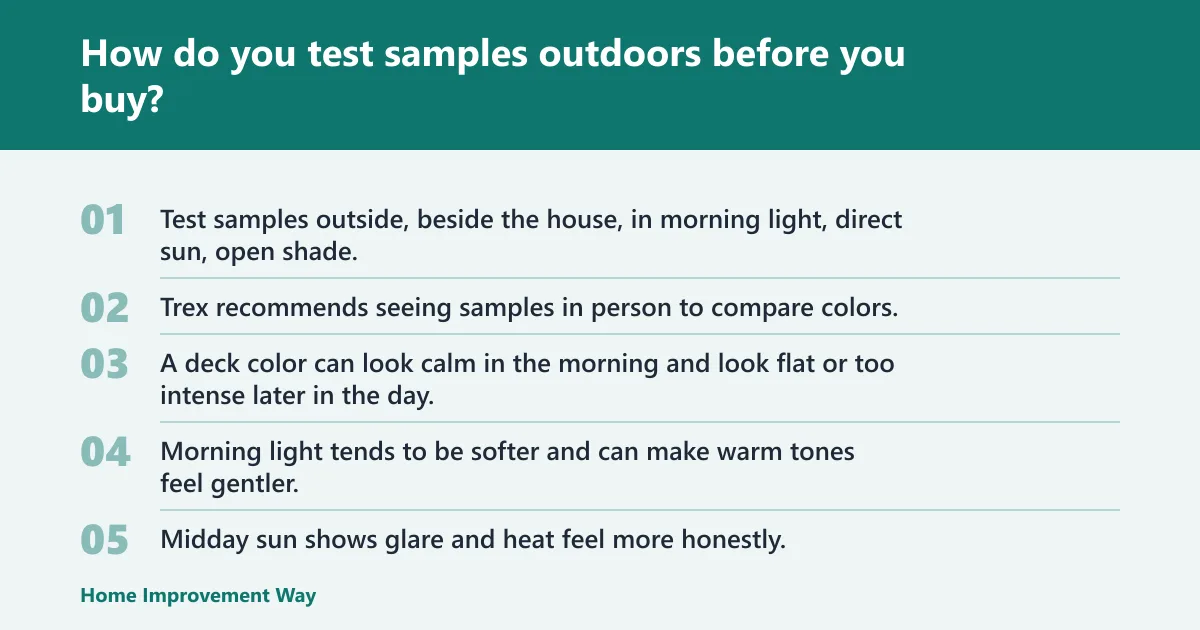
Test samples outside, beside the house, in morning light, direct sun, open shade, and at dusk. Trex recommends seeing samples in person to compare colors, and that means taking them where they will actually live. A deck color can look calm in the morning and look flat or too intense later in the day.
Check morning light, direct sun, open shade, and dusk
Morning light tends to be softer and can make warm tones feel gentler. Midday sun shows glare and heat feel more honestly. Open shade is where undertones often appear most clearly. At dusk, darker boards may read richer while lighter boards can lose definition.
Set samples beside the house, not on a table indoors
Indoor lighting distorts outdoor materials. Set the sample flat on the ground near the wall, or prop it against the railing area if that is the view you will see most often. Step back far enough to judge the whole elevation. A deck must belong to the house, not float away from it.
Look for surface glare and heat feel
Texture and sheen affect how hot a board feels and how bright it appears. Trex SunComfortable™ Technology is positioned to reduce heat buildup by up to 35°F compared to original boards. That claim matters most on exposed decks, stairs, and sitting zones that get afternoon sun.
Use the sample surface to judge comfort in real conditions. If one color looks ideal but feels too warm in the sun, it may not be the right pick for a south-facing patio. If a lighter board creates too much glare, a slightly deeper shade may be the better long-term choice.
How do Trex samples compare with siding, railing, and trim?
Compare samples directly against siding, railing, trim, roof edges, and stone so you can see whether the deck frames the house or fights it. Trex encourages visitors to see decking and railing matches before designing, and the Trex railing visualizer helps test pairing ideas before you commit to a full order.
Use the Trex railing visualizer for pairing ideas
The railing visualizer is useful when the deck color and railing finish need to work as one system. If the board is busy or dark, a simpler railing may calm the view. If the deck is quiet and neutral, a stronger railing can add definition without making the project feel crowded.
Judge warm and cool undertones against your exterior
Warm undertones usually pair better with beige siding, brick, and traditional trim. Cool undertones often sit well with gray siding, white trim, black windows, and more modern architecture. The goal is consistency. A mismatch is easy to spot when the deck color pulls in the opposite direction from the house.
Check whether the deck color frames or fights the facade
Walk to the curb and look back. A good choice frames the house and supports the main entry. A poor choice pulls attention away from the architecture. Trex color tools are useful, but the final decision should reflect the whole exterior, not just the back door area.
Use the sample scorecard to choose with confidence
A scorecard turns sample shopping into a repeatable method. Rate each sample on curb appeal, sun exposure, coordination with siding and railing, perceived heat, and maintenance confidence. Add the points, rank the top two colors, and keep one backup in case the first choice looks different once the full site is opened up.
Sample evaluation worksheet
| Color | Curb appeal | Sun exposure | Coordination with siding/railing | Perceived heat | Maintenance confidence | Total | Shortlist recommendation |
|---|---|---|---|---|---|---|---|
| Warm gray | 4 | 4 | 5 | 3 | 5 | 21 | Top pick |
| Cool gray | 5 | 4 | 4 | 4 | 5 | 22 | Top pick |
| Light brown | 3 | 3 | 4 | 3 | 5 | 18 | Backup |
| Deep brown | 4 | 2 | 3 | 2 | 5 | 16 | Backup if shade is ample |
Rank the top two colors and keep a backup
Do not stop at one winner. A second choice helps when budget, availability, or railing coordination changes. If two colors tie, use the one that looks best in the worst lighting condition you expect, usually direct afternoon sun or late-day shade.
Use the shortlist to guide the next design step
Once the shortlist is clear, the design stage becomes easier. The deck layout, railing finish, and trim details can be built around the chosen board instead of forcing the board to adapt to a late decision. That is where the planning tools save time.
What else should you check before ordering boards?
Before ordering full boards, estimate material cost with the Trex Cost Calculator and then confirm the layout in the Trex Deck Designer Tool on a laptop or desktop. Trex says the cost calculator estimates material costs in quick steps, and the designer tool is best experienced on a laptop or desktop for planning confidence.
Estimate material cost with the Trex Cost Calculator
The cost calculator is where sample choice meets project scope. A color that looks perfect may not fit the budget once the actual deck size and railing package are added. Use the calculator early so you do not build a plan around a finish that forces the rest of the project to shrink.
Build the layout in the Trex Deck Designer Tool
The Deck Designer Tool helps turn a color decision into a real layout. Trex recommends using it on a laptop or desktop, which is the better setup for comparing dimensions, views, and finish options. It is easier to judge railing, stairs, and board direction on a larger screen.
Compare your favorite sample to the final project scope
Make sure the deck color still works once the full project is mapped out. A small sample can feel understated on a single board but stronger across a large surface. The final choice should fit the footprint, the sightlines, and the practical budget, all at the same time.
Frequently asked questions
How do I order Trex decking samples?
Start with the Trex Color Selector, narrow the shades, and then order either single shades or a curated sample kit. Trex says sample shopping ships free to your door, and the order limit is up to 4 free samples per order, so choose the best comparisons first.
How many Trex samples can I order at once?
Trex allows up to 4 free samples per order. That limit is useful if you compare one light, one mid-tone, one dark option, and one wild-card choice such as a warmer or cooler gray. Use all four spots; do not waste one on a near-duplicate.
Are Trex decking samples free shipping?
Yes. Trex says sample shopping ships free to your door. That makes it easier to order the samples you need for a real outdoor comparison instead of guessing from photos. The key is to use that free shipping to gather enough near-matches to make a confident choice.
Which Trex color looks best in my backyard?
The best-looking color is the one that works with your siding, trim, roof, and railing in the light your yard gets most often. Test samples in morning light, direct sun, open shade, and dusk. The winner should still look right when the sun shifts and the shadows move.
Can I compare Trex decking samples with railing colors?
Yes. Trex encourages visitors to see decking and railing matches before designing, and the Trex railing visualizer can help with pairing ideas. Put the sample next to your railing options or visualize the combination first, then confirm the look outdoors beside the house.
Can I use Trex samples to estimate my deck budget?
Samples do not price the whole project, but they do help narrow the finish before you run numbers. After choosing a color, use the Trex Cost Calculator to estimate material costs in quick steps. That keeps the budget tied to the actual board choice instead of a guess.
Sponsored / affiliate links. As an Amazon Associate I earn from qualifying purchases. I may earn additional commission from eligible campaigns.