Best Vinyl Flooring Underlayment for Humid Climates: We Compared
The best underlayment for vinyl flooring in humid climates is usually the thinnest underlayment the flooring maker allows; skip underlayment if the product says no pad. A thick or wrong pad can trap moisture, telegraph subfloor movement, and void the floor warranty. This guide covers moisture barriers, thickness limits, and when to use no underlayment at all.
Quick comparison
| Product | Badge | Best for | Price | ||
|---|---|---|---|---|---|
 |
VEVOR Floor Underlayment 400 sq. ftVEVOR | Our pick | 400 sq ft · vapor barrier · 3 mm roll | $107.90
Price as of 2 Nov 2026
|
View |
 |
QuietWalk LV 100 Sq Ft Underlayment for Luxury VinylQuiet Walk | Also great | 100 sq ft · moisture barrier · LVP/LVT compatible | $51.75
Price as of 2 Nov 2026
|
View |
 |
ROBERTS Black Jack UnderlaymentROBERTS | Budget pick | 100 sq ft · 2.5 mm · closed-cell | $34.49
Price as of 2 Nov 2026
|
View |
In most humid rooms, the safest choice is a thin foam underlayment with a built-in vapor barrier. If your vinyl has an attached pad, or if you are installing glue-down vinyl, the better answer may be no underlayment at all.
How we chose
Moisture control comes first here, not comfort. That means the best pick has low compression under click joints, clear vinyl compatibility, and a barrier strategy that matches the subfloor.
We also weighed sound control, but only after checking thickness limits and installation type. Sound ratings matter less than whether the pad fits the floor system.
Finally, the options below stay within the product types most likely to fit humid rooms: thin foam, cork only with a barrier, and rubber where sound isolation matters and compatibility is clear.
VEVOR floor underlayment: best for large humid-room projects
This is a fit when you need broad coverage and want an attached vapor layer under floating vinyl, wood, or laminate in a humid room. Based on the published specs, the 3 mm profile and seam tape are useful for large areas where moisture control and simpler layout matter.
The drawback is thickness. At 3 mm, it may be too thick for some vinyl systems, and that leaves less room for error with rigid core click joints. If your flooring instructions call for 2 mm or less, choose something thinner.
QuietWalk LV: best for vinyl over damp subfloors
This is aimed at luxury vinyl and similar floating floors where moisture resistance matters more than plush feel. The built-in barrier makes it a practical choice for floating installs where the flooring system allows an underlayment, and the product is marketed for LVP and LVT compatibility.
The drawback is the fixed 100 sq. ft. coverage. That makes it less convenient for larger rooms, and the product still needs a flooring system that allows underlayment. If the planks already have an attached pad, do not add this below them.
ROBERTS Black Jack: best for thin closed-cell support
This fits homeowners who want a thin, closed-cell pad that adds some cushioning without pushing rigid core vinyl too far off its locking profile. The 2.5 mm thickness is still in the thin range, and the overlap plus adhesive strip can help keep seams orderly.
The drawback is that 2.5 mm is not the same as 2 mm, so it is closer to the upper edge for some vinyl products. If your manufacturer gives a hard limit, that limit wins. On a slab, you still need the right vapor strategy beneath or alongside it.
Vinyl flooring decision matrix
| Scenario | Safest underlayment type | Barrier requirement | Max thickness | Red-flag failure mode |
|---|---|---|---|---|
| Concrete slab | Thin closed-cell foam | Built-in barrier or separate 6 mil polyethylene | 2 mm, with 3 mm only if the flooring maker allows it | Trapped slab vapor leading to mold, cupping, or joint damage |
| Plywood subfloor | Thin foam or thin felt only if dry and flat | Usually no separate vapor sheet unless the room exposure calls for it | 2 mm is the safer target | Too-soft pad that lets locking joints flex and squeak |
| Bathroom | Thin foam with barrier, or no underlayment if the vinyl system forbids it | Barrier required wherever the system allows floating install | 1 to 2 mm preferred | Water held under the floor after splashes or leaks |
| Coastal or crawl-space room | Thin closed-cell foam with barrier | Barrier required, plus subfloor moisture control | 2 mm preferred | Ambient humidity and subfloor vapor combine to feed hidden moisture |
Thin foam underlayment: best for most humid rooms
Thin foam is the default choice for many floating vinyl floors in humid climates because it adds a moisture layer without much compression. A sensible default under rigid core vinyl is 2 mm underlayment. That thickness is usually enough to smooth tiny irregularities without making the click joints work too hard.
Why 2 mm is the safe target
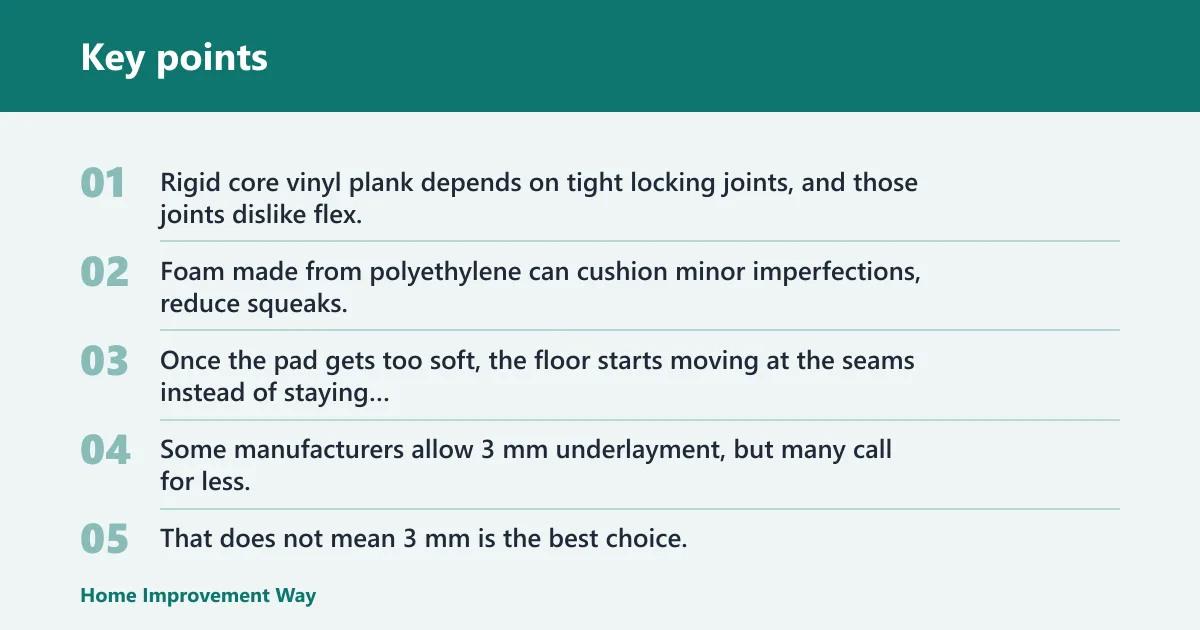
Rigid core vinyl plank depends on tight locking joints, and those joints dislike flex. Foam made from polyethylene can cushion minor imperfections, reduce squeaks, and still stay firm enough for click systems when it is thin. Once the pad gets too soft, the floor starts moving at the seams instead of staying locked.
Some manufacturers allow 3 mm underlayment, but many call for less. That does not mean 3 mm is the best choice; it means you should only use it when the vinyl maker specifically allows it.
Built-in vapor barrier options
Many foam products are sold with a built-in vapor barrier, which is useful over concrete and in humid rooms. On a slab, the barrier matters because vapor can move continuously through the concrete even when the room air feels only moderately damp.
That said, a built-in barrier is not a cure-all. If the slab is too wet, has a history of moisture problems, or fails the flooring system’s moisture limits, the floor still needs testing and possibly a different installation method.
Where it fits best
Thin foam is a good fit for floating vinyl over plywood or concrete when the maker allows underlayment. It is also the easiest answer for homeowners who want a simple, thin layer that keeps the floor profile low.
Say your 12-by-14-foot basement family room has a concrete slab and a rigid core plank with no attached pad. A 2 mm foam with a barrier is a cleaner match than a thick acoustic pad, because the floor needs moisture protection first and only modest sound control second.
Cork underlayment: best for sound control with a barrier
Cork can be a good underlayment when you need more sound reduction than thin foam can offer, but it must be paired correctly in humid rooms. Common thicknesses run from about 3 mm to 6 mm, and the thicker end is often too much for many vinyl click systems unless the manufacturer explicitly permits it.
Common thickness range
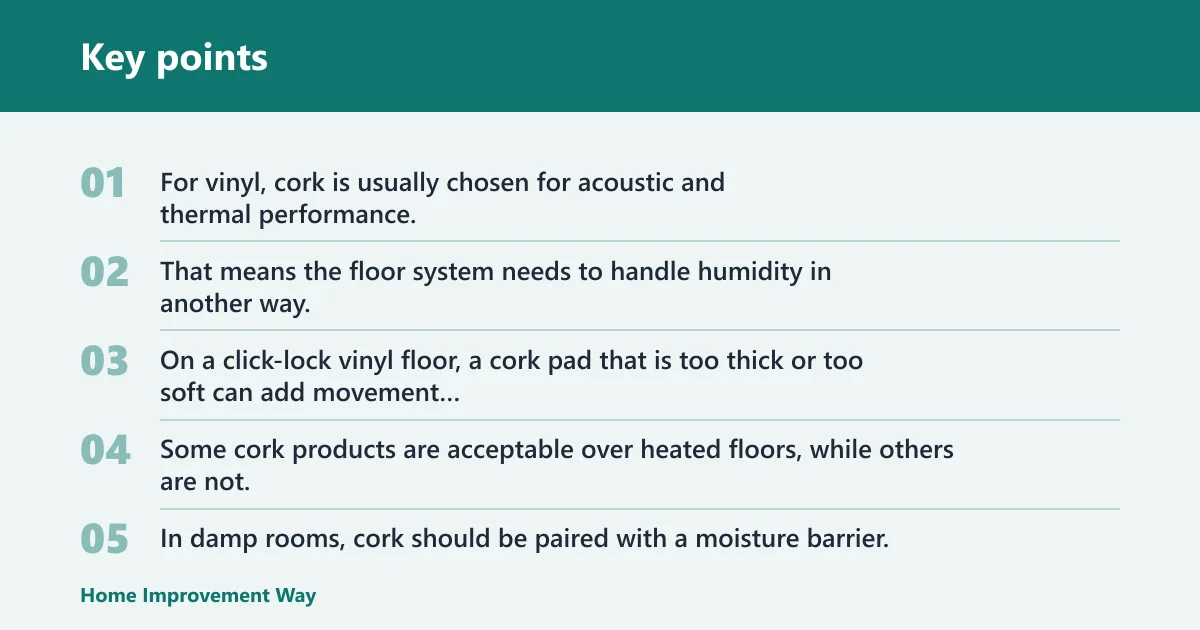
For vinyl, cork is usually chosen for acoustic and thermal performance, not for moisture control. That means the floor system needs to handle humidity in another way. On a click-lock vinyl floor, a cork pad that is too thick or too soft can add movement at the joints.
Radiant heat compatibility also varies. Some cork products are acceptable over heated floors, while others are not, so you need to confirm the flooring and underlayment both allow that assembly.
Moisture-barrier pairing
In damp rooms, cork should be paired with a moisture barrier, and that barrier must be acceptable to both the subfloor and the vinyl product. On concrete, the barrier may be a 6 mil polyethylene layer or a built-in barrier within a compatible underlayment.
Do not use cork as a moisture answer by itself. Cork can absorb and hold moisture if the room or subfloor stays damp, which raises the risk of hidden mold and floor movement under a floating system.
Radiant heat limits
If the room has radiant heat, check the full flooring stack, not only the cork label. Heat can change how much cushion the floor feels, and some underlayments limit heat transfer enough to matter. The safest path is the product pair that both the vinyl and underlayment makers approve.
Rubber underlayment: best for noise and durability
Rubber is the strongest sound-isolation option of the three products here, and it is usually the most expensive. It also resists wear well, which can matter in busy rooms or multi-story homes where sound control is important.
Sound isolation tradeoffs
Rubber often performs well for sound isolation, but those ratings only measure sound behavior. They do not tell you whether the pad is too soft for rigid core vinyl or whether it fits a damp slab. In humid climates, a pad can be excellent for noise and still be wrong for the floor system.
For vinyl adhesive systems, compatibility matters even more. Some rubber products are not a match for glue-down vinyl, and glue-down vinyl should use no underlayment unless the product system explicitly allows it.
Cost and weight
Rubber is heavier and usually costs more per square foot than foam. That can make it less practical for large rooms, especially when the real need is moisture control rather than maximum acoustic damping.
A common first-timer mistake is choosing the quietest-looking pad for a nursery or upstairs hall without checking the vinyl manufacturer’s thickness limit. The result can be more joint flex, not less noise.
Do you need a moisture barrier?

Often yes on concrete in humid climates, and often yes anywhere the room or subfloor has a moisture risk. A vapor barrier over concrete is listed at 6 mil polyethylene, and that is the minimum mention that should be on your checklist before you buy a floating vinyl underlayment.
6 mil polyethylene minimum
On concrete slabs, the problem is vapor drive from below, not only the humidity in the air. A barrier can slow that vapor, but it should be paired with a flooring system that still allows the slab to dry within the manufacturer’s limits.
If you have a known damp slab, test it before installing. A barrier can reduce risk, but it does not erase moisture that is already excessive.
Built-in barrier vs separate sheet
A built-in vapor barrier is convenient because it reduces one layer of assembly, but it is not automatically better than a separate sheet. What matters is whether the full system is approved for the subfloor, room type, and vinyl product.
Separate sheet barriers can work well when the underlayment itself is thin and the layout needs more control at seams. Built-in barrier products are simpler, but they still need proper overlap and sealing where the product instructions call for it.
Concrete slab warning signs
Watch for darkened spots, old adhesive residue that feels damp, efflorescence, or a slab that stays cool and humid under air conditioning. Those clues point to moisture that may still need testing before floating vinyl goes down.
Do not confuse a room that feels muggy with a slab that is safe. Ambient humidity and slab moisture are separate issues.
What thickness is safe?
For rigid core vinyl plank, the safe target is usually 2 mm, with 3 mm only when the maker allows it. Thicker is not safer if the underlayment gets softer or lets the floor move too much at the joints.
Rigid core vinyl plank limits
If the planks have an attached pad, do not add a separate underlayment. That extra layer can change how the locking edges sit and can conflict with the product warranty.
Floating vinyl is more sensitive to pad softness than many people expect. The lock system needs a firm base. Too much compression can cause the planks to shift, click open, or fatigue over time.
Why thicker is not safer
Thicker underlayment can help sound, but it can also increase bounce. In a humid climate, bounce is a problem because moisture and movement together speed up seam stress, especially around kitchens, baths, and entry zones.
If you want a quieter floor, it is better to choose a denser, thinner underlayment than a fluffy one that feels softer underfoot. That choice better supports the click joints.
How softness affects locking joints
Locking joints fail faster when the floor flexes at every step. That flex can open micro-gaps, let moisture work downward, and slowly wear the click profile.
Suppose a second-floor hallway gets afternoon sun and AC cycles. A thicker acoustic pad might sound appealing, but a firm 2 mm foam is usually the better match if the vinyl system is click-lock rigid core.
Best underlayment for vinyl flooring in humid climates
The best underlayment for vinyl flooring in humid climates is usually a thin closed-cell foam with a built-in vapor barrier, as long as the vinyl maker allows it. That choice keeps moisture control first, keeps compression low, and stays friendly to rigid core click joints.
Best for concrete
Choose thin foam with a barrier, or a system that combines a separate 6 mil polyethylene sheet with an approved underlayment. On a slab, moisture control is the main job. Sound comes second.
Best for plywood
Choose thin foam when you need minor imperfection smoothing and a little sound reduction. The plywood must still be flat and dry, and squeaks should be fixed before the floor goes down.
Best for bathrooms
Choose the thinnest approved floating system with moisture control, or skip underlayment if the product forbids one. Bathrooms add splash risk, so the floor assembly should resist trapped moisture and should not hold water beneath the planks.
Best for coastal or crawl-space rooms
Choose a thin closed-cell foam with a barrier, plus subfloor moisture control and ventilation or dehumidification where needed. Coastal air and crawl-space moisture can work together, so the barrier should be part of a broader moisture plan.
Frequently asked questions
What is the best underlayment for vinyl flooring in humid climates?
The best choice is usually the thinnest approved closed-cell foam with a moisture barrier, or no underlayment if the vinyl has an attached pad or the manufacturer forbids one. In humid climates, the main goal is limiting moisture and compression, not adding plushness.
Do I need a moisture barrier under vinyl plank on concrete in a humid climate?
Yes, most floating vinyl installs over concrete need vapor control in humid climates. A 6 mil polyethylene barrier is the minimum mention to look for, or a built-in barrier in an approved underlayment. The slab should still be tested if moisture is in doubt.
Can I use cork underlayment under vinyl in a humid room?
Yes, but only with the right barrier and only when the vinyl maker allows cork. Common cork thickness runs from 3 mm to 6 mm, which can be too thick for some click systems. Cork is better for sound than for moisture control.
What thickness underlayment is safe for rigid core vinyl plank?
Start with 2 mm. That is the sensible default under rigid core vinyl. Some products allow 3 mm, and even then only when the product instructions allow it. Softer pads can stress locking joints and shorten seam life.
Should I use underlayment under glue-down vinyl plank?
No, glue-down vinyl should use no underlayment unless the specific flooring system explicitly allows one. Extra padding can interfere with adhesive performance and floor stability. For glue-down installs, the subfloor needs to be flat, dry, and prepared for direct adhesion.
What underlayment works best for vinyl over plywood in humid areas?
A thin foam underlayment is usually the safest fit over plywood in humid areas, provided the floor is dry, flat, and approved for underlayment. It can smooth minor imperfections and reduce squeaks without adding much compression. Avoid thick or spongy pads.
How do I avoid locking joint failure from too-soft underlayment?
Match the underlayment thickness to the vinyl maker’s limit, keep it near 2 mm when possible, and avoid soft pads that rebound underfoot. If the planks have an attached pad, do not add another layer. The floor should feel firm, not springy.
Is a built-in vapor barrier enough for vinyl flooring over concrete?
Sometimes, but not always. A built-in barrier helps with vapor control, yet it does not solve a slab that is too wet or a room with ongoing moisture problems. If the slab is questionable, test it and confirm the full floor system is approved for that condition.
Sponsored / affiliate links. As an Amazon Associate I earn from qualifying purchases. I may earn additional commission from eligible campaigns.
 Interlocking Vinyl Flooring Planks 36" X 6", 14 Planks Covers 21 Sq.Ft Per Box, Grey, 5mm Thick DIY Easy Snap Lock Together Gray Oak Wood Grain Luxury Vinyl Flooring for Home
 Interlocking Vinyl Flooring Planks 36" X 6", 14 Planks Covers 21 Sq.Ft Per Box, Brown, 5mm Thick DIY Easy Snap Lock Together Brown Oak Wood Grain Luxury Vinyl Flooring for Home