Floor Underlayment Cost by Material
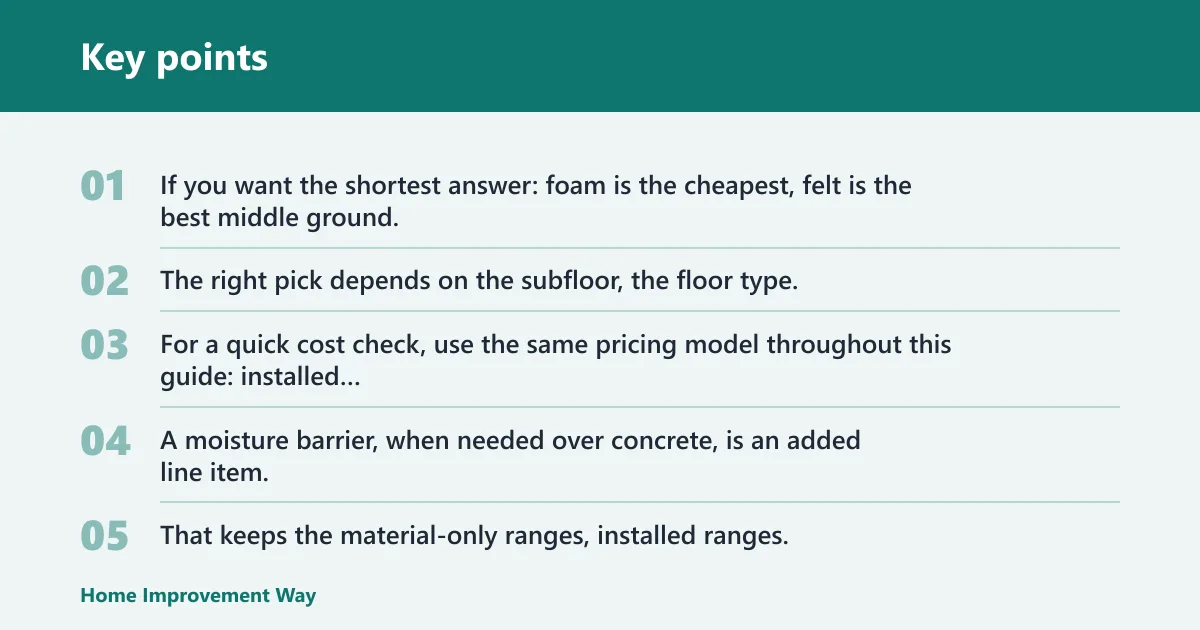
If you want the shortest answer: foam is the cheapest, felt is the best middle ground, cork adds comfort and better sound control, and rubber delivers the strongest sound performance at the highest price. The right pick depends on the subfloor, the floor type, and whether moisture protection is part of the job.
Best underlayment by cost, sound, moisture, and use


| Material | Material-only price per sq ft | Typical installed price per sq ft | Sound control | Moisture tolerance | Best-use floor scenario |
|---|---|---|---|---|---|
| Foam | $0.20–$0.40 | $0.70–$1.30 | Basic | Low unless paired with a barrier | Budget laminate or vinyl on a fair subfloor |
| Felt | $0.45–$0.95 | $1.05–$1.95 | Moderate | Moderate; depends on product and floor type | Laminate or hardwood in higher-traffic rooms |
| Cork | $0.60–$1.20 | $1.20–$2.20 | Good to very good | Moderate; barrier may be needed on concrete | Quieter rooms where comfort matters more than the lowest price |
| Rubber | $0.90–$1.80 | $1.65–$3.05 | Best for impact noise | Higher when dense or closed-cell; check product spec | Upper floors, media rooms, and noisy spaces |
For a quick cost check, use the same pricing model throughout this guide: installed price equals material price plus labor. A moisture barrier, when needed over concrete, is an added line item. That keeps the material-only ranges, installed ranges, and room examples aligned instead of competing with one another.
Floor underlayment typically runs about $0.70 to $3.05 per sq. ft. installed, before any moisture barrier or subfloor repair. Pick the wrong material and you can spend more later on noise, moisture, or floor failures. This guide breaks down price by material and the factors that change your total beyond the roll or sheet price.
Underlayment sits between the subfloor and the finished floor. Cost is not just the roll price. Material grade, labor, moisture barriers, subfloor repair, and room layout all move the final bill.
The broad pricing picture is wide because the job itself is wide. Underlayment material costs generally range from $0.20 to $1.80 per sq. ft., labor can add $0.50 to $1.25 per sq. ft., and total underlayment cost per square foot typically ranges from $0.70 to $3.05 before a barrier is added. For a 100 sq. ft. room, typical installed cost is $70 to $305.
What changes price from one material to another
Foam is usually the cheapest pick because it uses the least dense construction. Cork costs more because it is thicker and holds its shape better. Felt sits in the middle because density and traffic resistance improve performance. Rubber costs the most because its dense build gives stronger sound control and longer wear.
Material cost can also rise when a project needs a moisture barrier, extra seam work, or more prep under the underlayment. Concrete slabs, basements, and humid spaces often need that extra layer of protection. For a wood subfloor installation, those moisture costs are usually lower unless the room has a spill risk or other special condition.
Material-only cost versus installed cost
Material-only price is the roll or sheet cost before labor or accessories. Installed cost includes labor, seam work, cuts, and the time needed to fit the room. In this pricing model, labor adds about $0.50 to $1.25 per sq. ft., which is why a low-cost pad can still finish as a mid-range project once the room is measured and installed.
The cleanest way to compare products is to use the same formula for every material: material-only price plus labor, with moisture-barrier cost added only when the subfloor requires it. That keeps the budget honest and makes 100 sq. ft. and 250 sq. ft. examples easy to reconcile.
Foam underlayment cost
Foam is usually the least expensive underlayment option. It is a common fit for laminate and many vinyl installations, especially where the goal is a basic cushion layer rather than serious sound control. Foam underlayment often runs $0.20 to $0.40 per sq. ft. for material, and the low price is the main reason it stays popular.
Best uses for laminate and vinyl
Foam works well when the floor needs a simple, light layer under floating laminate or vinyl. It helps smooth minor irregularities and adds some comfort underfoot. It is most useful when the subfloor is already in fair shape and the room does not need premium noise control.
Say your 120 sq. ft. bedroom is getting laminate over a clean plywood subfloor. Foam can be the right call if the floor is flat and the room is on an upper level where you mainly want a budget-friendly cushion under the boards.
Where foam falls short
Foam compresses more than cork, felt, or rubber. That matters in rooms with heavy furniture, repeated traffic, or a need for stronger sound reduction. If you need better impact sound control, foam can become a false economy because a cheaper underlayment may leave noise issues in place and shorten the life of the floor assembly.
Foam is not the right answer for every floor type or every noise target. It is the low-cost choice, not the strongest one.
Cork underlayment cost
Cork is a premium material that costs more than foam because it brings better resilience and sound absorption. Cork material usually runs $0.60 to $1.20 per sq. ft., and the installed total commonly lands between $1.20 and $2.20 per sq. ft. It is often chosen when a room needs a more refined feel underfoot. It also adds some thermal insulation.
Price range and what drives it up
Cork price rises with thickness, density, and sound performance. Thicker products usually cost more and may need more careful installation. If a room also needs a moisture barrier or subfloor correction, the total climbs quickly.
The gap between foam and cork is easy to see in small rooms. At 100 sq. ft., the difference between a foam install and a cork install can be substantial even before moisture protection is added.
When cork makes sense over foam
Cork makes sense when you want better sound absorption, better resilience, and a bit more thermal comfort. It is a stronger choice than foam when the room is used often or when a quieter feel matters enough to justify extra cost. It also works well where a homeowner wants a higher-grade underlayment without moving all the way to rubber.
Suppose a living room over a crawlspace feels a little cold and the family wants less hollow sound from foot traffic. Cork can justify its higher price better than foam because it addresses comfort and sound at the same time.
Felt underlayment cost
Felt sits in the middle of the price ladder. It is usually priced above foam and below cork or rubber, which is why it often appears in projects that need more density and durability than basic foam can offer. In many budgets, felt is the balanced option for traffic resistance and long-term performance.
Mid-range pricing and density
Felt underlayment is valued for its density. That density helps it resist compression better than cheap foam, which matters in hallways, family rooms, and other spaces with regular foot traffic. It is often used under laminate and hardwood where the floor assembly needs a steadier base.
Because felt is denser, it may cost more to cut and fit cleanly in a room with lots of corners or closets. That labor shows up in the total even when the roll price looks reasonable.
Traffic resistance and durability
Felt is the material to watch when foam would flatten too quickly. It is a good choice if you want a middle-ground material that can handle more wear without jumping to the higher rubber tier. For many homeowners, that makes felt the better long-term buy than foam.
A common first-timer mistake is choosing the cheapest pad for a hallway because the room is small. The hallway gets repeated traffic every day, and a softer pad can compress early. The room is small, but the wear is not.
Rubber underlayment cost
Rubber is the premium cost tier. It is dense, often closed-cell or otherwise tightly built, and it is chosen for stronger sound-dampening and better durability. Rubber material commonly runs $0.90 to $1.80 per sq. ft., and the installed price is typically $1.65 to $3.05 per sq. ft.
Sound control and impact noise reduction
Rubber is the best fit when impact noise is the problem, not just a little footstep echo. It is often used where downstairs neighbors, media rooms, or busy upper floors need more noise control than foam or felt can provide. That performance is the main reason it costs more.
When rubber is worth the extra spend
Rubber is worth the money when sound reduction matters enough to protect the finished floor value. It also makes sense in rooms that see heavy daily use and in places where long service life matters more than upfront savings. If a cheaper pad would fail early, rubber can be the less expensive choice over time.
For a large open room over a basement rec area, rubber may be the smarter buy if footfall noise is already a complaint and the goal is to keep that problem from returning after the new floor goes in.
Underlayment cost matrix
This table separates material-only price from installed price and shows where each material fits best. The totals below use the same assumptions throughout: installed cost equals material plus labor, while moisture-barrier cost is separate and only added when the subfloor requires it.
| Material | Material-only price per sq ft | Typical installed price per sq ft | Sound control | Moisture tolerance | Durability | Best-use floor scenario | 100 sq ft total | 250 sq ft total |
|---|---|---|---|---|---|---|---|---|
| Foam | $0.20–$0.40 | $0.70–$1.30 | Basic | Low unless paired with a barrier | Lowest of the four | Budget laminate or vinyl on a fair subfloor | $70–$130 | $175–$325 |
| Cork | $0.60–$1.20 | $1.20–$2.20 | Good to very good | Moderate; barrier may be needed on concrete | Good | Quieter rooms where comfort matters more than the lowest price | $120–$220 | $300–$550 |
| Felt | $0.45–$0.95 | $1.05–$1.95 | Moderate | Moderate; depends on product and floor type | Good | Laminate or hardwood in higher-traffic rooms | $105–$195 | $262.50–$487.50 |
| Rubber | $0.90–$1.80 | $1.65–$3.05 | Best for impact noise | Higher when dense or closed-cell; check product spec | Highest | Upper floors, media rooms, and noisy spaces | $165–$305 | $412.50–$762.50 |
The table above keeps the comparison focused on the four materials that matter here: foam, cork, felt, and rubber. It also shows why installed cost, not just roll price, is what should drive the decision.
How moisture barrier and prep change each total
For concrete subfloors, a moisture barrier can add $0.50 to $1.50 per sq. ft. On a 250 sq. ft. room, that is an added $125 to $375 before prep work or repair changes. Once that layer is required, the cheapest underlayment may no longer be the cheapest finished project.
What adds to installed cost
Labor, prep, moisture protection, seams, and waste all affect the final bill. Labor can add $0.50 to $1.25 per sq. ft. to the project, and the broader estimate can rise further if the room needs patching, leveling, or removal of old flooring. A simple room with few cuts costs less than a small room with closets, offsets, and a tricky seam layout.
Labor cost and room complexity
Room shape changes labor fast. Straight rooms with open access are quicker to cover. Tight rooms, stairs, closets, and odd angles take more cutting and fitting, which raises labor time and sometimes crew size as well.
Seam work matters too. Large rolls reduce seams, but the layout still has to fit the room. More seams mean more time, more material handling, and more chances for a sloppy fit.
Subfloor prep, leveling, and patching
Subfloor prep can add cost through leveling, patching, moisture checks, and removal of old flooring. These tasks do not always show up in the first quote, so they deserve a separate line item. If the subfloor is uneven or damaged, the underlayment will not fix the problem by itself.
Moisture checks are especially important on concrete. Without them, a low-price underlayment can turn into a higher-risk install.
Roll coverage, waste factor, and ordering buffer
Roll or sheet coverage affects the purchase total. Most jobs need a waste factor for cuts and seams, especially in rooms with closets or irregular edges. A common ordering buffer is about 5% to 10%, though more complex rooms may need more.
If a roll covers 100 sq. ft. and the room is 92 sq. ft., you still may need to order extra to cover waste and allow for seam placement. That is why the room’s actual footprint is only part of the math.
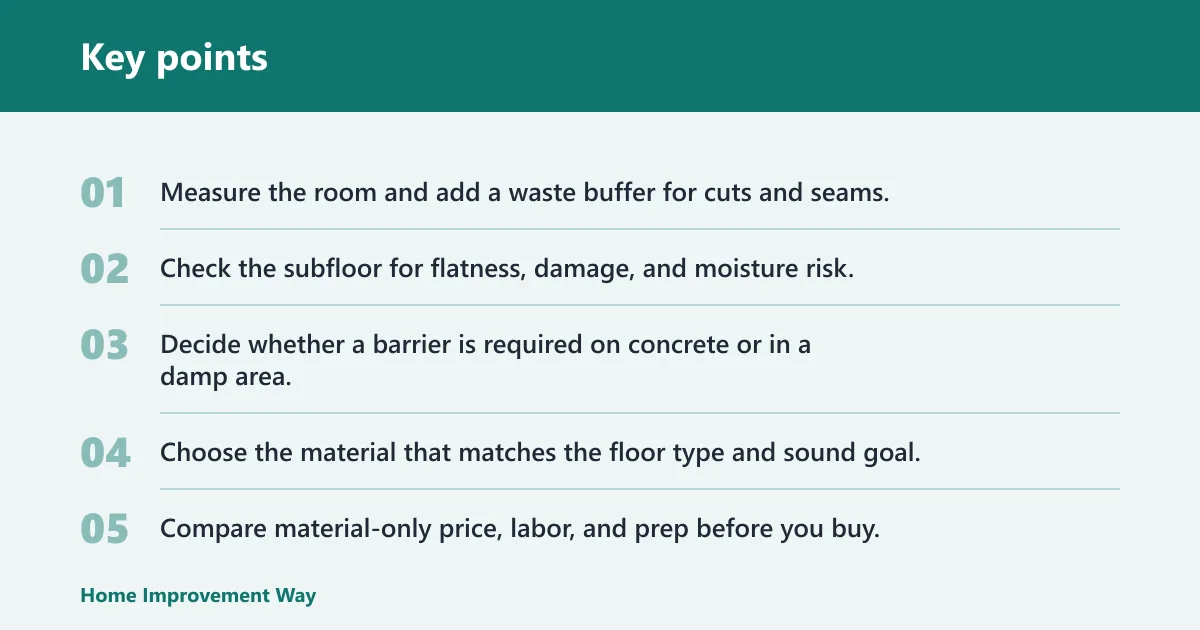
- Measure the room and add a waste buffer for cuts and seams.
- Check the subfloor for flatness, damage, and moisture risk.
- Decide whether a barrier is required on concrete or in a damp area.
- Choose the material that matches the floor type and sound goal.
- Compare material-only price, labor, and prep before you buy.
When should you spend more?

Spend more when the cheaper pad cannot meet the sound target, the traffic load, or the moisture conditions. Foam is fine for basic laminate or vinyl installs, but cork, felt, or rubber can be the better buy when compression, impact noise, or durability risk would make a cheap pad cost more later.
Sound control without overspending
If the goal is better sound without jumping straight to premium rubber, felt is often the middle-ground answer. It gives more density than foam and better traffic resistance, while cork offers better sound absorption and more comfort underfoot. Choose the least expensive material that still reaches the noise target.
Traffic, durability, and floor-failure risk
Choose felt or rubber when repeated traffic would flatten foam too quickly. Choose rubber when impact noise is the bigger issue or when long-term durability matters more than the upfront bill. A cheaper pad is false economy if it leads to movement, premature wear, or a noisy floor assembly.
Choosing by subfloor condition and room use
Moisture and subfloor condition should decide some of the budget on their own. Concrete slabs, basements, and humid areas often need a barrier. If the room already has uneven spots or patching needs, money spent on the right prep protects the underlayment and the finished floor above it.
Picture a 250 sq. ft. basement room with a concrete slab and a new laminate floor. Foam might look cheap at first, but a barrier and better sound control can push the project toward felt, cork, or rubber. In that case, the higher material cost buys a safer and quieter result.
Frequently asked questions
How much does floor underlayment cost by material?
Foam is usually the cheapest, felt sits in the middle, cork costs more, and rubber sits at the top. Material-only pricing commonly ranges from $0.20 to $1.80 per sq. ft. across these options, with labor and moisture protection added on top when the project calls for them.
Is foam underlayment cheaper than cork, felt, or rubber?
Yes. Foam is the cheapest and most common material in the calculator guidance. It is a good budget pick for laminate and vinyl, but it gives up compression resistance and sound control. Once noise or wear becomes a real concern, felt, cork, or rubber may be the better value.
What is the installed cost of underlayment per square foot?
Installed cost depends on the material, room layout, and prep. Foam may run $0.70 to $1.30 per sq. ft. installed, while premium rubber or sound-dampening products can run $1.65 to $3.05 per sq. ft. installed. Labor alone can add $0.50 to $1.25 per sq. ft.
How much extra does a moisture barrier add to underlayment cost?
For concrete subfloors, a moisture barrier can add $0.50 to $1.50 per sq. ft. That can add up quickly in a larger room. It is most common over concrete slabs and in basements or damp areas where moisture control is part of the floor assembly, not an optional extra.
Which underlayment material is best for sound control without overspending?
Felt is often the best middle-ground choice for sound control without paying the rubber premium. Cork gives better sound absorption and comfort, but felt usually offers a stronger balance of density, traffic resistance, and price when the goal is to improve noise control without going to the top tier.
Watch for subfloor prep, leveling, patching, moisture checks, removal of old flooring, seam work, and extra material waste. Room shape can also raise labor time. These costs often show up after the material price, so a low roll price can still lead to a higher total project bill.
Does room size change the price per square foot?
Yes, in practice it can. The material price per square foot does not change much, but small rooms often have a higher effective cost because waste, seam layout, and labor take up a larger share of the job. Larger rooms can spread those fixed tasks across more square footage.
Rubber is worth it when impact noise, traffic, or durability matter enough to protect the finished floor and the people below it. Cork is worth it when you want better sound absorption and more comfort than foam can offer. Both are better choices when a cheap pad would fail early.
Sponsored / affiliate links. As an Amazon Associate I earn from qualifying purchases. I may earn additional commission from eligible campaigns.