Range Hood Vent Material Comparison: Steel vs Aluminum
Galvanized steel is the best default for most range hood venting jobs. It is rigid, code-friendly in many installs, and less likely than flex duct to sag or crush; aluminum is lighter and holds up better in damp or salty air, while flex duct should stay limited to short, permitted transitions. Poor duct choice can trap grease, sag in warm spaces, leak at joints, and increase fire and cleaning risk. This guide compares galvanized steel, aluminum, and flex duct by durability, cleanliness, and code-sensitive failure points.
| Factor | galvanized steel | aluminum | flex duct | Winner |
|---|---|---|---|---|
| Code risk | Low | Low to moderate, depending on local approval and installation details | High for full exhaust runs | galvanized steel |
| Airflow loss | Low | Low | High | galvanized steel / aluminum |
| Grease buildup risk | Low | Low | High | galvanized steel / aluminum |
| Corrosion resistance | Moderate to good | High | Low to moderate | aluminum |
| Install difficulty | Moderate | Low to moderate | Low | flex duct |
| Long-term maintenance | Low | Low | High | galvanized steel / aluminum |
Range hood duct materials compared
Galvanized steel is the low-cost rigid baseline. Aluminum is lighter and better in humid or coastal settings. Flexible duct is the highest-risk option for a range hood exhaust, except where a short transition is specifically allowed. The main trade-off is airflow, failure risk, cleanup burden, and how often the run stays straight, tight, and clean.
What changes fan performance, cleaning, and failure risk
Static pressure is the resistance the fan must push against. CFM is the airflow delivery rating shown on hood specs. Corrugation, long runs, and extra elbows raise static pressure and lower delivered airflow, so the hood moves less air than the label suggests. Smooth, rigid metal keeps the inside cleaner and easier to inspect.
A common first-timer mistake is choosing a duct that fits the gap, then ignoring support and joint quality. A 7-foot run with two elbows can perform very differently from a straight 7-foot run, even if both are nominally 6-inch duct. Equivalent length matters because every elbow, transition, and rough interior adds resistance.
Key terms that affect the result
- Static pressure: the resistance the fan sees as air moves through the duct.
- CFM: the airflow rate the fan is rated to deliver.
- Equivalent length: the added resistance from elbows, transitions, and corrugation.
Side-by-side comparison matrix
Use this screen to choose the right material for your kitchen. The best duct is the one that keeps the fan close to its rated CFM, stays supported, and matches the code path your jurisdiction accepts. A cheap material can become the expensive choice if it traps grease, sags, or needs early replacement.
| Factor | galvanized steel | aluminum | flex duct | Winner |
|---|---|---|---|---|
| Code risk | 1 | 2 | 5 | galvanized steel |
| Airflow loss | 1 | 1 | 5 | galvanized steel / aluminum |
| Grease buildup risk | 1 | 1 | 5 | galvanized steel / aluminum |
| Corrosion resistance | 3 | 5 | 2 | aluminum |
| Install difficulty | 3 | 4 | 5 | flex duct |
| Long-term maintenance | 4 | 5 | 1 | aluminum |
Code risk
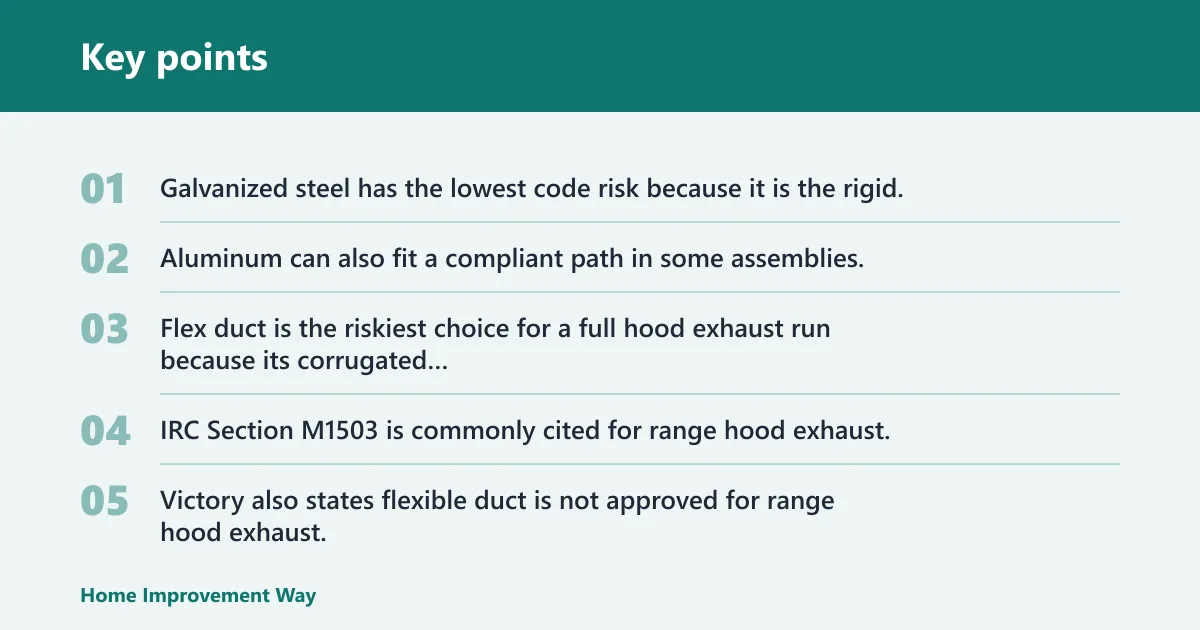
Galvanized steel has the lowest code risk because it is the rigid, non-combustible baseline many installers start with. Aluminum can also fit a compliant path in some assemblies, but the exact duct type and installation method matter. Flex duct is the riskiest choice for a full hood exhaust run because its corrugated interior and support needs create more ways to fail the inspection.
IRC Section M1503 is commonly cited for range hood exhaust, and Victory states it requires a smooth-interior metal duct. Victory also states flexible duct is not approved for range hood exhaust, while semi-rigid aluminum has variable code approval. That is why local approval matters: material choice and installation method are not the same question.
Airflow loss
Galvanized steel and aluminum both keep the interior smooth, so they are tied for best airflow potential in a properly sized run. Flex duct adds resistance because of the corrugated interior and spiral structure, which increases static pressure. If the run is long or elbows are unavoidable, that penalty grows and the hood may move less air than expected.
Suppose a homeowner has a 6-inch hood over a 30-inch range and a route with two elbows to reach the exterior wall. A smooth rigid run can keep pressure loss lower than a corrugated run of the same length, which means the fan is more likely to deliver closer to its rated CFM instead of straining against the duct.
Grease buildup risk
Smooth metal is easier to wipe, inspect, and keep clear of residue. Galvanized steel and aluminum both do better than flex duct because the inside is not ridged. Corrugation creates ledges where grease can collect, and once buildup starts, cleaning gets harder and the duct can hold odors longer.
Corrosion resistance
Aluminum wins where moisture is a real issue. Airwise says aluminum duct is used in marine and high-humidity environments, and it weighs about 35% of equivalent galvanized steel duct. That lighter weight helps during installation, but its main advantage here is resistance to corrosion in damp air or salt exposure.
Galvanized steel uses a zinc coating for sacrificial corrosion protection. Airwise identifies G60 as the standard galvanized coating and G90 for humid environments. That means galvanized steel is durable for many kitchens, but aluminum still has the edge when the duct may see persistent moisture or salty air.
Install difficulty
Flex duct is easiest to snake through a cramped cavity, which is why it keeps showing up in bad installs. But easy to route is not the same as good for exhaust. Rigid galvanized steel takes more planning and more accurate cuts. Aluminum sits between the two because it is lighter, easier to handle, and still keeps a rigid or semi-rigid form when used correctly.
Long-term maintenance
Galvanized steel and aluminum both need fewer repairs than flex duct because they keep their shape and are less likely to slump at hang points. Flex duct can loosen, sag, or trap grease at low spots. Over time, that makes cleanup harder and increases the chance that a homeowner will need to replace a section rather than simply reseal a joint.

Is galvanized steel better than aluminum for a range hood vent?
Galvanized steel is usually the better value for a dry, straightforward kitchen because it costs less, stays rigid, and is widely used in residential ductwork. Aluminum becomes the better choice when corrosion resistance matters more than upfront cost, especially in humid or coastal homes. For many kitchens, galvanized steel wins on value; aluminum wins on environment.
When galvanized steel is the better value
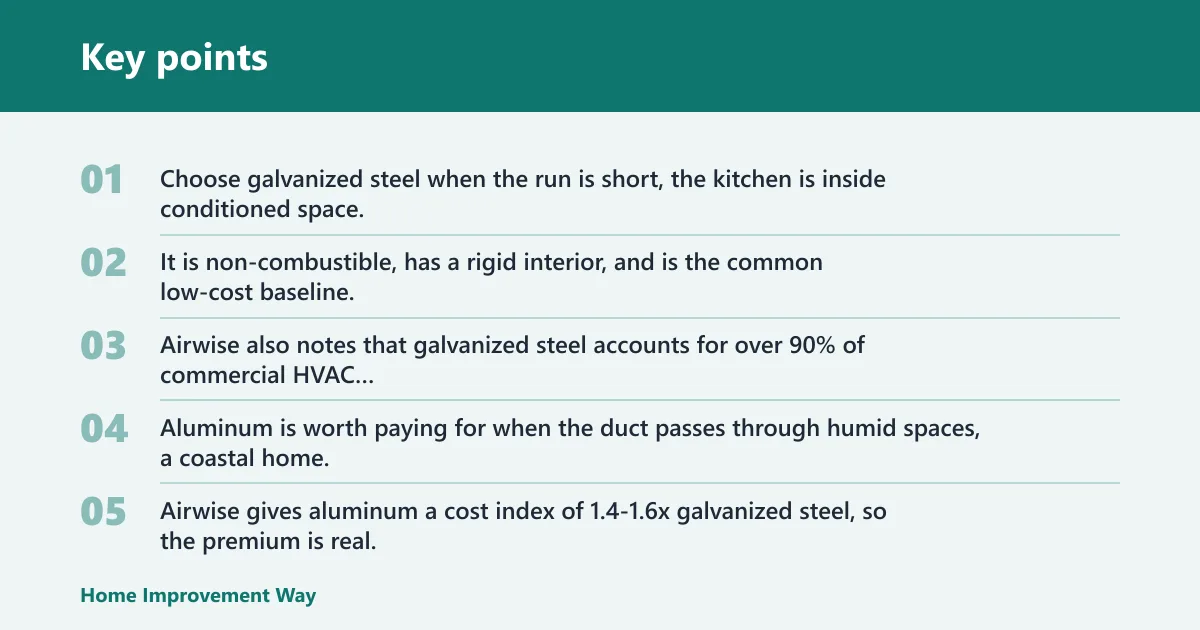
Choose galvanized steel when the run is short, the kitchen is inside conditioned space, and the duct will be easy to support with proper hanger spacing. It is non-combustible, has a rigid interior, and is the common low-cost baseline. Airwise also notes that galvanized steel accounts for over 90% of commercial HVAC ductwork installed worldwide, which reflects how widely trusted the material is.
When aluminum is worth the extra cost
Aluminum is worth paying for when the duct passes through humid spaces, a coastal home, or a location where oxidation is a known problem. The same source gives aluminum a cost index of 1.4-1.6x galvanized steel, so the premium is real. That premium makes sense when replacement risk from corrosion would be more expensive than the material difference.
How G60 and G90 coatings affect durability
G60 is the standard galvanized coating. G90 adds more zinc and is aimed at humid environments. If you want galvanized steel but the route crosses a space that stays damp or cold enough for condensation, G90 is the better version to ask about. It still does not beat aluminum for corrosion resistance, but it narrows the gap.
Can you use flexible duct for a range hood exhaust?

For a full range hood exhaust run, flexible duct is usually the wrong choice. Victory states that flexible duct has a corrugated interior and is not approved for range hood exhaust, while IRC Section M1503 is cited for a smooth-interior metal duct path. Flex duct is best treated as a short transition only, if local rules allow it.
Why corrugation hurts airflow and raises static pressure
Corrugation breaks up the airflow path and increases resistance. That raises static pressure, which can reduce delivered CFM even when the hood fan is strong on paper. The result is weaker capture at the cooktop, more noise from the fan working harder, and less effective removal of steam and grease.
Why flex is a short transition at most
When flex duct is used at all, it should be the shortest permitted connector between rigid sections, not the full exhaust path. The reason is simple: the more corrugation you add, the more resistance, buildup, and sag risk you create. A short transition can solve a fit issue. A long flex run creates a performance issue.
Sag, collapse, and grease traps
Flexible duct has a spiral wire core with an insulated jacket. That structure can be useful in some HVAC contexts, but for a hood exhaust it creates a corrugated interior and more places for grease to catch. Warm attics make the problem worse because the duct can sag between supports, which leaves low spots that hold residue.
Which duct material handles humidity best?
Aluminum handles humidity best among these three because it resists corrosion better than galvanized steel and is used in marine and high-humidity environments. Galvanized steel can still work well, especially with G90 coating, but a damp attic or coastal air makes aluminum the safer long-term material choice. Flex duct is the least attractive option where moisture and grease can combine.
Coastal homes and corrosion-prone kitchens
In coastal or salt-exposed areas, aluminum usually deserves a closer look because its corrosion resistance is the main advantage. Galvanized steel depends on its zinc coating, and that coating is sacrificial by design. Once corrosion starts, seams and cut edges are the first places to inspect.
Unconditioned attic runs and condensation risk
An unconditioned attic raises the stakes because temperature swings can create condensation inside the duct. That moisture can sit on seams, fasteners, and low points. A rigid aluminum or galvanized run with proper support is easier to keep dry and inspect than a flex run that may dip between hangers.
Picture a 5-inch tall soffit chase that forces a long horizontal run above a cooktop. If the duct is flexible, the lowest point can slowly collect grease and condensation. If the duct is rigid and supported, the run is more likely to stay straight and drain less residue into one spot.
How do installation details change performance?
Material alone does not decide the result. Hanger spacing, seam quality, fastener choice, and the number of elbows can make a good duct underperform. A rigid metal duct that is poorly supported can still leak or sag, while a shorter, straighter run can perform better than a longer one with fewer restrictions.
Hanger spacing and support for rigid duct
Rigid duct needs proper structural support so the joints do not separate and the run does not shift over time. Aluminum is lighter than galvanized steel, which can make it easier to hold up in long horizontal sections. Even so, both rigid materials need secure hangers, especially where the duct crosses a ceiling cavity or attic bay.
Seams, fasteners, and leak control
Leak risk rises when seams are loose, fasteners are poorly placed, or joints are left unsealed. That matters because grease-laden air can escape into cavities and coat framing or insulation. Use parts that fit correctly, keep the run as straight as possible, and verify that the joint system matches the duct material.
Why shorter runs and fewer elbows matter
Every elbow adds equivalent length and raises static pressure. That can hurt the fan’s delivered CFM even when the hood itself is strong. If you can reduce the run length, remove an unnecessary elbow, or keep the path more direct, you improve performance without changing the hood.
Choose galvanized steel if…
Choose galvanized steel if your kitchen has a straightforward route, you want the lowest-cost rigid option, and the duct will stay mostly in dry, conditioned space. It is also the safer choice when you want a strong default that is easy to justify during inspection and simple to support over time.


Choose aluminum if…
Choose aluminum if the kitchen is in a humid, coastal, or corrosion-prone setting, or if you want a lighter rigid duct that is easier to handle overhead. It is also a good pick when you want durability close to galvanized steel but better resistance to moisture-related failure.
Choose flex duct if…
Choose flex duct only for a short, permitted transition where the layout leaves no cleaner option and your local rules allow that specific use. It should not be the default for a full range hood exhaust run. If you need long routing, redesign the path around rigid metal instead.
Choose galvanized steel vs aluminum vs flex duct if…
- Straight run: choose galvanized steel for the best cost-to-performance balance, unless humidity pushes you toward aluminum.
- Coastal home: choose aluminum for better corrosion resistance.
- Tight soffit: choose rigid metal first; use flex only as a short permitted transition if the local code allows it.
- Unconditioned attic: choose rigid aluminum or galvanized steel with strong support; avoid long flex sections that can sag and trap moisture.
- DIY retrofit: choose aluminum if handling weight matters, or galvanized steel if you can support the run and want the lowest material cost.
Vent material decision matrix
This matrix turns the comparison into a buying decision. The scores below are editorial judgments based on code exposure, support needs, cleaning burden, and failure risk in common kitchens. Lower numbers are better. Use the notes to match the material to the room, not just the hood fan.
| Kitchen scenario | galvanized steel | aluminum | flex duct | Best pick |
|---|---|---|---|---|
| Straight run | Best balance of cost and durability | Good if moisture is a concern | Poor for a full run | galvanized steel |
| Coastal home | Acceptable with the right coating | Best corrosion resistance | Poor long-term choice | aluminum |
| Tight soffit | Good if you can keep it rigid | Good if weight matters | Only as a short transition, if allowed | aluminum |
| Unconditioned attic | Good with solid support | Best for corrosion resistance | High sag and buildup risk | aluminum |
| DIY retrofit | Good if you can cut and seal rigid parts cleanly | Good if easier handling matters more | Easiest to route, hardest to justify for a full exhaust | aluminum |
What to verify before you buy: duct diameter must match the hood outlet and the manufacturer’s specified size; more elbows mean more equivalent length; and the adopted code in your area can change what is acceptable. If the project uses any semi-rigid section, confirm whether your local building department allows it for that exact application.
Frequently asked questions
Which duct material is best for noise and airflow in a range hood?
Rigid metal is best for both noise and airflow because its smooth interior keeps static pressure lower than corrugated duct. Between the two rigid choices, galvanized steel and aluminum perform similarly on airflow, while flex duct tends to be noisier because the fan works against more resistance.
Does IRC require smooth metal duct for range hood venting?
The same source says IRC Section M1503 requires range hood exhaust to run through a smooth-interior metal duct. In practical homeowner terms, that means you should not assume flex duct is acceptable for the full exhaust path. Always check the exact adopted code and local interpretation before buying parts.
What is the difference between rigid and flexible duct for a range hood?
Rigid duct has a smooth interior and holds its shape, which lowers airflow loss and makes cleaning easier. Flexible duct has a corrugated interior, raises static pressure, and is more likely to sag or trap grease. For a range hood, rigid duct is the safer default.
When is semi-rigid aluminum duct allowed for range hood venting?
The same source lists semi-rigid duct as aluminum with a corrugated interior and variable code approval. That means allowance depends on jurisdiction and installation details, not on the material name alone. Do not treat it as a universal full-run option; verify the local rule before using it anywhere beyond a short permitted transition.
Which duct material is easiest to install in a tight kitchen layout?
Flexible duct is easiest to route through a cramped space, but that convenience comes with higher failure risk and code concerns. If you need a tight fit and want a better long-term result, aluminum is often the better compromise because it is lighter than galvanized steel and still keeps a rigid form.
Does aluminum resist corrosion better than galvanized steel?
Yes. Aluminum generally resists corrosion better, especially in marine and high-humidity environments. Galvanized steel relies on zinc coating for protection, and G90 is the better galvanized grade for humid conditions. For damp or coastal kitchens, aluminum usually has the edge.
Which range hood duct material is cheapest to buy?
Galvanized steel is usually the cheapest to buy among the rigid options. Airwise places aluminum at 1.4-1.6x galvanized steel on cost, so aluminum costs more up front. Flex duct may look cheap at the register, but the cleanup, support, and performance penalties can make it the costliest choice over time.
Sponsored / affiliate links. As an Amazon Associate I earn from qualifying purchases. I may earn additional commission from eligible campaigns.