Appliance repair cost breakdown: fees, parts, labor
A fair appliance repair quote often separates a diagnostic fee, a trip charge, labor, and parts, with the fee amounts commonly falling in modest ranges; it can be worth questioning any bill that charges both a diagnostic fee and a separate trip fee for the same visit. Hidden or duplicated line items can raise the total before work begins. This guide explains each charge, what is normal, and what to check before you approve work.
This guide is part of our Appliance repair: diagnose, fix, and maintain series.
What a fair appliance repair quote usually includes
A fair quote should tell you what the technician charges to find the problem, what they charge to travel, what the labor costs, and how much the replacement part costs. Some companies bundle the visit fee with diagnosis. Others itemize everything. The key is that the same visit should not be billed twice under different names.
The core line items
Diagnostic fee is the charge to inspect the appliance, confirm the failure, and identify the likely fix. Service call fee often means the cost of sending a technician to your home. Trip charge is the travel component, which may reflect distance, dispatch time, or a minimum visit fee. Labor is the charge to do the repair. Parts are the replacement components.
Some companies bundle the service call and diagnosis into one fee. Others split them. A quote can also include disposal, removal, second-visit labor, or after-hours charges. Ask for each line item in writing before you approve anything.
What should be written down before you approve the job
- The exact appliance model and symptom.
- The diagnostic fee or service call fee, and whether it is credited if you approve the repair.
- The estimated labor time and hourly rate.
- The part number, part price, and whether it is OEM or compatible.
- Any trip, rush, return-visit, disposal, or minimum-labor fee.
📊 This Old House says appliance repairs usually cost between $50 and $500. Source: How Much Does Appliance Repair Cost?.
How much should each fee cost?
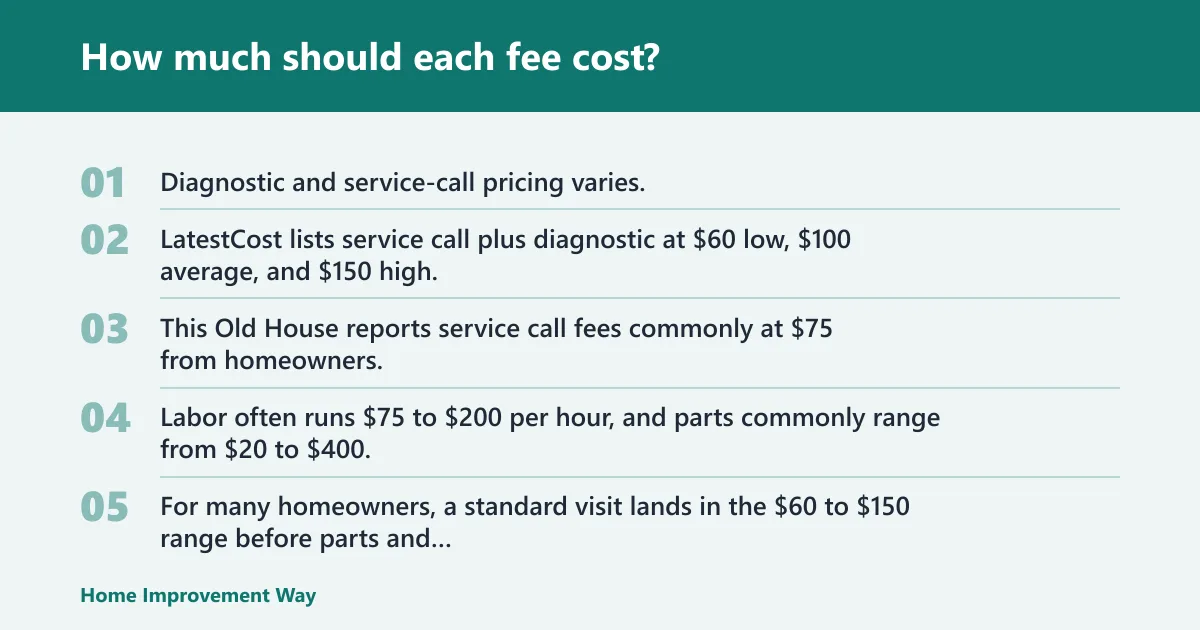
Diagnostic and service-call pricing varies, but the ranges below are a practical starting point. LatestCost lists service call plus diagnostic at $60 low, $100 average, and $150 high. This Old House reports service call fees commonly at $75 from homeowners. Labor often runs $75 to $200 per hour, and parts commonly range from $20 to $400.
Diagnostic fee and service call fee ranges
For many homeowners, a standard visit lands in the $60 to $150 range before parts and labor. LatestCost says diagnostic-only budgets can reach $300 when multiple visits are needed. That happens when the first visit confirms the issue but the repair requires a return trip for parts or access.
Refrigerator, dishwasher, and oven quotes often sit at different starting points because the diagnosis itself takes different time. LatestCost estimates refrigerator repair at $150-$500 for simple fixes, dishwasher repair at $100-$250 diagnostic, and range or oven repair at $130-$300 diagnostic. This Old House lists refrigerator repair at $200-$500 and dishwasher repair at $100-$300.
Trip charge ranges and when they are added
A trip charge is usually tied to travel, dispatch, or the minimum cost of showing up. It may be bundled into the service call fee, or it may appear separately for longer distances, rural homes, or rush appointments. Urban dispatch can be lower per mile but still carry a flat visit fee. Rural service often costs more because drive time is longer.
If a company lists both a service call fee and a trip charge, ask whether one is a true travel fee and the other is the diagnostic visit fee. If they describe the same visit twice, that is a duplicate charge risk.
Hourly labor rates and common minimum charges
LatestCost says labor for common repairs is typically $75 to $200 per hour. LatestCost also notes Midwest labor often runs $100-$150 per hour, while West Coast labor is often $120-$200 per hour. Some companies bill in 15- or 30-minute blocks, and some set a minimum labor charge even for a short fix.
Small repairs can still cost more than expected if the technician has to remove stacked laundry machines, pull a built-in wall oven, or disassemble panels to reach the failed part. Access changes time. Time changes price.
Replacement part price ranges
LatestCost says replacement parts commonly range from $20 to $400. Simple switches, thermostats, and door parts tend to sit near the low end. Control boards, motors, compressors, and sealed-system components often sit near the high end. Model-specific parts can also take longer to source.
Generic parts can work in some repairs, but compatibility matters. OEM parts usually fit the exact model more predictably, while generic parts can be a fit only when the maker allows it. A quote should say which one you are getting.
Is a service call the same as a diagnostic fee?
Not always. A service call is the technician’s visit to your home, while a diagnostic fee pays for finding the failure. Some companies combine them into one line. Others separate them, which can be fair if the quote explains what each fee covers. A problem starts when both charges apply to the same first visit without a clear reason.
When the diagnostic fee is credited
Some companies apply the diagnostic fee toward the repair if you approve the work. That is common, but it is not automatic. Ask whether the fee is waived, credited, or fully retained. A waived diagnostic fee should be spelled out. If the company promises a credit, get that in writing before authorizing the repair.
How to spot duplicate charges on the same invoice
Look for these patterns: diagnostic fee plus service call fee for one visit, trip charge plus service call fee with no distance explanation, or return-visit labor added after a quoted flat repair price. One visit should usually have one visit charge. If the bill has two names for the same thing, ask for a correction before paying.
What changes the final price on a repair?

The final price changes with appliance type, repair scope, part availability, labor time, and travel. A simple thermostat swap is not priced like a sealed-system refrigerator repair or a control board replacement. Regional labor also matters. Same-day service, weekend work, and a second visit can all push the total upward.
Appliance type
Refrigerators often cost more than a simple washer switch repair because the parts can be expensive and the diagnosis may take longer. Dishwashers are often lower than refrigerators, but built-in access can add time. Ovens and ranges are often repaired by a professional, and This Old House says ovens should usually be repaired by a professional. Microwaves can look simple, but internal parts and safety concerns still affect labor.
Repair scope
A simple fix might be a door latch, belt, thermostat, or igniter. A major repair might involve a control board, compressor, sealed system, motor assembly, or a hidden wiring fault. Sealed system work on a refrigerator costs more because it usually requires specialized labor, more time, and pricier parts. Control board replacement can also move the quote into a higher bracket fast.
Model-specific parts and access
Older or discontinued models can raise the price because parts may be harder to find. Built-in appliances, stacked laundry units, and wall ovens often take longer to access. A repair that needs a cabinet pull-out, heavy lifting, or a partial disassembly should not be priced like a front-access part swap.
Say your refrigerator stops cooling after a power surge. A technician may diagnose a failed control board in one visit, but if the board must be ordered, the quote may add a second trip charge or return-visit labor. That can be fair, but it should be stated before you agree.
Suppose your dishwasher is leaking from a door seal and the part is readily available. That repair may stay near the low end because labor is shorter and the part is inexpensive. If the same leak turns out to be a circulation pump or hidden tub crack, the total can change quickly.
When is appliance repair too expensive to approve?
Repair can be too expensive when the total climbs near replacement value, when the appliance has repeated failures, or when the quote is loaded with return visits and specialty labor. A repair can still be worth it on a newer unit, but age, part availability, and the failure type should guide the decision. There is no universal cutoff.
Signs the quote may be overpriced for the repair scope
- The service call, diagnostic fee, and trip charge all appear separately with no explanation.
- The labor estimate is high for a simple part swap.
- The part price seems far above the common $20 to $400 range without a special reason.
- A second visit is charged even though the company could have ordered the part from the model number.
- Minimum labor, after-hours, and rush fees stack on top of one another.
How age and repeat failures change the decision
A newer appliance with a single failed part is usually easier to justify. A unit with repeated compressor, control, or motor failures deserves more caution. If the same appliance has already needed several repairs, another high-dollar quote may make less sense than replacement, especially when the quote depends on specialty labor or hard-to-find parts.
Use this quote checker before you say yes
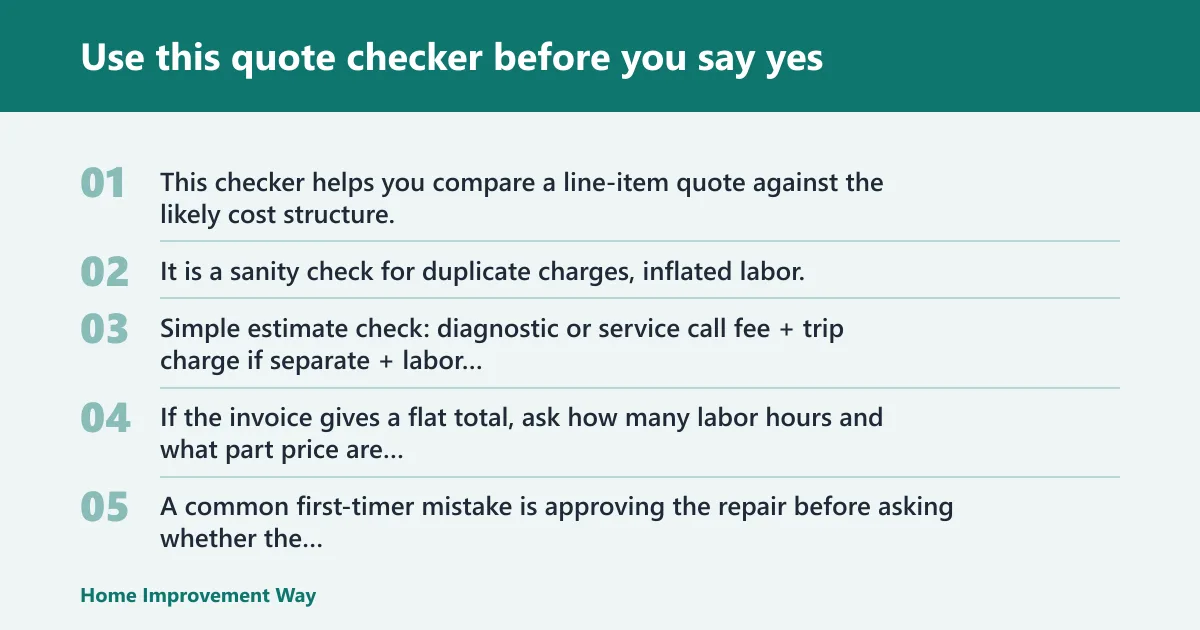
This checker helps you compare a line-item quote against the likely cost structure. It is not a replacement for diagnosis. It is a sanity check for duplicate charges, inflated labor, and travel fees that do not match the visit. Use it before you approve the repair.
| Quote item | Typical range | What it should cover | Duplicate-charge flag | Overcharge red flags |
|---|---|---|---|---|
| Diagnostic fee | $60-$150 | Inspection, troubleshooting, and repair estimate | Yes, if a separate service call fee covers the same visit | No clear credit if repair is approved; billed again on return visit without explanation |
| Service call fee | $60-$150 | Technician dispatch and first visit | Yes, if it duplicates the diagnostic fee or trip charge | Flat fee plus separate trip fee for the same drive |
| Trip charge | $50-$100 | Travel distance, rural dispatch, or minimum visit cost | Yes, if already included in service call | Added with no mileage, distance, or rural-service reason |
| Labor | $75-$200 per hour | Time spent on the repair | Yes, if the quote also includes a flat repair fee for the same work | Hours seem high for a simple access repair or common part swap |
| Parts | $20-$400 | Replacement component, OEM or compatible | No, unless the same part is listed twice | Part price is far above the model-specific market norm without a sealed-system or control-board reason |
| Common add-ons | Varies | After-hours, return visit, disposal, removal, minimum labor | Yes, if two charges cover the same added service | Multiple small fees stack and push the total far beyond the repair scope |
Simple estimate check: diagnostic or service call fee + trip charge if separate + labor hours × hourly rate + part cost + any stated add-ons. If the invoice gives a flat total, ask how many labor hours and what part price are included.
A common first-timer mistake is approving the repair before asking whether the diagnostic fee will be credited. That matters. A $100 diagnostic that is later applied to the repair is different from a $100 fee that stays on the bill even after the work is approved.
How to compare quotes and avoid paying twice
The easiest way to compare quotes is to force every company into the same format: visit fee, labor rate, labor hours, part price, and add-ons. Ask for the estimate in writing, then compare the same line items side by side. If one quote looks low, check whether it hides the trip fee, minimum labor, or a return-visit charge.
What to ask before approving work
- Is the diagnostic fee credited if I approve the repair?
- Is the service call fee the same as the trip charge, or are both billed?
- How many labor hours are included?
- Is the part OEM, compatible, or generic?
- Are disposal, removal, after-hours, rush, or return-visit fees included?
- Can I get a second estimate if the part or labor time changes?
Get at least two estimates when the repair looks expensive, the part is uncommon, or the quote includes a control board, sealed system, or multi-visit diagnosis. A written quote makes it easier to spot a fair price and harder for duplicate charges to hide.
Frequently asked questions
How much should an appliance repair diagnostic fee cost?
A common diagnostic or service-call range is $60 to $150, with LatestCost listing $60 low, $100 average, and $150 high for service call plus diagnostic. This Old House reports service call fees commonly at $75 from homeowners. Multi-visit troubleshooting can push diagnostic-only costs higher.
Do appliance repair companies charge for trip fees separately?
Sometimes. A trip charge may be bundled into the service call fee, or it may appear separately for longer distances, rural homes, or rush scheduling. If both a service call and trip fee are listed, ask whether one duplicates the other. The invoice should explain why both are there.
What labor rate is normal for appliance repair?
LatestCost says labor for common repairs is typically $75 to $200 per hour. It also notes Midwest labor often runs $100-$150 per hour and West Coast labor is often $120-$200 per hour. Short repairs can still cost more if access is difficult or a minimum labor charge applies.
Why do sealed system refrigerator repairs cost more?
Sealed system work usually involves specialized labor, longer repair time, and more expensive parts. It is not the same as swapping a shelf, thermostat, or gasket. Because the job can require refrigerant-related expertise and extra visits, the quote is often much higher than a simple refrigerator repair.
Should a diagnostic fee be waived if I approve the repair?
Sometimes, but not always. Many companies credit the diagnostic fee toward the repair if you approve the work, while others keep it as a separate charge. Ask before the visit starts, and get the answer in writing. A waived fee should never be assumed unless the quote says so.
Sponsored / affiliate links. As an Amazon Associate I earn from qualifying purchases. I may earn additional commission from eligible campaigns.