OEM vs Aftermarket Appliance Parts: Which Is Safer to Install?
OEM parts are the safer default for appliance installation when the part affects heat, electricity, sealing, or water flow, because the original spec is known and the fit is documented; quality aftermarket parts can still be safe if they match the exact model, electrical rating, and safety certifications, and if any of those are unclear, stop and call a technician. A wrong part can cause leaks, overheating, poor fit, repeated failures, or voided coverage. This guide ranks OEM, aftermarket, and professional install by risk so you can choose the safest option for your repair.
| Decision factor | OEM | aftermarket appliance parts | Winner |
|---|---|---|---|
| Safety-critical fit | Designed to match the original fit, shape, material, mounting points, and function | Can match well, but quality and tolerance vary by seller and part type | OEM |
| Price | Usually higher upfront cost | Some parts are 20% to 80% less expensive than OEM parts | aftermarket appliance parts |
| Risk of wrong-spec installation | Lower when the part number is correct | Higher if the listing uses vague compatibility claims or loose dimensions | OEM |
| Best use case | Exact-fit, safety-related, or programmed components | Low-risk cosmetic or storage parts, or simple replacements with exact verification | Tie |
OEM vs aftermarket at a glance
OEM parts come from the original manufacturer or an approved supplier, and they are built to meet the original model’s specifications and quality standards. Aftermarket parts come from a third-party maker and may be listed as compatible with the appliance. The real question is not brand loyalty. It is how badly the wrong fit would fail, and what damage it could cause.
Safety, fit, and cost tradeoffs
OEM usually costs more, but that extra cost often buys better certainty on fit, material, mounting points, and electrical or thermal behavior. Aftermarket can save money, and some parts are 20% to 80% less expensive than OEM parts, but the savings matter less if the part has to be replaced again.
A common first-timer mistake is choosing a replacement oven igniter because it looks identical, even though the OEM part is the only one rated for that model’s gas valve and safety circuit. Two parts can look nearly identical and still differ in gasket thickness, connector layout, wattage, or sensor calibration.
Side-by-side comparison
Use the table above for the quick answer. OEM wins where a mismatch can cause damage or unsafe operation. Aftermarket wins where the part is simple, noncritical, and fully verified against the appliance’s full model code and part number.
Is OEM safer than aftermarket appliance parts?
Yes, OEM is usually safer when the part affects safety, airflow, sealing, water, heat, or electricity. That is the clearest rule for most homeowners. Quality aftermarket parts can still be safe, but only when the exact model, part number, and critical specs line up with the original design.
Where OEM has the safety edge
OEM matters most when a small tolerance change can create a real hazard. A control board, heating element, water valve, or gasket can fit physically and still behave wrong if the electrical, thermal, or sealing behavior is off.
Suppose a dryer door seal is about 1 to 2 mm thinner than the original and still closes without obvious resistance. The dryer may still run, but lint capture, airflow, and heat control can drift enough to cause poor performance or extra wear.
Where quality aftermarket can be acceptable
Quality aftermarket can be fine for low-risk parts, or for a replacement that matches the original part number, dimensions, connector style, and mounting points exactly. The safer aftermarket choice is the one with clear specifications, not just a “fits many models” claim.
Appliance part safety matrix
This matrix ranks parts by install risk, not by price. Higher-risk items are more sensitive to fit, calibration, or material differences, and they deserve a lower tolerance for guesswork.
| Part category | Install risk level | Why the risk exists | What must match exactly | DIY aftermarket acceptable? | Warranty flag | Water-damage flag | Electrical flag | Fire-risk flag |
|---|---|---|---|---|---|---|---|---|
| Control boards | High | Programming, pin layout, and firmware differences can stop the appliance or cause erratic behavior | Exact part number, revision, connectors, and programming match | Usually no | Yes | No | Yes | Possible |
| Door gaskets / seals | High | Seal integrity affects leaks, condensation, and heat loss | Exact fit, profile, thickness, and mounting method | Only with exact match | Maybe | Yes | No | Possible |
| Heating elements | High | Wrong wattage or mounting can overheat nearby parts | Wattage, shape, terminals, and mounting points | Usually no | Yes | No | Yes | Yes |
| Water inlet valves | High | Pressure mismatch or poor sealing can cause leaks | Inlet and outlet size, pressure range, connector type | Only with exact match | Maybe | Yes | Sometimes | No |
| Knobs, shelves, handles | Low | Mostly cosmetic or storage function | Visible dimensions, attachment style, finish | Yes, if verified | No | No | No | No |
| Filters and screens | Low to medium | Fit affects airflow or capture, and a loose fit can reduce performance | Size, frame shape, mesh or media type | Sometimes | No | No | Sometimes | No |
How to read the risk levels
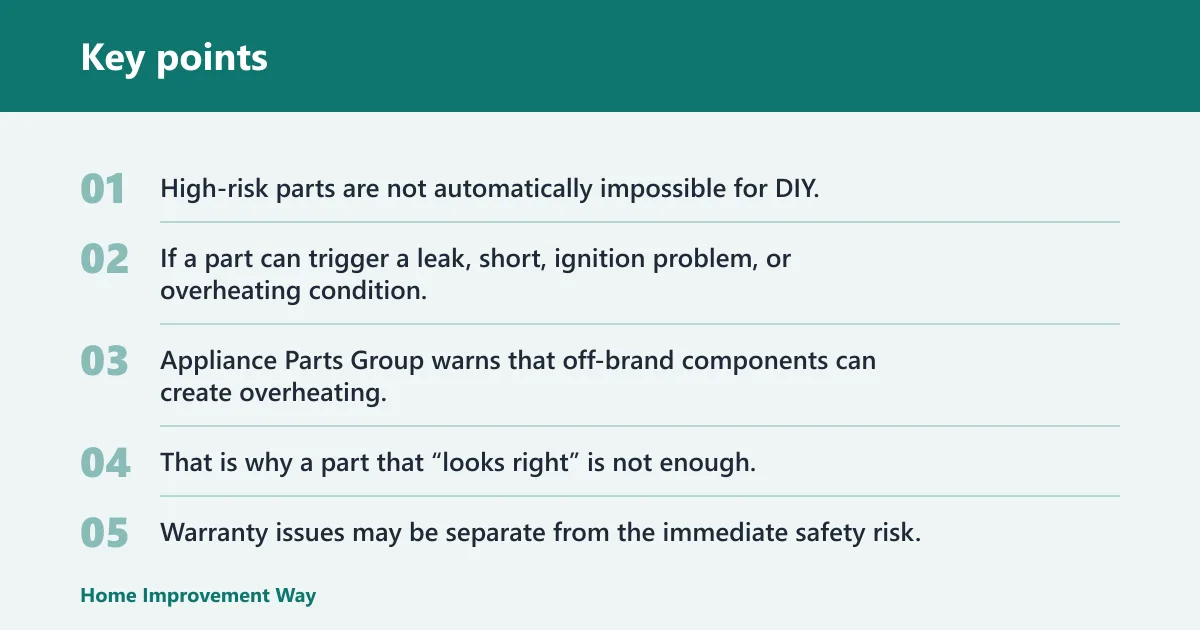
High-risk parts are not automatically impossible for DIY, but they are poor candidates for guesswork. If a part can trigger a leak, short, ignition problem, or overheating condition, the safest choice usually narrows to OEM or a technician install.
Appliance Parts Group warns that off-brand components can create overheating, water leaks, electrical shorts, gas ignition issues, and fire hazards. That is why a part that “looks right” is not enough.
Warranty, water, electrical, and fire flags
Use the flags as a stop sign. Warranty issues may be separate from the immediate safety risk, and water damage or fire risk can matter more than the part price. A cheap replacement can become expensive fast if it causes a callback, cabinet damage, or secondary repairs.
What parts should always be OEM?
OEM is often the safest default for control boards, heating elements, water inlet valves, and many door gaskets or seals. These parts affect safety, calibration, leakage, or heat control, so a small mismatch can create a large problem even when the part seems to fit.
Control boards and programmed electronics
Control boards are a high-risk compatibility category. They may require an exact part number and a programming match, not just the same connector count. If the board controls timing, temperature, or error logic, a wrong revision can create failures that are hard to diagnose.
Heating elements must match wattage, shape, terminals, and mounting points. A wrong spec can overheat the compartment, trip a protection device, or create a fire risk. OEM is usually the safer choice when the part affects heat or electricity.
Water inlet valves and leak-risk parts
Water inlet valves need pressure compatibility and a reliable seal. If the valve body, port size, or connector pattern is off, leaks can start at the hose connection or valve seat. Water damage is one of the least forgiving failure modes because the repair bill can spread beyond the appliance.
Door gaskets and seals
Door gaskets and seals depend on exact fit and material thickness. Even tiny differences can cause a gasket that does not seal correctly. That can lead to leaks, condensation, heat loss, or poor drying performance.
When is it okay to use aftermarket appliance parts?
Aftermarket is most reasonable for low-risk, noncritical parts that are easy to inspect and replace, such as knobs, shelves, handles, some filters, and other simple accessories. It can also work for a verified replacement when the part number, dimensions, and mounting points match exactly and the job is easy to access.
Simple cosmetic and storage parts
These parts usually do not control heat, water, or power. If a handle is the right length and the screw holes line up, the risk is low. A mismatch is still annoying, but it is far less likely to create a safety issue.
Low-risk parts with exact match specs
Some aftermarket parts are acceptable when the seller provides a precise model match and the specs line up with the original design. This is especially true when the part is not responsible for sealing, switching high voltage, or controlling a water path.
Rebuilt and refurbished parts: what changes the risk
Rebuilt or refurbished parts are a third category. They may be safe in some cases, but the risk depends on what was replaced, tested, or recalibrated before resale. A refurbished control board is much harder to trust than a refurbished shelf or handle, because internal wear is not always visible.
How do you verify a replacement part will fit?
Start with the full model code, then confirm the part number, then check the physical details. The model number should include letters, numbers, dashes, and suffixes. The serial number can be useful for warranty and batch checks, but it is not a substitute for the model or part number.
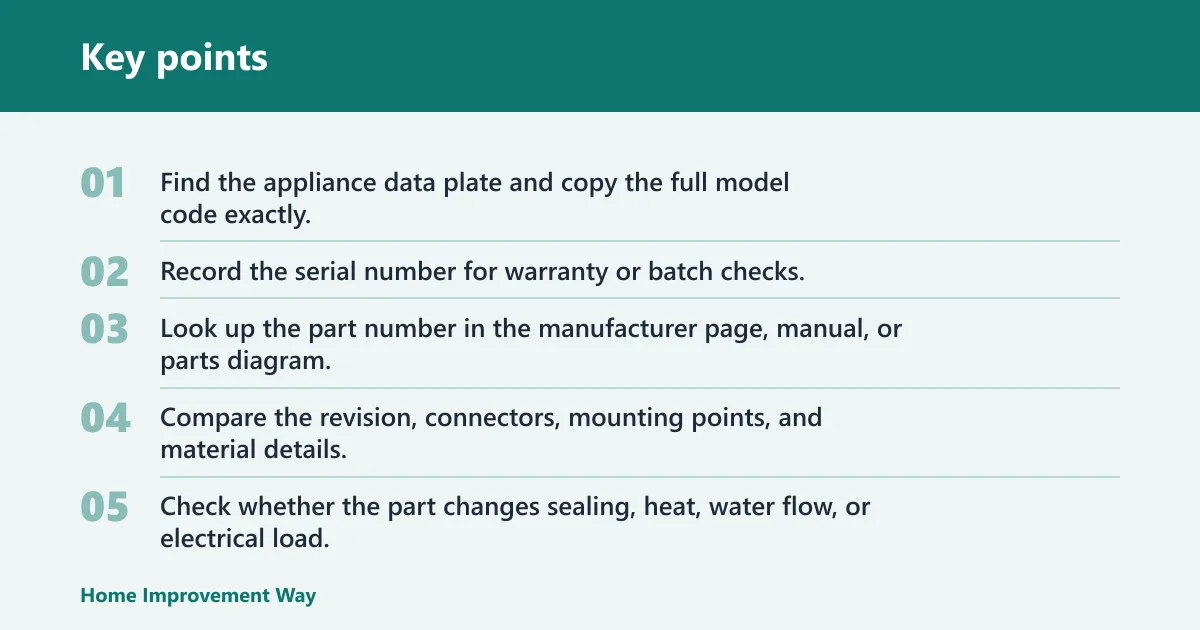
- Find the appliance data plate and copy the full model code exactly.
- Record the serial number for warranty or batch checks.
- Look up the part number in the manufacturer page, manual, or parts diagram.
- Compare the revision, connectors, mounting points, and material details.
- Check whether the part changes sealing, heat, water flow, or electrical load.
Model number first
Exact model matching comes first because compatibility often changes between production runs. A full code with letters, numbers, dashes, and suffixes can point to different trims or revisions that use different parts.
Serial number and part number checks
The serial number can help confirm warranty status or batch information, but it does not tell you what part belongs in the machine by itself. The part number is the replacement identifier you should confirm against the manufacturer source or parts diagram, and the best match is the exact revision when possible.
What must match on dimensions, material, and mounting points?
Do not rely on a visual match. Fit, shape, material, mounting points, connector type, and function must all line up. For a lint filter, for example, fit affects lint capture and airflow, so the wrong profile can reduce performance even if the part slides into place.
Choose OEM if… / Choose aftermarket appliance parts if…
Choose OEM if the part controls heat, electricity, sealing, water flow, or programming. Choose aftermarket appliance parts only when the part is low risk, the model and part numbers match exactly, and the seller gives enough detail to verify fit before you buy. If access is difficult, lean toward the safer choice.
Choose OEM if…
You are replacing a control board, heating element, water valve, or gasket where a mismatch could cause a leak or unsafe operation. You need the best chance of exact fit. You are already dealing with a hard-to-access repair and want to avoid repeat labor.
Choose aftermarket appliance parts if…
The part is cosmetic, storage-related, or simple enough that a wrong fit would be obvious before installation becomes risky. The listing shows the full model code, the exact part number, and the mounting details. The return policy is clear enough to protect you if the match is wrong.
Picture a dishwasher inlet valve mounted behind the lower front panel. If the machine must be pulled out and the floor is finished hardwood, a bad fit has a larger cost than the part price because the labor and water-damage risk rise together. In that situation, a safer part choice matters more than a small savings.
When to stop and call a pro
Stop if the part involves gas, sealed-system work, high-voltage electronics, or any repair where a leak or ignition problem would be hard to control. Also stop if the listing gives only vague compatibility language, the model code is incomplete, or the part appears to match visually but not by revision.
Warranty and return-policy checks before you buy
Can aftermarket parts void an appliance warranty? Sometimes a manufacturer may dispute coverage if the replacement contributed to the failure, but the details depend on the warranty terms and the failure itself. Parts warranty, manufacturer warranty, and labor or callback risk are different things, so check all three before ordering.
Frequently asked questions
Can aftermarket parts void an appliance warranty?
They can create warranty problems if the part or the installation causes the failure, but the exact outcome depends on the warranty terms and the problem at hand. Keep the part receipt, the model number, and the installation record. Those details help if you need to show what was installed and why.
How do I know if a replacement part will fit my model?
Match the full model code first, then confirm the part number, revision, connector style, and mounting points. The serial number helps with warranty or batch checks, but it is not a replacement for the model or part number. If any of those do not line up, do not assume it will fit.
What happens if an aftermarket part is slightly off?
Even a small mismatch can cause a gasket to leak, a valve to seep, a board to misread sensors, or a heater to run too hot. Some problems show up right away, while others appear after a few cycles. Tiny differences are often the ones that create the biggest repair costs.
Are rebuilt or refurbished appliance parts safe to install?
Sometimes, but they need the same careful review as any other replacement, and the risk is higher for electronics and safety-related parts. Ask what was replaced, tested, and recalibrated. A refurbished cosmetic part is a different risk category from a refurbished control board.
How do I avoid buying the wrong appliance part online?
Copy the full model code exactly, compare the part number to the manufacturer page or parts diagram, and avoid listings that rely on vague phrases like “fits many models.” Check dimensions, connector layout, and return terms before checkout. If the seller cannot confirm the revision, keep looking.
What appliance parts should always be OEM?
Use OEM for control boards, heating elements, water inlet valves, and most gaskets or seals when fit and function affect safety or damage risk. Those parts are less forgiving of small differences. If the job is hard to access, that is another reason to favor the safer part choice.
Sponsored / affiliate links. As an Amazon Associate I earn from qualifying purchases. I may earn additional commission from eligible campaigns.