Best Appliance Repair Parts Stores: Stock, Price, Returns
The best appliance repair parts store is the one that scores highest on three checks: in-stock rate, true delivered price, and return friction; if two stores tie, choose the one with the clearer parts match policy. Weak screening means the wrong part, slower repairs, and extra shipping or restocking fees. This guide gives you a scorecard to compare stock reliability, delivered cost, and returns before you order.
Top pick for appliance parts buyers
Choose the store that matches by model number first, shows stock by specific SKU, and states returns clearly before checkout. That combination cuts fit risk and makes the final cost easier to compare.
What makes this kind of store easier to buy
A good parts store does more than list a part name. It lets you search by appliance type, brand, and model, shows whether the exact SKU is in stock, and gives enough policy detail to judge delivery timing and returns before you pay.
Whitegoods Help, for example, says it has searches by appliance type, brand, and model, says stocked parts are dispatched in 1–3 days, and says parts are “Matched to your model first.” It also says it stocks 15,977 parts and offers help choosing before purchase.
Why model-number lookup matters before you click order
The appliance model number is the first fit check because it ties the part to the exact appliance type and brand. The part number is the next check, since it is the exact ordering identifier and removes confusion better than a description-only search.
That order matters. A dishwasher pump, a fridge gasket, a cooker hob element, and a washing machine valve can look similar in a catalog but differ in mounting points, seal profile, or electrical rating. A similar shape is not enough.
Quick picks by buying need
Different stores win for different reasons. If you need the right part fast, focus on stock certainty and dispatch timing. If you want lower risk, focus on model matching and returns. If you want the lowest total cost, include shipping and return postage in the comparison.
- Best for urgent repairs: the store that shows the exact SKU in stock and gives a dispatch estimate, not just a category listing.
- Best for lowest delivered cost: the store with the best total after shipping thresholds, not the lowest sticker price.
- Best for easier returns: the store with a clear return window, low or no restocking fee, and plain rules for opened packaging.
- Best for OEM or compatible choice: the store that separates genuine parts from compatible parts and explains the fit trade-off.
Urgent repair buys
If a refrigerator is warming up or a dishwasher is leaking, stock certainty matters more than a small price difference. A listing that says “in stock” by SKU and names a dispatch time is stronger than a broad “available” label with no fulfillment detail.
Planned maintenance buys
For a planned seal, filter, or pump replacement, you can spend more time comparing part numbers, return terms, and OEM versus compatible options. That is where total cost and support quality matter most.
Appliance parts scorecard
Use this scorecard before you order. Score each line from 0 to 5, then multiply by the weight. A seller with a good list price can still score poorly if stock is vague or returns are costly.
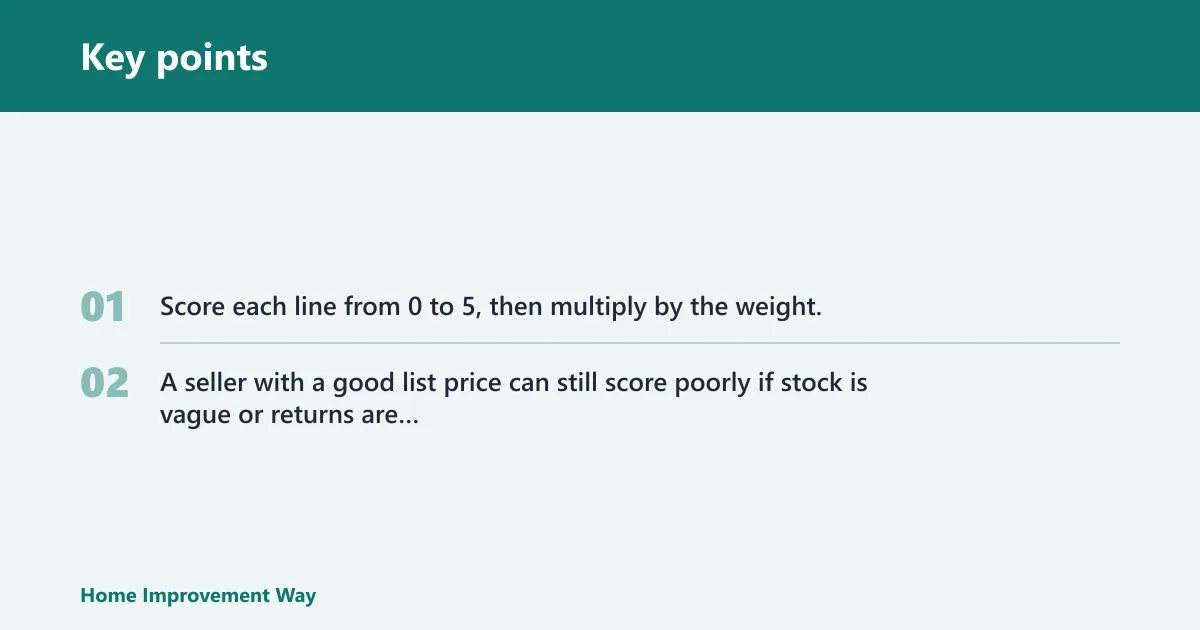
0-5 scoring rubric for stock certainty, price, and returns
| Criterion | Weight | 5 points | 3 points | 0 points |
|---|---|---|---|---|
| Stock certainty | 25% | Exact SKU shown as in stock, ready to ship | Stock shown but timing unclear | Only a category page or out of stock |
| Exact-model lookup | 15% | Model number required or strongly checked before order | Model lookup available, but part page is broad | Description-only search with no fit check |
| Delivered price | 15% | Low total after shipping and thresholds | Mid-pack total cost | Hidden shipping or fee makes it expensive |
| Return window | 10% | Clear window, long enough for fit check | Window exists but is short | No clear return window |
| Return postage | 10% | Free or clearly capped | Customer pays some return cost | Full return postage burden is unclear or high |
| Restocking fee | 10% | No fee, or a small disclosed fee | Moderate fee | Large or hidden fee |
| Support quality | 10% | Model-first help before purchase | Support available but limited | No useful pre-buy help |
| OEM or compatible selection | 5% | Clear split between genuine and compatible parts | Some choice, but the difference is not clear | Choice is unclear or mislabeled |
Text-only comparison template
| Store | SKU in stock? | Model match check? | Delivered price | Return window | Return postage | Restocking fee | Support | OEM/compatible split | Total score |
|---|---|---|---|---|---|---|---|---|---|
| Store A | Yes | Yes | Low | Clear | Low | Low | Strong | Clear | High |
| Store B | No | Partial | Lowest list price | Unclear | High | High | Weak | Mixed | Low |
Sample scorecard: dishwasher pump
| Criterion | Score | Why |
|---|---|---|
| Stock certainty | 5 | Exact pump SKU shown in stock and ready to ship |
| Exact-model lookup | 5 | Seller confirms the dishwasher model number first |
| Delivered price | 3 | List price is fair, but shipping pushes the total up |
| Return window | 4 | Enough time to inspect before installation |
| Return postage | 3 | Buyer pays return postage |
| Restocking fee | 2 | Fee applies if the box is opened |
| Support quality | 5 | Support checks the model number before purchase |
| OEM or compatible selection | 4 | OEM available, compatible option clearly labeled |
Sample scorecard: fridge gasket
| Criterion | Score | Why |
|---|---|---|
| Stock certainty | 4 | Exact gasket listed in stock, but dispatch timing is less clear |
| Exact-model lookup | 5 | Fridge model number required for the seal profile |
| Delivered price | 4 | Higher sticker price, but free shipping lowers the total |
| Return window | 3 | Window is shorter than ideal for checking fit |
| Return postage | 2 | Customer pays full return postage |
| Restocking fee | 3 | Moderate fee for opened packaging |
| Support quality | 4 | Support can confirm model and door style before order |
| OEM or compatible selection | 5 | OEM seal clearly separated from compatible substitute |
Which store has the right part in stock?
The right store shows stock by the exact SKU, not by a broad category page. That matters because a category can include multiple versions of the same-looking part, while only one version matches your appliance model and brand.
Stock status by SKU, not just category
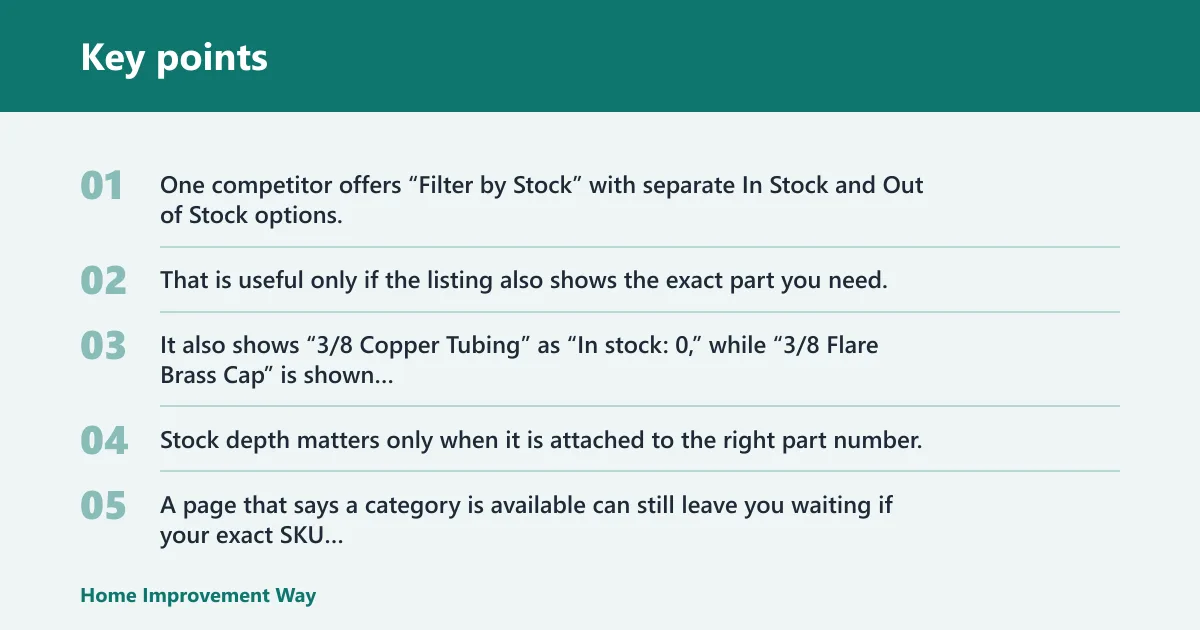
One competitor offers “Filter by Stock” with separate In Stock and Out of Stock options. That is useful only if the listing also shows the exact part you need. It also shows “3/8 Copper Tubing” as “In stock: 0,” while “3/8 Flare Brass Cap” is shown with 16 units in stock.
That difference is the point. Stock depth matters only when it is attached to the right part number. A page that says a category is available can still leave you waiting if your exact SKU is out of stock.
How to verify exact-model fit
Start with the appliance model number, then check the part number, then compare the appliance category. A dishwasher pump for one brand can fit one series and miss another series by connector layout or seal shape.
Whitegoods Help says parts are “Matched to your model first.” Needapplianceparts has a page organized “By part number only.” Those are both stronger buying cues than browsing by description alone.
When backorder language is a red flag
If the store says an item is “available” but does not show the SKU, stock count, or dispatch timing, assume the risk is higher. Backorder language often means the part is not ready to leave the warehouse today.
For a broken dishwasher pump or a fridge gasket that is already leaking cold air, a vague timeline can turn a one-week fix into a longer repair.
How do you compare delivered price?
Compare the delivered price, not the sticker price. The true total includes the part price, shipping, any order threshold needed for free delivery, and possible return postage if the part does not fit.
List price versus delivered price
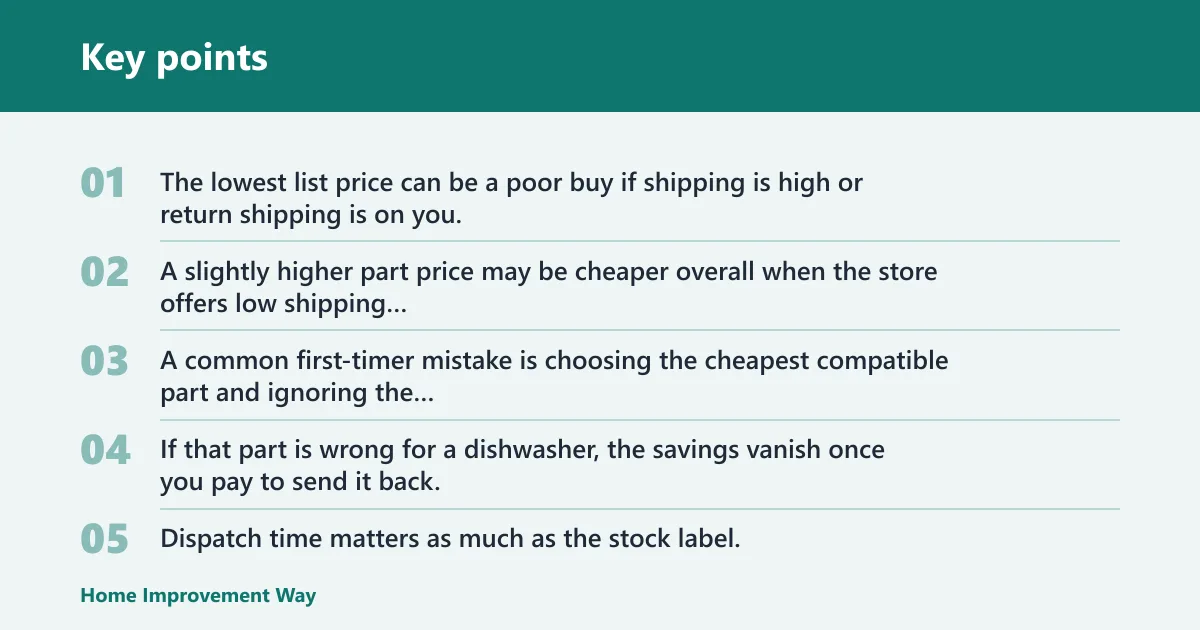
The lowest list price can be a poor buy if shipping is high or return shipping is on you. A slightly higher part price may be cheaper overall when the store offers low shipping or a better return policy.
A common first-timer mistake is choosing the cheapest compatible part and ignoring the return cost. If that part is wrong for a dishwasher, the savings vanish once you pay to send it back.
Shipping thresholds and dispatch timing
Dispatch time matters as much as the stock label. The same source says stocked parts are dispatched in 1–3 days, which is stronger than a store that only says “in stock” without a fulfillment estimate.
If a part is needed for an urgent repair, a seller with clear dispatch timing and stock by SKU is usually the safer choice, even if the sticker price is a little higher.
When a cheaper part costs more overall
Suppose a fridge gasket is $10 cheaper from one seller, but that seller charges more shipping and a restocking fee if the seal is not the right profile. The cheaper listing can become the more expensive order after one return.
That is why delivered price should include both outbound and possible return costs.
What return policy should you check first?
Check the return window, restocking fee, return postage, and any fit-related exceptions before you buy. Parts with opened packaging, electrical components, or fitted seals often face tighter rules than unopened accessories.
Return window and restocking fee
A short return window raises the risk on parts that need a careful fit check. A restocking fee makes that risk costlier. If the policy is vague, treat that as a warning sign.
Return postage and opened-box rules
Return postage is a hidden cost that matters on small, low-cost parts as much as on larger ones. Opened-box rules matter because many sellers will not take back a part once it has been installed, modified, or damaged during fitting.
Do not assume electrical parts are forgiving. If a control board, switch, or pump is opened and installed, the return path can be narrower than for a non-installed accessory.
Fit-related exceptions are common for parts that have been fitted. If the seller excludes installed items from return, you need stronger model-number confirmation before ordering.
That is especially important for dishwasher pumps and fridge gaskets, where the part can look close enough on the page but still fail the fit test in the appliance.
How do OEM and compatible parts compare?
Genuine parts and compatible parts are not the same buy. OEM parts usually give higher fit confidence; compatible parts can save money, but the buyer should accept more variation risk and check support more carefully.
Genuine parts and fit confidence
OEM or brand-made parts usually fit with less guesswork because they are made for the appliance brand and model family. That does not remove the need to confirm the model number, but it usually lowers fit risk.
Compatible parts and price trade-offs
Compatible parts can be a smart buy when the store explains the substitute clearly and the price gap is meaningful. The trade-off is fit certainty, especially on seals, pumps, and electrical parts.
Use compatible parts more cautiously on washing machine pumps, dishwasher components, and fridge gaskets than on simple trim pieces.
When to ask support before ordering
Ask support before ordering if the store cannot match your model number first, if the listing uses generic wording, or if the part is expensive to return. The same source says it offers help choosing before purchase, which is the right kind of support for a fit-sensitive buy.
Do not assume a photo alone is enough. If the seller cannot verify the model number, the risk stays high.
How to choose
Start with the model number, then the part number, then the SKU stock status. After that, compare delivered price, return friction, and whether the item is OEM or compatible. That order keeps you from paying less up front and more later.
- Find the appliance model number on the rating plate.
- Match the part number, not just the description.
- Check whether the exact SKU is in stock.
- Compare delivered price, including shipping and any thresholds.
- Read the return window, restocking fee, and return postage terms.
- Decide whether OEM or compatible is the safer choice for your appliance category.
- Use support if the fit is uncertain.
For a washing machine, the risk often sits in connectors and load-specific variants. For a cooker or hob, the risk may be electrical rating or burner layout. For a fridge/freezer, gasket profile and door side matter a great deal. For a dishwasher, spray path and pump fit matter more than the part’s general shape.
Picture a dishwasher that shows an error and will not drain. The right pump listing should match the model number first, show the exact part number, and explain whether the part is OEM or compatible before you buy.
Say your fridge door seal is torn at one corner. A seller with a clear model lookup, a defined return window, and an explicit gasket profile is a better buy than the cheapest listing with no fit checks.
Frequently asked questions
Which appliance parts store has the right part in stock?
The better store is the one that shows stock at the SKU level and matches your model number first. A broad “in stock” label is not enough. If the site can also show dispatch timing, that is stronger evidence the part is ready to ship.
How do I compare part prices across appliance repair parts stores?
Compare the delivered price, not the list price. Add shipping, any free-shipping threshold you may miss, and possible return postage. Then weigh the restocking fee and the chance of a fit error, especially on electrical parts and seals.
What return policy should I look for before buying a replacement part?
Look for a clear return window, a disclosed restocking fee, and plain rules for opened packaging or installed parts. If the seller limits returns on fitted items, you need stronger model-number confirmation before you order.
How can I tell if a parts store will match my model number first?
Look for language that says the store searches by appliance type, brand, and model, or states that parts are matched to your model first. A support option before purchase is also a good sign, especially when the part is expensive or fit-sensitive.
Should I buy genuine or compatible appliance spare parts?
Buy genuine parts when fit confidence matters most, especially for gaskets, pumps, and electrical parts. Buy compatible parts when the listing clearly explains the substitute and the price gap is worth the added risk. If the fit is unclear, ask support first.
How fast can stocked appliance parts usually ship?
Stocked parts can ship quickly, but you should look for a real dispatch estimate. The same source says stocked parts are dispatched in 1–3 days. If a store does not state timing, do not assume the order will leave immediately.
Sponsored / affiliate links. As an Amazon Associate I earn from qualifying purchases. I may earn additional commission from eligible campaigns.