Are Appliance Repair Parts Universal? What Fits and What Does Not
Some appliance repair parts can fit more than one model, but only when voltage, size, mounting pattern, connector type, and control specs appear to line up. Many cosmetic and mechanical parts are brand- and model-specific. Buy the wrong part and you can damage the appliance, create a safety risk, or lose time and shipping money. This guide shows which parts can be universal, which must match exactly, and how to check fit before you buy.
Are appliance repair parts universal?
Some are, but only within narrow limits. A part can fit the opening and still fail electrically, mechanically, or by calibration. Appearance is a weak test. Exact model matching matters most for control, safety, sealing, and any part that affects airflow, water flow, or heat.
Why two parts that look identical can fail for different reasons
Two parts may share the same shape and still differ in connector layout, shaft length, bracket position, trip point, resistance, or programming. A switch can click into place and still send the wrong signal. A gasket can mount and still leak. Fit is only one layer.
Appliance parts compatibility matrix
| Part category | Usually universal? | Must match exact model? | Key specs to verify | Common failure if wrong |
|---|---|---|---|---|
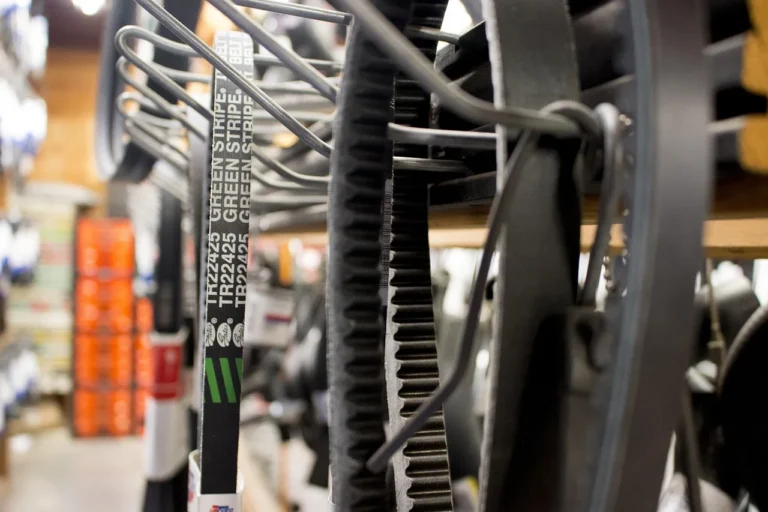
| Belts | Sometimes | No, if dimensions and profile match | Length, width, rib count, stretch, tension path | Slipping, noise, no drum or fan movement |
| Gaskets | Rarely | Usually yes | Perimeter length, profile, magnet layout, corner shape | Leaks, warm spots, airflow loss, poor closing force |
| Switches | Sometimes | Often yes | Voltage, amperage, terminals, actuator shape, mounting | No start, false readings, intermittent operation |
| Sensors | Rarely | Usually yes | Resistance curve, calibration, connector style, placement | Wrong temperatures, fault codes, poor cycle control |
| Water valves | Rarely | Usually yes | Inlet size, outlet count, coil rating, mounting bracket | Leaks, low fill, overfill, ice maker problems |
| Control boards | Rarely | Almost always | Part number, revision, firmware, connectors, appliance code | Dead control, error codes, erratic cycles |
| Igniters | Rarely | Usually yes | Mounting position, lead length, current draw, gas system type | No ignition, delayed ignition, gas buildup risk |
| Filters | Sometimes | Yes for claim and fit | Filter model, certification, seal diameter, lock style | Leaks, poor filtration, bad taste, bypass flow |
What OEM, aftermarket, and universal mean
OEM parts are made by or for the original manufacturer. Aftermarket parts are made by third parties. Universal parts are built to fit more than one appliance or configuration. The labels sound similar, but they do different jobs, and none of them removes the need to check the full model number and part number. (Wikipedia)
OEM parts
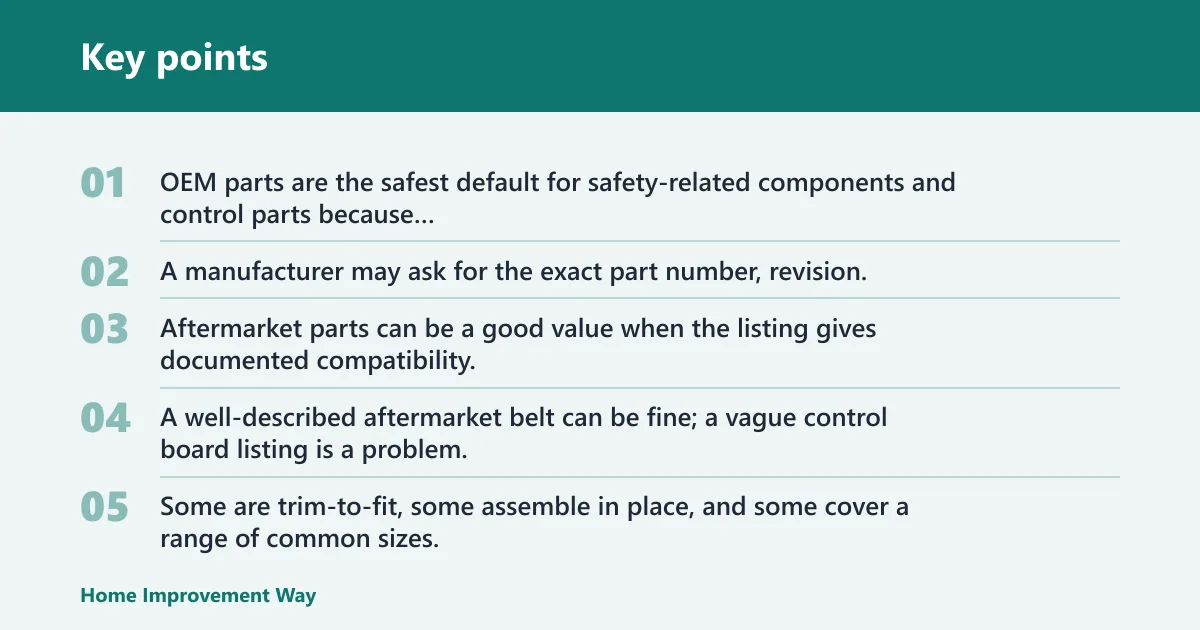
OEM parts are the safest default for safety-related components and control parts because they are tied to the appliance’s documented fit and specification. That matters for warranty review too. A manufacturer may ask for the exact part number, revision, and cause of failure before approving coverage.
Aftermarket parts
Aftermarket parts can be a good value when the listing gives documented compatibility, the specs match, and the part is not safety-critical. Quality varies more than with OEM. A well-described aftermarket belt can be fine; a vague control board listing is a problem.
Universal parts
Universal parts are generic or adaptable. Some are trim-to-fit, some assemble in place, and some cover a range of common sizes. They make sense for simple mechanical jobs, but they stop being practical when exact fit affects heat, water flow, airflow, sealing, or electrical control.
Which parts can be universal?
Low-risk mechanical parts are the best candidates for universal fit. Belts, some rollers, some hinges, and a few trim-to-fit seals can work if the dimensions and mounting points line up. Some replacement filters are acceptable too, but only when the certification claim and model match are exact.
What to verify before buying
Check dimensions first, then connector type, mounting points, and electrical rating if the part carries power. Also verify appliance category. A part that works on one refrigerator line may not suit another. A “fits most” claim is not enough when bracket depth or lead length differs.
- Find the full model number, including suffixes.
- Match the part number against the diagram, not the photo alone.
- Confirm voltage, amperage, resistance, or certification where relevant.
- Check connector style, bracket shape, and shaft length.
- Read whether the listing is exact replacement, revised substitute, or only a partial fit.
Which parts should match exact model?
Safety and control parts should usually match the exact model or a manufacturer-approved substitute. Igniters, thermal fuses, door locks, gas valves, control boards, and many sensors are generally not casual swap items. A part that fits physically can still be wrong in calibration, trip point, or electrical rating.
Why exact match matters
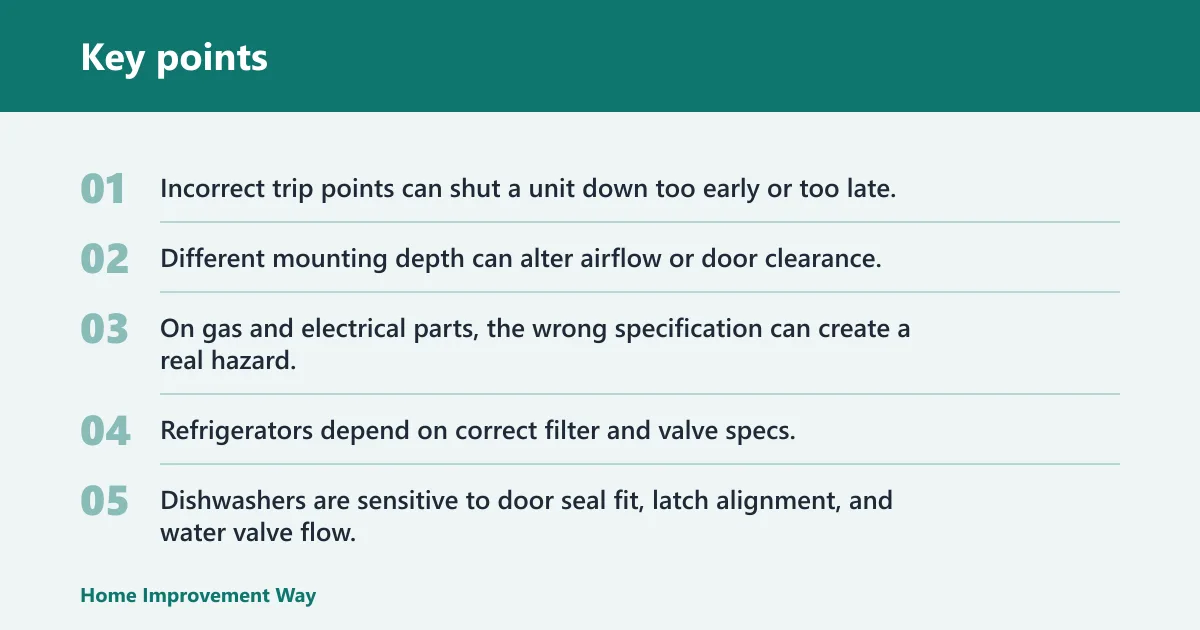
Incorrect trip points can shut a unit down too early or too late. Wrong connectors can force a bad splice. Different mounting depth can alter airflow or door clearance. On gas and electrical parts, the wrong specification can create a real hazard, not just a repair delay.
Appliance-specific notes
Refrigerators depend on correct filter and valve specs, plus exact gasket shape and magnetic pull. Dishwashers are sensitive to door seal fit, latch alignment, and water valve flow. Ovens and ranges need careful igniter and gas valve matching. Washers and dryers are often sensitive to belt length, motor spec, and switch layout.
Suppose a dryer belt is 1 inch too short. It may still stretch onto the drum, then slip under load and leave the drum turning unevenly. Change only one variable, and the symptom can move from “won’t turn” to “starts, then stalls,” which is why dimensions matter more than appearance.
A common first-timer mistake is buying a door gasket because the old one looks close in photos. If the magnetic strip is weaker or the corner profile is off by a small amount, the door may close but the cabinet still leaks cold air or moisture. That is a fit failure, not a cosmetic one.
How to match a part to your model
Start with the full model code, including suffixes. Do not confuse it with the serial number. The model number is what parts diagrams and compatibility lists use. The part number then tells you the exact replacement identifier, including any superseded or revised version.
Use model number, part number, and diagram together
Check the appliance diagram to confirm how the part mounts and what revision it replaces. A part listing may say “revised version” or “exact substitute.” That wording matters. If the listing only says “fits selected models,” verify your full code before ordering.
Check the listing for three things
Look for exact-model coverage, the current part number, and any supersession note. If a part was revised, the older number may no longer be sold. That does not mean any close-looking part will work. It means the replacement path should be documented.
Choose universal or OEM if…
Choose universal when the part is simple, low-risk, and dimension-driven. Choose OEM when the part affects safety, sealing, calibration, or warranty review. The best choice depends on the function, not the price tag. A cheap part that misses one spec can cost more than the original replacement.
Choose universal if…
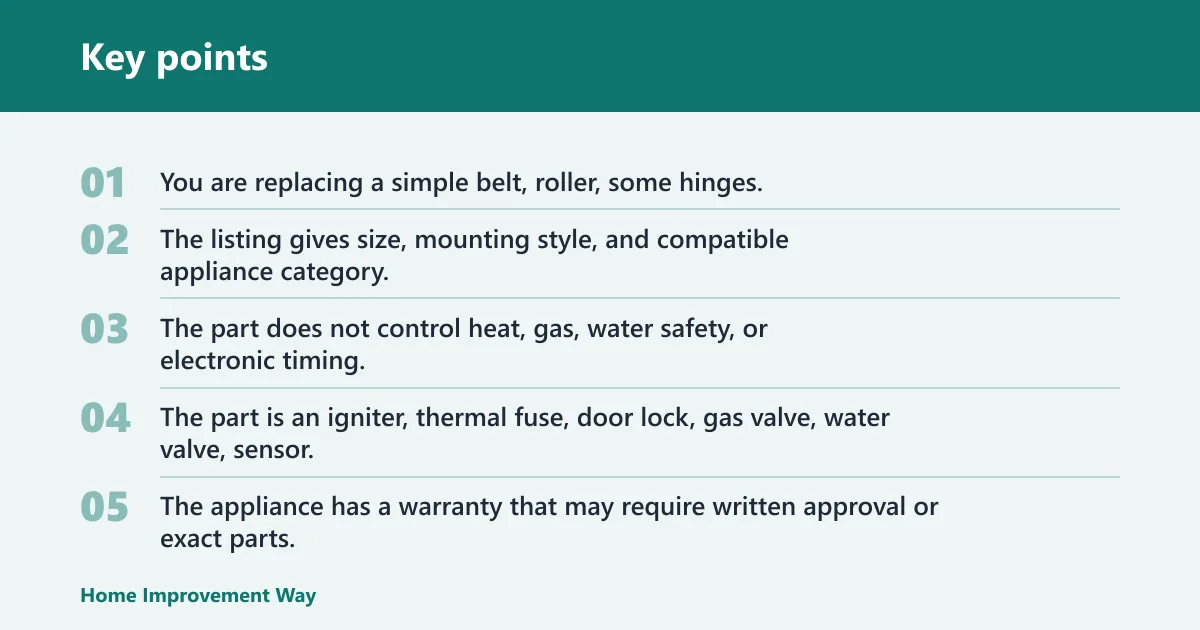
You are replacing a simple belt, roller, some hinges, or another mechanical part with clear dimensions. The listing gives size, mounting style, and compatible appliance category. The part does not control heat, gas, water safety, or electronic timing.
Choose OEM if…
The part is an igniter, thermal fuse, door lock, gas valve, water valve, sensor, or control board. The appliance has a warranty that may require written approval or exact parts. The job depends on precise calibration, trip points, connector layout, or sealed fit.
Use appliance category as a filter
In refrigerators, a filter, gasket, and valve deserve extra scrutiny. In ovens and ranges, ignition and gas parts should be treated as exact-match items. In washers and dryers, belts and some rollers are more flexible, while switches, locks, and controls are not. In dishwashers, spray and water-control parts need close spec matching.
Frequently asked questions
Are appliance repair parts universal, or do they need to match my exact model?
Many appliance repair parts are not universal. Some mechanical items can fit multiple models, but safety parts, controls, seals, and water or gas components usually need the exact model or a clearly documented substitute. The full model code, including suffixes, is the starting point for a safe match.
Which appliance parts can be universal and which parts should never be universal?
Belts, some rollers, some hinges, and some trim-to-fit seals are the best candidates for universal use. Igniters, thermal fuses, door locks, gas valves, control boards, and most sensors should not be guessed. If the part affects heat, gas, water, or control logic, exact specs matter.
How do I know if an aftermarket part will fit my appliance?
Check whether the listing names your exact model, not just the brand. Compare the part number, revision, connector layout, mounting points, and electrical rating. Good aftermarket listings explain compatibility in detail. If the listing only says “looks the same,” treat that as incomplete.
Do universal appliance parts work for refrigerators, ovens, washers, and dishwashers?
Sometimes, but not equally. Refrigerators can accept some filters and gaskets only if the claim and dimensions match. Ovens are stricter around ignition and gas parts. Washers and dryers allow more flexibility with belts and rollers. Dishwashers are sensitive to seals, valves, and latch fit.
What parts are okay to buy generic, and what parts need OEM?
Generic can be reasonable for simple belts, rollers, and some hinges when dimensions match. OEM is the safer choice for safety-related parts, control boards, and sealed components. If the part affects performance, safety, or warranty review, OEM or manufacturer-approved parts are the better path.
Can a universal part affect safety, warranty, or performance?
Yes. A universal part can change trip points, airflow, water flow, sealing, or electrical behavior. It can also complicate warranty review if the manufacturer asks for exact part evidence. Save the model number, part number, listing text, and any written approval before you install anything uncertain.
How do I match a replacement part to my model number?
Use the full model number, including suffixes, then match the part number against the parts diagram and listing. Do not use the serial number as a substitute. If the listing says revised version or superseded replacement, verify that the new part is approved for your exact model.
What should I check before buying a universal appliance part online?
Check the model number, connector type, mounting points, size, electrical rating, and any certification or claim wording. For filters, the exact filter and the certification claim must match. For safety parts, look for manufacturer-approved or exact-spec wording, not just a close visual match.
Sponsored / affiliate links. As an Amazon Associate I earn from qualifying purchases. I may earn additional commission from eligible campaigns.