Best Organizers for Fasteners (2026): Based on Specs and Reviews
Use a 3-zone system: one bin for active screws, one for leftovers sorted by size and type, and one case for bits and drivers. Label every container and keep duplicates out of the active bin. Without that split, you buy duplicates, lose matching screws, and waste time hunting. This guide shows the bins, labels, size rules, and setup steps that keep fasteners findable in under 10 seconds.
Quick comparison
| Product | Badge | Best for | Price | ||
|---|---|---|---|---|---|
 |
Akro-Mils 10124, 24 Drawer Plastic Parts Storage HardwareAkro-Mils | Our pick | 24 drawers · cabinet style · red | $45.99
Price as of 27 Oct 2026
|
View |
 |
IRIS USA 44-Drawer Small Parts Storage Cabinet, Crafts,IRIS USA | Also great | 44 drawers · wall-mountable · stackable | $39.99
Price as of 27 Oct 2026
|
View |
 |
Stanley BOSSTST14022 – Sortmaster Junior OrganizerStanley | Budget pick | Sortmaster Junior · organizer case · black | $36.72
Price as of 27 Oct 2026
|
View |
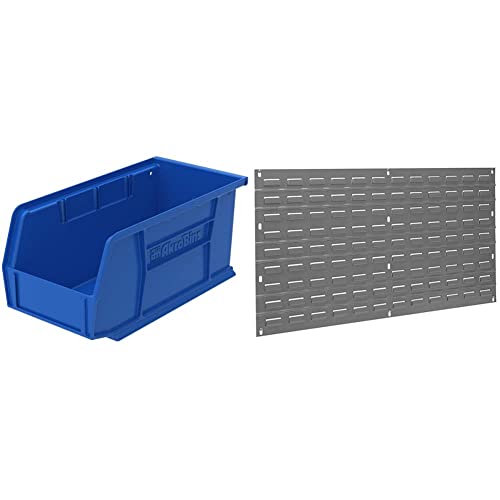 |
Akro-Mils Hanging Storage Bins and Wall Mount Panel BundleAkro-Mils | Upgrade pick | 12 bins + wall panel · hanging system · black/grey | $122.87
Price as of 27 Oct 2026
|
View |
 |
4 Pcs Magnetic Hex Bit Holders 1/4" Drill Bits Holder, 148MAQUITA | Pair with it | 4-pack · magnetic base · bit trays | $20.49
Price as of 27 Oct 2026
|
View |
The right organizer depends on where the hardware lives and how often you move it. A fixed bench fits drawers best, while mixed leftovers and carry-around parts fit caddies or tackle boxes.
How we chose
The comparison below focuses on visibility, portability, container control, and how well each setup keeps leftovers separate from active-use stock. It also accounts for a separate path for bits, since bits fail the system when they end up mixed into screw bins.
We compared organizer styles that match common home storage patterns: bench cabinets, portable caddies, tackle boxes, and small-parts cabinets. The goal is not one universal box. The goal is a system that still works after a project ends, after a move, and after a new bag of screws gets opened.
We also looked for the practical details many guides skip: whether dividers can move, whether lids control spills, whether drawers stay aligned, and whether labels can carry the exact screw information needed for restocking.
Akro-Mils 24-drawer cabinet: best for bench storage
This cabinet fits a permanent workbench or wall section where you want a fixed home for active inventory and leftovers. Based on the published product details, the 24 drawers and included dividers make it a strong fit for separating similar screws before they get mixed together.
The best use is category-based storage: one drawer for wood screws, one for drywall screws, one for machine screws, and separate drawers for nuts, washers, anchors, and clips. That layout makes it easier to restock from a label instead of rummaging through one crowded bin.
The drawback is size discipline. If you let one drawer become a catchall, the cabinet loses the visibility advantage that makes it useful in the first place.
IRIS USA 44-drawer cabinet: best for tiny hardware
This is the strongest pick when you have micro screws, tiny washers, or classroom-style hardware that needs many shallow drawers. The published details list 44 drawers, wall-mounting, and stackability, which suits a garage wall or a compact parts area where bench space matters.
Use the smallest drawers for like-sized fasteners that are easy to confuse, especially small machine screws, specialty clips, and tiny anchors. The drawer count helps prevent the “everything small goes here” problem that turns into a search job later.
The drawback is that shallow drawers leave little room for bulky packaging or mixed project leftovers. If your hardware often arrives in half-used bags, you may still need a caddy for overflow.
Stanley Sortmaster Junior: best for portable mixed parts
This organizer works well when you need a compact case for screws, nuts, bolts, and other mixed pieces that travel between rooms or to a jobsite. It is the simplest fit for someone who wants a single portable box without setting up a full cabinet.
Use it for project leftovers, not your full inventory. A portable case is best when you want the day’s parts in one place and do not want loose items spilling across a truck bed or stairwell.
The drawback is capacity. Portable cases are easy to overpack, and overpacked cases make similar fasteners harder to separate by size and type.
Akro-Mils hanging bins: best for wall sorting
This setup suits a wall-mounted garage system where each bin can hold one fastener family and the panel frees shelf space. The published bundle includes 12 bins plus a wall panel, which makes it useful when you want categories visible at a glance.
It works best for active-use stock that gets reached often: wood screws in one bin, anchors in another, clips in a third, and so on. The open format speeds picking, but it also makes it easier for careless sorting to spread across nearby bins.
The drawback is spill control. Open bins are fast, yet they are less forgiving if a bin gets knocked loose or if you repack mixed leftovers without a label.
MAQUITA magnetic bit trays: best for bit access
This is the clearest answer for bit storage because it keeps driver bits separate from screws and gives them a fast-access home. Based on the published details, the trays hold up to 1/4-inch hex bits, use a magnetic base, and keep bits visible instead of buried in a screw box.
Use it as a dedicated bit path beside your fastener bins. That separation matters because bits are not just another small part; they are a tool interface, and mixing them with screws slows the job and invites the wrong grab.
The drawback is that open trays are not ideal for every mobile setup. If the whole system gets tossed into a truck or packed with heavy tools, the tray still needs a secure storage spot.
Which fastener organizer should you buy?
Choose a caddy if you move between rooms, repack often, or need a carry format for leftovers. Choose a tackle box if you want portable storage with more compartments and tighter closure for screws, nuts, bolts, and nails. Choose a small-parts cabinet if your main problem is tiny hardware that disappears in deep bins. Skip jars for mixed fasteners; they are poor at separating similar sizes and type families.
A common first-timer mistake is throwing drywall screws, wood screws, and machine screws into one clear box because “they all fit.” They do fit. They also become a slow mess the first time you need one specific size and type during a trim repair or hinge swap.
Say your shelf bracket repair needs 8 x 1-1/4 wood screws, but the drawer also holds #8 drywall screws and a handful of anchors. If those stay together, the right screw takes a full search. If they are split by type and size, the choice is immediate.
Choose a caddy if you move between rooms
A caddy is the best middle ground for homeowners who want order without a fixed cabinet.
Look for adjustable or removable dividers and a lid that controls spills. That matters more than a fancy case shell, because the dividers are what stop mixed screw types from sliding together when the box moves.
Choose a tackle box if you need portable storage
A tackle box style organizer is useful when you want a multi-compartment layout that closes tightly and travels well. FarmFoodFamily recommends tackle boxes for portable screw storage, and the form works especially well for homeowners who move hardware between a workshop, garage, and jobsite.
Pick one with latches that stay shut and compartments that are easy to clean out. If the locks are weak, the whole system fails during a move or when the box tips in a trunk.
Choose a small-parts cabinet for tiny hardware
Use a small-parts cabinet when you have lots of micro screws, tiny anchors, or small specialty pieces that need many shallow drawers. The IRIS USA cabinet with 44 drawers is a good example of the type, and Best Home Tools also highlights a 30-drawer Craftsman organizer and an Akro-Mils cabinet with 44 drawers for visible storage.
These cabinets are best for garage workspaces, classrooms, or any area where tiny parts need a fixed place. Check drawer alignment during setup and after moves, because misaligned drawers make the labels less useful.
Skip jars for mixed fasteners
Jars are fine for one loose category, but they are poor for a system that needs quick sorting by size and type. A jar hides labels, hides duplicates, and makes it easy to dump in the wrong piece when you are in a hurry.
If you already use jars, reserve them for one temporary overflow category only. Do not use them for the active bin.
Fastener labels and bit storage

Label each container with the screw size and type, then keep bits on a separate, easy-access path. For metric hardware, include diameter and thread pitch so restocking does not depend on guesswork. This is what turns a pile of similar parts into a system you can refill correctly.
What to label on every container
Put the fastener type first, then the size, then any special finish or head style that matters to the job. For example: “wood screw #8 x 1-1/4,” “drywall screw #6 x 1-5/8,” or “machine screw M4 x 0.7.”
Use a label maker, tape, or a permanent marker. The tool matters less than the consistency. One label format across all bins is what keeps restocking fast.
How to separate bits from screws
Keep bits in a quick-access tray, bit bar, or portable bit organizer, not in the same drawer as screws. Bits are selected by drive style and use case, while screws are selected by diameter, length, and thread type. Those are different jobs, so they need different access paths.
Best Home Tools notes a DEWALT box with a patented bit-bar design, which is the right kind of idea for this section of the system. The point is fast access, not bulk storage.
Labeling metric fasteners correctly
For metric fasteners, the label should include diameter and thread pitch. That prevents the common mix-up between similar-looking machine screws that fit different threads. If the container says only “M4,” it is incomplete for restocking.
Write the full format every time, such as “M4 x 0.7” or “M6 x 1.0,” so the label carries enough information to replace the part without checking three boxes.
Keeping active-use stock distinct from leftovers
Active-use stock is what you reach for first during a project. Leftovers are the partial bags, odd counts, and nearly empty packs that still matter but should not sit in the main working bin. Keep those two groups separate, or the active bin turns into a dead-stock drawer.
A simple rule works best: if it is enough to finish a current project, it stays in the active bin; if it is a small remainder or an odd match, it goes into leftovers by type and size. That prevents duplicate purchases and makes restocking visible.
Fastener organization matrix
This matrix turns the setup choice into a practical rule. Use it to match your storage style to the kind of hardware you keep most often, the label format you need, and the failure mode to watch for.
| Storage setup | Best screw types | Bit storage | Label format | Common failure mode |
|---|---|---|---|---|
| Bench cabinet | Wood screws, machine screws, drywall screws, washers, nuts | Separate bit tray or bit bar beside the cabinet | Type + size; for metric, diameter and thread pitch | Mixed drawers after a rushed cleanup |
| Caddy | Project leftovers, anchors, clips, a short active set | Portable bit-access organizer in the top section | Type + size + project name if temporary | Overfilling and divider drift |
| Tackle box | Screws, nuts, bolts, nails, mixed carry parts | Bit tray in a locked or latching pocket | Type + size on each compartment lid or insert | Lids unlatch or parts migrate between slots |
| Repurposed drawer bin | Small leftovers, tiny anchors, clips, specialty screws | Small side tray, not the same drawer | Short label plus size code on the front edge | Drawer overflow and label mismatch |
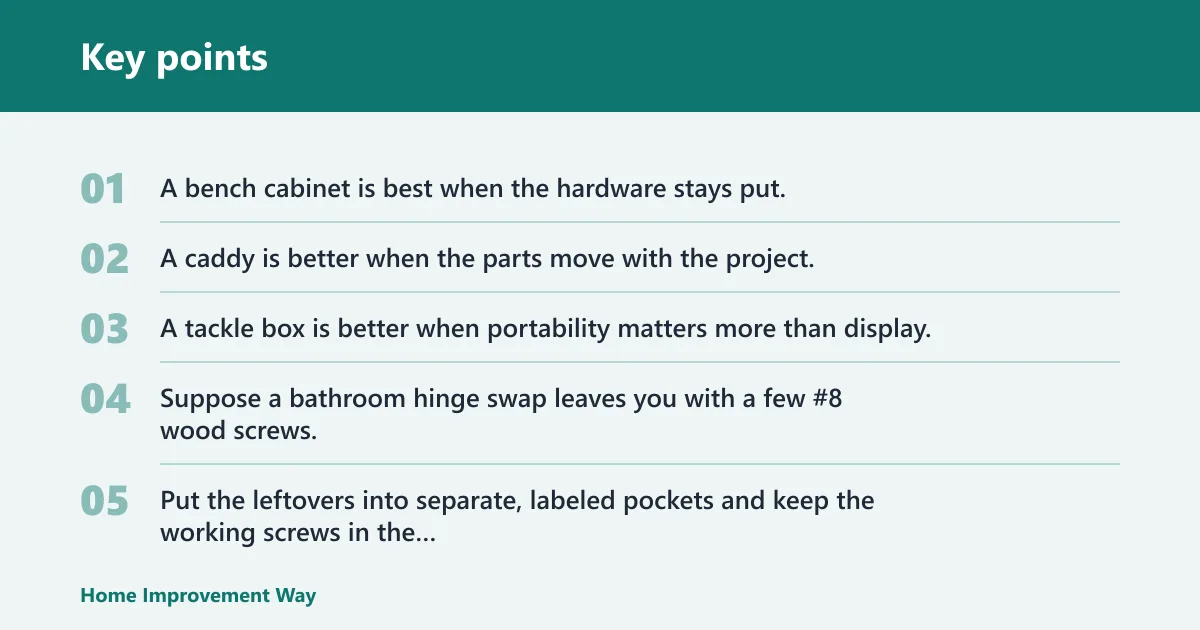
The four setups are not interchangeable. A bench cabinet is best when the hardware stays put. A caddy is better when the parts move with the project. A tackle box is better when portability matters more than display.
Suppose a bathroom hinge swap leaves you with a few #8 wood screws, several drywall screws, and one unopened pack of anchors. Put the leftovers into separate, labeled pockets and keep the working screws in the active bin. That split keeps the next small repair from starting with a dump-and-sort session.
Bench cabinet setup
Use a bench cabinet when you want visible drawers for permanent storage and quick identification. Modular drawer bins with transparent fronts and stackable expansion are a good fit because you can grow the system without rebuilding it.
The same source describes a 30-drawer Craftsman organizer for visible storage, and a 44-drawer cabinet is a useful benchmark when the collection is larger. Keep similar fasteners in neighboring drawers, but never in the same one unless the label is exact.
Caddy setup
Use a compartment caddy when you need a portable carry format with adjustable or removable dividers and a lid for spill control.
This is the best choice for homeowners who move between rooms often or repack the same fasteners after each task. The tradeoff is that the system depends on divider discipline. If a divider shifts, the categories shift with it.
Tackle box setup
Use a tackle box when you need portability for screws, nuts, bolts, and nails, but still want more slots than a basic carry case. The same source suggests clear stackable boxes for visibility and a toolbox with adjustable sections and detachable dividers, which fits the same logic.
The advantage is control during transport. The downside is that a packed box can still blur the line between active inventory and leftovers unless every compartment has a label.
Repurposed drawer bin setup
Use a repurposed drawer bin only when you can give it a clear role, such as micro screws or rare specialty pieces. A small-parts cabinet works well here because it uses many shallow drawers and fits tiny hardware better than deep bins.
Check drawer alignment after any move, and keep the bins shallow enough that labels remain readable. This setup is good for garage or classroom storage where tiny parts need consistent sorting, but it is weak if you let mixed hardware pile in one drawer.
Which one should you buy?
Choose a fixed garage bench setup if you want the fastest visual sorting and the least repacking. Choose a caddy if your hardware moves room to room or if you want a home base for leftovers that can ride in a moving box. Choose a tackle box if you carry fasteners often and need tighter closure than a loose bin can offer.
For small mixed leftovers, start with a caddy or tackle box and reserve the cabinet for active stock. For micro screws and tiny hardware, pick a small-parts cabinet with shallow drawers and enough labels to keep similar pieces apart. For bits, buy a separate tray or bit bar; do not bury them in the screw system.
One cleanout schedule keeps the whole setup honest. OneSource suggests checking and reorganizing hardware every couple of months. That cadence is enough to remove rusted pieces, trim duplicates, and move forgotten leftovers back into the correct category before the system drifts.
Way organize screws bits checklist
Use this short reset after projects so the system does not slide back into a pile. Keep the checklist one page and repeat it the same way every time.
| Step | Action | Pass check |
|---|---|---|
| 1 | Return bits to the bit tray or bit bar | No loose bits in screw drawers |
| 2 | Move project leftovers into the leftovers bin | No mixed leftovers in active stock |
| 3 | Match labels to contents on every open container | Type and size still agree |
| 4 | Remove bent, rusted, or stripped pieces | Damaged parts are out |
| 5 | Count obvious duplicates in active bins | No crowded active drawer |
| 6 | Restock the most-used categories first | Most-used sizes are reachable |
Restock log template
Use a simple log to stop dead stock from hiding in the back of a drawer. Record only what you need to refill the right compartment the next time.
- Date
- Category: wood screws, machine screws, drywall screws, bolts, washers, nuts, anchors, or clips
- Size and type
- Metric diameter and thread pitch, if used
- Count added or removed
- Source bin or package
- Notes on rust, damage, or duplicates
Frequently asked questions
What is the best way to organize screws, bits, and fasteners at home?
The best home setup uses three zones: active screws, leftovers, and bits. Keep screws sorted by type and size, keep leftovers separate from inventory you plan to restock, and store bits in their own tray or bar. That split prevents mix-ups and makes the right piece easier to reach fast.
How do I keep screws sorted by size and type without losing track of leftovers?
Separate leftovers from active-use stock from the start. Label each container with screw size and type, then add a project note only if the parts are temporary. If a partial bag is small or odd, move it to the leftovers area instead of forcing it into the main drawer.
Should I use drawer bins, caddies, jars, or tackle boxes for fasteners?
Use drawer bins for permanent bench storage, caddies for mixed leftovers and carry-around parts, and tackle boxes for portable storage with tighter closure. Skip jars for mixed fasteners because they hide labels and make similar screws harder to separate. Match the container to how often the hardware moves.
How do I organize screws so I can find the right one fast during a project?
Sort by category first, then by size, then by type. Keep wood screws, machine screws, drywall screws, bolts, washers, nuts, anchors, and clips in separate labeled spots. Put the most-used sizes at the front, and keep bits in a separate access path so they do not slow the grab.
What should I label on fastener containers?
Label the screw size and type on every container. For metric fasteners, include diameter and thread pitch. If the bin holds leftovers, add a short note such as “project leftovers” or the project name. Clear labels make restocking faster and cut down on duplicate buys.
How often should I clean out or reorganize screw storage?
Check the system every couple of months, then do a quick weekly reset after larger projects. Remove rusted or damaged pieces, trim duplicates, and move mixed leftovers back into the correct bin. That cadence keeps the system from drifting into a single catchall drawer.
Sponsored / affiliate links. As an Amazon Associate I earn from qualifying purchases. I may earn additional commission from eligible campaigns.