Best Woods for Garage Cabinets: Based on Specs and Reviews
For garage storage cabinets and workbenches, choose moisture-resistant sheet goods for cabinet boxes, solid wood or hardwood plywood for faces, and a tougher top such as maple, birch plywood, or laminated 2x lumber for the bench surface. Pick poorly, and you get sagging shelves, swollen edges, loose fasteners, and a work surface that dents or warps fast. This guide breaks down the best wood by cabinet box, door, face frame, shelf, and workbench top so you can match material to moisture, load, and abuse.
Quick comparison
| Product | Badge | Price | ||
|---|---|---|---|---|
 |
Heavy-Duty Height Adjustable Workbench Table, Maple WoodGeneric | Our pick | $439.99
Price as of 21 Oct 2026
|
View |
 |
38 Inch Industrial Pipe Table Leg Set H-Shape Black IronLengfkus | Also great | $38.99
Price as of 21 Oct 2026
|
View |
 |
Edge Supply Birch 1-1/4 in x 50 ft Roll – Pre-Glued Iron OnEdge Supply | Also great | $29.99
Price as of 21 Oct 2026
|
View |
 |
TotalBoat 5:1 Marine Epoxy Resin for Fiberglass & Wood 1TotalBoat | Also great | $149.91
Price as of 21 Oct 2026
|
View |
Use the table to match each part to the material that fits its job. The right choice for a cabinet side is not the right choice for a bench top.
Garage conditions matter too. An unconditioned space needs materials that stay flatter through seasonal swings, resist edge swelling, and keep screws tight after repeated temperature change.
How we chose
The decision comes down to four things: dimensional stability in humidity swings, resistance to sag under load, fastener holding at the edge and face, and how well the surface cleans up after dirt, oil, and glue.
That is why cabinet-grade plywood leads for boxes, hardwood fits wear points, melamine works for wipe-clean storage, and bench tops need more stiffness than a shelf.
Cabinet-grade plywood: best for cabinet boxes
Cabinet-grade plywood is the default choice for garage cabinet boxes because it stays flatter than solid wood when humidity changes. It is also available in practical thicknesses for sides, shelves, and backs, and its edges can be finished with edge banding or solid-wood strips for better wear.
Where 3/4-inch plywood belongs
Use 3/4-inch plywood for cabinet sides, tops, bottoms, and full-depth shelves that carry bins, power tools, or heavy containers. The extra thickness improves screw purchase and reduces flex across wider spans.
For shelves, span matters. A 3/4-inch panel is less likely to sag than a thinner sheet when the shelf is about 36 inches wide or longer and loaded with heavy items.
When 1/2-inch plywood is enough
Use 1/2-inch plywood for backs, light-duty dividers, and shallow cabinet components that mainly help keep the carcass square. It can work well where the panel is captured in a groove or backed up by framing, but it is not the first choice for long, loaded shelves.
A 1/2-inch back also lowers weight, which helps wall cabinets and overhead units. Just do not expect it to carry shelf loads without support.
How to edge plywood for garage use
Raw plywood edges absorb moisture faster than the face veneer. Edge banding gives a clean finish, while solid-wood edging gives a harder wear edge where doors, carts, and tools will bump the cabinet.
For a garage, edge treatment is not cosmetic. It slows edge swelling and cuts the odds of a joint opening after humid summers or cold, damp winters.
Solid hardwood facing: best for edges and frames
Solid hardwood works best as face frames, door stiles and rails, drawer fronts, and edge reinforcement. It resists dents better than softwood, but it moves more than plywood as temperature and humidity change, so it belongs where toughness matters more than panel stability.
Why face frames need tougher wood
Face frames take repeated contact from hands, hinges, and moving bins. Hardwood species such as maple, oak, or birch are common choices because they hold up better at the edges than softwood trim and stay cleaner under handling.
Species choice affects both dent resistance and cost. Harder woods cost more, but they are worth it where corners get bumped and clamps or latches dig in.
Which hardwood traits matter most?
Look for straight grain, stable stock, and a moisture content that matches the space as closely as possible. In a garage, the most useful trait is not appearance. It is how well the piece stays straight when the air dries out or turns damp again.
Hardwood facing should be used as reinforcement, not as the primary structural panel for a cabinet box.
Where solid wood should not be the main structure
Solid wood is a poor choice for large cabinet sides and broad shelves in an unconditioned garage because it expands and contracts across the grain. That movement can bow panels, open joints, and throw door reveals off line.
Use solid wood where edges take abuse. Use plywood where panel stability matters more.
Melamine-laminate panels: best for wipe-clean storage
Melamine-laminate panels are a strong choice for closed cabinets and shelf surfaces when you want an easy-to-clean face. They resist staining well and wipe down fast, but the surface can scratch and chip, especially at exposed corners and cut edges.
Best uses for closed cabinets
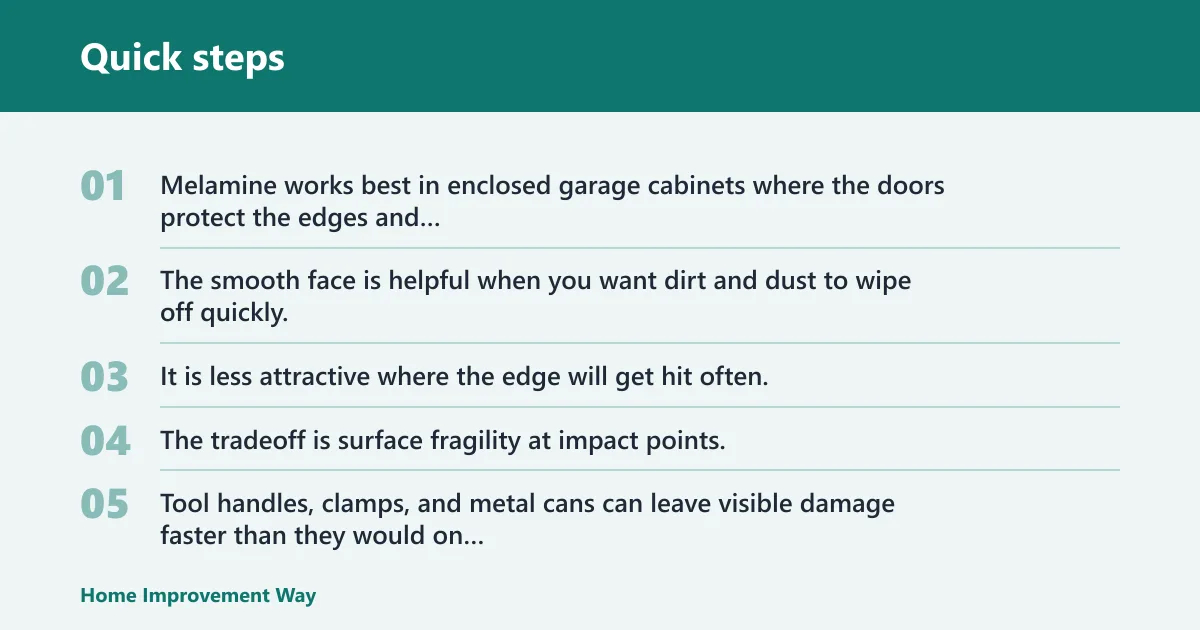
Melamine works best in enclosed garage cabinets where the doors protect the edges and the load is mostly dry storage: rags, bins, seasonal supplies, or packaged materials. The smooth face is helpful when you want dirt and dust to wipe off quickly.
It is less attractive where the edge will get hit often. A chipped melamine corner is hard to hide.
Scratch and chip tradeoffs
The tradeoff is surface fragility at impact points. Tool handles, clamps, and metal cans can leave visible damage faster than they would on hardwood or painted plywood.
That makes melamine a better fit for stationary storage than for open shop surfaces or busy loading zones.
Fastener and edge-tape limits
Melamine is commonly reported to hold screws less well at raw edges than plywood or hardwood. Pre-drilling matters, and edge banding or edge tape is important to protect the cut line from moisture and chipping.
Use it where the design can support the fasteners through thicker structure, not where every screw must bite into a thin edge.
Workbench top material: best for heavy use
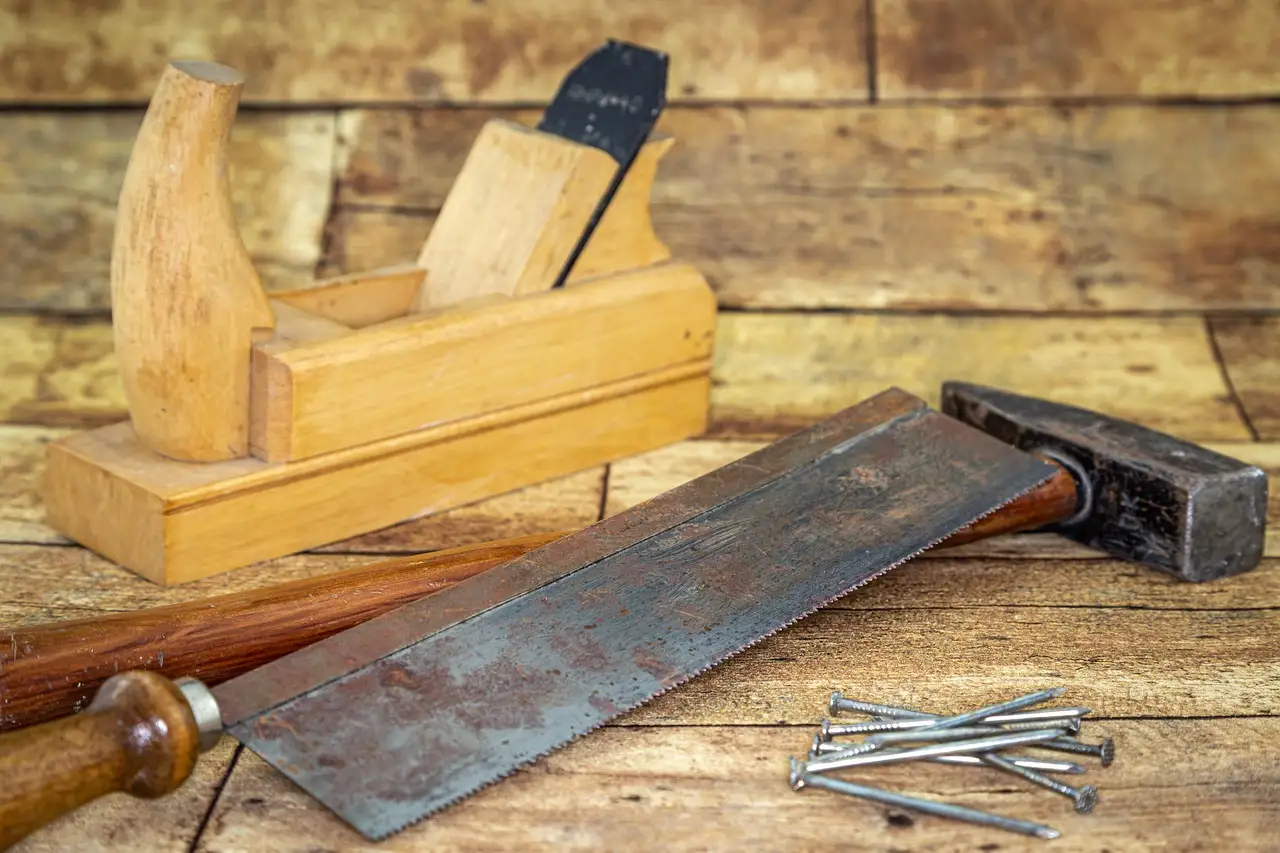
A garage workbench top should be chosen for stiffness, impact resistance, and how easily it cleans after glue, paint, or oil. For most buyers, the top matters more than the base because that is where loads, clamps, and dropped tools do the most damage.
Plywood tops for stiffness and cost
A plywood top is the best value when you need stiffness and a flatter build surface. Thick plywood works well for a bench that also carries storage underneath, because the structure below can support the span and keep flex down.
For many garage benches, 3/4-inch plywood is a common minimum practical starting point, and laminated layers are generally stronger than a single thin sheet.
Hardwood and butcher block for impact resistance
Hardwood or butcher block is better when the bench will take repeated impact from hand tools, clamps, or metal stock. These tops feel tougher at the edge and can be resurfaced more easily than many sheet goods.
The downside is cost and movement. A thick hardwood top can still change shape with humidity if the build allows it, so fastening details matter.
Stainless steel for glue and stain cleanup
Stainless steel is the cleanest option for glue scraping, solvent wipe-downs, and stain resistance. It suits finishing work, repairs, and messy tasks where cleanup speed matters more than a warm wood feel.
It is also louder and harder on dropped parts, so it is not the best fit for every garage.
Garage cabinet decision table
This table gives a part-by-part buy decision. It separates the structure from the wear surfaces, because those parts do not need the same material.
| Part | Best material choice | Minimum practical thickness | Moisture risk | Fastener note | Upgrade to hardwood or laminate when | Buy this if |
|---|---|---|---|---|---|---|
| Cabinet sides | Cabinet-grade plywood | 3/4-inch | Moderate; edge swelling is the main risk | Pre-drill near edges; use dados or screws with glue for case joints | You need extra dent resistance at exposed edges or a painted finished face | Humid or heavily loaded garage |
| Shelves | Cabinet-grade plywood | 3/4-inch for loaded spans; 1/2-inch only for short, light spans | Moderate; sag and edge swell rise with load | Support long shelves with a front stiffener or center divider | Shelves exceed about 36 inches without support or carry heavy bins | Heavily loaded garage |
| Backs | Cabinet-grade plywood or laminate-faced panel | 1/2-inch | Low to moderate; main risk is racking if too thin | Staples or screws work if the panel is captured square and sealed | You want a cleaner face, added stiffness, or easier wipe-down | Heated garage with dust and dirt control |
| Face frames | Solid hardwood | About 3/4-inch stock | Moderate; seasonal movement can stress joints | Use glue plus pocket screws, dowels, or mortise-and-tenon joints | You expect repeated impacts at corners or heavy hinge loads | Humid garage with frequent door use |
| Drawer fronts | Solid hardwood or hardwood-faced plywood | 3/4-inch | Moderate; faces move less if plywood is used behind hardwood edging | Keep joinery tight and leave room for seasonal movement | Drawers get frequent pulls, bumps, or exposed corners | Heavily used garage storage |
| Workbench tops | Plywood, hardwood, butcher block, or stainless steel | 3/4-inch plywood minimum; thicker is better for hard use | Moderate to high depending on finish and exposure | Fasten with slotted holes or figure-eight clips when movement is expected | You need better impact resistance, glue cleanup, or stain resistance | Garage workbench with storage |
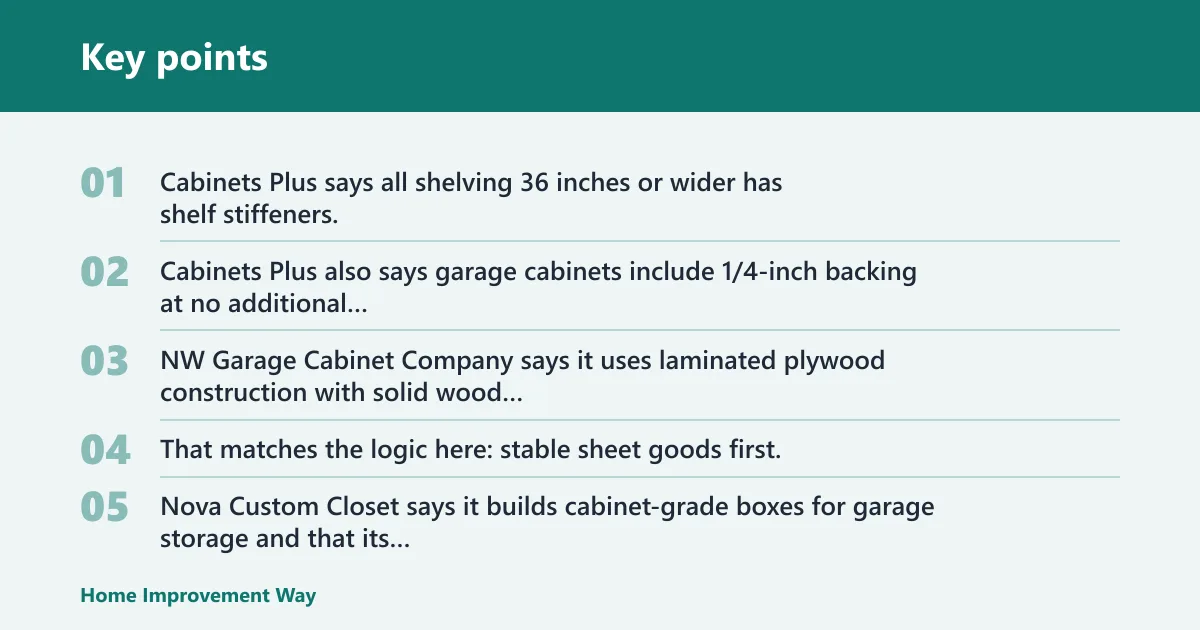
Cabinets Plus says all shelving 36 inches or wider has shelf stiffeners, and that detail matters because wide shelves sag first. Cabinets Plus also says garage cabinets include 1/4-inch backing at no additional up-charge, which is useful where budget pushes you toward a thinner back.
NW Garage Cabinet Company says it uses laminated plywood construction with solid wood reinforcement and mahogany facing, and it says it never uses pressed or particle board in frame construction or shelving. That matches the logic here: stable sheet goods first, hardwood only where edges need help.
Nova Custom Closet says it builds cabinet-grade boxes for garage storage and that its systems can include shelving, cabinets, overhead racks, and a workbench. Nova also says its garage systems use cabinet-grade materials, not a big-box wire grid.
IKEA lists a BROR work bench with drawers made from black and pine plywood, and it lists a BROR storage with cabinet/work bench measuring 340x40x191 cm. IKEA also lists an IVAR cabinet made of pine at 80x30x83 cm, which is a reminder that even simple systems can mix panel and solid-wood parts.
Say your garage stays above freezing but swings from damp to dry every month. A 24-inch-deep cabinet made from solid boards can move enough to open a joint at the back, while a plywood box with hardwood edging keeps the shell square and the doors aligned.
Which one should you buy?
For the best budget choice, start with cabinet-grade plywood for the box and use a hardwood edge or face only where the cabinet gets touched. That gives you stability without paying hardwood prices for every part.
For humid garages, plywood boxes with sealed edges are the safest pick. Add hardwood face frames only where the cabinet gets bumped, and avoid bare panel edges wherever water, melt-off, or wet tires can reach.
For heavy storage, choose 3/4-inch plywood sides and shelves, then add shelf stiffeners if the span is wide. Melamine is fine for wipe-clean cabinet interiors, but it should not be your answer for long, load-bearing shelves.
For a garage workbench, pick the top by use case. Plywood is the practical default, hardwood or butcher block is better for impact and edge abuse, and stainless steel belongs where glue, solvents, and stain cleanup are routine.
Suppose you want a 72-inch bench in a detached garage that sees winter damp and summer heat. A laminated plywood top over a stiff base will resist seasonal movement better than a thin softwood plank top, and it will be easier to square up if the base settles over time.
Frequently asked questions
What is the best wood for garage cabinets?
Cabinet-grade plywood is the best all-around choice for garage cabinet boxes because it stays more stable than solid wood when humidity changes. Use hardwood for faces, trim, and edge reinforcement. That combination handles seasonal movement better than all-solid construction and keeps the cabinet square longer.
Is plywood better than MDF for garage cabinets?
Yes, plywood is usually better than MDF for garage cabinets, especially in unconditioned spaces. Plywood holds up better at edges and around fasteners, while MDF is more vulnerable to moisture swelling and edge damage. If the garage sees damp air or temperature swings, plywood is the safer default.
Can I use solid wood for a garage workbench?
Yes, solid wood can be used for a garage workbench, but it works best as a top layer or laminated surface, not as a thin single board. A thick hardwood or butcher block top handles impact well, but it still needs a stable base and careful fastening to limit seasonal movement.
What thickness plywood should I use for garage cabinets?
Use 3/4-inch plywood for cabinet sides, bottoms, tops, and loaded shelves. Use 1/2-inch plywood for backs, dividers, and lighter parts. If a shelf is wide or carries heavy bins, add a front stiffener or choose thicker material to control sag.
How does humidity affect garage cabinet wood?
Humidity makes wood expand and contract, and those seasonal changes can lead to bowing, cupping, loose joints, swollen edges, and finish failure. In an unconditioned garage, stable sheet goods like plywood are less likely to move enough to throw doors out of alignment or crack joints.
Should garage cabinets be plywood or melamine?
Use plywood for the structural cabinet box and melamine where you want a wipe-clean interior or shelf surface. Melamine is easy to clean, but it chips more easily at exposed corners and does not like rough edge abuse. Plywood is the better structural base in a garage.
Sponsored / affiliate links. As an Amazon Associate I earn from qualifying purchases. I may earn additional commission from eligible campaigns.