Gutter Screen vs. Reverse-Curve Guards Tradeoffs Explained
Choose gutter screens for steep, debris-heavy roofs and easier cleaning. Choose reverse-curve guards only when heavy rain and open gutters matter more than leaf load. Pick the wrong style and you will buy overflow, clogs, ice dams, or constant maintenance anyway. This guide breaks down failure modes, roof pitch, rainfall, debris type, and when each system is the wrong buy.
Gutter screen vs. reverse-curve guards: the core trade-off


Gutter screens stop debris with perforated or mesh openings. Reverse-curve guards use a curved hood that sends water into the gutter by surface tension and throws debris off the front edge. Screens are easier to match to a debris type. Reverse-curve guards depend more on pitch, storm intensity, and installation accuracy.
| Decision factor | Gutter screen | Reverse-curve guards | Winner |
|---|---|---|---|
| Debris fit | Best for large deciduous leaves; weak against pine needles and fine litter | Good for large leaves; pine needles can still slip in or mat on the hood | Gutter screen for large leaves only |
| Heavy rain handling | Usually less sensitive to roof pitch, but openings can still clog | Can overflow or overshoot in extreme rain, especially if pitch or gutter capacity is wrong | Gutter screen |
| Installed cost per linear foot | Plastic screens: $2-6/ft installed; metal screens: $4-10/ft installed | Traditional reverse curve systems: $15-22/ft installed | Gutter screen |
| Lifespan | Often 5-10 years | Often 15-25 years | Reverse-curve guards |
| Maintenance burden | Regular cleaning is still needed | Lower debris entry, but residue still collects and should be checked | Tie |
How gutter screen guards work
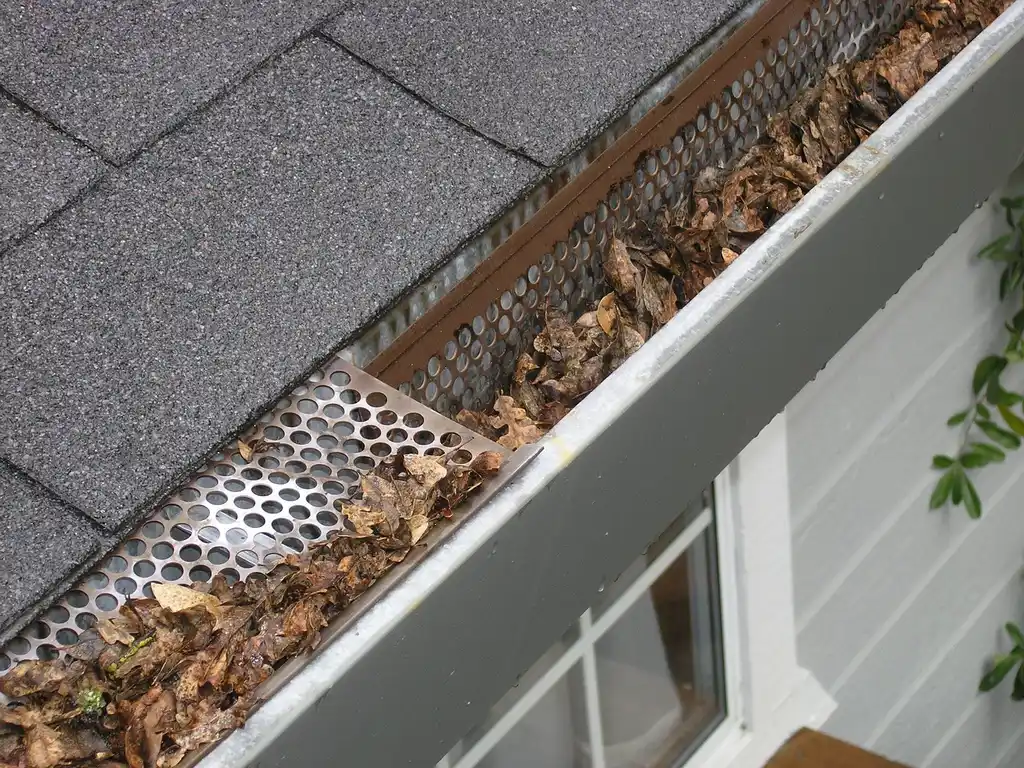
Gutter screen guards cover the gutter with perforated or mesh openings. Standard screen openings are commonly 1/4" to 3/4", while micro-mesh is a separate, finer category with openings listed from 50-400 microns and standard micro-mesh often at 150-275 microns. That distinction matters because a screen and a micro-mesh product do not solve the same debris problem.
How reverse-curve guards work
Reverse-curve guards use a curved surface, sometimes sold as a one-piece hood, to direct water around the bend and into the gutter. Debris is meant to fall off the front edge. That design depends on the water staying attached to the curve, which means roof pitch and rainfall intensity have a bigger role than they do with a basic screen.
What each design is trying to keep out, and what still gets in
Both systems reduce debris entry, but neither is maintenance-free. Screens are best when the debris is large and dry enough to shed, especially oak, maple, or elm leaves. Reverse-curve guards do well with leaves too, but fine debris, needles, and windblown litter can still collect at the front edge or slip through gaps at the wrong angle.
📊 Screen/perforated guards use holes from 1/4" to 3/4". Source: Best Gutter Covering Options: Micro-Mesh vs Screens vs Reverse Curve.
Side-by-side comparison of screens and reverse-curve guards
The better choice depends less on marketing claims and more on what falls on the roof, how hard it rains, and how much upkeep you will accept. A cheap screen can beat an expensive hood on the right roof. The wrong reverse-curve setup can fail where a lower-cost screen would stay easier to service.
Debris type: large leaves, pine needles, and mixed litter
Screen guards are the better fit for large deciduous leaves only, because their openings can keep out oversized debris without needing a full hood profile. Pine needles are a weak point: they can pass through larger openings, wedge across mesh, or mat together into a bridge. Reverse-curve guards handle leaves well, but pine needles often slip in or collect where the curve meets the gutter.
Suppose a one-story ranch sits under two mature maples. A standard screen may keep the leaves out and still be simple to clear once or twice a year. Put the same guard under white pines, and the openings can load up with needles faster than the homeowner expects.
Rain handling: everyday storms versus heavy downpours
Screens do not depend on surface tension, so they are less sensitive to roof slope, but they still need enough open area to pass water without clogging. Reverse-curve guards can work well in heavy rain, yet they can overflow in extreme rain or overshoot at the front edge if the water breaks away from the curve. Undersized gutters make that problem worse no matter which guard is installed.
A common homeowner mistake is assuming a gutter screen will stop overflow caused by undersized downspouts. It does not. If the roof sheds a large volume of water into 5-inch gutters with too few downspouts, the water can back up at the inlet even when the guard itself is clean.
Install and upkeep: DIY access, cleaning interval, and lifespan
DIY-friendly options exist in both categories, but screen guards are usually simpler to install and replace. Screen guards are also listed with a shorter lifespan of 5-10 years, while reverse-curve guards are often listed at 15-25 years. That longer life comes with a tradeoff: reverse-curve systems are commonly professionally installed, and fit matters more.
After installation, neither system can be ignored. Screen guards may need regular cleaning, sometimes once or twice a year depending on how much tree cover there is. Reverse-curve guards may need less frequent cleanup, but residual debris still accumulates at edges, seams, and downspout inlets.
Installed cost per linear foot
Price spreads are wide enough to matter. Plastic screens are listed at $2-6/ft installed, metal screens at $4-10/ft installed, and traditional reverse curve systems at $15-22/ft installed. DIY micro-mesh materials are listed at $3-8/ft, but that number covers materials, not professional installation.
That cost gap is why a basic screen can be the better buy on a house where large leaves are the main issue. If the roof and rainfall pattern are poor matches for a reverse-curve design, the higher installed cost buys a more expensive version of the wrong answer.
Which gutter guard is better for pine needles?
For pine needles, neither category is a clean win, but screen guards usually fail first when the openings are too large and the needles start matting on top. Reverse-curve guards also struggle because needles can slip under the hood edge or bridge across the front lip. If pine needles are the main debris, micro-mesh is the more relevant comparison point.
Why pine needles are a problem for screens
Pine needles are small, flexible, and good at forming mats. On a screen with 1/4" to 3/4" openings, they can pass through, stand up across holes, or pack into a layer that blocks water flow. The result is often a dirty top surface that needs more frequent cleaning than a leaf-only roof.
Why pine needles can still fail reverse-curve guards
Reverse-curve guards depend on water movement over the hood. Pine needles can hang at the front edge, form a bridge, or gather where wind pushes them against the nose. Once that happens, runoff may sheet over the front or push debris into the gutter opening instead of away from it.
When micro-mesh is the better comparison point
If the home has pines, cedar, or other fine debris, compare micro-mesh against reverse-curve before comparing standard screens. Micro-mesh is a separate aperture category, not just a nicer version of a screen. With openings listed at 50-400 microns, it targets finer material than a standard perforated screen can stop.
Do reverse-curve gutter guards overflow in heavy rain?
Yes, they can. Reverse-curve guards can overflow in extreme rain when the water volume exceeds the hood’s ability to hold surface tension, or when the roof pitch is too shallow for the water to stay attached to the curve. Gutter size, downspout capacity, and installation angle all affect whether that happens.
Overshoot from surface-tension design
The same curved shape that sheds leaves can send water past the gutter when rainfall is intense enough. That is overshoot. It often shows up as water arcing over the front edge, dripping off the nose, or missing the trough during a downpour even though the guard looks clean.
Roof pitch limits and water speed
Roof pitch changes water speed and adhesion. Reverse-curve guards need enough slope for water to follow the hood consistently. On low-slope roofs, water can lose contact sooner, while steep roofs can move water fast enough that poor placement or a wrong angle increases spillover risk.
When gutter size and downspout capacity matter more than guard style
If the system cannot move the water away, the guard choice only moves the problem around. Undersized gutters, too few downspouts, or clogged downspout outlets can cause overflow at the front lip, at a seam, or at the outlet regardless of guard type. A good guard is not a substitute for proper drainage capacity.
Decision matrix: choose by debris, pitch, rain, and upkeep
Use the roof’s actual conditions, not the product label, to choose the guard. Large leaves on a moderate-pitch roof point one way. Pine needles on a shallow roof point another. High rainfall and low maintenance tolerance change the answer again. The best option is the one least likely to fail for your debris and climate.
| Home condition | Better choice | Why |
|---|---|---|
| Large deciduous leaves, moderate pitch, normal rainfall, okay with annual cleaning | Gutter screen | Large leaves are the best-case debris for screens, and the lower cost fits a simpler maintenance plan |
| Pine needles, mixed litter, steep roof, homeowner wants fewer clog points | Micro-mesh or carefully selected reverse-curve guard | Standard screens can mat up quickly; a finer aperture or hood design may handle the debris better |
| Heavy rainfall, frequent downpours, steep roof, good gutter capacity | Reverse-curve guards | They can shed debris well if the roof pitch and water volume suit the design |
| Heavy rainfall, shallow pitch, small gutters, frequent overflow already present | Gutter screen | A screen is less dependent on surface tension and avoids some overshoot failure modes |
| Low maintenance tolerance, willing to pay more upfront | Reverse-curve guards | Higher installed cost, longer lifespan, and fewer open holes can reduce service frequency |
| Budget-sensitive, comfortable with periodic cleaning | Gutter screen | Lower installed cost and easier access usually win if the debris is mostly leaves |
Choose screen guards if…
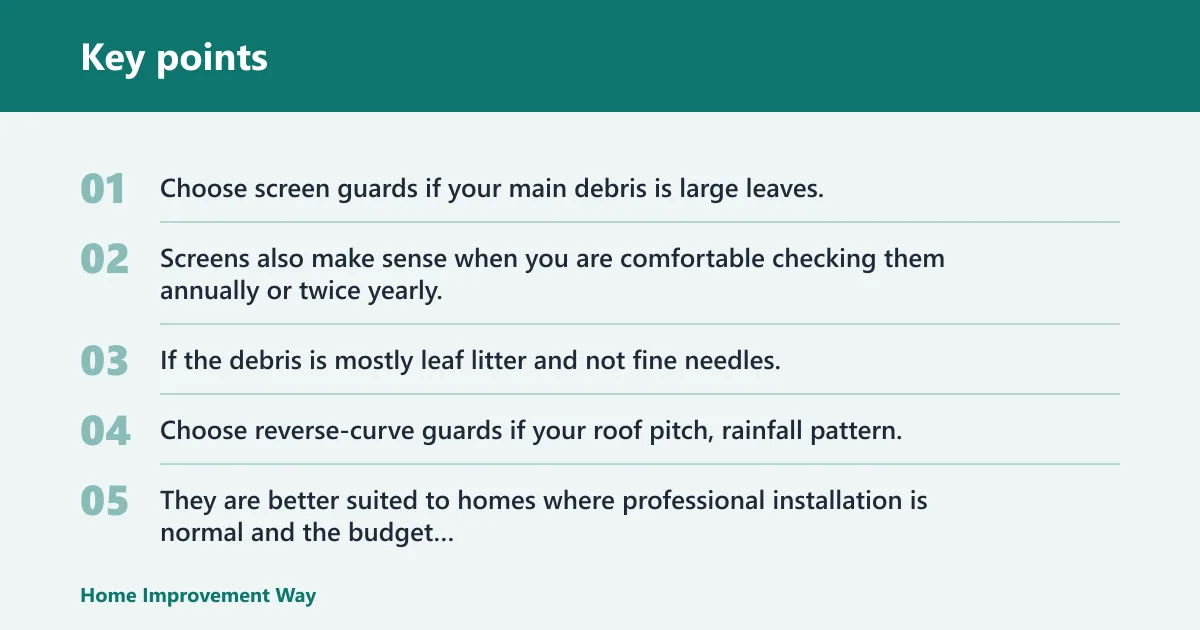
Choose screen guards if your main debris is large leaves, your roof pitch is not ideal for a surface-tension system, or you want the simpler and cheaper installed option. Screens also make sense when you are comfortable checking them annually or twice yearly. If the debris is mostly leaf litter and not fine needles, screens are often the better buy.
Choose reverse-curve guards if…
Choose reverse-curve guards if your roof pitch, rainfall pattern, and gutter sizing fit the design, and you want a longer service cycle with less visible debris sitting on top. They are better suited to homes where professional installation is normal and the budget allows a higher installed cost. They are not the right pick just because they look more advanced.
When neither is a good fit
If the roof sheds heavy pine needles, the pitch is shallow, or storms routinely push water beyond the gutters, neither basic screen nor reverse-curve should be treated as a universal fix. That is the point where micro-mesh, drainage corrections, downspout changes, or a full gutter redesign may matter more than the guard category itself.
Failure-case checklist for an existing gutter guard
Existing guards can fail in ways that are easy to miss from the ground. Pine-needle matting, debris bridging, and overshoot each leave different clues. A quick visual check can tell you whether the problem is the guard style, the installation, or the gutter system beneath it.
- Look for pine-needle matting. A felt-like layer on top of the guard, especially near valleys or tree-heavy sides of the house, means fine debris is collecting faster than water can pass through.
- Check for debris bridging. Needles, twigs, or leaf stems spanning across holes or across the hood edge often signal that the opening size is too large or the debris is too fine for the design.
- Watch for overshoot during rain. Water that sheets over the front edge or misses the gutter entirely points to a reverse-curve fit problem, a pitch mismatch, or excess storm intensity.
- Inspect the downspouts. If the gutter is clean at the guard but still overflows, the outlet may be undersized, partially blocked, or too few for the roof area.
Say your two-story home sits under a line of pines and the gutters still overflow during a fast thunderstorm. If the front edge of a reverse-curve guard is dry on one side but packed with needles on the other, the issue is usually a mix of debris bridging and poor water control, not a single failed part.
Frequently asked questions
What is the difference between gutter screens and reverse-curve guards?
Gutter screens use perforated or mesh openings to block debris while letting water pass through. Reverse-curve guards use a curved hood and surface tension to send water into the gutter and shed debris off the front. Screens are simpler. Reverse-curve systems depend more on pitch and rainfall behavior.
Are screen gutter guards cheaper than reverse-curve guards?
Yes, usually. Plastic screens are listed at $2-6/ft installed and metal screens at $4-10/ft installed, while traditional reverse curve systems are listed at $15-22/ft installed. The lower price is useful only if the screen matches the debris and does not create a new maintenance problem.
Which gutter guard works best for large leaves only?
Gutter screens are generally the better fit for large deciduous leaves only. Their openings are designed to stop oversized debris without needing a curved hood to manage water. If the roof mainly sheds oak, maple, or elm leaves and not fine needles, a screen is often the more practical buy.
How often do gutter screens need cleaning?
They still need regular cleaning. Annual cleaning is common in lower-debris settings, while twice-yearly checks make more sense under heavy tree cover. Screen guards reduce how much debris enters the gutter, but they do not eliminate buildup on top, especially after storms or during leaf drop.
Which guard type is better for a DIY installation?
Gutter screens are usually the easier DIY choice because they are simpler to fit and replace. Reverse-curve guards are more dependent on correct pitch, edge alignment, and a clean installation line, so professional installation is more common. A capable DIYer can still install either one, but screens are less finicky.
Can gutter guards make gutter cleaning harder?
Yes. Guards can make routine cleaning less frequent, but they can also make access harder when you do need to clear residue or inspect a blockage. That tradeoff is strongest with reverse-curve systems, which may need more careful removal or a different cleaning approach than open gutters.
Sponsored / affiliate links. As an Amazon Associate I earn from qualifying purchases. I may earn additional commission from eligible campaigns.