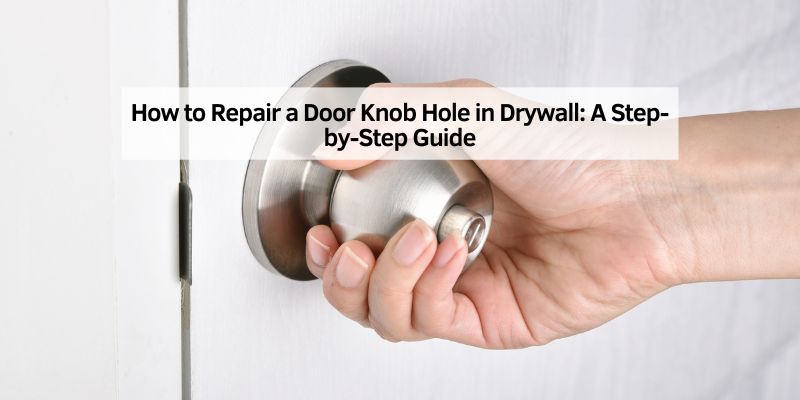
How to Repair a Door Knob Hole in Drywall: A Step-by-Step Guide
Hey there, friend! So, you’ve got a pesky hole in your drywall from a door knob, huh? I get how annoying that can be. I’ve been there, staring at an ugly dent in my garage wall after my car door handle got a bit too enthusiastic. Fixing a door knob hole in drywall might seem daunting, but trust me, it’s a project you can tackle with a little patience and the right tools. I’ve patched up a few of these holes myself—both in my home and at a friend’s place—and I’ve learned some handy tricks along the way.
Whether you’re a DIY newbie or a seasoned fixer-upper, I’m excited to walk you through how to repair that hole and make your wall look good as new. Let’s dive in and get that drywall sorted!
Why Door Knob Holes Happen
I’ll never forget the first time I noticed a door knob hole in my wall. My kid was swinging the door open a bit too fast, and bam—there it was. Door knob holes are super common, especially in homes with kids, pets, or just a lot of foot traffic. They happen when a door swings open too hard, and the knob smacks into the drywall, leaving a dent or hole.
Drywall is soft and not super tough, so it’s prone to damage. In my garage, where I park my car, the door leading inside often gets hit by the car’s door handle. Older homes with thinner drywall are even more likely to get these holes. Sometimes, it’s not just the knob but the force behind it—like when you’re carrying groceries and push the door open with your elbow.
Another reason is poor door stoppers. I learned this the hard way when my door stopper fell off, letting the knob crash into the wall. Repeated impacts weaken the drywall, and before you know it, you’ve got a hole. Understanding why these holes happen helps you fix them and prevent future damage.
Tools and Materials You’ll Need
Before we start patching, let’s talk about what you’ll need. I’ve made the mistake of starting without all my tools, and it turned a quick job into a frustrating scavenger hunt. Here’s what I keep handy based on my experience.
You’ll need a putty knife—3 or 4 inches wide works great for spreading compound. A utility knife is handy for cutting drywall patches. Sandpaper (120-150 grit) smooths things out after patching. I also use a small paintbrush and roller for primer and paint to finish the job.
For materials, grab some drywall joint compound (also called spackle or mud). I like the pre-mixed kind in a tub—it’s about $5–$10 at hardware stores. You’ll need a drywall patch or a piece of scrap drywall for larger holes. Mesh drywall tape helps reinforce the patch. A door stop or wall guard is a smart add-on to prevent future holes—I wish I’d installed one sooner!
Optional but helpful: a stud finder to check for studs behind the wall, and a small container for mixing compound if you get the powdered kind. Gloves and a dust mask keep things clean and safe. Here’s a table of the essentials:
| Tool/Material | Purpose | Where to Get It |
|---|---|---|
| Putty Knife (3-4 inch) | Apply and smooth joint compound | Hardware store, home center |
| Utility Knife | Cut drywall patches | Hardware store, home center |
| Sandpaper (120-150 grit) | Smooth patched area | Hardware store, home center |
| Drywall Joint Compound | Fill and patch the hole | Hardware store, home center |
| Drywall Patch/Mesh Tape | Reinforce larger holes | Hardware store, home center |
| Paintbrush and Roller | Apply primer and paint | Hardware store, home center |
| Door Stop/Wall Guard | Prevent future holes | Hardware store, online |
Assessing the Damage
Before you start patching, take a good look at the hole. I’ve fixed everything from small dents to fist-sized holes, and the size matters for how you approach it. Small dents (less than an inch) are easy—just a bit of spackle will do. Medium holes (1–3 inches, like from a door knob) need a patch and some tape. Big holes (over 3 inches) might require cutting out a section of drywall and replacing it.
Check the wall around the hole. I once found cracks radiating from a door knob dent, which meant I had to patch a larger area. Press gently to see if the drywall is loose or crumbly. If it’s near a stud, use a stud finder to locate it—you don’t want to patch over a weak spot.
Also, figure out what caused the hole. In my garage, it was the car door hitting the wall. I installed a door stop after fixing the hole to avoid a repeat. Knowing the cause helps you plan prevention while you repair.
Preparing the Area
Prep work makes the repair go smoothly. I learned this when I rushed a job and ended up with dust everywhere. Start by clearing the area. Move furniture or anything near the wall. I lay down a drop cloth or old towel to catch dust and spackle.
Clean the hole. Use a utility knife to trim any loose drywall or frayed edges. I make a smooth, even circle around the hole—it helps the patch stick better. Wipe the area with a damp rag to remove dust. Drywall dust can mess up your compound, so don’t skip this.
If the hole is bigger than 1 inch, cut a piece of cardboard or thin wood to use as a backing. I cut a square slightly larger than the hole, slide it behind the drywall, and secure it with a dab of joint compound. This gives the patch something to hold onto.
Tape off nearby surfaces, like the door frame, with painter’s tape to avoid getting spackle or paint on them. I also wear gloves and a dust mask when sanding—drywall dust is no joke!
Step-by-Step Guide to Repairing a Door Knob Hole
Alright, let’s fix that hole! I’ve done this a few times, and here’s the process I follow. It works for most door knob holes (1–3 inches), but I’ll note tweaks for smaller or larger ones.
For small dents (less than 1 inch), scoop a bit of joint compound with your putty knife and spread it over the hole. I use a thin layer, about 1/8 inch thick, and smooth it out. Let it dry for 4–6 hours (check the tub’s instructions). Apply a second layer if needed, then sand it smooth with 120-grit sandpaper. I sand lightly to avoid damaging the surrounding wall.
For medium holes (1–3 inches), you’ll need a patch. Cut a piece of drywall patch or scrap drywall slightly larger than the hole. If the hole is deep, slide a piece of cardboard behind it first. I secure the cardboard with a bit of compound and let it dry for an hour. Place mesh drywall tape over the hole, overlapping the edges. Spread a thin layer of joint compound over the tape, feathering it out to blend with the wall. Let it dry for 4–6 hours. Apply a second layer, let it dry, and sand smooth.
For larger holes (over 3 inches), cut a square around the hole with a utility knife. I make it big enough to reach the nearest studs for support. Cut a new piece of drywall to fit the square, secure it to the studs with drywall screws, and cover the seams with mesh tape and compound. I apply two or three layers, sanding between each, to get a seamless finish.
Once the compound is dry, prime the patched area with a drywall primer. I use a small paintbrush for edges and a roller for larger areas. After the primer dries (about an hour), paint over it to match your wall. I keep a small can of my wall paint for touch-ups—it’s a lifesaver.
Test the door to make sure it doesn’t hit the patched area. I swung my door a few times to check the clearance. If it’s still hitting, install a door stop or wall guard (more on that later).
Sanding and Finishing the Patch
Sanding is where the magic happens. I love seeing a rough patch turn smooth and invisible. Use 120- or 150-grit sandpaper and sand lightly in circular motions. I focus on blending the patch into the surrounding wall so you can’t tell there was a hole.
Don’t oversand—my first time, I sanded too much and had to reapply compound. If you see paper or cardboard showing through, stop and add another thin layer of compound. Let it dry, then sand again.
Wipe the area with a damp rag to remove dust. I check the patch by running my hand over it—if it feels smooth and flush with the wall, you’re golden. Apply primer, then paint. I use two coats of paint for a perfect match, letting each dry for an hour. If your wall has texture, you can buy spray-on texture at hardware stores to mimic it. I tried this on a textured wall, and it worked like a charm.
Preventing Future Door Knob Holes
Fixing the hole is great, but I learned it’s even better to stop them from happening again. After patching my garage wall, I installed a door stop, and it’s been a game-changer. Here are some prevention tips I swear by.
Install a door stop. I got a simple rubber stopper for $5 and screwed it into the baseboard. It catches the door before the knob hits the wall. You can also get wall-mounted guards that stick on with adhesive—perfect for renters.
Adjust the door’s swing. I noticed my door was swinging too fast, so I tightened the hinge screws to add resistance. If your door has a closer, adjust it to slow the swing. My friend’s minivan had this, and a quick tweak fixed the issue.
Use a door knob cover. These are soft pads that fit over the knob and cushion impacts. I put one on my kid’s bedroom door, and it’s saved the wall from countless slams. They’re about $3–$10 online or at hardware stores.
If you’re in a garage like me, consider a wall guard. I installed a foam strip on the wall where my car door hits. It’s ugly but effective, and it costs $15. You can paint it to blend in.
Check your hinges regularly. Loose hinges make doors swing harder, causing more damage. I tighten mine every year with a screwdriver to keep them snug.
Common Challenges and How to Handle Them
I’ve hit a few snags patching holes, so let me save you some trouble. One issue is crumbling drywall. If the area around the hole is weak, cut it back to solid material. I had to enlarge a hole once because the drywall was too damaged to hold a patch.
Another problem is mismatched paint. I patched a wall perfectly, but used the wrong shade, and it stood out like a sore thumb. Test your paint on a small area first, or keep a record of your wall’s paint color. If you don’t have the original, take a chip of drywall to a paint store—they can match it.
If the compound cracks after drying, you applied it too thickly. I did this my first time and had to sand it down and start over. Apply thin layers and let each dry fully. If the patch isn’t sticking, check that your backing (cardboard or wood) is secure. I had to re-glue mine once with construction adhesive.
If the door still hits the wall after patching, your door stop might be too short. I swapped mine for a longer one, and it solved the problem. Measure the door’s swing to get the right size.
When to Call a Professional
I’m all about DIY, but some jobs are best left to pros. If the hole is huge (over 12 inches) or the wall is severely damaged, a drywall contractor can handle it. I called one for a friend’s house where the entire wall section was cracked—it was worth the $200.
If you’re dealing with a textured wall and can’t match the texture, a pro can blend it seamlessly. I tried texturing once and made a mess, so I let a pro finish it for $100. Electrical or plumbing behind the wall is another red flag—my garage had wiring near the hole, so I got a pro to avoid shocks.
Expect to pay $100–$500 for professional repairs, depending on the damage and your location. It’s pricier than DIY, but it saves time and ensures a perfect finish.
Cost of Repairing a Door Knob Hole
This is one of the cheapest home repairs you can do. I spent about $20 total on my garage wall fix. Joint compound costs $5–$10 for a small tub. A drywall patch or mesh tape is $3–$8. Sandpaper is $3–$5, and a putty knife is $5–$10. If you need paint, a quart is $10–$20, and a door stop is $5–$15.
If you already have tools like a utility knife or paintbrush, you’re looking at $15–$30 total. Hiring a pro costs $100–$500, depending on the hole size and complexity. I saved a ton by doing it myself, but it took me a weekend to get it perfect.
Tips for First-Time DIYers
If this is your first drywall repair, don’t worry—I was nervous too! Watch a YouTube video for visual guidance. I found one that showed patching a door knob hole, and it gave me confidence.
Work slowly and be patient. I rushed my first patch and had to redo it because the compound was lumpy. Apply thin layers and let them dry fully. Keep a small container for screws or tape scraps—I use an old yogurt cup.
Take photos before you start. I forgot where my door stop went and wished I had a picture. If you get stuck, hardware store employees are super helpful. I asked one about texture spray, and they pointed me to the right product.
Have fun! Patching a hole is like a mini art project. I felt so proud when my wall looked brand new.
Conclusion
Phew, we’ve covered everything you need to know about fixing that door knob hole in your drywall! From gathering tools to patching like a pro, I hope you’re ready to tackle this project. Repairing my garage wall was such a satisfying win—it saved me money and made the space look clean again. Whether you’re patching a small dent or a bigger hole, you’ve got the skills now. Plus, with a door stop or wall guard, you can keep those walls safe from future dings. Thanks for hanging out with me through this guide—I had a blast sharing my tips. If you try it out or have a funny door knob story, drop it in the comments. Here’s to flawless walls and happy DIY adventures!
FAQ: Common Questions About Repairing a Door Knob Hole in Drywall
How long does it take to repair a door knob hole in drywall?
It depends on the hole size. Small dents take 1–2 hours, including drying time. Medium holes (1–3 inches) take 4–6 hours with drying. Larger holes might take a day with multiple drying steps.
Can I fix a door knob hole myself?
Yes, it’s a beginner-friendly DIY job. You’ll need joint compound, a putty knife, sandpaper, and a patch for larger holes. Follow a guide and take your time.
What’s the best material to patch a door knob hole?
Drywall joint compound works for all holes. For holes over 1 inch, use mesh drywall tape or a drywall patch. Cardboard or wood backing helps for deeper holes.
How do I match my wall’s paint after patching?
Keep a small can of your original wall paint. If you don’t have it, take a drywall chip to a paint store for matching. Test the paint on a small area first.
How can I prevent future door knob holes?
Install a door stop or wall guard. Adjust the door’s swing to slow it down. Door knob covers or foam wall strips also cushion impacts.
What if the drywall around the hole is crumbling?
Cut back to solid drywall with a utility knife. Use a backing like cardboard for support. Apply mesh tape and compound to reinforce the patch.
Should I hire a professional for a door knob hole?
For small to medium holes, DIY is fine. Call a pro for huge holes, textured walls, or if there’s electrical or plumbing behind the wall. Pros charge $100–$500.