
Latent load calculator: estimate moisture load fast
A latent load calculator estimates moisture removal from airflow and humidity: use Latent Btu/hr = 0.68 × CFM × grains of moisture removed, or in pounds of water, 0.68 × CFM × 4.5 × Δgrains/7000. If you miss the moisture side, the system short-cycles, holds damp air, and burns more energy trying to make people feel comfortable. I use this guide to estimate latent load from humidity and airflow, see when the shortcut holds up, and know when a full psychrometric calculation is the better call.
How is this calculated?
Press Calculate to see the math with your numbers.
What latent means in HVAC and everyday use
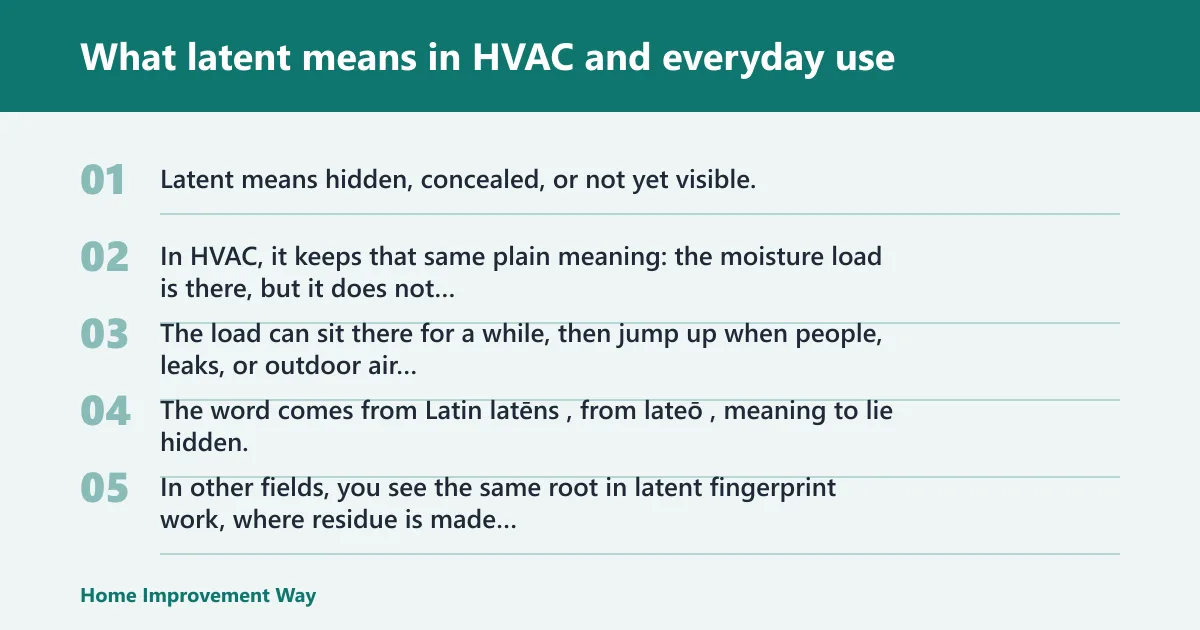


Latent means hidden, concealed, or not yet visible. In HVAC, it keeps that same plain meaning: the moisture load is there, but it does not show up as a temperature rise the way sensible heat does. The load can sit there for a while, then jump up when people, leaks, or outdoor air change.
The word comes from Latin latēns, from lateō, meaning to lie hidden. In other fields, you see the same root in latent fingerprint work, where residue is made visible by powder dusting or another development method; in latent infection, where disease is present but inactive; in latent learning, where knowledge exists before it is expressed; in latent demand, where need is not yet visible in use data; and in statistics, a latent variable is an unobserved factor inferred from patterns.
Latent heat is different. In physics, it is the heat tied to a phase change, not a temperature rise. That is a technical meaning, not the plain dictionary meaning of latent. The overlap is only in the word form.
What is latent load?
Latent load is the moisture part of building load. It is the water vapor a system must pull from air to keep a space comfortable and dry. Sensible load changes temperature. Latent load changes humidity. A room can sit at 74°F and still feel sticky if the moisture load is high.
Moisture comes from people, showers, cooking, laundry, plants, infiltration, and outdoor air. A tight home may leak less, but it can still carry a heavy moisture load when several people live there or when ventilation brings in humid air. A leaky home can be worse, because outdoor humidity enters without control.
Latent load vs sensible load
Sensible load is the heat you can measure with a dry-bulb thermometer. Latent load is the moisture the cooling coil must condense or a dehumidifier must remove. Total cooling load is the sum of both. If a calculator gives only total BTU/hr and skips moisture, it can miss why a space feels damp even when the thermostat is satisfied.
What inputs does a latent load calculator need?
A useful latent load calculator needs indoor temperature, indoor relative humidity, outdoor temperature, outdoor relative humidity, airflow in CFM, and occupancy. Those inputs let you estimate how much moisture enters the space and how much the system must remove to hold indoor conditions steady. Without airflow, the estimate is usually weak.
Why airflow matters
CFM carries the moisture load. More air moving through a coil, a duct leak, a fan, or a ventilation opening means more water vapor can enter or leave. If you cut airflow in half, latent load often changes too. That is why two homes with the same floor area can have very different moisture demand.
Occupancy and outdoor air
Each person adds moisture through breathing and skin evaporation. Showers add a lot. Cooking and laundry add more. Outdoor air and infiltration can overwhelm the rest during humid weather. In a tight house, mechanical ventilation may be the main moisture source. In a leaky house, infiltration may do the damage for you.
How to calculate latent load in BTU/hr
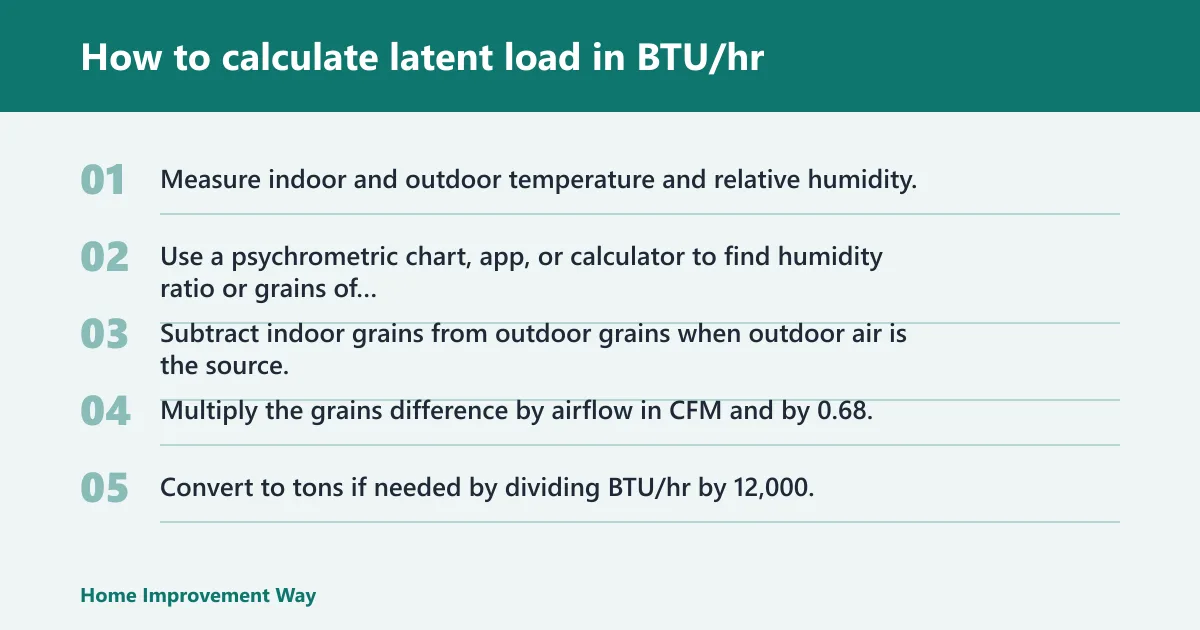
The basic workflow is to find the humidity difference, convert that difference into grains of moisture per pound of dry air, and multiply by airflow. For many HVAC estimates, latent Btu/hr = 0.68 × CFM × Δgrains. One grain is a very small fraction of a pound of water. The 0.68 factor is a practical HVAC shortcut tied to air properties.
Step-by-step calculation
- Measure indoor and outdoor temperature and relative humidity.
- Use a psychrometric chart, app, or calculator to find humidity ratio or grains of moisture per pound of dry air.
- Subtract indoor grains from outdoor grains when outdoor air is the source.
- Multiply the grains difference by airflow in CFM and by 0.68.
- Convert to tons if needed by dividing BTU/hr by 12,000.
Unit handling that trips people up
Do not mix RH with grains. Relative humidity is not a direct load value. Also do not use room volume when the problem is airflow-based unless you are first converting volume to CFM through a known air-change rate. And do not confuse latent load with total cooling load. Those errors can make a system look adequate on paper when it is not.
Worked latent-load worksheet: three real-world scenarios
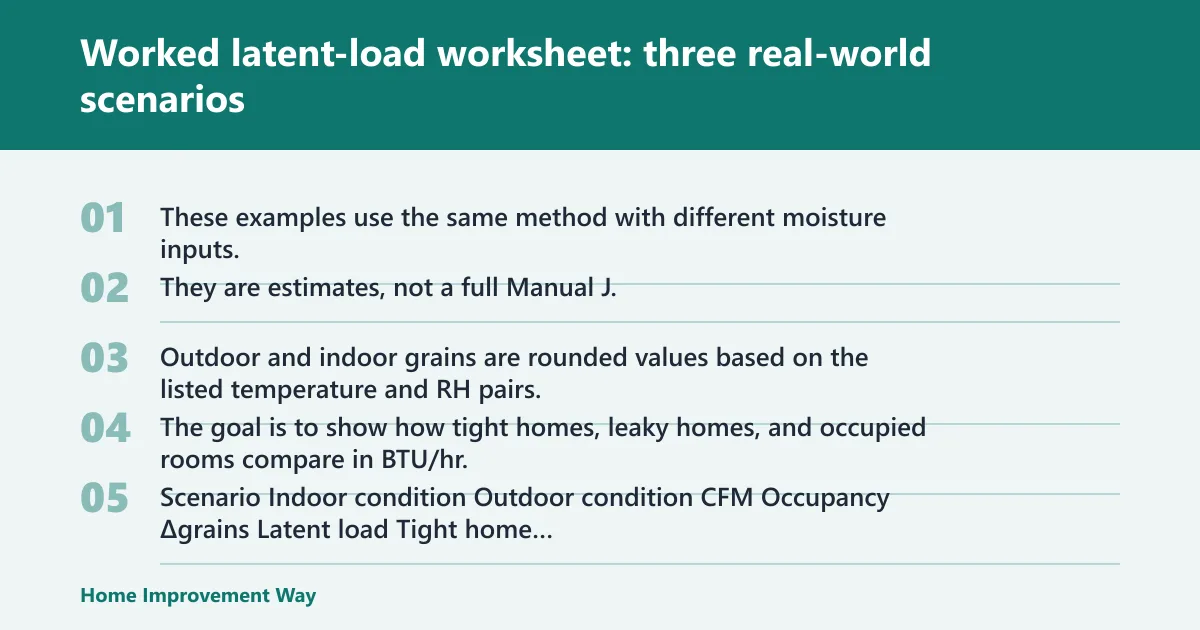
These examples use the same method with different moisture inputs. They are estimates, not a full Manual J. Outdoor and indoor grains are rounded values based on the listed temperature and RH pairs. The goal is to show how tight homes, leaky homes, and occupied rooms compare in BTU/hr.
| Scenario | Indoor condition | Outdoor condition | CFM | Occupancy | Δgrains | Latent load |
|---|---|---|---|---|---|---|
| Tight home | 75°F, 50% RH | 90°F, 60% RH | 400 | 4 people | ~42 grains | ~11,424 BTU/hr |
| Leaky home | 75°F, 50% RH | 90°F, 60% RH | 800 | 4 people | ~42 grains | ~22,848 BTU/hr |
| High-occupancy room | 74°F, 50% RH | 82°F, 65% RH | 300 | 12 people | ~23 grains | ~4,692 BTU/hr |
Tight home example
With lower airflow and a similar moisture difference, the latent load comes out near the low tens of thousands of BTU/hr, or about 1 ton. That is real dehumidification work. A tight house can still need strong moisture removal because people and mechanical ventilation add water vapor even when leakage is low.
Leaky home example
At a higher airflow, with the same grain difference, the latent load rises to roughly the low tens of thousands of BTU/hr, or around 2 tons. This is where cooling equipment often struggles. The house may hit temperature setpoint while humidity stays high, because the system spends too much capacity on sensible cooling and too little on moisture removal.
High-occupancy room example
A classroom, meeting room, or event room can have a smaller CFM number but a strong occupancy load. Twelve people breathing in a room can push the moisture balance hard. In this case the latent load is roughly in the mid-thousands of BTU/hr, or around a third of a ton, before you account for door opening, cooking, or extra outdoor air.
What changes latent load the most?
Air leakage and outdoor air usually move latent load the fastest. Occupants matter next, followed by showers, cooking, and laundry. A tight home is not immune to moisture because internal sources still work. A leaky home is harder because it takes moisture in from outside when the weather is humid.
Infiltration and outdoor air
Outdoor air in summer often carries far more water vapor than indoor air. Every CFM of infiltration or ventilation brings that moisture into the building. If the system does not remove it, indoor RH rises. That is why two homes with similar cooling sizes can feel very different in the same weather.
People and appliances
Breathing, showering, boiling water, drying clothes, and even houseplants add moisture. A room with heavy use needs more than a thermostat setting. A latent load calculator should include occupancy and likely moisture sources, or it can miss the peak condition by a wide margin.
When a calculator is not enough
A simple calculator is not enough when the home has unusual leakage, mixed-use spaces, high occupancy, duct losses, or uncertain humidity readings. If the estimate changes a lot when you adjust one input, the result is only a rough guide. That is the point where a full Manual J or a pro load calculation is safer.
Signs the estimate is too simple
Watch for a cooling system that meets temperature but not humidity, rooms that go damp after occupancy spikes, or a home that behaves differently after weather changes. If supply airflow, return leakage, or outdoor air are unknown, the latent result is shaky. A bad RH reading can also ruin the calculation.
When to use Manual J or an HVAC pro
Use Manual J when sizing equipment for a new build, a major remodel, a retrofit with duct changes, or a complaint that does not match a simple calculator. Bring in an HVAC pro when condensation, mold risk, or repeated short-cycling is already showing up. That is especially true in tight homes and leaky homes with big moisture swings.
How to calculate building load factor
Building load factor is the ratio of average load to peak load over a chosen period. In plain terms, it shows how steady the demand is compared with the maximum. You can use it for cooling or heating, but it is separate from latent load. For moisture problems, the factor helps explain whether peaks are brief or persistent.
Simple formula
Load factor = average load ÷ peak load. If a room’s average load is about half its peak load, the load factor is about 0.50. A low factor means sharp swings. A higher factor means a steadier demand. That matters because moisture control is often worse during peaks than during the average day.
What is latent?
Latent means hidden or not immediately visible. In HVAC, it describes the moisture side of load that does not show up as a temperature change. In common English, it can mean inactive or concealed. In technical work, the exact meaning shifts with the field, so context matters.
Frequently asked questions
What is latent?
Latent means hidden, concealed, or present in a way that is not yet visible. The word is used in ordinary English and in technical fields. In HVAC, it points to hidden moisture load. In other fields, it can describe inactive disease, hidden evidence, or an unobserved factor.
What does latent mean?
Latent means something exists but is not acting or showing itself yet. A latent issue can sit there without obvious signs. In building work, that idea fits moisture well: the water vapor may already be in the air, but the discomfort only appears later.
What is latent in pathology?
In pathology and virology, latent means inactive or hidden, often with no visible symptoms at the moment. A latent infection is still present, but it is not showing active disease signs. That is different from the HVAC use, where latent refers to moisture removal demand in air.
What is a latent fingerprint?
A latent fingerprint is a print left by skin oils or residue that is not immediately visible. It is developed with powder dusting, chemicals, or other methods, then photographed or lifted for evidence handling. The word latent fits because the print is present before it is made visible.
What is latent heat?
Latent heat is the heat absorbed or released during a phase change, such as evaporation or condensation, without a temperature change. That physics meaning is separate from the HVAC word latent, even though both involve hidden effects. Cooling coils remove moisture partly through this phase-change process.
What is latent load?
Latent load is the moisture load a building or room imposes on cooling or dehumidification equipment. It is measured in BTU/hr or tons, and it depends on airflow, humidity difference, occupancy, infiltration, and outdoor air. It is not the same as sensible load.
What is latent learning?
Latent learning is a psychology term for knowledge that has been acquired but not shown right away. The learning becomes visible later when the conditions are right. That matches the basic idea of latent as hidden, but it is unrelated to building load calculations.
What is the difference between latent and dormant?
Latent and dormant both suggest something hidden or inactive, but latent often means present without being obvious, while dormant often means temporarily inactive and able to become active again. In HVAC, latent load is not a synonym for dormant load. It is a moisture-load term with a specific job.
What is latent demand?
Latent demand is an unrealized need that does not yet show up clearly in sales or usage data. Economists and transport planners use it for potential demand that would appear if barriers were removed. The HVAC connection is only conceptual: hidden need that becomes visible when conditions change.
How to calculate building load factor
Calculate building load factor by dividing average load by peak load over the period you care about. If the average is 8,000 BTU/hr and the peak is 16,000 BTU/hr, the load factor is 0.50. It helps explain whether a building has steady demand or sharp spikes.
Sponsored / affiliate links. As an Amazon Associate I earn from qualifying purchases. I may earn additional commission from eligible campaigns.