What Is the Difference Between Schlage Camelot and Century Trim?
Schlage Camelot and Century trim differ mainly in face shape. Camelot is more curved and traditional. Century is straighter and more modern. They are not universally interchangeable across all deadbolts or keypad deadbolts. Using the wrong trim can leave you with a mismatched look or a part that will not fit your exact model. This guide explains the visual differences, which Schlage models accept both trims, and how to match the right trim to your existing deadbolt.
Camelot vs. Century trim at a glance

Camelot and Century are exterior trim styles rather than separate lock mechanisms. Camelot is generally described as having a more decorative outline, while Century is described as using a cleaner rectangular profile. The locking action comes from the deadbolt or keypad deadbolt body; the trim mainly affects appearance and how the hardware sits on the door face.
| Trim style | Visual profile | Best-fit home style | Common finish cues | Swap risk by Schlage model family |
|---|---|---|---|---|
| Camelot | Curved, decorative rosette and grip details | Traditional, classic, colonial, or craftsman-leaning exteriors | Satin nickel, aged bronze, matte black; availability varies by model line | Moderate to high if you do not match the exact lock family and part number |
| Century | Straighter edges, rectangular, minimal exterior profile | Contemporary, transitional, or minimal front doors | Satin nickel, aged bronze, matte black; availability varies by model line | Moderate to high if the existing deadbolt or keypad deadbolt family differs |
What changes and what stays the same
The trim changes the look of the exterior escutcheon, levered grip area, and overall shape around the cylinder or keypad. It does not change the internal bolt throw, the cylinder core, or the electronics inside a keypad deadbolt. That is why two trims can look very different while still belonging to the same lock family.
For a homeowner, that means two decisions happen at once. First, the trim has to suit the front door. Second, the replacement trim has to match the exact Schlage model family already installed.
Where each trim usually fits best
Camelot usually fits traditional homes better because of its rounded decorative edges. Century usually fits contemporary homes better because of its straighter lines and simpler face. If nearby hardware is already angular, Century often blends in more naturally. If the house uses more ornamented hardware, Camelot usually feels more coordinated.
How the two trim styles look
The easiest way to separate Camelot from Century is by shape, not by finish. Camelot has a softer outline and more ornamented exterior styling. Century is flatter, straighter, and more restrained. Finish alone will not identify the trim, because both styles can appear in satin nickel, aged bronze, or matte black depending on the product line.
Camelot’s decorative rosette and grip details
Camelot trim often includes a more decorative rosette around the cylinder area and a visibly shaped grip or surround. The profile tends to look fuller at the edges. On a front door, that gives the lock more presence, which is why it often pairs well with traditional entry doors and classic moldings.
Century’s rectangular, minimal profile
Century trim usually has a more rectangular outline with fewer decorative cues. The face looks more geometric and less embellished. On contemporary doors, that simpler shape often disappears into the overall design instead of standing out.
Finish cues that help with identification
Finish can help you confirm what you are looking at, but it cannot confirm compatibility by itself. Satin nickel is usually a bright, brushed silver tone. Aged bronze leans darker and warmer, often with a slightly worn look. Matte black reads as a flat dark finish without reflective shine. Those finishes may appear on either trim style, so the shape still matters most.
Which trim suits your front door?
For most homeowners, the better trim is the one that matches the door’s architectural language and the other hardware on the entry. Camelot usually fits traditional homes better. Century usually fits contemporary homes better. That style match matters because the front door is one of the first things people see from the curb.
Traditional and classic exterior styles
Camelot is usually the safer choice for paneled wood doors, arched entries, and homes with classic trim details. Its curved exterior shape tends to look intentional on older or more formal facades. If the house already has decorative mail slots, lanterns, or ornate house numbers, Camelot usually coordinates better.
Contemporary and minimal exterior styles
Century usually works better on flat-panel doors, modern entryways, and homes with simple exterior lines. Its cleaner geometry fits with matte black levers, square rosettes, and linear house numbers. If the front elevation is already spare and straight-edged, Century typically feels more consistent.
Matching nearby hardware and finishes
Coordinate the trim with what is already on the door and around it. If the handle set, door closer, and house numbers are all matte black, a matte black Century trim can look more unified. If the rest of the entry uses satin nickel or aged bronze with a softer profile, Camelot may blend better.
Say your entry door has a six-panel design, bronze hinges, and a brushed bronze handle set. Camelot will usually read as the closer fit because the trim shape and finish both echo the more traditional hardware.
Suppose the door is a flat slab with a black lever set and square address numbers. Century is the better visual match because the trim line follows the cleaner geometry already on the door.
Can you swap one trim for the other?
Sometimes, but not automatically. Whether a Camelot trim can replace a Century trim, or the reverse, depends on the exact Schlage lock family and replacement part number. The trim name alone may not be enough to identify the correct part. You need a model match, because Schlage deadbolt trim kits are model-specific.
Why lock family matters more than trim name
The trim is a decorative exterior kit, but it is built around the geometry of a specific deadbolt or keypad deadbolt platform. Two products can both be Schlage, and both can be single-cylinder deadbolts or keypad deadbolts, yet still use different trim mounting patterns. If the family does not match, the trim may not seat correctly or may not align with the existing hardware.
When a trim-only replacement may work
A trim-only replacement can work when the existing lock family and the new trim kit are meant to pair together. That is most likely when the replacement part number is listed for the same model line and the finish matches the product family. In that case, you may be able to change the exterior look without replacing the full lock.
When you need a full lock replacement instead
You need a full lock replacement when the trim family is discontinued, the existing model is from a different platform, or the part number does not match the current deadbolt body. If the old hardware is a keypad deadbolt, the battery housing and electronics also have to line up with the replacement trim system. A trim swap cannot fix a mismatched mechanism.
Schlage Camelot trim compatibility guide
Camelot and Century can both appear on some Schlage deadbolts and Schlage keypad deadbolts, but not every model line accepts both. The real compatibility check is the lock family, not the style name. Treat the trim as a part that has to match the platform, finish, and mounting details.
Deadbolt and keypad deadbolt model families
For a standard single-cylinder deadbolt, a common starting point is identifying the exact Schlage model family on the interior side of the door or on the original packaging. For a keypad deadbolt, the body may include battery-powered electronics and a separate exterior assembly. That makes model matching even more important, because not every keypad line uses the same trim kit.
Finish matching and part-number checks
Finish availability can vary by trim style and product line. A satin nickel Camelot kit may exist for one family, while a matte black Century kit exists for another. Do not assume every finish is offered in both shapes for every model. Check product packaging or model details before buying a replacement. Then verify that the finish is listed for your lock family.
Swap risk by model family
Higher swap risk usually shows up when the existing lock is older, the finish is discontinued, or the home already has an unusual prep hole that was matched by a previous installer. Lower risk usually shows up when you are replacing a current Schlage deadbolt or keypad deadbolt with the same family and finish. The closer the family match, the better the odds that the trim-only change will work.
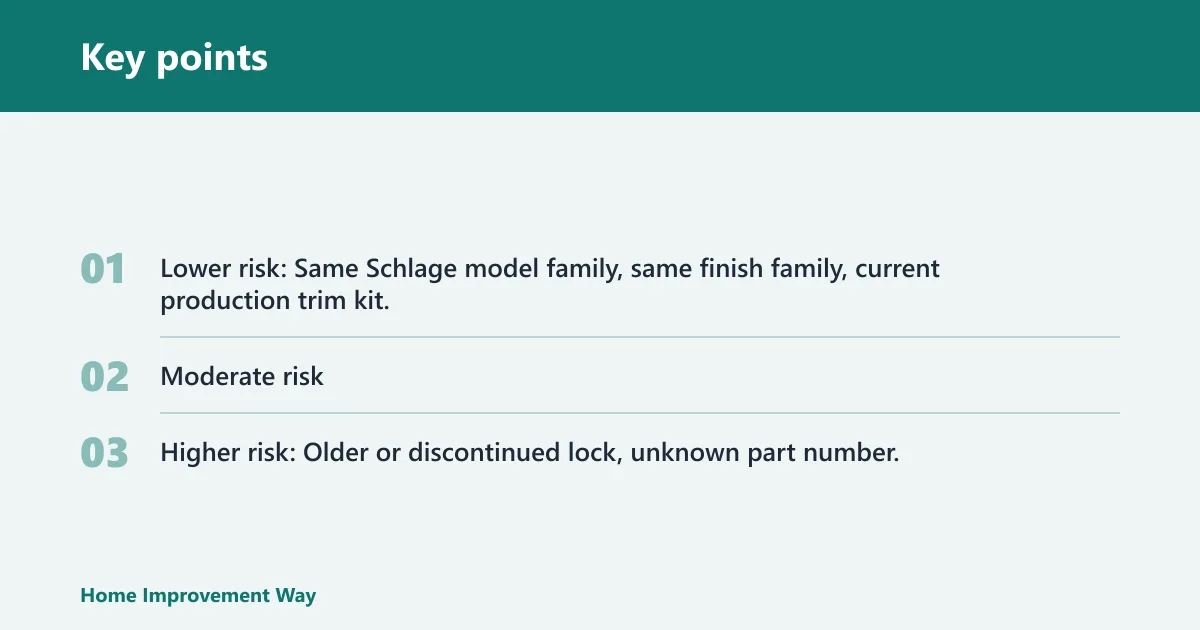
- Lower risk: Same Schlage model family, same finish family, current production trim kit.
- Moderate risk: Same general product type, but a different trim style or a finish that varies by line.
- Higher risk: Older or discontinued lock, unknown part number, or a trim kit from a different Schlage platform.
Schlage trim identification checklist
To identify your existing trim, compare shape cues first, then confirm the model label or packaging. Photos can help, but the exterior shape alone is not enough to prove interchangeability. The goal is to match both the look and the lock family before buying a replacement.
- Look at the exterior outline. Curved and decorative usually points to Camelot. Straight and rectangular usually points to Century.
- Check the rosette area around the cylinder or keypad. A more decorative surround usually points to Camelot.
- Compare the door’s other hardware. Square levers and simple plates often pair with Century.
- Find the model label on the interior side of the lock or in the original packaging.
- Match the exact part number, not just the product name.
- Confirm the finish listed for that model family: satin nickel, aged bronze, or matte black, if available.
- For a keypad deadbolt, verify that the replacement trim is listed for the same keypad platform.
Photo and shape cues to compare
From a photo, Camelot usually shows more rounded shoulders and a decorative border around the exterior plate. Century usually shows straighter lines and a more squared-off face. If the exterior plate looks soft and ornate, think Camelot. If it looks crisp and boxy, think Century.
Model labels, packaging, and part numbers
Model labels are more reliable than looks. Use the lock’s inside labeling, the packaging, or the replacement listing to confirm the family. A trim kit can share a family name with a deadbolt or keypad deadbolt, but the part number still has to line up. That is the safest way to avoid buying a trim that will not mount correctly.
Choose Camelot or Century if…
Choose Camelot if the front door, nearby hardware, and overall exterior style lean traditional, and if your exact Schlage model family accepts the Camelot trim kit. Choose Century if the door is more contemporary, the hardware is more minimal, and the replacement part number matches your existing deadbolt or keypad deadbolt. Style and compatibility should both point the same way.
Choose Camelot if…
- Your front door has a classic or formal exterior style.
- The existing hardware uses curved or decorative shapes.
- You want a more traditional Schlage look on a deadbolt or keypad deadbolt.
- Your exact model family lists Camelot trim in the matching finish.
Choose Century if…
- Your front door has a contemporary or minimal design.
- The other entry hardware uses straight lines and square forms.
- You want a cleaner Schlage exterior trim profile.
- Your exact model family lists Century trim in the matching finish.
Frequently asked questions
What is the difference between Schlage Camelot and Century trim?
Camelot is the more curved, decorative trim style, while Century is the straighter, more minimal one. Both are exterior trim options for Schlage deadbolts and keypad deadbolts. The main difference is appearance and model-family fit, not the internal locking mechanism or how the bolt operates.
Is Camelot or Century better for my front door?
The better choice depends on the door style and the hardware already on the entry. Camelot usually suits traditional or classic exteriors. Century usually suits contemporary or minimal doors. If the rest of the front entry uses square lines, Century often blends better. If it uses ornate details, Camelot usually fits better.
Are Schlage Camelot and Century the same lock mechanism?
No. They are trim styles, not separate lock mechanisms. The mechanism is the deadbolt or keypad deadbolt body inside the lock, while Camelot and Century are the exterior styling pieces. That is why two locks can work the same way while looking very different on the door face.
Does Camelot trim fit the same deadbolt as Century trim?
Sometimes, but not always. Fit depends on the exact Schlage model family and replacement part number. Some lock families offer both trim styles, while others do not. The safe approach is to match the current model label and confirm that the replacement trim is listed for that same family.
Can I replace Camelot trim with Century trim without changing the lock?
You may be able to, if the existing deadbolt or keypad deadbolt family supports that trim swap. If the mounting pattern, electronics, or trim kit part number does not match, you will need a different replacement. Do not assume the trim alone is interchangeable just because both products are Schlage.
Does the trim style affect smart lock compatibility?
Trim style does not determine smart lock compatibility by itself. The important factors are the exact Schlage platform, the electronics, and the model-specific trim kit. A smart-enabled keypad deadbolt may come in either style, but only if that family offers both or supports the replacement trim you want.
How do I know which Schlage trim style I already have?
Look at the exterior shape first. Rounded and decorative usually means Camelot. Straight and rectangular usually means Century. Then confirm the model label, part number, or original packaging. That second step matters because a similar-looking trim can still belong to a different Schlage family with different compatibility rules.
Sponsored / affiliate links. As an Amazon Associate I earn from qualifying purchases. I may earn additional commission from eligible campaigns.