How to Tell If a Door Handle Is Loose From Wear
If the handle wiggles at the lever but the latch still works, the spindle is usually worn or the screws are loose; if the whole trim plate shifts, the fixings or installation are the problem. Ignore it, and the latch case can strip, the door edge can wear, or the door can become hard to close. This guide shows how to tell wear from poor installation by checking what moves, when it moves, and whether the latch seats cleanly.
Quick diagnosis guide

Start with the visible movement. A lever handle that wobbles, sags, creaks, or sits slightly out of line often points to loose fixings or wear at the spindle, while a latch that still catches cleanly points away from the lock case. A handle that turns but does not move the latch is different. That usually means the connection has failed.
Look at the timing of the fault. If the handle feels loose before the latch starts moving, the problem is usually in the handle set, not the frame. If the handle works better with the door open than closed, the strike plate or door alignment is likely part of the diagnosis.
Use this order:
- Check for wobble at the lever or knob.
- Check whether the rose, rosette, or backplate moves.
- Find exposed screws or hidden fixings.
- Test whether the latch moves smoothly.
- Compare the feel with the door open and closed.
Suppose a privacy lever on a bedroom door feels loose, but the latch throws fully and the door closes cleanly. That points more toward fixings, a grub screw, or a worn spindle than a strike plate fault. A keyed entrance handle that turns with no latch movement is a different case and needs faster attention.
What part is actually loose?
The first job is to separate handle movement from trim movement. A lever or door knob that wiggles, rotates, or sags at the handle body usually points to the handle assembly itself. If the rose, rosette, or backplate shifts with the lever, the mounting is loose. If the trim is steady but the lever droops, the issue is more local to the lever, spindle, or return spring.
Lever or knob movement
Grab the handle and move it gently up, down, and side to side. A little play at the lever can come from wear, but a handle that creaks or visibly misaligns is a warning sign. A sagging handle can be caused by loose mounting screws. A handle that stays down or returns slowly can point to a broken return spring.
Rose, rosette, or backplate movement
Move the cover or base with your fingers. If the whole plate rocks, the through-bolts or mounting screws may be loose, or the door may have poor screw bite from the start. That is common when screws were never tightened evenly, when the wrong screw length was used, or when the holes have already been stripped.
Hidden fixings and exposed screws
Some handles show screw heads on the face; others hide them under a plate. A loose handle can be removed by undoing screws through the rose. Some handles require an Allen key, and some use a flathead screwdriver for hidden plates. Check both sides of the door before assuming the handle set is worn out.
Loose handle diagnosis matrix

| Symptom | Likely cause | How to test it | Whether DIY repair is appropriate |
|---|---|---|---|
| Lever wobbles but latch still works | Loose through-bolts or mounting screws | Check whether the handle base moves while the latch still throws normally | Yes, if screws are intact and accessible |
| Handle sags downward | Loose mounting screws or tired return spring | Let go of the lever and see whether it hangs low or rises slowly | Maybe; tighten first, then replace if the spring is failing |
| Play before the latch moves | Worn spindle or loose connection at the lever | Turn the handle and note how far it moves before the latch retracts | Yes, if the spindle or grub screw is the issue |
| Handle turns but latch does not move | Failed spindle connection or broken internal follower | Remove the handle and inspect whether the square bar engages both sides | No, replacement is often needed |
| Hidden plate feels loose | Loose hidden fixings under the rose or cover plate | Lift or slide the cover to find the screws underneath | Yes, if the screws can be tightened without damage |
| Screw heads spin without tightening | Stripped screws or stripped holes | Try hand-tightening; if the screw keeps turning, the thread has likely failed | No, repair the fixing points before reuse |
| Grinding with the door open | Latch wear, dry mechanism, or damaged handle parts | Test the handle with the door open and listen for scraping at the latch case | Sometimes, if cleaning or lubrication restores movement |
| Grinding only when the door is closed | Strike plate misalignment or door alignment issue | Repeat the test with the door open; if the problem disappears, the frame fit is suspect | Yes, if it is a simple strike plate adjustment |
| Keyed, deadbolt, or multipoint set feels loose | Lockset or security hardware issue | Check whether the handle movement affects locking or latching performance | No, call a locksmith if the lockset is involved |
Wear or poor installation?
Wear and installation faults can look similar, but the clues are different. Worn parts usually create play, roughness, or a slow return after the hardware has been in service for a while. Poor installation often shows up as movement in the base, screws that never held well, misaligned parts, or fasteners that were forced too tight from the start. Poor installation is one of the common reasons handles loosen.
Signs of worn parts
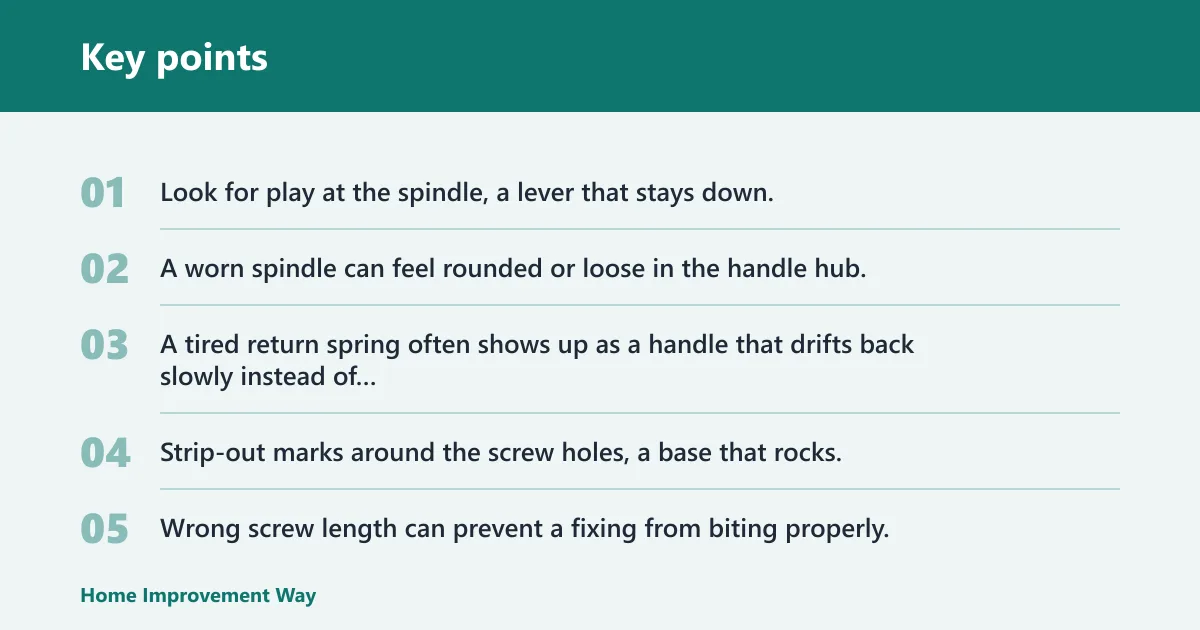
Look for play at the spindle, a lever that stays down, or a handle that returns slowly after release. A worn spindle can feel rounded or loose in the handle hub. A tired return spring often shows up as a handle that drifts back slowly instead of snapping level.
Signs of bad installation
Strip-out marks around the screw holes, a base that rocks, or hardware that never sat flush point to installation trouble. Wrong screw length can prevent a fixing from biting properly. Over-tightening can also leave the fixing weak, especially if the thread has already been damaged. A screwdriver is preferred because a power driver can strip the thread.
How to tell one from the other
Ask two questions. Did the handle become loose gradually, or did it feel wrong from the start? And does the looseness stay the same with the door open and closed? If the handle set works better when the door is open, the frame or strike plate is more likely than normal wear. If the entire trim shifts, start with the fixings.
A common first-timer mistake is to blame the latch immediately when the handle itself is only loose at the rose. If the lever still springs back, the latch may be fine and the trouble may be a loose through-bolt or a grub screw that has backed out.
Check the screws and spindle
Once you know what moves, inspect the fasteners. A loose lever handle can often be fixed with a screwdriver and the small hex key. Tighten the screws that hold the two halves together through the door. Then tighten the grub screw at the base of each lever. That order matters, because the grub screw should be tightened after the through-screws.
Through-bolts and mounting screws
Through-bolts hold both sides of the handle together through the door. Mounting screws do the same job on many sets. They can loosen, spin, or strip. Tighten them by hand with a screwdriver first. If a screw spins without pulling the handle tighter, stop. That is a stripped fixing, not a simple loose screw.
Grub screw at the lever base
The grub screw is the small set screw at the base or underside of the lever. It secures the lever to the spindle on many handles. If it loosens, the lever can feel sloppy even when the backplate is solid. A grub screw typically takes a small hex key if the original key is lost.
Spindle fit, length, and wear
The spindle is the square bar that usually connects both handles to the latch. It can wear round, work loose in the hub, or be the wrong size or length for the set. Too short and it can leave play. Too long and it can bind the mechanism. If the handle turns but the spindle does not drive the latch cleanly, the connection has failed.
Does the latch or strike plate cause the problem?
Use the door-open versus door-closed test to separate handle wear from frame problems. If the handle feels rough with the door open, the latch or handle hardware is likely at fault. If the handle feels normal with the door open but scrapes or refuses to seat when closed, the strike plate or door alignment is the likely cause.
Door-open versus door-closed test
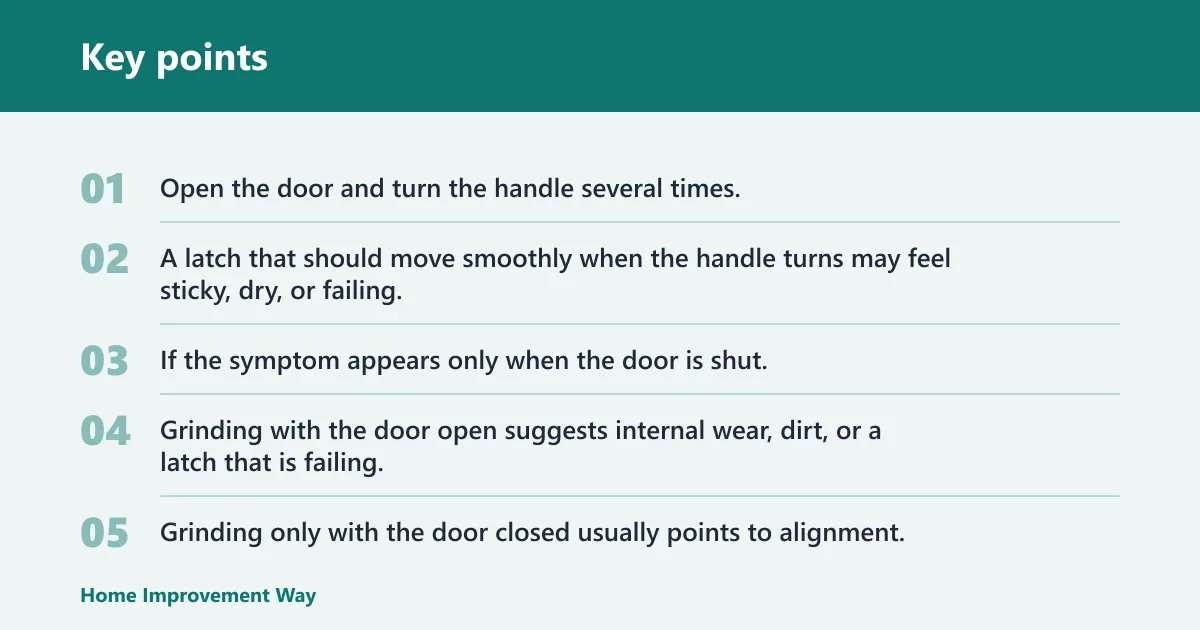
Open the door and turn the handle several times. Then close the door and repeat. A latch that should move smoothly when the handle turns may feel sticky, dry, or failing. If the symptom appears only when the door is shut, the bolt or latch is probably hitting the strike plate off center.
Grinding, sticking, and misalignment
Grinding with the door open suggests internal wear, dirt, or a latch that is failing. Grinding only with the door closed usually points to alignment. Watch whether the latch tongue enters the strike plate cleanly. If it scrapes the frame edge or needs extra force to seat, the installation may be out of square.
When the strike plate needs adjustment
Adjust the strike plate when the latch hits the edge, bounces, or fails to fully seat. Small shifts can improve closure, but do not force the plate far out of position if the door itself is sagging. If the door rubs or the gap is uneven at the top and latch edge, the hinge alignment may also need attention.
When should you repair or replace it?
Many loose handles are repairable with simple tools, especially when the issue is a loose screw, grub screw, or accessible hidden fixing. A handle that turns but doesn’t move the latch suggests a failed connection, and that is often a replacement job. If the lockset is keyed, deadbolt, or multipoint hardware, looseness may affect security as well as convenience.
DIY fixes that are usually safe
If the handle only wobbles, check the visible screws first, then the hidden fixings, then the grub screw. Clean dirt from the latch, add a suitable dry lubricant if the mechanism is sticky, and test again. If the handle set tightens and the latch still seats cleanly, the repair is probably complete.
When replacement is the better choice
Replace the handle or internal mechanism if the spindle is badly worn, the return spring is broken, or the fixing holes are stripped beyond a secure hold. Do not keep tightening damaged threads. That can make the base move more and may chew up the door further.
Security warning cases
When the handle is part of a keyed lock, deadbolt, or multipoint set, treat looseness as a possible security problem. If the handle no longer drives the latch reliably, or the lockset feels loose as a whole, stop using the door as a day-to-day fix. A locksmith should inspect those cases promptly.
Picture a front door with a lever that droops, a backplate that rocks, and a key cylinder nearby. That is not the same as a loose interior passage handle. The second can be inconvenient; the first can affect whether the door latches or locks correctly.
Frequently asked questions
How do I tell if a loose door handle is just worn out or badly installed?
Check what moves first. Wear usually shows up at the lever, spindle, or return spring, while bad installation usually makes the whole rose or backplate shift. If the handle still works but the trim moves, the fixings are suspect. If the handle feels sloppy at the lever itself, wear is more likely.
What signs mean the screws are loose versus the spindle or latch wearing out?
Loose screws usually cause wobble at the base or visible movement in the trim. A worn spindle more often creates play before the latch starts moving. A worn latch can feel sticky, gritty, or slow. If tightening the screws improves the feel right away, the fixing was the main issue.
Should a handle that turns but doesn’t move the latch be repaired or replaced?
That usually means the connection has failed, so repair may not be enough. Check the spindle, grub screw, and internal follower first. If the spindle is damaged or the mechanism inside the lock case is broken, replacement is often the practical fix. Do not keep forcing the handle.
How do I check whether the strike plate or door alignment is causing the wobble?
Run the handle test with the door open, then closed. If the wobble or grinding only appears when the door is shut, the strike plate or door alignment is involved. If the handle feels loose in both positions, the problem is in the handle set, not the frame fit.
What parts should I inspect first on an internal or entrance door handle?
Start with the exposed screws or hidden fixings, then check the rose, rosette, or backplate for movement. After that, inspect the grub screw at the lever base and the spindle fit. On entrance hardware, also check whether the latch still seats cleanly and whether the key or lock parts are affected.
When is a loose handle a security problem that needs immediate repair?
It becomes urgent when the handle no longer drives the latch reliably, when the lockset is keyed or multipoint, or when the door will not close and stay latched cleanly. If the handle can be turned without proper latch travel, the door may not secure as intended. That needs prompt attention.
Can a loose handle be fixed with a screwdriver or Allen key?
Often, yes. Many loose lever handles can be tightened with a screwdriver and the small hex key. Use the screwdriver for the through-bolts or mounting screws, then the Allen key for the grub screw if present. Stop if the screw spins, because stripped threads need a different repair.
How do I know if the handle set is stripped, misaligned, or simply overused?
Stripped fixings usually spin without tightening. Misalignment shows up when the handle works better with the door open than closed. Overuse tends to show gradual play, a softer return, or a worn spindle. If the handle wobbles but the latch still works, the fault is often fixings rather than the lock.
Sponsored / affiliate links. As an Amazon Associate I earn from qualifying purchases. I may earn additional commission from eligible campaigns.
 Exterior Door Lock Set with Deadbolt, Front Door Handle Set with Deadbolt, Door Levers Single Cylinder Deadbolt Set, Keyed Alike Heavy Duty Keyed Entry Handles Locksets,(Satin Nickel ,3Pack)
 Keyed Alike Front Door Handle and Deadbolt Set, Exterior Door Lock Set with Deadbolt, Heavy Duty Round Door Knob and Deadbolt Lock for Front Doors, Satin Nickel, 1 Pack