Best Crown Molding for Living Rooms (2026): Based on Specs
For 9-foot ceilings, crown molding is commonly about 4 to 5 inches. Too much projection can make walls feel shorter and windows smaller, while too little molding reads thin and unfinished. This guide shows how to size crown by ceiling height, room width, material, and existing trim so the result feels proportional.
Quick comparison
| Product | Badge | Best for | Price | ||
|---|---|---|---|---|---|
 |
Creative Crown Engel LED Foam Molding Kit, 48 Ft 3.5in,Austin Crown Molding | Our pick | 3.5in · LED · Foam | $189.85
Price as of 19 Oct 2026
|
View |
 |
Marsui 3 Pcs 12 ft Wooden Ceiling Crown Molding Trim 3.5" FMarsui | Budget pick | 3.5in · White · Wood | $56.99
Price as of 19 Oct 2026
|
View |
 |
14 Pack 55Ft Ceiling Crown Molding Trim, Room Top Lightmoonoom | Also great | 55ft · LED · Foam | $104.99
Price as of 19 Oct 2026
|
View |
 |
ElaraBerry 4 Pcs Crown Molding Corner Blocks, 3 1/2"W x 3ElaraBerry | Pair with it | 3.5in · Plaster · Corner | $45.99
Price as of 19 Oct 2026
|
View |
 |
Creative Crown Foam Crown Molding Samples | 6 Profile &Austin Crown Molding | Also great | 3.5-5.5in · Sample · Foam | $15.95
Price as of 19 Oct 2026
|
View |
This quick comparison helps you match ceiling height to profile weight before you compare materials or finishes. The right choice depends on how much crown projects into the room, not only on how ornate it looks.
How we chose
We compared options by ceiling height fit, visual weight, material behavior, installation difficulty, and how well the profile matches common living room trim packages. Crown molding bridges the wall-and-ceiling junction, but the best one also respects room width, wall run length, and the scale of nearby baseboards and casing.
The selection below also accounts for finish. MDF is affordable and smooth for painted finishes. Solid wood is best for stained finishes and premium projects. Polyurethane is lightweight and moisture-resistant, which matters when you want ornate detail without heavy stock.
Creative Crown Engel LED Foam Molding Kit: best for quick visual height
This fits a living room that needs a lighter look and a faster install. The built-in LED channel adds a bright upper edge, which can make the ceiling line feel higher when the room is otherwise plain or flat.
Based on the published specs, the flat-back foam construction and precut corners reduce the need for compound cuts. That makes it friendlier for a simple DIY retrofit, especially when the walls are already painted and you want to avoid a long finish process.
The drawback is the same feature that makes it easy: foam can read less substantial than wood or plaster, so it may look underpowered in a formal room with thick casing, large baseboards, or 10-foot-plus ceilings.
Marsui wooden ceiling crown molding: best for painted wood trim
This suits a painted living room that needs a classic wood look without moving into ornate territory. The pre-painted white finish cuts down prep time, and the 3.5-inch size sits well in many 8-foot rooms where oversized crown would crowd the wall.
The wooden construction gives it more visual substance than foam, which helps when the room has simple furniture and you want the upper trim to feel deliberate rather than decorative-only. It also suits spaces where the crown should tie into painted baseboards and casing.
The main drawback is moisture sensitivity compared with polyurethane, and wood can ask more from your install if the walls or corners are not very straight. Construction adhesive is listed as the install method, but gaps still need careful fitting and caulk.
Moonoom ceiling crown molding trim: best for larger living rooms
This is a stronger choice for a wider living room or open-plan area where a longer run needs more presence. The 55-foot coverage is useful when the room perimeter is substantial and you want one coordinated molding package rather than piecemeal sections.
The integrated LED channel adds perceived height at the ceiling line, and the waterproof polystyrene material gives it a practical edge in spaces that face humidity swings or frequent cleaning. It can work well when you want a modern look with some architectural presence.
The drawback is scale. In a narrow living room, a longer, more feature-rich profile can feel busy fast, especially if the room already has patterned drapery, heavy furniture, or detailed window trim.
ElaraBerry crown molding corner blocks: best for easier corners
This is for a project where inside corners are the sticking point. The gypsum plaster blocks can simplify the visual transition at corners and reduce the fiddly alignment that comes with miter-only work.
They are especially useful in traditional rooms where corner detail is part of the trim package. The factory-primed white surface blends with common painted crown styles, and the harder material resists dents better than foam.
The drawback is that corner blocks are not a full crown solution by themselves. They work best as a support piece in a broader trim plan, and they may look out of place in a very clean modern room.
Creative Crown sample set: best for choosing scale
This is the safest first step when you are unsure about size. The six swatches let you compare 3.5-inch, 4.5-inch, and 5.5-inch profiles against your room’s ceiling height, wall color, and existing casing.
That matters because crown size reads differently in the room than it does online. A profile that seems modest in a listing can feel heavy once it meets a narrow wall run, tall drapes, or a short ceiling line.
The drawback is obvious: it is a sample set, not a finished trim package. It helps you choose, but it does not solve installation or complete the room.
What size crown molding looks best in a living room?
The best size usually tracks the ceiling first, then the room width. For 8-foot ceilings, a common living-room range is about 2 1/2 to 3 1/2 inches of profile height; for 9-foot ceilings, 4 to 5 inches; and for 10-foot and taller ceilings, larger profiles or built-up crown can work if the room has enough width to support them.
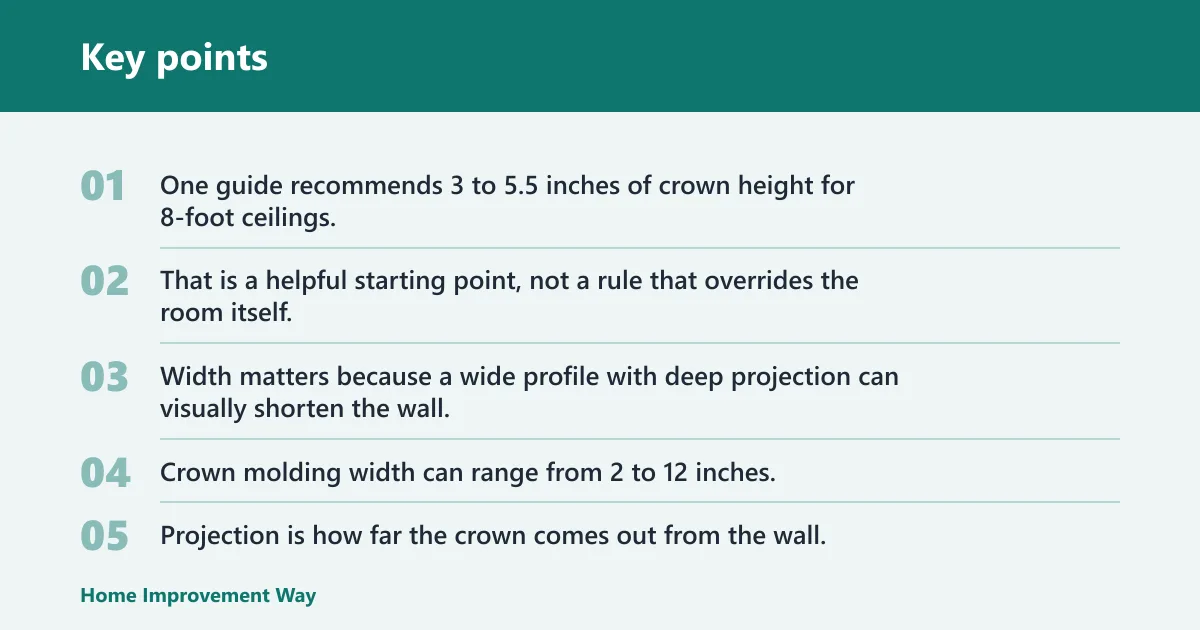
3 to 5.5 inches of crown height for 8-foot ceilings, 5 to 7 inches for 9-foot ceilings, and 7 inches and up for 10-foot and taller ceilings. That is a helpful starting point, not a rule that overrides the room itself.
Width matters because a wide profile with deep projection can visually shorten the wall. Crown molding width can range from 2 to 12 inches, but a living room does not benefit from the top end unless the ceiling is tall and the wall runs are broad enough to carry it.
How projection and drop change the look
Projection is how far the crown comes out from the wall. Drop is how far it runs down the wall face. Bigger numbers in either direction make the molding read heavier because they create a stronger shadow line and a larger visual band at the ceiling.
Spring angle matters too. Many installations use a 38 or 45 degree angle, and that angle affects how the profile sits in the corner and how much of the face you actually see from the room. A profile with a steep, deep face can look bulkier than its measured height suggests.
Should living room crown molding be simple or ornate?
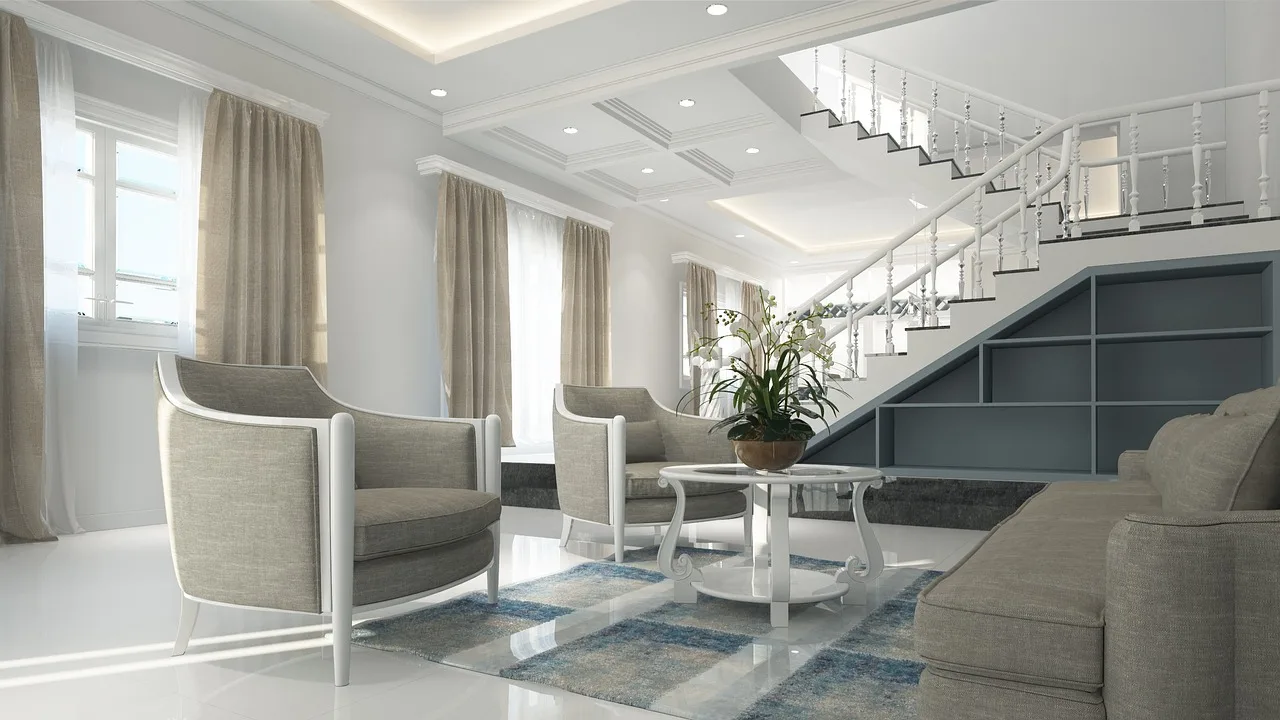
Simple profiles work best when the room already has a lot going on. Ornate crown adds detail, but detail is only useful when the room can carry it. In many living rooms, a clean cove, ogee, or stepped profile looks more finished because it supports the architecture instead of competing with it.
If the room is modern, transitional, or visually busy, keep the ornament count low and pay more attention to projection, drop, and face size. If the room has tall ceilings, larger windows, and substantial baseboards, more profile depth can make sense without feeling crowded.
Best cove crown: best for low ceilings
Cove crown reads lighter because its curve softens the junction without a strong stacked edge. It works well in 8-foot rooms, small-to-medium living rooms, and spaces that need a cleaner transition rather than a decorative statement.
That softer edge also reduces the sense of weight at the ceiling line. Use it when the room feels squat, when the wall runs are short, or when the furniture already brings in a lot of visual mass.
Avoid it if the room needs stronger shadow lines or if the baseboards and casing are already thin and plain. In that case, the crown may look too small to belong with the rest of the trim package.
Best ogee crown: best for transitional living rooms
Ogee crown suits many trim packages because it has enough curve to feel classic without pushing into heavy ornament. It is a good middle ground for living rooms that blend painted millwork, simple furniture, and mixed traditional and modern pieces.
The curved face gives a bit more shadow than a flat stepped profile, which can help the ceiling line feel defined. That extra contour is useful when you want visual height without a bulky stack.
Avoid it when the walls already feel busy, such as rooms with patterned wallpaper, elaborate drapery, or multiple layers of trim. In those spaces, the curve can add visual noise instead of structure.
Best stepped crown: best for modern living rooms
Stepped profiles look cleaner because they rely on planes rather than ornament. In a modern living room, that simplicity helps the crown read as part of the architecture instead of a decorative add-on.
It pairs well with simple baseboards and casing, especially when those trims have square edges and modest thickness. If the room has a flat ceiling and open sightlines, a stepped crown can finish the top edge without drawing too much attention.
Avoid it if you want a traditional look. The profile is too plain for rooms that need a classic painted millwork feel or a more formal transition.
Best built-up cornice: best for tall ceilings
Built-up cornice means stacked molding, often combining multiple pieces to create greater visual impact. It makes sense when the ceiling is tall enough that a single small crown would disappear, and when the room width can support a broader top treatment.
This approach works well in 10-foot-plus rooms because it gives the wall-to-ceiling transition more scale. It can also help a long living room wall feel intentionally framed rather than underdressed.
Avoid it if the room is narrow or modest in scale. The stack can overwhelm the wall, especially if the windows are short or the ceiling is tall but the room footprint is tight.
How do I choose crown molding for 8-foot ceilings?
For 8-foot ceilings, choose a smaller crown and keep the profile light. 3 to 5.5 inches of crown height, and in a living room that usually means staying near the lower end unless the room is wide and the trim package is substantial.
Oversize crown can overwhelm 8-foot ceilings, especially in narrow rooms. A large face, deep drop, or heavy dentil detail can make the wall feel shorter and the room feel more compressed than it really is.
Choose cove, small ogee, or a slim stepped profile if the room is modest. If the room already feels squat, keep projection conservative and avoid deep stacks or heavy ornament.
Crown molding selection table
| Ceiling band | Recommended projection/drop | Style match notes | Avoid if |
|---|---|---|---|
| 8-foot ceilings | About 2 1/2 to 3 1/2 inches tall; keep projection modest | Cove, slim ogee, or stepped profiles keep the room open and clean | The room is narrow, the walls are visually busy, or the crown would sit below thick casing |
| 9-foot ceilings | About 4 to 5 inches tall; moderate projection and drop | Transitional ogee or restrained built-up treatments fit most living rooms | The room has very short wall runs or already uses heavy drapery and ornate trim |
| 10-foot-plus ceilings | 7 inches and up; deeper drop and stronger face can work | Built-up cornice, larger ogee, or a bolder stepped stack can feel proportional | The room is narrow, the windows are small, or the rest of the trim is minimal |
How do I make crown molding make the ceiling look taller?
Use crown to draw the eye upward, not to cap the wall too hard. A lighter profile, smaller face, and cleaner shadow line usually make the ceiling feel higher than a bulky or deeply ornate one. Painting the crown the same color as the ceiling can also reduce the visual break.
The goal is proportion. A crown that is too large can make windows feel smaller and ceilings feel lower, while a profile that is too small can leave the room looking unfinished. In living rooms, the best effect often comes from restraint, especially near short walls.
Picture a 13-by-15-foot living room with an 8-foot ceiling and standard 3 1/2-inch baseboards. A 5-inch crown with deep projection would likely feel heavy. A slimmer cove profile with modest depth would lift the line without taking over the wall.
How room width and wall runs change the choice
Room width changes how much molding the eye can absorb at once. Long wall runs can handle a little more size because the profile repeats over distance, while narrow rooms concentrate the visual weight in a shorter span.
That is why a crown that feels balanced in a wide open-plan room can look oversized in a narrow living room. The same profile also reads differently beside tall windows than beside short ones.
What crown molding material is best for a painted living room?
MDF is usually the easiest painted choice because it is affordable and smooth for painted finishes. It gives a clean surface, stays visually quiet after paint, and often makes sense when the goal is a crisp finish rather than natural grain.
Polyurethane is also strong for painted living rooms, especially when you want lightweight profiles or moisture resistance. It is useful for more ornate shapes because the material can carry detail without the weight of solid wood.
Solid wood is the premium route for stained finishes, but it also works in painted rooms when the trim package needs a more substantial feel. The drawback is humidity sensitivity and higher cost compared with MDF.
Painted vs stained finishes and scale
Painted crown usually reads larger and flatter than stained wood because the finish reduces grain contrast and lets the profile line do the work. That can be helpful in modern and transitional rooms where you want the trim to blend into the wall or ceiling color.
Stained wood adds grain and contrast, which can make the molding feel more prominent. In a living room with strong wood floors or stained window casings, that can look coordinated. In a smaller room, though, the extra contrast can make the crown feel heavier.
Can I use built-up crown molding in a living room?
Yes, but only when the room can support the scale. Built-up crown works best in tall, wide living rooms where a single-profile crown would feel too slight against the wall height. It is also useful when you want a more formal, architectural look.
The tradeoff is labor and visual weight. More pieces mean more cuts, more fitting, and more chance for the top treatment to dominate the room. If the room is narrow, low, or already crowded with trim, a stacked cornice can overwhelm the walls.
A common first-timer mistake is choosing built-up crown because the profile looks impressive on paper. In a modest living room, that same profile can make the ceiling feel lower and the corners harder to read cleanly.
Installation basics that affect fit
- Use a compound miter saw for corner cuts and test the spring angle before cutting full lengths.
- Coping helps inside corners stay tight when the walls are not perfectly square.
- Use adhesive for lightweight profiles when the product calls for it, especially foam and some polyurethane trims.
- Fasten into framing when possible so the molding stays secure and the joint line does not open over time.
- Plan the order of corners first. A long living room run is easier to fit when the tricky corners are mapped before the straight sections go up.
Which one should you buy?
For 8-foot ceilings, choose a slim cove or small ogee in MDF or lightweight polyurethane. For 9-foot ceilings, a medium ogee or restrained stepped profile usually gives the best balance of presence and restraint. For 10-foot-plus ceilings, built-up crown or a larger solid-wood profile can work if the room width supports it.
For a modern living room, stepped crown is the safest fit. For transitional rooms, ogee is usually the easiest match. For traditional rooms, a fuller cove, ogee, or built-up cornice can work, but only if the rest of the trim has similar weight.
If the room is painted and budget-sensitive, MDF is the practical default. If the room is stained or needs a premium look, solid wood is the better visual match. If you want a lighter install or more ornate shape without heavy stock, polyurethane is the most flexible option.
For DIY level, pick the simplest profile that still fits the room. Fewer edges, less depth, and lighter material all reduce fitting trouble. If the room has long runs, multiple corners, and uneven walls, the easier profile usually looks better in the end than the fancier one.
Sponsored / affiliate links. As an Amazon Associate I earn from qualifying purchases. I may earn additional commission from eligible campaigns.