Accent Lighting vs General Lighting: When to Use Each
Use general lighting for safe movement and everyday tasks, then add accent lighting to draw attention to art, texture, or a focal point; in my experience, accent alone is usually only practical for short stretches in small, low-use areas. Without the right mix, rooms feel dim, harsh, or flat, and you may overlight some spots while missing others. This guide gives a room-by-room rule for when accent lighting should support general lighting, stand alone, or fail.
| Decision factor | Accent Lighting | General Lighting | Winner |
|---|---|---|---|
| Main job | Focuses light on a chosen object or area | Provides overall illumination for the room | General Lighting |
| Comfort for movement | Can leave paths dim or uneven | Supports safe movement with a calm, even base layer | General Lighting |
| Visual effect | Creates contrast, depth, and hierarchy | Creates uniform light with less drama | Accent Lighting |
| Control over direction | Uses focused beams and aiming | Usually broader and less directional | Accent Lighting |
| Best use case | Artwork, shelving, textures, and details | Daily living, cooking, cleaning, and circulation | Tie |
What is the difference between accent lighting and general lighting?

General lighting is the room’s base layer of light. It gives the room overall illumination, often called ambient lighting, and should feel comfortable, even, and dependable for safe movement. Accent lighting is the focused layer that draws attention to a specific feature, such as artwork, shelving, textures, or an architectural detail.
The difference comes down to beam spread, aiming, and purpose. General lighting uses broader distribution from recessed ceiling lighting, linear lighting systems, indirect lighting, or ceiling-mounted luminaires. Accent lighting uses narrower, more controlled beams from architectural spotlights, recessed luminaires, or track lighting systems.
General lighting is about coverage
General lighting should light the whole room without harsh bright spots or dark corners. It is the layer you notice when a space feels usable rather than theatrical.
Accent lighting is about selection
Accent lighting adds focus, depth, and hierarchy to an interior. It works best when the room already has enough base light and you want the eye to land on something specific.
When should you use accent lighting instead of general lighting?

Use accent lighting instead of general lighting only when the room already has enough base light or when the space is used briefly and does not need full-room illumination. It is the right choice for drawing attention to art, shelving, texture, or a single wall feature, but it should usually support the main light rather than replace it.
If the room needs safe walking, cleaning, reading, or cooking, accent lighting cannot carry the whole load. It can work on its own in a small display alcove, a decorative niche, or a low-use corner, but it fails quickly when the task changes from viewing to living.
Use accent lighting as a supplement
A common first-timer mistake is adding more spotlights before fixing the base layer. That creates bright objects floating in a dim room, which feels uneven and often uncomfortable.
Use it alone only in narrow use cases
Accent lighting can stand alone for short periods in a gallery-like wall, a shelving niche, or a quiet sitting corner where people are not moving around much. Even then, the room should still have some other source of light nearby if the use changes.
Can accent lighting be the main light in a room?
Accent lighting can be the main visible layer for a short period in small, low-use areas, but it usually is not enough on its own to be the only useful light in an occupied room. It leaves movement paths, corners, and tasks underlit unless the space is very limited and the activity is mostly visual.
It tends to fail in living rooms, bedrooms, kitchens, bathrooms, and home offices because those rooms need broader coverage and glare reduction. If you see bright spots on the wall but shadows on the floor or counter, you need more general lighting.
Where accent-only can work
Accent-only lighting can work in a display wall, a decorative alcove, or a hallway feature where the goal is visual emphasis more than full visibility. It can also work temporarily in a dining setting if another layer is available elsewhere in the room.
Signs you need more general light
If you squint near the seating area, miss items on a countertop, or notice dark corners at the edges of the room, the accent layer is doing too much. The fix is usually broader ambient lighting, not more aiming.
How many layers of lighting does a room need?
One layer may be enough only in small, simple spaces with one main use and little need for mood changes. Many rooms work better with two layers: general lighting for the base and accent lighting for selected features. Larger rooms, taller ceilings, and rooms with multiple activities often need three layers when task lighting is added.
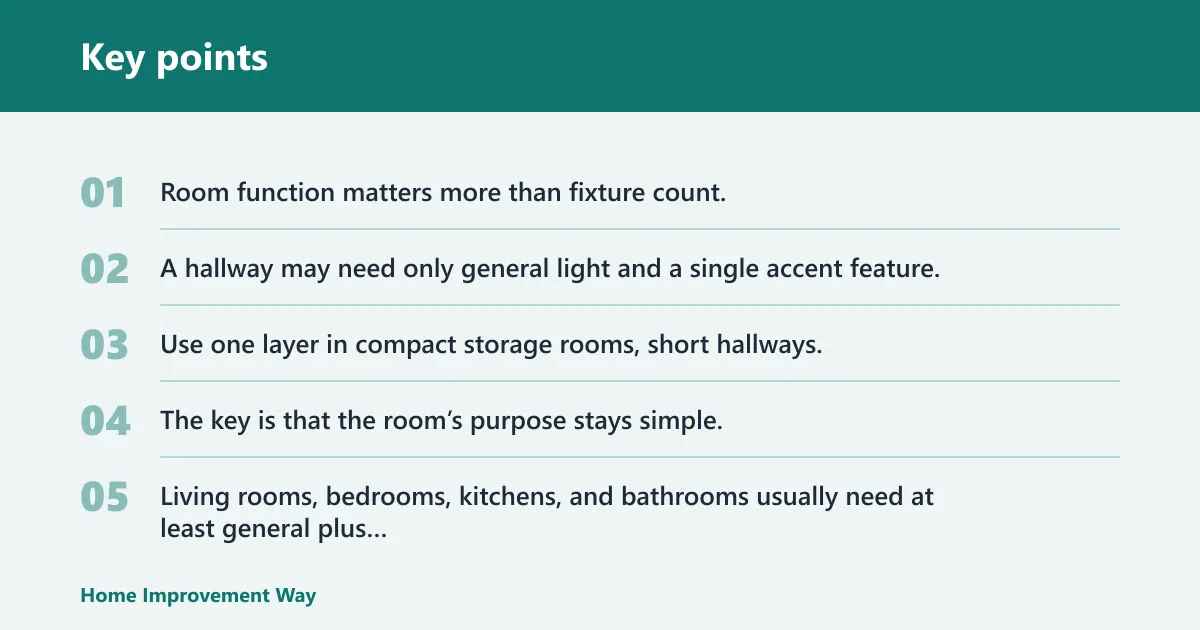
Room function matters more than fixture count. A hallway may need only general light and a single accent feature, while a living room or home office usually needs a layered lighting plan to avoid shadows and overfocused spots.
When one layer is enough
Use one layer in compact storage rooms, short hallways, or decorative spaces that are not used for long periods. The key is that the room’s purpose stays simple.
When two layers are the practical minimum
Living rooms, bedrooms, kitchens, and bathrooms usually need at least general plus accent, because the room has to function well and still look balanced. Two layers give you a base and a point of interest.
How ceiling height changes the mix
Taller ceilings often need more careful spacing and stronger beam control so the light reaches the right surfaces. Lower ceilings can be harder because glare from directly visible fixtures becomes more noticeable.
| Room | Need | Priority | Best rule of thumb |
|---|---|---|---|
| Living room | Both | Comfort and visual focus | Start with a calm base, then add accent for art, shelves, or a fireplace wall |
| Bedroom | Both | Comfort and glare control | Use general light for dressing and cleaning, then accent for headboard or wall detail |
| Kitchen | General first, accent optional | Visibility | Prioritize even task light; use accent only for cabinets or a feature wall |
| Hallway | General first | Safe movement | Keep the base even, then use a controlled accent only if the hall needs visual direction |
| Dining room | Both | Atmosphere and table light | Center the base on the table, then add wall or buffet accents if the room feels flat |
| Reading corner | Both | Task clarity | Give the chair a bright task source and keep the rest of the zone comfortable |
| Bathroom | General first, accent optional | Face and mirror visibility | Keep general light even around the mirror; use accent only outside splash zones |
| Home office | Both | Task visibility | Use general light to support the room, then add accent only if decor needs a lift |
What fixtures work best for accent lighting?
Track lighting, adjustable recessed luminaires, and architectural spotlights are the most useful accent fixtures because they give you beam control and aiming. That control lets you direct light onto artwork, shelving, textures, or an architectural surface without flooding the whole room.
Recessed lighting can be either general or accent lighting depending on beam angle, spacing, and placement. A wide, evenly spaced layout reads as general light; a tighter, aimed layout reads as accent.
Track lighting for flexible aiming
Track lighting systems are commonly used for accent lighting because each head can be aimed where needed. They are useful when you want to change the focus without rewiring.
Recessed lighting with controlled beam spread
Recessed lighting can disappear visually in contemporary interiors, which is helpful when you want the room, not the fixture, to stand out. Narrower beam spread and careful placement make it better for accent use.
Spotlights for specific surfaces
Spotlights work well for framed art, a bookshelf, a textured wall, or a fireplace surround. They should hit the target cleanly, not wash the floor or the opposite wall.
How do you balance ambient and accent lighting in a living room?
Start with a calm ambient layer that covers seating, walking paths, and the full room, then add accent light only where you want the eye to pause. In a living room, the balance should keep the room usable first and decorative second.
Dimmers help because they let you shift the room from daily use to evening atmosphere. They are useful for both general lighting and accent lighting, especially when the room changes from reading and cleanup to watching TV or hosting guests.
Build the base before the feature light
If the room feels flat, the answer is often not more accents. It is a better base layer with more even distribution and less glare at eye level.
Avoid hotspots near seating
Do not aim a narrow beam where people face it directly from a sofa or chair. That creates discomfort fast, even if the room looks dramatic in a photo.
How do architects combine general and accent lighting?
Architects usually combine general and accent lighting as layered lighting: a base layer for visibility, a focused layer for emphasis, and sometimes a task layer for work surfaces. The mix changes with room type, ceiling height, surface reflectance, and how people move through the space.
In practical terms, that means planning the base first, then placing accents where the architecture or furnishings need direction. The best layouts keep the room calm and usable while giving selected areas more visual weight.
Planning order matters
General lighting comes first because it solves comfort and circulation. Accent lighting comes after because it should support the room’s shape and features, not fight the base layer.
Beam control makes the difference
A narrow beam spread creates a sharper accent and a stronger sense of focus. Broader distribution belongs to general lighting because it reduces glare and smooths out contrast.
Failure cases: glare, shadows, and overfocused spots
Accent lighting fails when it creates glare at eye level, leaves dark corners, or puts too much brightness on a single surface. Those problems are usually caused by poor aiming, weak spacing, or using a beam that is too narrow for the surface size.
General lighting fails when it is too harsh, too bright, or too sparse. That creates visual fatigue and makes the room feel less calm, even if the space is technically well lit.
- Check glare: If you can see bare light sources from normal seated or standing positions, soften the fixture choice or change the aiming.
- Check shadows: If walls, corners, or counters fall into darkness, add broader base light or adjust spacing.
- Check hotspots: If one patch of wall or one object is much brighter than everything around it, widen the beam or reduce the output.
- Check movement paths: If walking through the room feels patchy, the accent layer is being asked to do the job of general lighting.
Choose accent lighting if…
Choose accent lighting when your goal is to direct attention, create contrast, or give a feature more visual weight. It is the right pick for art, shelving, textured walls, and architectural details, especially when the room already has enough base light from general lighting.
Choose general lighting if…
Choose general lighting when the room needs safe movement, routine visibility, and a calm, even base layer. It wins for kitchens, hallways, bathrooms, and the main part of living rooms and bedrooms because those spaces need comfort before emphasis.
Frequently asked questions
Do I need dimmers for accent lighting and general lighting?
Dimmers are useful for both. They let you keep general lighting comfortable during the day and lower it later for a softer mood, while also letting accent lighting stay visible without overpowering the room. In a living room or bedroom, dimmers make the layers easier to balance.
Sponsored / affiliate links. As an Amazon Associate I earn from qualifying purchases. I may earn additional commission from eligible campaigns.