Basement Waterproofing Cost Per Square Foot: What Drives It
Basement waterproofing cost per square foot often runs from about $5 to $30+, and the most useful quote is the one that reflects the water source, access, and included drainage work rather than floor area alone. Skip those details, and you can end up paying twice when the first repair fails or leaves out key items. This guide explains what drives price differences, which quote items to compare, and how to spot a low bid that leaves out the real fix.
How much does basement waterproofing cost?
For many homes, interior waterproofing falls around $3 to $9 per square foot, while exterior waterproofing sits around $4 to $10 per square foot before site complications are added. Those numbers do different jobs. Interior work deals with seepage from inside the basement. Exterior work tries to stop water at the foundation wall.
Typical per-square-foot ranges for interior work
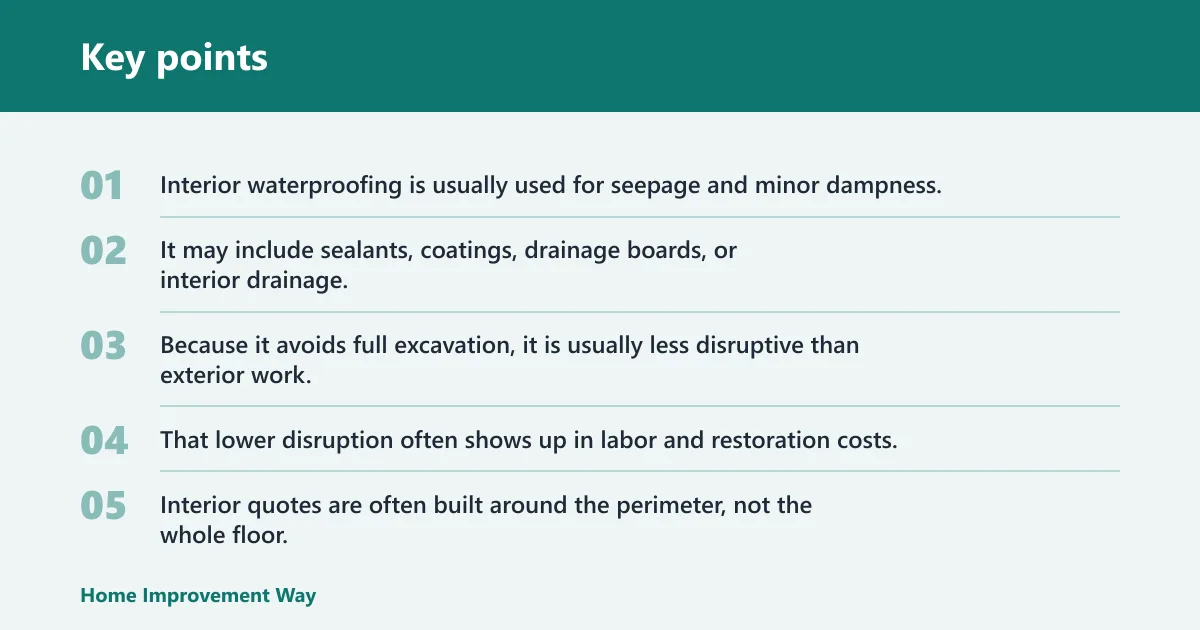
Interior waterproofing is usually used for seepage and minor dampness. It may include sealants, coatings, drainage boards, or interior drainage. Because it avoids full excavation, it is usually less disruptive than exterior work. That lower disruption often shows up in labor and restoration costs.
Interior quotes are often built around the perimeter, not the whole floor. If a contractor prices by square foot, ask whether the number assumes a full-floor system or only the wall sections that actually collect water.
Typical per-square-foot ranges for exterior work
Exterior waterproofing usually costs more because it requires excavation and backfill, uses membrane and drainage components, and often brings more labor and permit complexity. One source pegs exterior waterproofing at $4 low, $7 average, and $10 high per square foot. Another puts exterior waterproofing with trenching between $8.00 and $20.00 per square foot.
That spread matters. Exterior work is not only a membrane price. It includes digging to the footing, handling spoil, protecting landscaping, and restoring the site after the wall is opened up.
Why perimeter often prices the job better than floor area
Basement perimeter is often a better pricing unit than floor area because many waterproofing systems follow the wall line, not the entire slab. A 1,000-square-foot basement with a long perimeter can cost more than a larger but squarer basement with fewer wall feet. Perimeter also helps you compare quotes that include interior drains, exterior excavation, or crack work.
A common mistake is assuming a 900-square-foot basement will cost the same to waterproof whether it needs only crack injection or a full interior drain system with sump pump. A better comparison is to translate each bid into wall length, access difficulty, and included components. That shows whether the contractor priced the failure or only the visible damp spot.
Interior vs exterior waterproofing costs
Interior and exterior waterproofing solve different water problems. Interior work is usually chosen for seepage, damp walls, and minor recurring moisture. Exterior work is aimed at stopping water before it reaches the foundation, which is why it usually costs more and involves more disruption.
Interior drainage, sealants, and coatings
Interior systems most commonly cost $3,000 to $8,000, and one source lists interior upgrades at about $4,500 to $9,000 for a typical 1,500 sq ft basement. Another source shows interior waterproofing between $3.00 and $9.50 per square foot. These bids may include coatings, drainage boards, or an interior drain channel with a discharge route to a sump.
Interior work is often the better fit when water shows up as seepage, dampness, or small wall leaks rather than bulk pressure from outside. It can be a practical choice for finished basements where full exterior digging would destroy landscaping or hardscape.
Exterior membranes, excavation, and backfill
Exterior excavation and membrane systems cost $8,000 to $15,000 according to one source, and a 1,500 sq ft exterior project is estimated at $6,000 to $15,000. Exterior waterproofing often clusters around $6 to $7 per sq ft. Those figures can rise fast once the job includes deep trenching, difficult soil, or code-driven restoration.
Exterior work usually needs excavation, membrane application, drainage components, and backfill. It can also trigger inspections or permit steps that interior work may avoid. That makes it a more complete fix in some cases, but also a more expensive one to scope correctly.
When each method fits the water problem
If the wall is weeping after storms and the issue appears to come through joints, cracks, or hydrostatic pressure, the chosen method should match the source. Interior drainage can manage water that has already entered. Exterior waterproofing is more appropriate when the wall itself needs to be protected from outside saturation or failed grading.
Say your 24-by-30 basement has a damp rear wall and a hairline crack near a window well. A quote that covers only interior sealant may look cheap, but it may not address the crack or the drainage path that is feeding the leak.
Basement waterproofing quote decoder
Use a quote decoder to separate the price of stopping water from the price of opening, repairing, and restoring the basement. The line item matters as much as the total, because two bids can use the same per-square-foot number while covering very different scopes.
| Line item | Typical unit used | When it appears | What it fixes | Red-flag omissions |
|---|---|---|---|---|
| Interior drainage system | Per linear foot | Persistent seepage along the wall-floor joint | Collects and redirects water that enters at the perimeter | Floor cutting, gravel, sump connection, patching |
| Sealant or coating | Per square foot | Minor dampness or wall staining | Reduces moisture entry through the surface | Prep work, wall repair, source drainage correction |
| Exterior membrane | Per square foot | Full exterior excavation | Blocks water before it reaches the wall | Excavation, backfill, disposal, landscaping repair |
| Sump pump installation | Each system | Interior drainage or active water collection | Pumps collected water away from the basement | Discharge line, check valve, backup controls, electrical tie-in |
| Crack injection | Per linear foot or per crack | Visible wall or floor crack leaks | Seals cracks with epoxy or polyurethane | Surface prep, finish repair, wall stabilization if needed |
| Permits and inspections | Project or local fee | Code-dependent work, often exterior excavation | Legal approval and compliance checks | Inspection trips, reinspection fees, permit closeout |
| Restoration | Per area or separate line | After demolition or excavation | Returns the basement or yard to usable condition | Drywall, paint, trim, concrete patching, grading |
What drives the price up?
The biggest price jumps usually come from labor time, soil conditions, and access limits. Those factors change how long the crew is on site, how much equipment is needed, and how much demolition or restoration follows the waterproofing work.
Labor rate and crew time
One source lists labor at $1.50 low, $3.50 average, and $6.00 high. Another source places permits and inspections between $100 and $2,000, which shows how regional pricing can swing even before materials are counted. Larger crews, longer mobilization, and slower site work all push the total higher.
Labor pricing also changes with duration. A quick interior drain job in an open basement is not the same as a two-day exterior excavation with hauling, membrane work, and backfill. If the bid does not say how many crew days are included, the total may be under-scoped.
Soil conditions and water table pressure
Clay soil holds water and can make excavation slower, wetter, and more labor-intensive. Sandy soil usually drains more easily, but loose conditions can still complicate trench walls and backfill. A high water table can force pumping, stabilization, or slower digging, all of which raise cost.
Suppose two homes both need exterior waterproofing on a 40-foot wall. The one with clay soil and standing water may need more labor and equipment time than the one with dry, sandy ground, even if the wall length is identical.
Foundation access and basement layout
Finished walls, tight access, and irregular geometry increase labor and demo costs. Interior work in a finished basement often requires wall removal and later repair. Exterior work can be slowed by decks, stairs, patios, narrow side yards, and landscaping that must be protected or replaced.
Irregular layouts also matter. A basement with corners, jogs, and short wall segments takes more setup time per foot than a simple rectangle, so square-foot pricing can hide a real labor premium.
How much do add-ons cost?
Add-ons can change a basement waterproofing budget fast because they are often priced separately from the main waterproofing system. Sump pumps, crack repair, permits, and disposal each solve a different part of the failure, and each can be missing from an attractive base quote.
Sump pump installation
It may include the pump, pit, discharge line, and controls. If the basement needs active water removal, leaving the pump out can make an interior drainage system incomplete.
Ask whether the price includes a check valve, lid, battery backup, or electrical work. Those items can change the real installed cost and the usefulness of the system after the first power outage or heavy storm.
Crack repair and injection
Crack repair is quoted at $40 low, $80 average, and $150 high per linear foot. It is usually priced per linear foot or per crack, and the method is typically epoxy or polyurethane injection. The final cost depends on crack count, crack length, whether the crack is active, and whether the wall needs additional repair.
A bid that lists waterproofing but leaves out crack repair may still leak after the main work is done. That is especially true when the leak follows a single visible crack instead of broad wall seepage.
Permits, inspections, and disposal
Permits and inspections can range from $100 to $2,000, and they are more common with exterior excavation. Disposal can also be separate when spoil, broken concrete, or old drainage materials must be hauled away. If the bid leaves those off, the low number may not be the final number.
Why some quotes miss key costs
Some bids cover only the part that stops water. Others include the work needed to return the basement and yard to usable condition. That difference is why two quotes can look close on paper but land far apart once the job is finished.
Demo and finish repair
Finished basements often need drywall removal, trim work, insulation removal, or concrete patching after the waterproofing is installed. Exterior jobs may need sidewalk repair, patio reset, or landscaping restoration. Those items are easy to omit because they are not part of the drainage system itself.
Discharge routing and grading
Waterproofing may move water to a sump, but the discharge line still has to send it somewhere safe. Some bids do not include the full discharge route, exterior termination, or freeze protection. Grading corrections are another frequent omission, especially when downspouts or negative slope are part of the water problem.
Dehumidification and cleanup
After moisture problems, a basement may need cleanup, drying, or a dehumidifier to control indoor humidity. Those costs are separate from waterproofing and are easy to miss in a quote that focuses only on wall treatment or drain installation.
What makes one basement waterproofing quote higher than another?
One quote is higher when it includes more of the actual failure path: excavation, crack repair, sump work, permits, disposal, and restoration. A lower quote may still be valid, but only if it is scoped to the same problem and includes the same finish work, access constraints, and drainage components.
Use this comparison checklist
- Confirm whether the price is per square foot, per linear foot, per crack, or per system.
- Check whether the bid includes excavation, drainage, membrane, and backfill.
- Look for separate pricing on sump pump installation and discharge routing.
- Verify whether crack repair is included or excluded.
- Ask about permits, inspections, disposal, and restoration.
- Compare how the bid handles finished walls, landscaping, and access limits.
When is exterior excavation worth it?
Exterior excavation is worth the extra cost when the main water problem is outside the wall and the basement needs a longer-term barrier at the foundation itself. It is also worth considering when interior work would only manage water after it enters, or when code, access, or durability goals point to a more complete repair.
Signs the issue is outside the wall
Exterior work becomes more attractive when water appears after heavy rain, grading slopes toward the house, gutters overflow near the foundation, or wall leaks line up with exterior cracks and failed joints. In those cases, interior drainage may reduce symptoms without fixing the source.
When interior work is only a partial fix
Interior waterproofing can be a smart choice for seepage, but it does not stop soil water from pressing against the outside of the wall. If the wall is under repeated moisture load, a surface-only fix may need later repair or an added exterior stage.
Tradeoffs in disruption, code, and durability
Exterior excavation is more disruptive because it affects the yard, planting beds, hardscape, and sometimes adjacent structures. It also tends to bring more permit and inspection steps. The upside is that it addresses the wall from the outside, which can be the better durability choice when the failure is structural or persistent.
For a typical 1,500 sq ft basement, that difference can be large enough to change the whole project plan. The right choice is not the cheapest line item. It is the scope that matches the water path.
Frequently asked questions
How much does basement waterproofing cost per square foot?
Interior waterproofing commonly runs $3 to $9 per square foot, while exterior waterproofing is often $4 to $10 per square foot, with trenching and site difficulty pushing higher. A fuller quote may land in the $5 to $30+ range once drainage, access, repairs, and restoration are included.
Is interior basement waterproofing cheaper than exterior waterproofing?
Usually yes, because interior work avoids full excavation and backfill. But the cheaper quote is not always the better fix. Interior systems manage water after it enters, while exterior systems try to stop it at the foundation wall, so the right choice depends on the failure source.
Why do labor, soil, and access change waterproofing costs so much?
These factors change how long the job takes and how difficult it is to reach the work area. Clay soil, high water tables, finished walls, tight side yards, and irregular layouts all slow the crew down. That means more labor hours, more equipment use, and more restoration work.
Common omissions include demolition, disposal, discharge routing, grading correction, dehumidification, and finish repair. Exterior bids may also leave out permit fees, inspection costs, landscaping repair, and backfill. The quote should say which of those items are included, not leave them implied.
How much does a sump pump affect basement waterproofing pricing?
A sump pump installation is often listed separately at $1,000 to $3,000. It can materially change the total because it may need a pit, discharge line, controls, and electrical work. If the basement needs active drainage, leaving the pump out can make the system incomplete.
Sponsored / affiliate links. As an Amazon Associate I earn from qualifying purchases. I may earn additional commission from eligible campaigns.
 KINJOEK Paint Brush 14 Packs 1 Inch, Home Wall Trim House Chip Paintbrush Set, Professional Multi-Purpose Home Repair Tools for DIY Paint Stains Varnishes Glues Acrylics Cabinet Deck Fence Edge Door
 Basement Foundation Repair Sealant - Polyurethane Waterproof Coating for Concrete, Wood, Outdoor, Roof, Walls, Garden (300g, Black)