Basement Waterproofing Cost Estimate: What a Quote Should Include
A basement waterproofing quote should spell out the exact work, materials, drainage or crack-repair method, access assumptions, exclusions, permits, cleanup, restoration, and warranty. If any of those are missing, the bids are not comparable. Missing line items can turn the lowest price into the most expensive project after change orders and unfinished repairs. This guide helps you audit each quote line by line so you can compare scope, assumptions, exclusions, and restoration terms on equal terms.
What a waterproofing quote should cover
A usable quote starts with diagnosis. It should name the water source, the foundation condition, the measured scope, and the method that fits those conditions. It should also separate construction from cleanup, restoration, exclusions, permits, and warranty terms so you can compare bids without guessing what is included.
Diagnosis and source-of-water notes
The quote should say why the contractor chose that method. Good notes mention whether water is coming through wall cracks, the wall-floor joint, hydrostatic pressure, failed grading, short downspouts, or a mix of surface-water and subsurface issues.
That matters because a drain tile system is not the right answer for every leak, and crack injection alone will not solve grading that sends water back toward the house. If the bid only says “waterproofing” with no source notes, it leaves too much room for dispute later.
Measured scope and method selection
Ask what was measured. For wall-based work, the quote should list linear feet, crack count, or another clear unit of measurement. It should also say whether the scope is partial-wall, a full perimeter, or a single elevation only, or otherwise clearly define the area covered.
Foundation type and condition should be named too. Poured concrete, concrete block, bowing walls, stair-step cracking, or horizontal cracking can change whether waterproofing alone is appropriate or whether a structural review should come first.
Labor, materials, and cleanup
The bid should separate labor, materials, excavation or demolition, disposal, and final cleanup. If the contractor plans to remove soil, concrete, drywall, flooring, or trim, those tasks need to be visible in the estimate instead of hidden in one lump sum.
Waterproofing quote audit table
Use this table to compare bids line by line. A quote that skips one of these sections is incomplete, even if the total price looks competitive.
| Quote section | What should be stated | What to compare across bids | Missing or mismatched? |
|---|---|---|---|
| Diagnosis / source notes | Where the water enters and why the contractor chose the method | Same leak source, same foundation condition, same method rationale | Yes / No |
| Measured scope | Linear feet, crack count, partial wall, or full perimeter | Same unit and same scope limits | Yes / No |
| Method | Interior drain tile, exterior excavation, crack injection, or another specific system | Same method and same performance goal | Yes / No |
| Materials | Drain pipe, membrane, drainage board, sump components, injection material | Same material grade and component list | Yes / No |
| Labor | Installation, demolition, installation sequence, and site cleanup labor | Same labor scope and crew responsibility | Yes / No |
| Excavation / removal | Soil removal, concrete removal, wall exposure, spoil hauling | Same depth, same haul-off, same access assumptions | Yes / No |
| Sump / discharge | Pit, pump, check valve, discharge line, alarm, backup power if needed | Same pump package and discharge routing | Yes / No |
| Restoration allowance | Drywall, flooring, trim, paint, finish repairs, and demolition limits | Same finish scope and same allowance cap | Yes / No |
| Exclusions | What is not included, such as landscaping repair or hidden structural work | Same exclusions in plain language | Yes / No |
| Warranty | Coverage period, transfer rules, what is covered, and what voids coverage | Same duration and same coverage terms | Yes / No |
| Change-order triggers | Conditions that change price after demolition or excavation | Same hidden-condition rules and pricing basis | Yes / No |
Should the quote list linear feet?
Yes. Linear feet should appear whenever the work follows a wall, perimeter drain, membrane, or crack line. Do not compare square footage to linear footage as though they measure the same thing; they do not, and that mistake can make two bids look similar when they are not.
Linear footage vs. square footage
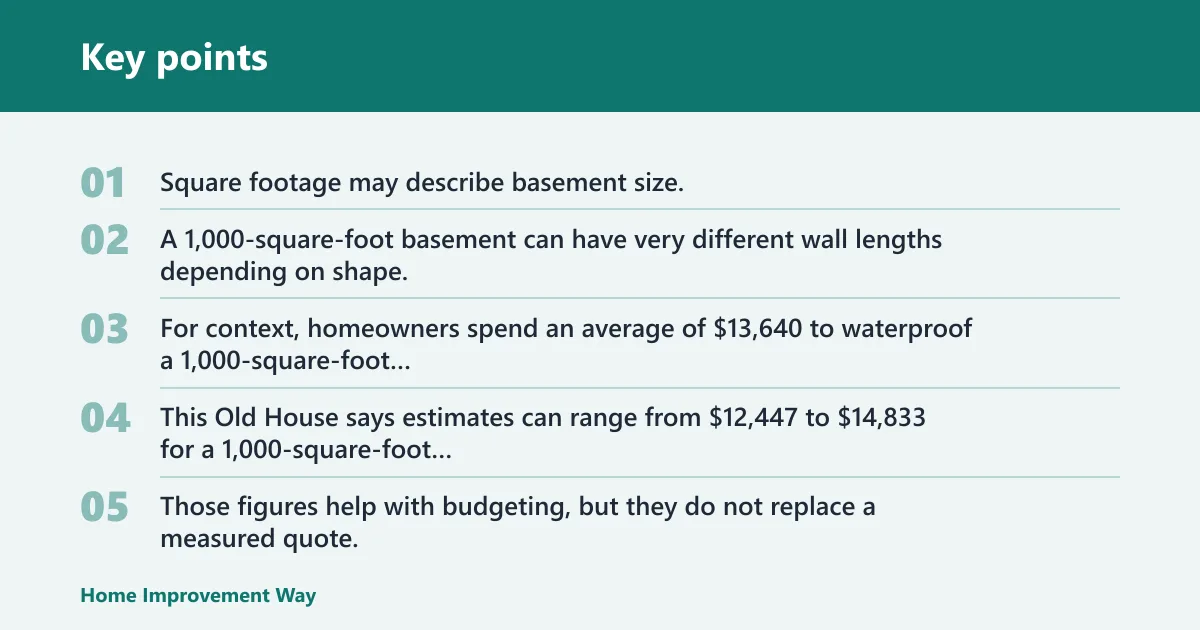
Square footage may describe basement size, but it should not be the only pricing unit for waterproofing work that follows walls. A 1,000-square-foot basement can have very different wall lengths depending on shape, layout, and whether the job covers one side or the full perimeter.
For context, homeowners spend an average of $13,640 to waterproof a 1,000-square-foot basement. This Old House says estimates can range from $12,447 to $14,833 for a 1,000-square-foot basement. Those figures help with budgeting, but they do not replace a measured quote. (Thisoldhouse)
Partial-wall and full-perimeter pricing
Ask whether the quote covers the full perimeter or only the wall sections that show symptoms. A partial-wall bid may cost less up front, but it may not match a problem caused by hydrostatic pressure around the whole foundation.
Say your basement has a 30-foot wet wall and a dry rear wall. One contractor prices only the wet wall, while another prices the full perimeter drain. Those bids are not equivalent, even if the totals are close.
Crack counts and other units
Foundation crack injection is usually priced per crack. That is appropriate for isolated leaks in poured concrete walls, where a contractor can target a few distinct openings instead of rebuilding the drainage system.
InspectandTest says crack injection costs about $300 to $1,200 per crack. If a bid for wall cracks gives only one lump sum with no crack count, it is harder to tell whether the contractor priced two cracks or eight.
Interior drain tile and sump items
An interior perimeter drain tile system should be itemized because it often includes more than pipe. A good estimate lists the drain run, the sump pit, the pump, the discharge line, the check valve, and any alarm or backup power if needed.
Perimeter drain tile scope
Interior drain tile is commonly used when water enters at the wall-floor joint or when hydrostatic pressure pushes water through the foundation. The quote should say how many linear feet will be installed and whether the work ties into an existing sump or a new one.
The same source says an interior perimeter drain with sump often costs $5,000 to $15,000 total. That range only helps if the bid tells you the scope behind the number.
Sump pit, pump, and discharge line
The sump system should not be buried inside a single line item if the system is new. You want to see the pit, pump, check valve, discharge line, and any battery backup or alarm called out separately so you know what was included and what was optional.
Do not assume a sump pump is included just because the estimate mentions drain tile. Some contractors price the drainage work and the pump package separately, especially when an upgrade or backup battery is recommended.
Backup power and alarm options
A battery backup and alarm are often add-ons, but they should still be listed if the contractor believes the house needs them. That is especially important in homes with recurring outages, a deep discharge run, or a history of pump failure during storms.
When exterior excavation changes the price
Exterior excavation is usually the most expensive waterproofing method because it involves digging to the foundation, exposing the wall, installing the waterproofing system, then restoring the site. The quote should state excavation depth, soil removal, membrane work, and site-access limits in plain language.
Excavation depth and wall exposure
Exterior waterproofing depends on how much of the wall must be exposed and how deep the contractor has to dig. Greater depth usually means more labor, more spoil, more equipment time, and more repair work after the wall is treated.
The same source says exterior excavation, membrane, and footing drain often cost $10,000 to $30,000+. Canada Waterproofers says exterior waterproofing is priced by linear foot and lists exterior waterproofing at $120 to $400 per linear foot, with a 20 linear foot minimum applied to exterior waterproofing estimates.
Membrane waterproofing and drainage board
The bid should say whether the wall will get membrane waterproofing, drainage board, footing drain replacement, or all three. Exterior jobs often fail as estimates because one contractor prices only the membrane while another includes the drainage layer and footing drain work.
Access limits, spoil removal, and repairs
Access difficulty can change the price when decks, patios, driveways, landscaping, or tight side yards block equipment. The same source says final pricing depends on property access and actual scope of work. That same rule applies indoors when finished walls or built-ins slow removal and reconstruction.
Say a patio sits six feet from the foundation wall. The estimate should say whether the contractor will remove part of the patio, work around it, or require a separate repair allowance for concrete replacement and hardscape restoration.
What counts as restoration work
Restoration should be separate from waterproofing construction. If the basement has drywall, flooring, trim, or built-ins in the work area, the quote should specify what gets demolished, what gets replaced, and what allowance applies to finish work.
Drywall, flooring, and trim replacement
Finished basement restoration may materially change the total project cost. A waterproofing bid that includes opening walls but not rebuilding them is incomplete if the contractor expects you to hire another crew for drywall, paint, flooring, or baseboard repair.
Demolition and disposal allowances
Ask whether demolition and disposal are included or only allowed for as a separate line item. If the contractor opens finished walls, removes carpet, or tears out tile, the quote should say how much disposal is included and what happens if debris exceeds that allowance.
Finished basement exclusions
Many bids exclude cosmetic work unless you request it. That is fine if the exclusion is spelled out clearly. It is not fine if the contractor removes finished materials and leaves you with no restoration path in the written quote.
Why do waterproofing bids vary so much?
Waterproofing bids vary because the problem, the access, and the repair method are rarely identical from one house to the next. The biggest differences usually come from foundation condition, hidden damage, site access, and whether the contractor priced surface-water fixes with the foundation work or left them out.
Foundation type and condition
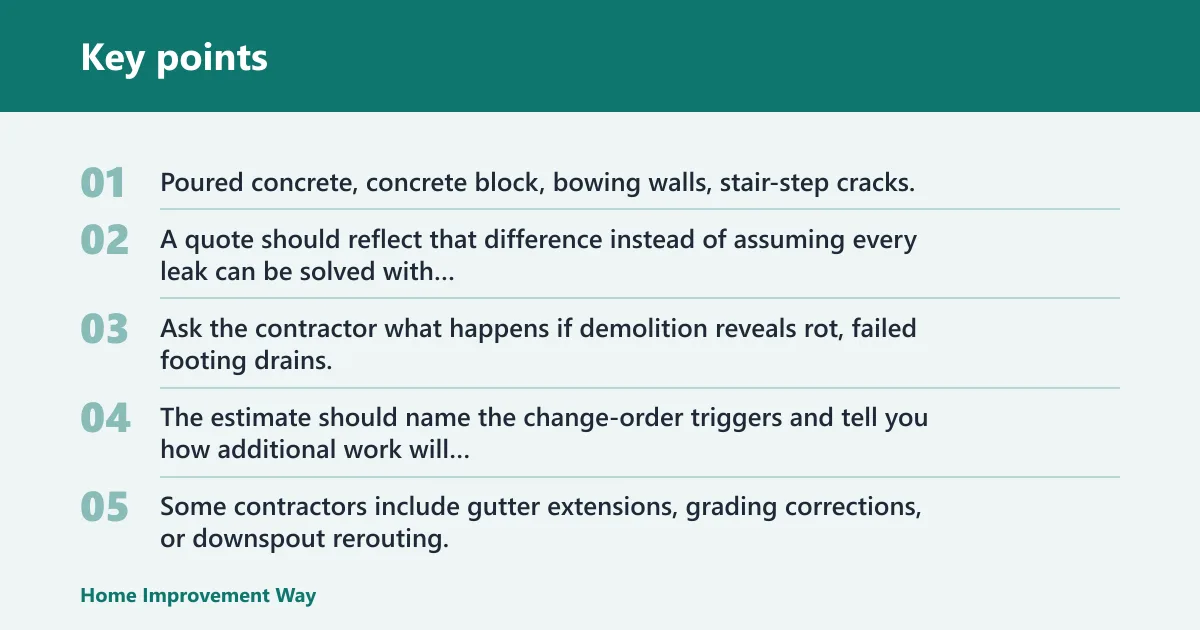
Poured concrete, concrete block, bowing walls, stair-step cracks, and horizontal cracks do not carry the same risk or the same repair sequence. A quote should reflect that difference instead of assuming every leak can be solved with the same interior drain or crack injection plan.
Hidden conditions and change orders
Ask the contractor what happens if demolition reveals rot, failed footing drains, voids behind the wall, or extra cracking. The estimate should name the change-order triggers and tell you how additional work will be priced before the extra labor starts.
Surface-water fixes bundled or excluded
Some contractors include gutter extensions, grading corrections, or downspout rerouting. Others price only foundation work. The same source says downspout extensions and regrading cost about $200 to $3,000, so you need to know whether that work is already in the bid or still pending.
A common mistake is comparing one quote that includes excavation, membrane installation, and a sump pump backup with another that only covers patching a crack and applying sealant. Those are not competing numbers until the surface-water fixes are separated and labeled.
What a fair comparison looks like
Get at least three quotes, and ask each contractor to measure the same areas using the same units. Before signing, compare diagnosis notes, measured scope, method, cleanup, restoration, exclusions, and warranty terms side by side. If one bid is vague, request a revised written estimate.
- Confirm the water source and foundation condition named in the quote.
- Check the unit of measure: linear feet, crack count, or another specific scope unit.
- Verify whether the bid is interior, exterior, or a mix of methods.
- Look for sump components, discharge routing, and backup options if drainage is included.
- Check demolition, disposal, restoration allowances, and excluded finish work.
- Read the warranty and the change-order language before accepting the price.
Frequently asked questions
What should be included in a basement waterproofing quote?
A fair quote should include the water-source diagnosis, measured scope, method, materials, labor, cleanup, exclusions, permits if needed, restoration allowances, and warranty terms. If it does not explain what is being fixed and how the contractor priced it, you cannot compare it against another bid.
Is a waterproofing quote supposed to include excavation and cleanup?
Yes, if excavation is part of the method. The estimate should say how deep the excavation goes, what soil or debris will be removed, where it goes, and whether cleanup is included. If those items are excluded, they should appear as separate line items.
Why do basement waterproofing estimates vary so much?
They vary because the work may be interior or exterior, partial or full perimeter, simple or structural, accessible or blocked by patios and tight side yards. Foundation type, finish level, and hidden conditions also change the price. Two bids can only be compared when the scope is the same.
Should a quote list linear feet or square footage?
For wall-based waterproofing, linear feet is the more useful unit. Square footage can describe the basement size, but it does not tell you how much wall, crack, or perimeter drain is being treated. Do not compare the two as if they mean the same thing.
Common omissions include disposal, restoration, battery backup for the sump, discharge-line work, grading corrections, downspout extensions, and extra labor caused by hidden damage. Finished basement repairs are especially easy to leave out, so check whether drywall, flooring, and trim are actually included.
How many basement waterproofing quotes should I get?
Three is a practical minimum. Fewer bids make it hard to spot missing scope or inflated assumptions. More quotes help only if each contractor inspects the same issues and writes the estimate in enough detail to compare measured scope, method, exclusions, and warranty terms.
Sponsored / affiliate links. As an Amazon Associate I earn from qualifying purchases. I may earn additional commission from eligible campaigns.