Best Waterproofing for Interior Basement Walls
The best waterproofing for interior basement walls depends on the failure mode: use crack repair and a cementitious or crystalline coating for seepage through sound masonry, but use an interior drain and sump system for active wall-to-floor leaks or hydrostatic pressure. If you treat the symptom instead of the source, water can stay behind the finish, rot framing, and drive mold growth. This guide helps you match the right inside-only fix to wall type, leak pattern, and when sealer is enough versus when drainage or structural repair is needed.
This guide is part of our Basement waterproofing series.
What kind of basement wall problem do you have?


Start by separating dampness, seepage, and active leaking. Damp walls often point to vapor movement or condensation, while wet streaks, puddles, and recurring leaks after rain usually point to hydrostatic pressure. Then check the wall material, because poured concrete and CMU block fail in different ways.
Dampness, seepage, or active leaking
A wall that feels cool and shows light moisture may need a sealer or surface prep, not a drain. Water that shows up as running lines, wet corners, or water at the wall-footing joint needs crack repair or drainage. Standing water should be removed before repairs begin, and Bob Vila recommends checking moisture with a 1-foot square of aluminum foil.
Poured concrete versus CMU block
Poured concrete usually leaks through cracks, cold joints, and wall-to-floor transitions. CMU wall leakage often comes through mortar joints, block webs, and hollow cores, so a coating that works on a solid pour may not stop block-wall seepage. CMU needs a different diagnosis before you choose a product.
Cracks, cold joints, and pipe penetrations
Cracks and penetrations can often be sealed from inside if the wall is otherwise sound. Cold joints, where the footing and wall meet, are a different case because water can ride along that seam under pressure. If the wall is bowing or bulging, stop and get structural input first.
Interior basement wall decision table
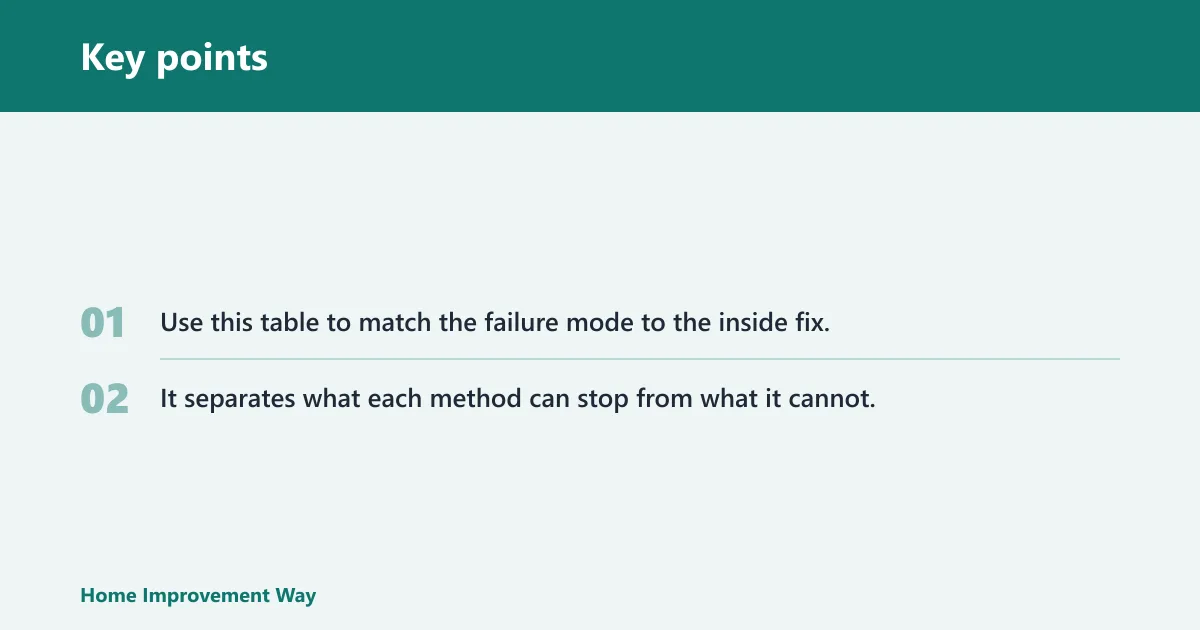
Use this table to match the failure mode to the inside fix. It separates what each method can stop from what it cannot, which is the part many product pages blur.
| Scenario | Best interior fix | What it stops | What it cannot stop | Prep required | Rough DIY / pro cost band |
|---|---|---|---|---|---|
| Damp wall | Sodium silicate or crystalline interior sealer | Minor moisture, vapor movement, light pore seepage | Active hydrostatic pressure, running leaks, structural cracks | Remove paint, dust, and loose material; surface must be clean and absorbent | Low / low to moderate |
| Hairline crack | Epoxy crack injection if dry and stable; polyurethane if it seeps | Crack leakage along a narrow path | Wall movement beyond minor flex, wall-wide pressure | Open crack enough for ports or bond; dry if using epoxy | Moderate / moderate |
| Active crack leak | Polyurethane crack injection | Wet cracks and small active leaks | Whole-wall pressure, bowing, large voids outside the crack line | Injection ports set about every 6–8 inches; surface cleaned and crack mapped | Moderate / moderate to high |
| CMU seepage | Crystalline sealer or drain tie-in if seepage is recurring | Moisture moving through block faces and mortar joints | Open block cavities under pressure, chronic footing seepage | Strip coatings, remove efflorescence, expose sound masonry | Low to moderate / moderate |
| Cold-joint leak | Interior French drain or crack/joint injection if isolated | Water entering at wall-footing seam | Pressure coming through the whole wall field if drainage is absent | Expose the joint, assess whether it is localized or widespread | Moderate / high |
| Efflorescence-only wall | Crystalline interior sealer after cleaning | Light moisture migration and salt staining | Active leaks hidden behind the stain | Dry-brush salts; confirm with foil test before coating | Low / low to moderate |
| Bowing wall | Structural evaluation first; waterproofing comes later | Nothing safely until movement is addressed | Structural failure, progressive inward movement | Do not coat over movement; document cracks and offsets | Not a DIY sealant job / pro only |
| Recurring spring seepage | Interior French drain with sump pump | Chronic water at the footing during saturated soil periods | Exterior soil saturation itself | Trenching, concrete removal, drain tile, discharge planning | High / high |
What stops a wet crack?
For a wet crack, use the patch or injection method that matches the crack’s condition. Hydraulic cement works for active seepage at small cracks, polyurethane injection works best for wet or actively leaking cracks that may move a little, and epoxy injection fits dry structural cracks when strength matters more than flexibility.
Hydraulic cement for active seepage
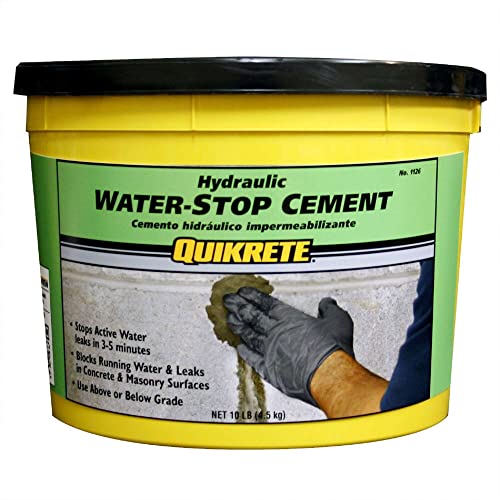
Hydraulic cement is a fast-setting crack patch product. Drylok Fast Plug is one example of this type. It works on localized leaks and small cracks, but it does not solve whole-wall pressure. Remove standing water first, pack the repair firmly, and expect it to stop a point leak rather than a broad wet wall.
Polyurethane injection for wet cracks
Polyurethane crack injection is commonly used for wet or actively leaking cracks. It expands on contact with water and stays flexible enough for minor movement. Injection ports are typically installed along the crack, often spaced every 6–8 inches, so the material can fill the path from the inside out.
Epoxy injection for dry structural cracks
Epoxy crack injection is commonly used when the crack is dry and added strength matters. It makes a rigid bond, so it is not the right choice for moving cracks. If the crack has a clean, stable pattern and you want to restore continuity in a dry wall, epoxy is the better fit.
Suppose a poured concrete wall has a dry vertical crack with no staining and no seepage after rain. Epoxy makes more sense there than polyurethane, because flexibility is not the priority. Change one variable, and the answer changes: if that same crack drips after a storm, polyurethane is the safer call.
Can basement waterproofing paint actually work?
Yes, but only in the right case. Negative-side waterproofing can help from the basement side, and interior sealers can reduce minor moisture or vapor, but neither should be treated as a cure for active hydrostatic pressure. If the wall is under pressure, a coating may fail no matter how carefully it is rolled on.
Negative-side coatings and their limits
Interior waterproofing products can be tested against hydrostatic pressure, but performance varies by product. UGL Drylok Extreme is described as having a 15-foot head limit and lasting up to 15 years, which shows the claims can be specific yet still product dependent. That does not mean every coating will stop an active leak.
Sodium silicate and crystalline sealers
Sodium silicate or crystalline sealers penetrate concrete pores and can help with minor moisture migration. They work best on sound masonry with clean, absorbent surfaces. They are not for active water entry under hydrostatic pressure, because a product that blocks pores cannot relieve the force pushing water through the wall.
When surface prep decides failure
Paint removal matters. Loose paint, dust, salts, and oil can break adhesion and make even a decent product fail early. Koster NB1 Grey was tested with an emulsion additive and primer, and the treatment used two coats, which is a reminder that surface prep and application details matter as much as the product label.
A common first-timer mistake is painting over white salt bloom and calling the wall “sealed.” Efflorescence is only a sign of moisture migration through masonry. If the wall is still damp, the salt will return and the coating can blister or lose bond.
When do you need drainage and a sump pump?
Use drainage and a sump pump when water keeps returning after rain, the wall-footing joint is wet, or seepage appears across a long section instead of one crack. That points to hydrostatic pressure. An interior French drain intercepts water at footing level, routes it to a sump pit, and gives the water a path out.
Signs of hydrostatic pressure
Hydrostatic pressure pushes water through walls and cold joints when surrounding soil is saturated. That is why coatings fail when the source is not fixed. Repeated wet spots after rain, leaks at the floor edge, and seepage across multiple points are stronger signs of pressure than a single crack line.
Interior French drain systems
An interior French drain requires trenching and concrete removal along the footing. It is the right inside-only option for chronic seepage, not isolated pinhole leaks. Constructionspedia puts interior French drain installation at $3,000–$8,000, which is a very different budget from patching a crack or rolling on a sealer.
Sump pump setup and backup power
The sump pump is the final discharge point for collected water, and it should move water away from the foundation. Submersible pumps sit in the pit and run quieter; pedestal pumps keep the motor above the pit and are easier to access. Battery backup matters because power loss often comes during the same storms that load the system.
Say your basement has a 12-foot section of wall-to-floor seepage every spring, but the cracks are narrow and the wall is straight. A crack patch alone is likely too small a fix. Drainage at the footing, tied to a sump, matches the failure pattern better than another surface coat.
What do you do with CMU walls and efflorescence?
CMU walls leak differently from poured concrete because they are hollow block construction with joints and internal paths for water. Efflorescence tells you moisture is moving through the masonry, but it is not a cure. It is a clue that should guide you toward the right inside-only fix.
Why block walls leak differently
CMU walls can seep through mortar joints, face shells, and grooves in the block itself. That is why a wall that only needs a small concrete crack repair on a pour may need a different approach on block. A coating can help with minor dampness, but recurring seepage often needs drainage or a more specific masonry treatment.
What efflorescence tells you
Efflorescence is a white powdery salt deposit that forms when moisture migrates through masonry and leaves minerals behind. It is useful for diagnosis because it shows water has moved through the wall. It does not tell you the water is gone, and it does not stop future seepage. (Wikipedia)
When sealing is enough and when it is not
If the wall is only damp and the foil test shows slow moisture, a crystalline or silicate sealer may be enough. If salts return after rain, or the block stays wet near the base, drainage is a better answer. CMU with recurring spring seepage usually needs more than paint.
When to stop and call a pro
Stop and call a pro when the wall is bowing, bulging, or moving, or when seepage returns every spring even after repairs. Those signs point past waterproofing and into structural or drainage failure. A coating cannot safely correct a wall that is shifting inward.
Bowing or bulging walls
A bowing wall is not a sealing problem. It may need structural repair first, such as reinforcement or engineering review, before any interior waterproofing is considered. Covering movement with a coating can trap moisture without solving the cause.
Repeated spring seepage
Recurring seepage during wet seasons usually means the soil around the foundation is saturating and loading the wall with pressure. That pattern often calls for an interior French drain and sump system. If seepage shows up the same way every thaw or rainy season, a surface fix alone is rarely enough.
Wall prep standards that matter
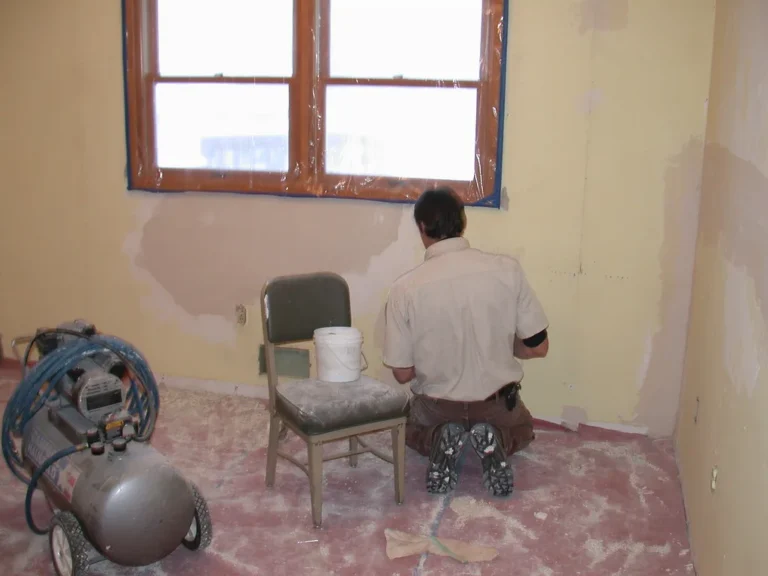
Before any coating or patch, remove loose paint, salts, dust, and standing water. Adhesion failures often start with dirty concrete, glossy old coatings, or a wall that is still actively weeping. If a product says it can go over damp concrete, read that carefully; damp is not the same as actively wet.
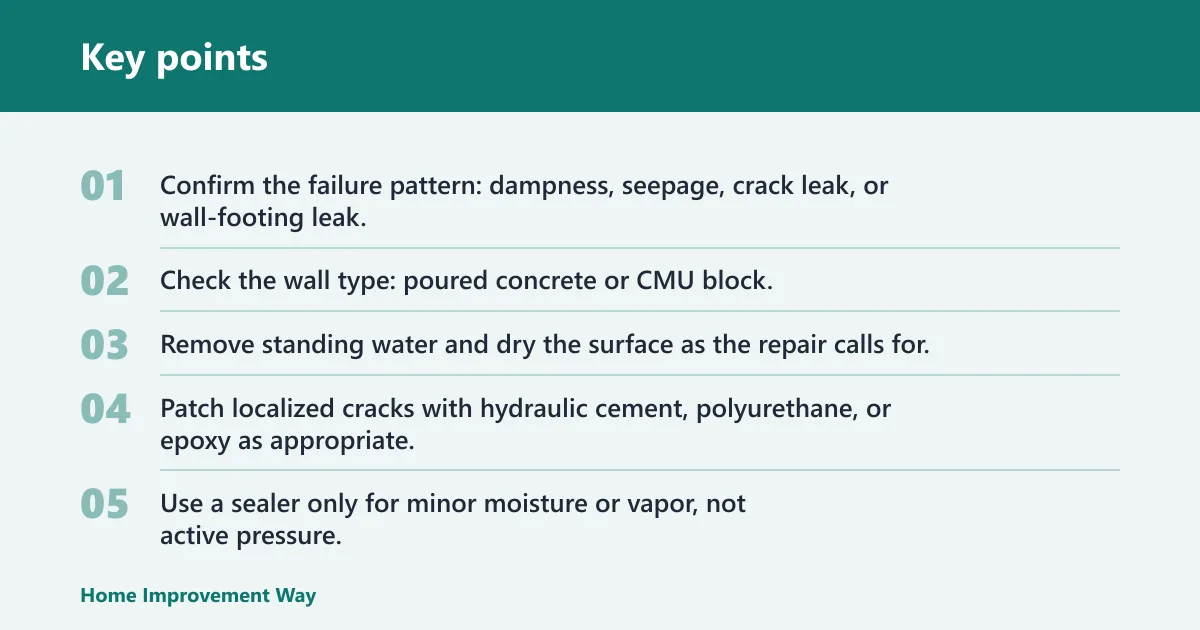
- Confirm the failure pattern: dampness, seepage, crack leak, or wall-footing leak.
- Check the wall type: poured concrete or CMU block.
- Remove standing water and dry the surface as the repair calls for.
- Patch localized cracks with hydraulic cement, polyurethane, or epoxy as appropriate.
- Use a sealer only for minor moisture or vapor, not active pressure.
- Move to drainage and sump if leaks are chronic or pressure-driven.
Frequently asked questions
What is best for waterproofing interior basement walls?
The best interior method depends on the failure mode. Use crack repair and a crystalline or cementitious coating for minor seepage through sound masonry, but use an interior drain and sump system for recurring wall-to-floor leaks or hydrostatic pressure. Matching the fix to the leak pattern matters more than choosing a stronger-looking product.
What to use to waterproof basement walls?
Use hydraulic cement for active seepage at small cracks, polyurethane injection for wet cracks, epoxy injection for dry structural cracks, and sodium silicate or crystalline sealer for minor vapor or dampness. For recurring pressure or wall-footing seepage, use an interior French drain and sump pump rather than a surface coating alone.
Does interior waterproofing stop hydrostatic pressure?
Not by itself. Interior coatings can be tested against hydrostatic pressure, but performance varies by product and many coatings fail if the pressure source remains. Hydrostatic pressure is what drives water through walls and cold joints, so the fix often needs drainage and discharge, not just a basement-side coating.
When should I use hydraulic cement vs polyurethane injection?
Use hydraulic cement for localized active seepage where you need a fast-setting patch and the wall is not moving much. Use polyurethane injection for wet or actively leaking cracks, especially if the wall may flex slightly. Hydraulic cement blocks the spot; polyurethane fills the crack path more completely.
How much does interior basement waterproofing cost?
Costs vary by method and scope. The same source gives interior sealant cost at $50–$200 for a 500 sq ft basement, while interior French drain installation costs $3,000–$8,000. Crack injection and hydraulic cement repairs usually sit between those extremes, with price rising as leak length, wall type, and access get more difficult.
Sponsored / affiliate links. As an Amazon Associate I earn from qualifying purchases. I may earn additional commission from eligible campaigns.