How to Install Fasteners in Softwood vs Hardwood
Use smaller pilot holes in softwood and larger, more exact ones in hardwood: for screws, drill about 70% to 85% of the screw root diameter in softwoods and 85% to 100% in hardwoods, then match the fastener to the wood density. Skip that, and you risk split boards, stripped heads, and joints that loosen under load. This guide explains fastener choice, pilot-hole sizing, and driving technique for pine, fir, oak, maple, cherry, and similar lumber.
| Decision factor | How to Install Fasteners in Softwood | Hardwood | Winner |
|---|---|---|---|
| Pilot-hole size | Smaller pilot holes help prevent splitting and still let threads bite. | Larger, more exact pilot holes reduce driving torque and strip-out. | Tie |
| Best common fastener | Wood screws and hex-drive inserts work well in pine and fir. | Wood screws, knife-thread inserts, and machine-screw joints hold better in dense stock. | Tie |
| Split resistance | Better when the pilot hole, edge distance, and drive speed are controlled. | Usually better than softwood, but only if the pilot hole is sized correctly. | Hardwood |
| Strip-out resistance | Lower risk of strip-out than hardwood, but overdriving still ruins the joint. | Higher risk of strip-out if the bit is undersized or the driver cams out. | How to Install Fasteners in Softwood |
| Reusable joints | Good with threaded inserts when you want repeated assembly. | Very good with knife-thread inserts in furniture and cabinetry. | Tie |
Fastener behavior in softwood vs hardwood
Softwood and hardwood need different fastener strategies because density, grain structure, and withdrawal resistance change how wood reacts to a screw or insert. Softwoods are coniferous lumber such as pine, fir, spruce, and cedar; hardwoods are deciduous lumber such as oak, maple, cherry, and walnut.
Softwoods are usually lighter and less dense, so they split more easily and tear out more readily when you overdrive or place a fastener too close to an edge. Hardwoods are denser and heavier, so they resist dents better, but they push back harder on the driver and can strip if the pilot hole is wrong.
Why density changes fastening behavior
Wood density changes how much force the fastener needs to move through the fibers and how much thread engagement you get after installation. In oak, for example, Bob Vila lists a cubic foot at 37 to 56 pounds, while pine is listed at 22 to 35 pounds per cubic foot, which helps explain why hardwood usually needs a more exact pilot hole and more driving torque.
Grain direction matters too. Driving across grain near an edge raises split risk in softwood, while driving with the grain in dense hardwood can still burn the bit if the pilot hole is too small.
What you’ll need
- Drill with a clutch setting and a sharp bit set
- Twist bits sized for the pilot hole and clearance hole
- Wood screws in the gauge and length your joint needs
- Threaded inserts, if you want a reusable joint
- Hex key or screwdriver for insert installation
- Driver bits that fit the screw head cleanly
- Clamps to hold the joint before driving
- Marking tool and square
- Depth stop or tape flag for the drill bit
Which fastener fits the wood?
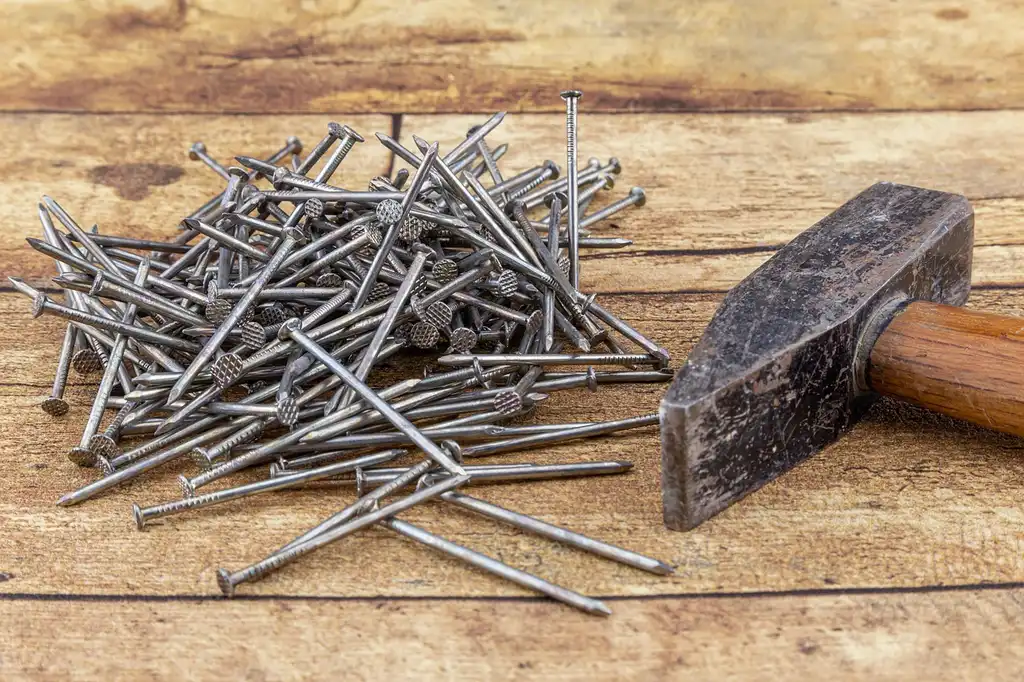
For most wood-to-wood joints, the best fastener is the one that matches the load and the wood density. Use wood screws for ordinary joinery, threaded inserts for repeated assembly, and lag screws or machine screws when the joint carries higher load or needs a stronger metal interface.
In softwood, wood screws bite quickly but can split a board if the pilot is too small. In hardwood, the same screw may need a larger pilot and more careful driving, or it will strip before the threads fully seat.
Wood screws for common joinery
Use wood screws for face frames, cleats, brackets, and ordinary wood-to-wood joints. In pine or fir, the main target is enough pilot-hole relief to prevent splitting without making the hole so large that the threads lose grip.
Threaded inserts for repeat assembly
Threaded inserts make sense when you plan to remove and reinstall a bolt or machine screw. E-Z LOK says softwood inserts are ideal for pine and fir, while hardwood inserts are engineered for oak, maple, and cherry; it also notes that softwood inserts use wide, shallow threads, while hardwood inserts use sharp knife threads to cut into dense grain.
Lag screws and machine screws for heavier joints
Lag screws suit heavier wood connections where withdrawal resistance matters, such as framing-adjacent furniture parts or wall-mounted brackets. Machine screws pair with threaded inserts or captured hardware, which gives you a cleaner reusable joint than forcing a wood screw to do every job.
Softwood vs hardwood decision table
Use this table for a fast pick on pine, fir, oak, maple, or cherry. It puts the wood, the fastener, the pilot-hole priority, the risk level, and the main failure mode in one place.
| Wood | Recommended fastener | Pilot-hole priority | Risk level | Top failure mode to watch |
|---|---|---|---|---|
| Pine | Wood screw or softwood threaded insert | High; use a smaller pilot and protect edges | Medium | Splitting at the edge or spin-out |
| Fir | Wood screw or softwood threaded insert | High; keep the bit centered and straight | Medium | Tear-out from overdriving |
| Oak | Wood screw, knife-thread insert, or lag screw | Very high; use a precise larger pilot | High | Strip-out or burned pilot hole |
| Maple | Wood screw or knife-thread insert | Very high; reduce driving torque with a proper pilot | High | Cam-out and thread stripping |
| Cherry | Wood screw or knife-thread insert | High; keep the pilot accurate and avoid over-torque | Medium to high | Fine-surface tear-out |
Pine and fir
Pine and fir are softwoods, so they usually accept screws with less driving force, but they split more easily if the pilot hole is too small or the screw lands too close to the edge. The same source says softwood inserts are for softwoods such as pine and fir, and that softwoods are more susceptible to splitting if installed incorrectly.
Suppose you are fastening a pine apron to a pine leg with a #8 screw. A slightly undersized pilot hole helps the threads bite, but if the screw is within a narrow edge distance, the board can crack before the head seats.
Oak and maple
Oak and maple are dense hardwoods, so they usually need a more exact pilot hole and a driver that stays square under higher torque. The same source says hardwood inserts are designed for dense species like oak, maple, and cherry, and that hardwood inserts use sharp knife threads to cut into hardwoods.
Say your oak face frame uses a screw that starts cleanly but stalls before seating. That often points to an undersized pilot hole, not a bad screw.
Cherry and other medium-density woods
Cherry still behaves more like hardwood than softwood at the driver, but it can split or bruise if you force the fastener. A clean pilot hole and moderate drive speed matter more than raw screw force.
How do you size the pilot hole?
Use a smaller pilot in softwood and a larger, more exact pilot in hardwood. For screws, a common rule of thumb is about 70% to 85% of the screw root diameter in softwood and 85% to 100% in hardwood, then adjust for the screw gauge, the grain direction, and the load on the joint.
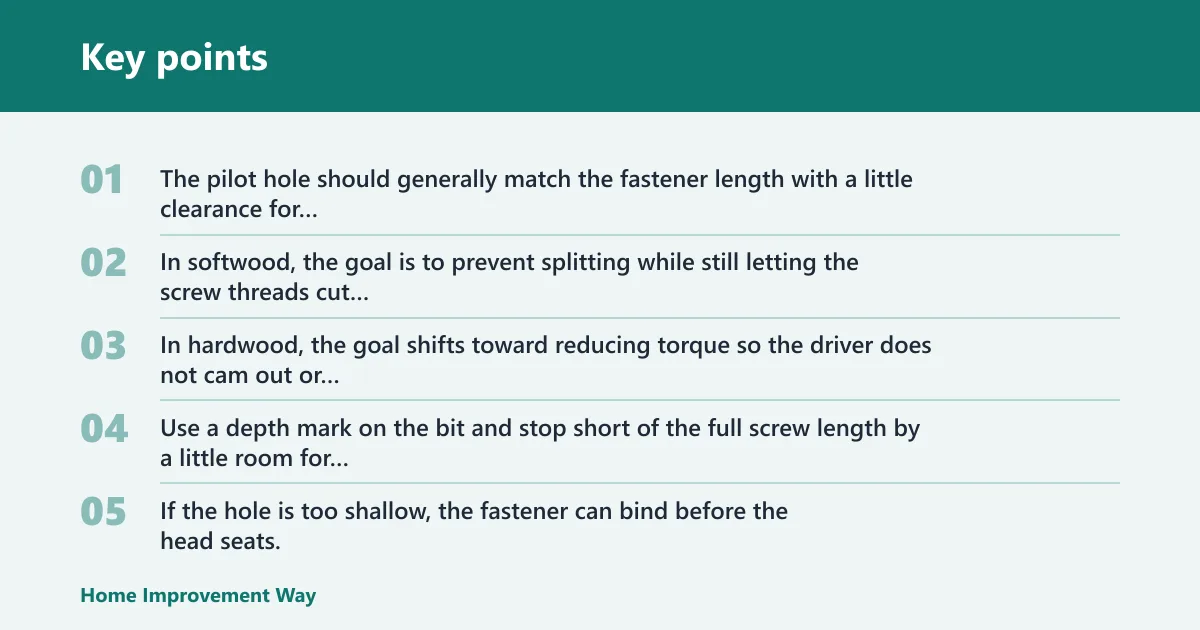
Depth matters as much as diameter. The pilot hole should generally match the fastener length with a little clearance for debris and tip space so the screw does not bottom out and jack the joint apart.
Pilot-hole diameter by wood type
In softwood, the goal is to prevent splitting while still letting the screw threads cut cleanly. In hardwood, the goal shifts toward reducing torque so the driver does not cam out or strip the head.
Pilot-hole depth and clearance
Use a depth mark on the bit and stop short of the full screw length by a little room for dust and the screw tip. If the hole is too shallow, the fastener can bind before the head seats; if it is too deep in softwood, the grip can weaken.
Adjusting for screw size and grain
Large-diameter screws and end-grain joints need more care than side-grain joints. Grain direction affects withdrawal resistance, so a screw loaded across grain and near an edge needs a more conservative pilot than one in a wide face with good thread engagement.
Install fasteners step by step
- Mark the joint, then check the grain direction and edge distance before you drill.
- Select the fastener type: wood screw for ordinary joinery, threaded insert for repeat assembly, or lag hardware for heavier load.
- Set the bit depth to the screw length plus a little clearance for debris.
- Drill the pilot hole straight, using a sharper and slightly smaller bit in softwood and a more exact bit in hardwood.
- Clamp the pieces together so the joint does not shift as the screw enters.
- Drive the fastener at steady speed and stop as soon as the head seats; over-torque is what tears softwood fibers and strips hardwood threads.
- For threaded inserts, start the insert straight with a screwdriver or hex key, then seat it until it is flush or to the maker’s depth mark.
- If the screw feels too tight, back it out, increase the pilot by about 0.5 mm, and recheck the fit before forcing it home.
Common mistakes and fixes
Split softwood, stripped hardwood, spin-out, and burned pilot holes usually come from the same few setup errors. Fix the hole size, the bit condition, or the drive method before blaming the fastener.
Splitting softwood at the edge
A split board usually means the pilot hole was too small, the screw was too close to an edge, or the drive speed was too aggressive. Move the fastener farther from the edge, keep the pilot smaller but not tiny, and clamp the work so the board cannot flex apart during seating.
Stripping hardwood threads
Hardwood strip-out usually shows up when the pilot hole is undersized, the bit is dull, or the driver is camming out under high torque. Switch to a more exact pilot, use a fresh bit, and stop the drive as soon as the head seats cleanly.
Spin-out, burning, and weak hold
Spin-out in softwood happens when the pilot is too large or the wood is crushed by overtightening. HY-C notes softwoods have more pockets of air and burn more easily, so a dull bit in pine or fir can heat the hole quickly; if that happens, slow the drill, sharpen or replace the bit, and clear dust before trying again.
Prevention is simple: match the pilot to the wood, keep the driver square, and do not use a screw to pull misaligned parts together.
Verdict: How to Install Fasteners in Softwood or Hardwood?
Choose How to Install Fasteners in Softwood if you are fastening a pine apron to a pine leg with a #8 screw and need a smaller pilot hole to help the threads bite while preventing splitting at the edge.
Choose Hardwood if you are working on an oak face frame or installing knife-thread inserts in oak, maple, or cherry, where a precise larger pilot hole and steadier driving help prevent strip-out and seating problems.

Frequently asked questions
Do I need a different pilot hole for softwood vs hardwood?
Yes. Softwood usually needs a smaller pilot hole to prevent splitting, while hardwood needs a larger, more exact pilot to reduce torque and strip-out. For screws, a common rule is 70% to 85% of the screw root diameter in softwood and 85% to 100% in hardwood.
What fastener works best in softwood without splitting it?
A wood screw with a properly sized pilot hole is the usual choice for pine and fir. If you need repeat assembly, use a softwood threaded insert; E-Z LOK says these are ideal for pine and fir and use wide, shallow threads that spread force more evenly.
What fastener holds best in hardwood without stripping?
Use a wood screw with a precise pilot hole, or a knife-thread insert when you want better pull-out resistance and repeated disassembly. The same source says hardwood inserts are engineered for oak, maple, and cherry, and their knife threads are designed to cut into dense grain.
How do I choose pilot hole size for oak vs pine?
Start with the screw root diameter, not the outside thread diameter. Pine usually wants the smaller end of the range so the threads bite, while oak usually wants the larger end so the screw does not bind or strip before seating.
Should I pre-drill hardwood more than softwood?
Yes, usually. Hardwood is denser, so pre-drilling reduces driving torque and lowers the chance of cam-out, thread stripping, or bit burning. Softwood still needs a pilot, but the hole is often slightly smaller and more focused on split prevention.
Are threaded inserts better in hardwood or softwood?
They work in both, but the insert type should match the wood. The same source says softwood inserts are for pine and fir, while hardwood inserts are engineered for oak, maple, and cherry. Use them when you want reusable threads, not as a blanket replacement for every screw joint.
Sponsored / affiliate links. As an Amazon Associate I earn from qualifying purchases. I may earn additional commission from eligible campaigns.