Fastener Installation Guide
Start with the base material: wood gets screws sized to bite 2/3 of the lower piece, masonry needs the exact bit and anchor match, metal needs pilot holes, and hollow walls need rated anchors for the expected load. Get that wrong and you’ll strip threads, split studs, spin anchors, crack brick, or watch the fixture pull loose. This fastener installation guide walks through substrate-first selection, drilling, driving torque, and final checks for wood, metal, masonry, and hollow walls.
How to choose a fastener by base material first



Choose the substrate before the fastener type because the base material sets the real limits on thread grip, expansion, hole prep, and failure risk. Wood, metal, masonry, and hollow walls each need a different drill-drive-inspect sequence, and that sequence matters more than the label on the box.
Start with substrate, then load, then exposure
A fastener is the hardware that actually holds parts together, a wood screw biting into a stud, a machine screw clamping steel with a nut, or an anchor gripping inside block or drywall. Most fastening in houses is meant to come apart later for repair or replacement, and I still see removable joints fail because the hole size, drive type, or base material was wrong from the start.
The practical order is simple. Identify the base material first. Then sort the expected load into light loads under 10 pounds, medium loads 10 to 25 pounds, and heavy loads 25 to 50 pounds or more. After that, check moisture, exterior exposure, and whether the fastener must come back out later. (thisoldhouse.com)
Pick a fastener by asking a few plain jobsite questions: can you reach the back side, is the area damp or outdoors, what hole prep and tools does the install need, what are you fastening into and through, will you remove it later, and how much weight will it carry. That is why a drywall anchor that works for a picture frame is a bad call for a grab bar, and why a wood screw that holds in pine can fail in a brittle hardwood edge without a pilot hole.
The four base materials covered in this guide
- Wood: accepts threads well, but splits near edges and ends if pilot holes are skipped.
- Metal: needs clean pilot holes, matched threads, and enough thickness or a nut for thread engagement.
- Masonry: needs the exact bit and hole depth, plus dust cleanup and edge awareness.
- Hollow walls: have weak face material, so holding power often comes from expansion behind the surface.
When the substrate limits the fastener choice
Weak gypsum limits a drywall screw far sooner than the screw itself. Soft brick can crumble before a concrete screw reaches full bite. Thin sheet metal may not give enough thread engagement for a machine screw unless the hole is tapped or backed by a nut. The substrate decides the go or no-go call.
Steel fasteners usually come as stainless steel for wet areas and stain resistance, carbon steel for common indoor hardware, and alloy steel where higher strength is needed. Common coatings and platings include zinc, chrome, and hot-dip galvanizing. In damp basements, exterior trim, pressure-treated lumber, and bath hardware, finish choice is part of installation, not an afterthought.
The drill-drive-inspect sequence used throughout this guide
- Drill: mark location, confirm edge distance, choose the right bit, and make the correct pilot or anchor hole.
- Drive: fit the driver bit tightly, keep the tool square to the work, and stop before stripping or over-expanding.
- Inspect: check thread bite, head seating, substrate damage, and whether the fixture moves under hand pressure.
📊 The U.S. fastener industry was estimated to run 350 manufacturing plants in 2005. Source: Fastener.
What fastener should I use for wood?
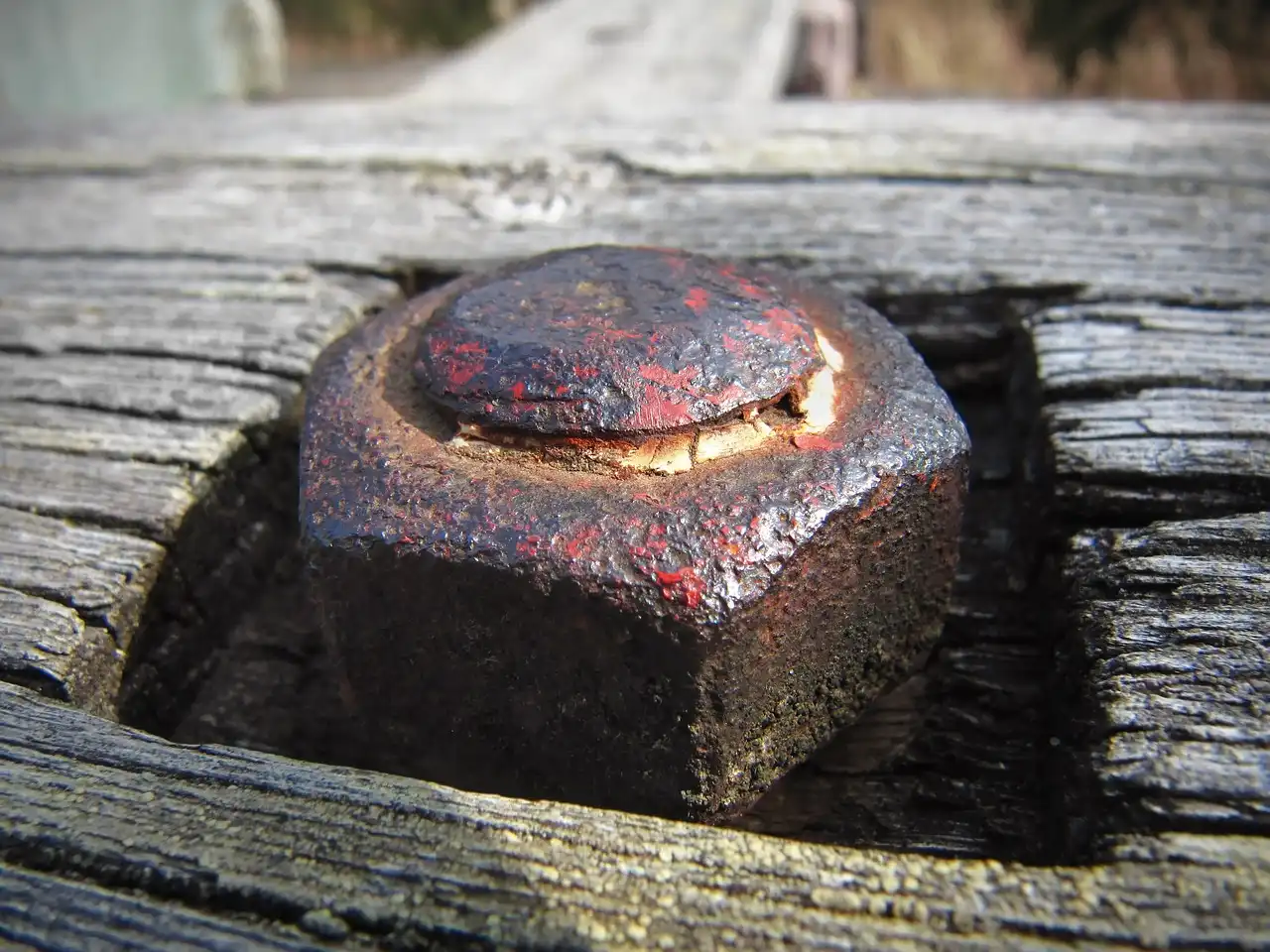
Use coarse-thread wood screws for most wood-to-wood and wood-to-hardware connections, lag screws or lag bolts for studs and structural framing, and nails or staples where speed matters more than pull-out resistance. Pilot holes, edge distance, and proper screw length prevent the common wood failures: splitting, mushrooming, and weak thread bite.
Wood screws for general holding strength and household mounting
This Old House says coarse-thread screws are for wood. That matches what I use in the field because coarse threads clear fibers and hold in softwood, plywood, and many household mounting jobs better than fine-thread machine screws.
For a bracket, cleat, cabinet part, or utility hook mounted to wood, use a wood screw long enough to bite well into the lower piece, often around two-thirds of it. If the top piece is thin, avoid overdriving. A buried head can strip the hole before the joint feels tight.
Lag screws for studs, ledgers, and framing connections
Lag screws and lag bolts belong where the load transfers into studs, rim boards, or structural framing. They need pilot holes. Without one, the shank can force the wood apart or stall before full seating, especially near ends and edges.
A hex head or structural-style head is safer than a small Phillips recess on large fasteners because the tool stays engaged under higher torque. Use a socket or nut driver that fits cleanly. Sloppy fit rounds heads fast.
Nails and staples where speed matters more than pull-out resistance
Nails and staples still make sense for trim backing, temporary positioning, light sheathing repairs, and some carpentry tasks. They install fast, but they have less holding power than screws in pull-out. When vibration, repeated loading, or fixture weight matter, threads beat smooth shanks.
Pilot holes, edge distance, and how to avoid splitting
Predrilling is mandatory near board ends, in hardwood, and anywhere the screw feels like a wedge. Even in softwood, a pilot hole lowers driving torque and helps the screw pull parts together instead of jacking them apart.
Common failure signs are easy to spot: a hairline split at the board end, a screw that stops early and squeals, or a head that sinks while the joint still has a gap. If that happens, back out the screw, clamp the work closed, and redrill before trying again.
Which fasteners work best in metal?
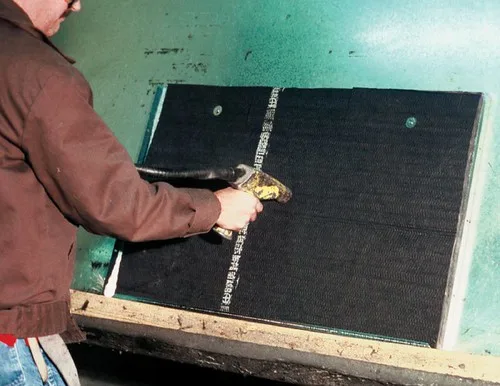
Machine screws work best in metal when the hole is tapped or backed by a nut, while sheet metal screws and self-tapping screws fit thin stock where they can cut or form threads. Clean pilot holes, the right driver bit, and enough thread engagement matter more than raw screw size.
Machine screws in tapped holes or with nuts
This Old House says machine screws have fine threads and need a pre-threaded hole or nut. Use them for brackets, electrical covers, access panels, and metal assemblies where parts may need to come apart cleanly later.
If there is no tapped hole and no room for a nut, a machine screw is a no-go. It may feel snug for a turn or two, then strip because fine threads need real engagement.
Sheet metal screws and self-tapping screws for thin stock
Sheet metal screws and self-tapping screws are meant for thin metal where they cut or form threads as they go. They are common for ductwork, light brackets, appliance panels, and light-gauge framing attachments.
Do not expect them to rescue a ragged or oversized hole. Once the threads have little metal left to bite, the screw will spin or pull out under load.
Bit choice, cutting oil, and preventing stripped threads
Use a metal-cutting bit for pilot holes. Keep the drill square. In thicker steel, slow speed and cutting oil help the bit cut instead of burn. For driving, Torx and hex heads resist cam-out better than worn Phillips recesses in higher-torque installs.
Poor bit fit causes many “bad screw” complaints. The driver rides up, chews the recess, and leaves a half-seated fastener that cannot be tightened or removed cleanly.
When poor thread engagement means a different fastener is needed
If only a few threads catch in thin metal, switch strategy. Use a machine screw with a nut, add a rivet nut or threaded insert, or move to a through-bolt assembly. Forcing a larger self-tapper into thin stock often enlarges the hole and makes the next repair harder.
What fastener should I use for masonry?
Use concrete screws for direct fastening into concrete and sound masonry, and use masonry anchors when the base material is brick, block, stone, or concrete that needs expansion or load distribution. Masonry work fails when the bit, hole depth, dust cleanup, or edge placement is wrong.
Concrete screws for direct fastening into concrete and masonry
Concrete screws are often a solid choice for fixtures fastened straight into concrete, dense block, or sound brick when a predrilled hole can be made accurately. They suit heavier loads than light sleeves in many household tasks because the threads bite the hole wall directly.
They do not forgive sloppy drilling. If the hole is too large or full of dust, the screw may bottom out, spin, or feel tight without real holding power.
Masonry anchors for brick, block, concrete, and stone
Masonry anchors include sleeve, wedge, and similar styles that expand or spread load in brick, concrete, block, or stone. Use them where the base material varies, where the fixture has a slotted mounting hole, or where the anchor body needs to bridge a brittle face shell.
Brick and block need extra care. A hollow block web or weak brick face can fail before the anchor does. In stone, drilling can wander and chip edges if the bit starts poorly.
Drill-bit type, hole depth, dust cleanup, and embedment basics
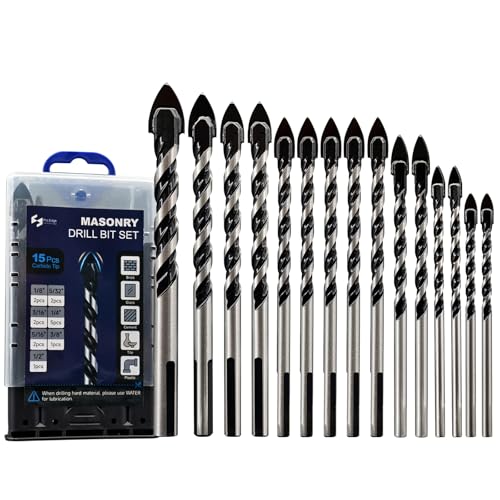
Use a masonry bit for masonry work. Match the bit exactly to the fastener or anchor requirement. Drill to the needed depth, then clean dust from the hole so the anchor can seat or the concrete screw threads can cut cleanly.
Dust is a hidden problem. Packed dust steals embedment, raises drive torque, and can crack a weak edge while giving the false feel of a snug install.
How to avoid cracked masonry and weak edge installations
Stay back from corners, mortar edges, and damaged faces. If the first hole chips badly or wanders into a void, stop and relocate instead of forcing a larger anchor. Masonry rarely forgives a second bad move in the same spot.
What fastener should I use for drywall and hollow walls?
Fasten into a stud whenever the load allows a stud location, because drywall alone is weak and prone to blowout. For open cavities, choose drywall anchors for light and medium loads and toggle bolts for heavier loads, with plastic retainers reserved for light panels and trim pieces.
When a screw should go into a stud instead of drywall alone
If a shelf bracket, towel bar, coat hook, or TV accessory can hit framing, use a screw into the stud instead of relying on drywall. A wood screw or lag screw into framing beats any hollow-wall anchor when the load will be bumped, tugged, or cycled over time.
The common mistake is treating drywall as a base material when the real structure is an inch deeper. A stud changes the whole choice.
Drywall anchors for light and medium loads
This Old House places light loads under 10 pounds in the smallest fastener category and medium loads at 10 to 25 pounds. In drywall, those anchors only work if the gypsum is sound and the anchor is installed cleanly without tearing or enlarging the face paper.
Drywall anchors expand behind the wall surface or bear against the face of the panel. If the hole is oversized, the anchor spins. If the gypsum is crushed, the anchor may tighten once and loosen later.
Toggle bolts for heavier loads in hollow walls
This Old House places heavy loads at 25 to 50 pounds or more. In hollow walls, toggle bolts are often the next step up because the wings or strap spread the load behind the drywall instead of relying only on thread bite in gypsum.
They still have limits. Soft, water-damaged, or crumbling drywall can fail around the bearing area before the toggle reaches its listed strength.
Plastic retainers, trim clips, and stayput-style fasteners
Trim and body-style plastic retainers belong on lightweight panels, access covers, kick plates, and similar light assemblies. They work by snapping into a sized hole or by compressing barbs during insertion, then expanding behind the panel.
Stayput-style fasteners vary by pattern, but the install logic is the same: verify hole size, check panel thickness, align the stem squarely, and press until the shoulder seats. If the hole is wallowed out, replace the retainer with an oversize repair style or repair the panel first.
How do I choose between screws, bolts, anchors, nails, and staples?
Choose by how the load is resisted: screws hold by thread bite, bolts clamp parts together, anchors expand or spread load in weak substrates, and nails or staples favor speed over pull-out strength. Then narrow the choice by load bucket, drive type, corrosion exposure, and access for installation.
Threaded holding versus clamping force versus expansion behind the surface
- Screws: best where threads can bite the base material directly.
- Bolts and machine screws with nuts: best where both sides are accessible and clamping force matters.
- Anchors: best where the base material cannot hold threads by itself.
- Nails and staples: best for lighter-duty fastening and speed.
Light, medium, and heavy load buckets in real household terms
Light loads under 10 pounds fit small décor, cable clips, and light trim pieces. Medium loads 10 to 25 pounds fit many mirrors, utility racks, and modest shelves. Heavy loads 25 to 50 pounds or more call for studs, masonry fastening, or a hollow-wall fastener built for that load path.
Base material condition can limit the assembly before the fastener does. Crumbly plaster, hollow brick, or split wood lowers the safe choice fast.
Head style and drive type
Phillips is common but can be easier to cam out as torque rises. Torx and square drive stay engaged better in wood and structural screws. Hex heads and nut-setters suit lag screws, concrete screws, and many sheet metal fasteners. Slotted heads are still around, but they are slow and easy to slip out of.
Corrosion-resistant finishes for wet rooms, exterior work, and treated lumber
Use stainless steel where moisture stays present or staining matters. Zinc works indoors in dry spaces. Hot-dip galvanizing is a better match for many exterior and treated-lumber jobs. Mixed-metal contact can also matter, so match the fastener finish to the hardware where possible.
Substrate-by-fastener installation matrix
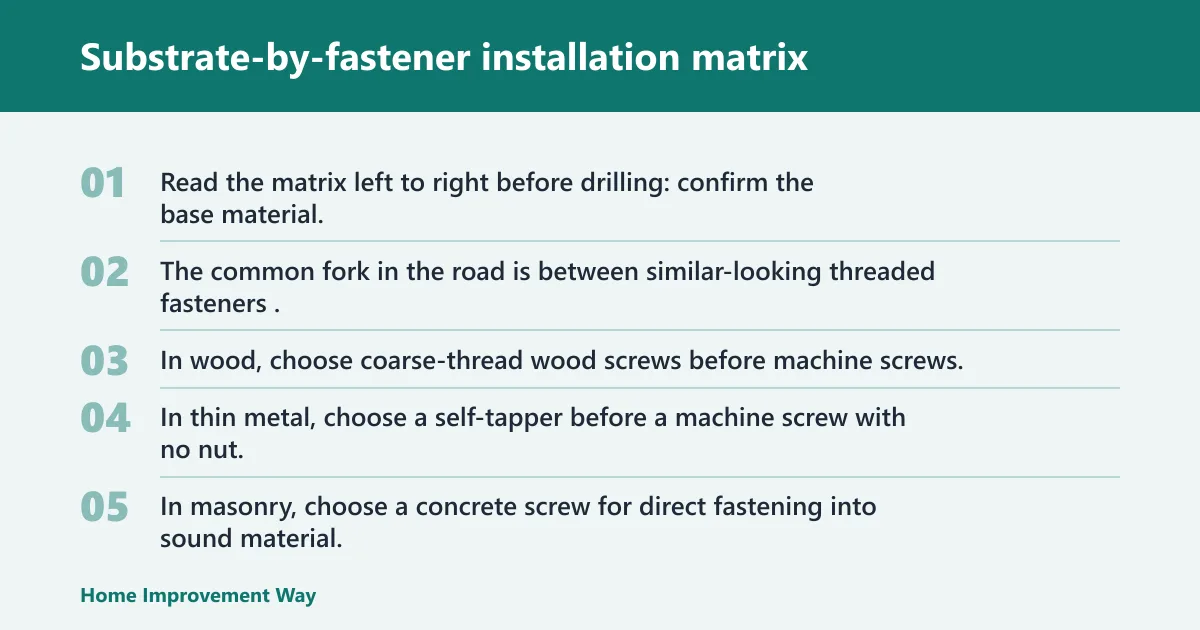
Read the matrix left to right before drilling: confirm the base material, verify whether a pilot hole is required, match the tool to the fastener, check the failure most likely to happen, and use the quick go/no-go note to stop bad installs before they start.
Installation matrix
| Base material | Fastener | Pilot hole requirement | Driver/bit type | Typical failure mode | Quick go/no-go check before fastening |
|---|---|---|---|---|---|
| Wood | Wood screw, coarse thread | Recommended near edges, ends, hardwood, and larger diameters | Wood bit; Phillips, square, or Torx driver | Split wood or stripped hole | Go only if screw can bite about 2/3 of lower piece and edge area is sound |
| Wood framing | Lag screw / lag bolt | Required | Wood bit plus hex socket or nut driver | Split stud, snapped fastener, rounded head | Go only if hitting solid framing and the pilot is straight |
| Wood trim or light carpentry | Nails or staples | No, except specialty finish work | Hammer, nailer, or stapler | Pull-out or loosened joint | Go only if load is light and vibration is low |
| Metal with tapped hole or nut | Machine screw | Required hole or existing thread path | Metal bit; Phillips, Torx, hex, or slotted driver | Stripped threads | Go only if there is a pre-threaded hole or nut |
| Thin metal | Sheet metal screw / self-tapping screw | Usually yes for cleaner starts; some self-tappers start without one | Metal bit; hex or Phillips driver | Spun-out hole or cam-out | Go only if metal is thin enough to form threads and hole is not oversized |
| Concrete or dense masonry | Concrete screw | Required | Masonry bit; hex or Torx driver | Poor bite from dusty or oversized hole | Go only if hole is clean, correctly sized, and away from weak edges |
| Brick, block, concrete, stone | Masonry anchor | Required | Masonry bit plus wrench, driver, or setting tool | Cracked masonry or spinning anchor | Go only if the material is sound and anchor style matches solid or hollow base |
| Drywall, hollow wall | Drywall anchor | Depends on anchor style | Drill, screwdriver, or setting tool | Spinning anchor or face blowout | Go only if drywall is sound and load fits light or medium duty |
| Drywall, hollow wall | Toggle bolt | Required | Drill plus screwdriver | Oversized hole or crushed drywall face | Go only if cavity is clear and drywall is not damaged or wet |
| Panels and light trim | Plastic retainer / stayput-style fastener | Required sized hole | Hole punch or drill; hand pressure or trim tool | Loose fit from wallowed hole | Go only if hole size and panel thickness match the retainer |
Using the matrix to compare similar fasteners
The common fork in the road is between similar-looking threaded fasteners. In wood, choose coarse-thread wood screws before machine screws. In thin metal, choose a self-tapper before a machine screw with no nut. In masonry, choose a concrete screw for direct fastening into sound material, but move to a masonry anchor if the base is brittle, hollow, or edge-sensitive.
How to install fasteners without common failures
Prevent most failures by stopping before the tool starts to slip, the substrate starts to crack, or the fastener stops gaining real bite. Tight driver fit, correct pilot holes, straight alignment, and a short final inspection catch stripped heads, spinning anchors, split wood, poor engagement, and chipped masonry early.
Avoiding stripped heads, cam-out, and overdriving
Seat the bit fully and keep pressure in line with the screw. Replace worn driver bits. If the recess starts to deform, stop and back out. Driving harder rarely fixes a poor fit.
Fixing oversized holes and spinning anchors
In wood, an oversized screw hole usually needs repair and redrilling, not a random larger screw. In metal, move to a through-bolt, nut, or threaded insert if the hole has spun out. In drywall, remove the failed anchor and use a larger anchor only if the gypsum is still sound; otherwise shift to a stud or a toggle in fresh material.
What to do when wood splits or masonry chips
For split wood, remove the screw, clamp if needed, and redrill a pilot farther from the end or edge. For chipped masonry, abandon the damaged edge location if the face has broken away. A fresh hole in sound material is usually the cleaner repair.
Inspection checks before the load goes on
- Head seated flat without chewing the recess
- No visible crack, chip, or crushed face around the fastener
- Fixture pulled tight with no gap that grows under hand pressure
- No spinning anchor, no stripped thread feel, no wobble
Special cases competitors skip
Some fasteners only make sense in narrow jobs, but they fail fast when treated like general hardware. Hidden deck clips need sound board edges and accurate spacing, Dzus fasteners need matched receptacles for repeat panel access, and plastic trim retainers need the exact hole and panel thickness.
Hidden deck fasteners
Hidden deck fasteners work by gripping board edges or slots rather than driving through the face. They are sensitive to board straightness, joist spacing, and moisture movement. If the board edge is blown out or the clip seat is packed with debris, the board may never pull down tight.
Dzus fasteners
Dzus fasteners are quarter-turn panel fasteners used where repeated access and vibration resistance matter. They need the stud, spring, and panel thickness to match. If the receptacle position is off, the fastener may feel locked while the panel still rattles.
Trim and body-style plastic retainers
These are common on access panels, under-cab covers, appliance trim, and light interior panels. Pry them out with the right trim tool when possible. Twisting or yanking often tears the panel hole, which turns a cheap retainer replacement into a panel repair job.
Frequently asked questions
how to attach fasteners
Attach fasteners by identifying the base material first, drilling any needed pilot or anchor hole, matching the driver bit tightly to the head, and stopping once the joint is snug. The final step is inspection: confirm bite, head seating, and that the substrate did not crack, spin, or crush.
how to install plastic fasteners
Install plastic fasteners by matching the retainer to the hole size and panel thickness, aligning it square to the opening, and pressing it until the shoulder seats. If the hole is enlarged or torn, replace the retainer with a repair size or fix the panel before reinstalling.
what fastener should I use for drywall
Use a screw into a stud whenever possible. If the location is between studs, use a drywall anchor for light loads under 10 pounds or many medium loads 10 to 25 pounds, and move to a toggle bolt for heavier loads when the drywall is sound and the cavity is clear.
what fastener should I use for masonry
Use concrete screws for direct fastening into sound concrete and dense masonry when the predrilled hole can be made accurately. Use masonry anchors for brick, block, stone, or variable material where expansion or load distribution fits the base better. Clean holes and safe edge placement decide the result.
do I need to predrill before installing fasteners
Yes, predrilling is required for masonry anchors, concrete screws, and most metal installs, and it is strongly recommended in wood near edges, ends, hardwood, or larger screw sizes. The right pilot lowers splitting and stripping risk, while the wrong size can ruin holding power.
which fasteners work best in metal
Machine screws work best in metal when there is a tapped hole or a nut, because fine threads need real engagement. Sheet metal screws and self-tapping screws fit thin stock where they can cut or form threads. If the metal is too thin to hold threads, use a nut or insert instead.
Sponsored / affiliate links. As an Amazon Associate I earn from qualifying purchases. I may earn additional commission from eligible campaigns.