Super Glue vs Epoxy: Which Is Better for Small Repairs?
Use super glue for tight, clean breaks with almost no gap and fast set time; choose epoxy when the joint needs gap filling, working time, or stronger resistance to sideways stress. Pick the wrong one, and the repair can fail early, leave a visible bond line, or lock pieces in the wrong position. This guide compares fit, stress, cure speed, and common materials so you can choose the right adhesive for small household repairs.
| Factor | Super Glue | Epoxy | Winner |
|---|---|---|---|
| Best joint fit | Best for microscopic bond lines and close-fitting breaks | Better for small voids and uneven breaks | Epoxy |
| Speed | Sets in seconds to about 10 minutes | Longer working time; full cure can take 24 to 72 hours | Super Glue |
| Gap filling | Low gap-filling ability | Better gap-filling ability | Epoxy |
| Lap shear strength | 13.7 MPa in the cited comparison | 25 MPa in the cited comparison | Epoxy |
| Cleanup and repositioning | Little repositioning time; cleanup gets harder after grab | More repositioning time before cure; cleanup is easier while fresh | Epoxy |
Best fit, not just best glue
The real choice is not “which adhesive is stronger.” It is which adhesive matches the joint. Super Glue wins on tight, precise breaks that need instant grab. Epoxy wins when the repair has a gap, mixed materials, or side-to-side stress that would punish a brittle bond.
Fit decides the bond line
Cyanoacrylate, the chemistry behind super glue, works best on close-fitting small joints where the bond line stays microscopic. It works well on non-porous surfaces and can polymerize in seconds when exposed to moisture, so a snug fit matters more than clamp pressure. If the pieces do not fit cleanly, the bond gets weaker fast.
Stress direction changes the answer
Lap shear strength is the useful comparison for many small repairs because it reflects how well an adhesive handles sideways load. In the cited comparison, super glue is 13.7 MPa and epoxy is 25 MPa. That makes epoxy the better pick for many joints that will be bumped, twisted, or slid from the side.
Working time is not cure time
Super glue can set in about 10 minutes in the cited comparison, but that fast set leaves little time to adjust the parts. Epoxy gives more working time because it needs resin and hardener mixed before use, and full cure can take 24 to 72 hours. A fast set is useful, but it is not the same thing as full strength.
Repair decision table
Use this table as a quick filter. Find the material, check the fit, note the gap, and match the load direction before you reach for either adhesive.
| Repair | Material | Joint fit | Expected gap | Load direction | Best adhesive | Reason | Speed | Gap-fill | Strength | Cleanup |
|---|---|---|---|---|---|---|---|---|---|---|
| Broken mug handle chip | Ceramic | Close-fitting | Hairline | Mainly pull | Super Glue | Clean break and small part favor a fast, tight bond. | 5 | 1 | 3 | 4 |
| Pottery shard with missing fleck | Ceramic | Uneven | Small void | Light side load | Epoxy | Gap filling and shape loss make epoxy easier to use. | 2 | 5 | 4 | 3 |
| Loose picture-frame corner | Wood trim | Moderate fit | Thin gap | Corner shear | Epoxy | Corner joints often need time to align and close small voids. | 2 | 4 | 4 | 3 |
| Plastic clip snapped cleanly | Plastic | Close-fitting | Almost none | Light pull | Super Glue | Clean edges and a tiny bond line suit cyanoacrylate. | 5 | 1 | 3 | 4 |
| Remote battery-door tab | Plastic | Close-fitting | Hairline | Repeated pull | Epoxy | Repeated flex makes a tougher, filled joint more reliable. | 2 | 4 | 4 | 3 |
| Small metal bracket crack | Metal | Close-fitting | Very small | Shear | Epoxy | Shear resistance matters more than instant grab here. | 2 | 4 | 5 | 3 |
| Aluminum badge or trim piece | Aluminum | Close-fitting | Microscopic | Light pull | Super Glue | The cited aluminum numbers favor super glue in this specific case. | 5 | 1 | 4 | 4 |
| Ceramic chip at a sink edge | Ceramic | Uneven | Small void | Side load | Epoxy | Edge repairs need fill and better resistance to sideways stress. | 2 | 5 | 4 | 3 |
| Decorative handle on a box | Mixed materials | Moderate fit | Thin gap | Twist | Epoxy | Mixed surfaces and twist load favor more working time. | 2 | 4 | 4 | 3 |
| Small wood veneer edge | Wood | Close-fitting | Hairline | Light peel | Super Glue | A tight edge can grab quickly before the veneer shifts. | 5 | 1 | 3 | 4 |
| Appliance knob crack | Plastic | Uneven | Small void | Repeated twist | Epoxy | Twist load and imperfect fit make epoxy the safer choice. | 2 | 5 | 4 | 3 |
| Loose ceramic figurine foot | Ceramic | Close-fitting | Microscopic | Mostly compression | Super Glue | Conservation-minded repairs often want a fine bond line and easy alignment. | 5 | 1 | 3 | 4 |
How to use the table in under 60 seconds
Start with fit. If the pieces meet cleanly and the bond line is nearly invisible, move toward Super Glue. If there is a gap, a missing chip, or a need for repositioning time, move toward Epoxy. Then check the load: side-to-side stress pushes the decision toward Epoxy again.
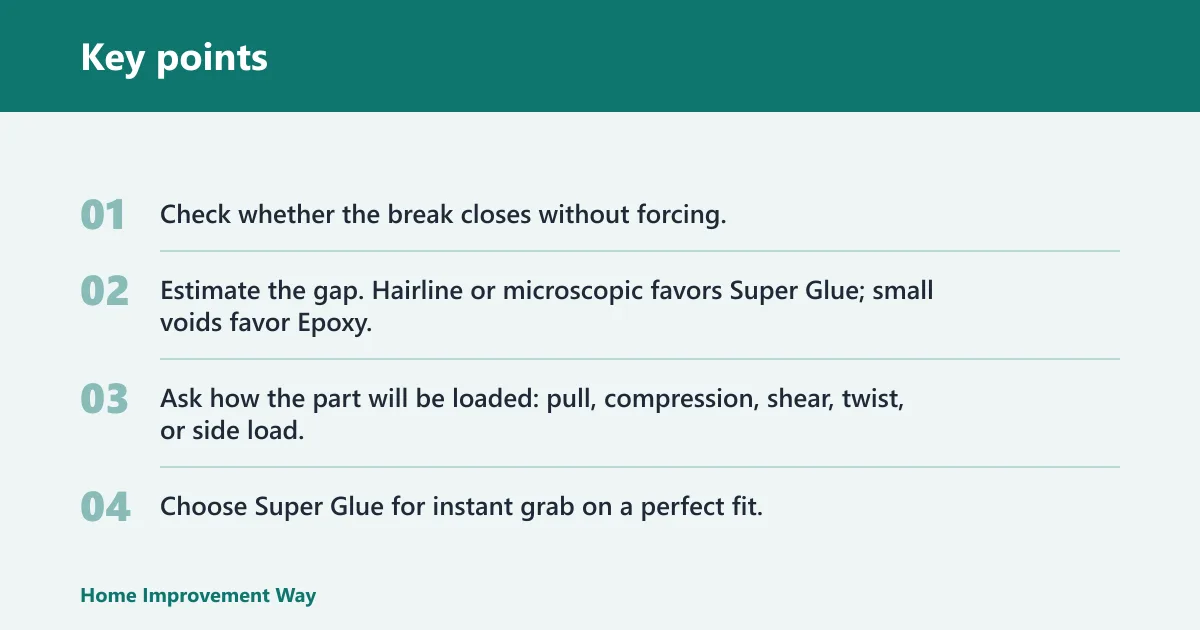
- Check whether the break closes without forcing.
- Estimate the gap. Hairline or microscopic favors Super Glue; small voids favor Epoxy.
- Ask how the part will be loaded: pull, compression, shear, twist, or side load.
- Choose Super Glue for instant grab on a perfect fit, or Epoxy for fill and adjustment time.
How super glue behaves
Super Glue is a single-component cyanoacrylate adhesive commonly used for small home repairs. It polymerizes quickly when exposed to moisture, which is why it grabs fast on tight joints. That speed is useful, but it also leaves very little time to shift the part into place.
Best uses for tight, non-porous joints
Use Super Glue when the break is clean and the faces line up almost perfectly. It does well on non-porous surfaces such as metal, glazed ceramic, and many plastics when the fit is precise. Small parts that need an instant hold often benefit most from it.
Where super glue fails
Super Glue has low gap-filling ability and a microscopic bond line requirement. That makes it a poor choice for uneven breaks, missing fragments, or joints that flex sideways. A brittle bond can crack again if the part is levered after repair.
How epoxy behaves
Epoxy uses a resin and a hardener that must be mixed before use. That gives you more working time and better gap filling, which is useful when the break is uneven or the part needs a moment to align. In many small repairs, epoxy also gives stronger lap shear than super glue.
Why epoxy fills small voids better
Epoxy tolerates small voids and uneven edges better than cyanoacrylate. That makes it the safer pick when the repair is not a perfect puzzle fit. It can bridge thin spaces and still leave a usable bond, which is why it often wins on mixed materials and broken corners.
Working time, cure time, and cleanup
Working time is the period before the adhesive grabs. Cure time is when the bond reaches full strength. Epoxy can take about 24 to 72 hours to fully cure in the cited comparison, so cleanup is easier before it hardens, but it is wise to wait before the part sees load.
Which glue is better for your repair?
For ceramic and pottery, both adhesives can be right. Super Glue can give a cleaner line on a tight ceramic chip, while epoxy helps when the break is irregular, the chip is missing, or the repair must look smooth from a small viewing distance. In conservation-minded work, reversibility and appearance can matter as much as raw strength.
Ceramic and pottery
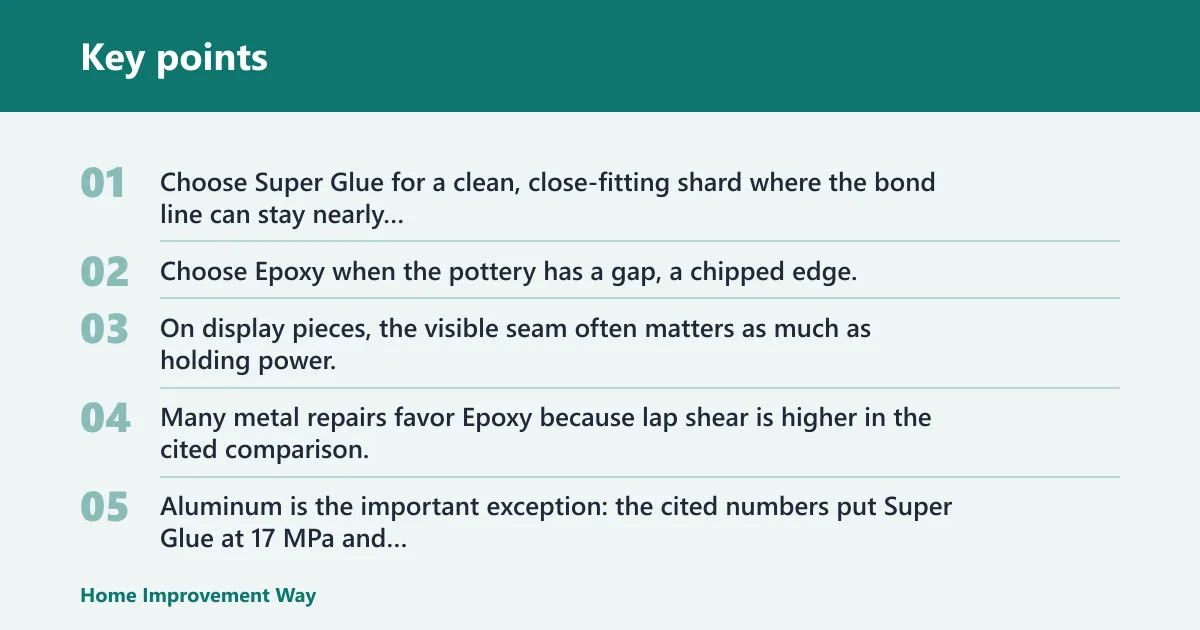
Choose Super Glue for a clean, close-fitting shard where the bond line can stay nearly invisible. Choose Epoxy when the pottery has a gap, a chipped edge, or a part that needs more time to align. On display pieces, the visible seam often matters as much as holding power.
Metal and aluminum
Many metal repairs favor Epoxy because lap shear is higher in the cited comparison, 25 MPa versus 13.7 MPa. Aluminum is the important exception: the cited numbers put Super Glue at 17 MPa and Epoxy at 6 MPa on aluminum. For a small aluminum repair with a tight fit, Super Glue can often be the better call.
Plastic, trim, and mixed materials
Plastic trim, household clips, and mixed-material parts often decide the answer by fit and load, not by the label on the tube. Clean plastic breaks with almost no gap can suit Super Glue. Uneven trim joints, twisted knobs, and mixed materials usually favor Epoxy because you get more time to align the parts.
Say your cabinet pull snaps at the screw boss and leaves about a 1 mm gap on one side. Super Glue will grab fast, but the missing material and twist load make a second failure more likely. Epoxy can fill that small gap and give you time to center the pull before it cures.
Suppose a ceramic figurine foot breaks cleanly into two matching pieces. If the faces meet with almost no daylight between them, Super Glue is the faster and neater choice. If a chip is missing from the edge, Epoxy is the better match because it can bridge the void.
When should I use super glue instead of epoxy?
Use super glue instead of epoxy when the break is tight, the pieces fit almost perfectly, and you need a fast hold with little clamp time. It is also a strong pick for small non-porous parts that will not face much sideways stress after the repair.
Close-fitting breaks with microscopic bond lines
When the bond line can stay microscopic, cyanoacrylate has the best chance of making a clean, quick repair. That is the condition Super Glue likes most. If the pieces rock, wobble, or leave a visible gap, move away from it.
Fast fixes where clamping time is short
Super Glue is the faster choice when you cannot hold a part in place for long. It sets quickly, which helps with tiny parts that tend to slide out of position. That speed is useful on small household repairs that do not need time for fine adjustment.
Small parts that do not take sideways load
Choose Super Glue when the repaired part mainly sits in compression or light pull, not in twist or side-load. A small decorative chip, a clean plastic tab, or a close-fitting ceramic fragment usually fits this profile. Sideways stress is where the bond becomes more vulnerable.
When should I use epoxy instead of super glue?
Use epoxy instead of super glue when the break has a small gap, the edges are uneven, the materials differ, or the joint needs more working time. Epoxy is also the better pick when the repaired part may be bumped, twisted, or loaded from the side.
Uneven breaks and small gaps
If the pieces do not fit perfectly, epoxy is usually the safer choice. It can bridge small voids better than super glue and tolerate a less exact break. That matters on chipped corners, broken handles, and missing bits of material.
Repairs that need more working time
Some small repairs fail because the adhesive grabs before the piece is aligned. Epoxy gives you more repositioning time, so it is better when you need to center a part, wipe excess, or line up a second edge before the bond sets.
Joints that need better resistance to side load
Side-to-side stress is hard on brittle bonds. Epoxy generally handles that situation better than super glue, which is why it wins on many repairs involving twist, shear, or repeated nudging. If the part will be handled often, that extra margin matters.
Choose Super Glue if… / Choose Epoxy if…
Choose Super Glue if the break is clean, the fit is exact, the surfaces are non-porous, and the part needs a fast, small repair without much repositioning. Choose Epoxy if the pieces have a gap, the fit is uneven, the repair needs more working time, or the part will face sideways stress.
Choose super glue if…
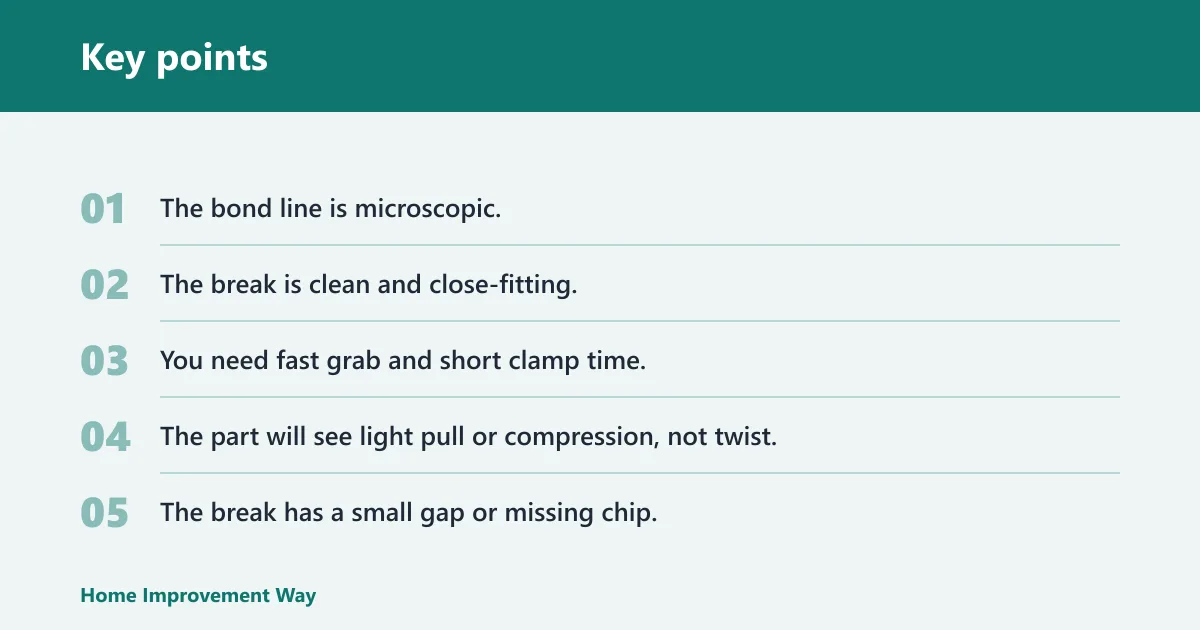
- The bond line is microscopic.
- The break is clean and close-fitting.
- You need fast grab and short clamp time.
- The part will see light pull or compression, not twist.
Choose Epoxy if…
- The break has a small gap or missing chip.
- The part needs repositioning before the bond sets.
- The repair involves mixed materials or uneven edges.
- The joint may face shear, twist, or side load.

Frequently asked questions
Is super glue or epoxy better for a small repair?
For a small repair, the better adhesive is the one that matches the joint. Super Glue is better for tight, precise breaks with almost no gap. Epoxy is better when the repair needs fill, adjustment time, or more resistance to sideways stress.
How long does super glue take to dry compared with epoxy?
In the cited comparison, super glue dries in about 10 minutes, while epoxy can take a full day to cure. That difference matters because a fast set does not equal full strength. Epoxy gives more working time, but you must wait longer before loading the part.
Can epoxy fill small gaps better than super glue?
Yes. Epoxy is better for small gaps because it tolerates uneven breaks and small voids more effectively than super glue. Super Glue needs a very tight bond line, so it is less forgiving when the pieces do not meet cleanly.
Which glue is stronger for metal repairs, super glue or epoxy?
For many metal repairs, epoxy is stronger in lap shear, with the cited numbers at 25 MPa versus 13.7 MPa for super glue. Aluminum is the exception in the cited comparison, where super glue is listed at 17 MPa and epoxy at 6 MPa.
Is super glue or epoxy better for ceramic repairs?
Both can work on ceramic repairs. Super Glue is better for a clean, tight break with a nearly invisible bond line. Epoxy is better when the chip is missing, the edges are uneven, or the repair needs more time to line up cleanly.
Will super glue hold up if the joint has side-to-side stress?
Sometimes, but it is not the better choice when side-to-side stress is significant. Super Glue is more brittle under sideways load, so epoxy usually lasts longer in that situation. If the joint is likely to twist or get bumped, epoxy is the safer pick.
Sponsored / affiliate links. As an Amazon Associate I earn from qualifying purchases. I may earn additional commission from eligible campaigns.