How to Repair Drywall Around Electrical Boxes
Patch drywall around an electrical box only if the box remains accessible and the finished wall will not recess the box beyond what the wall material allows. If the box is set back too far after the wall is repaired, use a listed box extender or ring rather than burying the opening. Junction boxes must stay accessible, and panels must keep their required working clearance. This guide shows when to patch, when to extend the box, and when the opening is unsafe to close. NEC accessibility and box-setback guidance are summarized in NEC 314.29 and box-extender requirements commonly cited by inspectors and manufacturers such as Arlington and Southwire.
What you’ll need


- Utility knife
- Putty knife
- Fine-grit sandpaper
- Damp sponge
- Spackling compound for small holes
- Joint compound for larger repairs
- Primer
- Paint
- Faceplate or box extension if the box needs one
How do you know what kind of fix fits?
Start by identifying the box type and checking how the drywall opening sits against it. Outlet boxes can often be repaired at the edge, but junction boxes and panels should remain reachable. If the finished wall would cover the box, stop patching and switch to a box adjustment or leave the opening open. NEC 314.29 requires junction boxes to remain accessible, and electrical panels must stay unobstructed for service access and working clearance.
Which fix fits this box opening?
| Opening type | Safe to patch | Best repair method | Required access note | Red-flag symptoms | Outcome |
|---|---|---|---|---|---|
| Outlet box | Yes, if the box stays flush with the finished surface and the opening does not crowd the device screws | Patch small edge damage; use a larger faceplate if the cut is slightly oversized; use a box extension if wall thickness changed | Keep the receptacle screws and device body reachable from the face | Broken box ears, the device sits back too far, or the plate would not cover the cut cleanly | Patch / plate / extender |
| Junction box | No, if patching would bury the box | Leave it accessible and install the required cover plate | The box must remain open for inspection access and future servicing | Drywall would cover the lid, loose conductors are present, or the opening has no cover | Stop and rework |
| Electrical panel | No | Do not patch over the panel opening; keep the service area open | Working clearance and service access must stay unobstructed | Any cut that narrows access to breakers, the dead front, or the panel cover | Stop and rework |
| Recessed outlet box | Only if the device remains usable and the box is not set back beyond the wall finish | Add a listed box extender or extension ring before finishing the wall | Box set back is limited by the wall surface and device mounting requirements | The receptacle is behind the finished plane, screws are hard to reach, or the plate rocks | Extender / rework |
| Oversized cut still covered by jumbo plate | Yes, if the plate fully covers the damaged edge and the box remains accessible | Use the jumbo plate, then patch only visible edge damage | The plate should cover the opening without hiding required box access | Plate flexes, exposes raw drywall, or leaves a gap at the box edge | Patch / plate |
| Broken mounting ears | No, not as-is | Replace or adjust the box before any drywall repair | The device and cover plate must mount securely to the box | Device will not tighten, plate will not seat, or the yoke shifts when screwed down | Stop and rework |
| Metal vs plastic box | Yes for either type if access is preserved and the box depth is correct | Metal boxes may need a listed extender or ring; plastic boxes may need replacement if ears are damaged | Material does not change the accessibility rule; the box must still be serviceable | Corrosion, stripped threads, cracked plastic, or missing screw points | Patch / extender / rework |
| Panel drywall cut too tight | No | Trim back the drywall so the panel cover and working space remain clear | Do not reduce the panel’s required clearance or service access | Door bind, cover interferes, or the opening crowds the panel edge | Stop and rework |
Common failure cases
| Failure case | What it means | Best next move |
|---|---|---|
| Broken box ears | The box cannot hold the device or cover plate correctly | Replace or adjust the box before any drywall repair |
| Oversized cut | The opening is larger than the faceplate can hide | Use a patch with backing support or replace the damaged drywall section |
| Gap too close to the stud | The edge is too narrow to hold filler well | Rebuild the edge with backing or cut back to sound drywall |
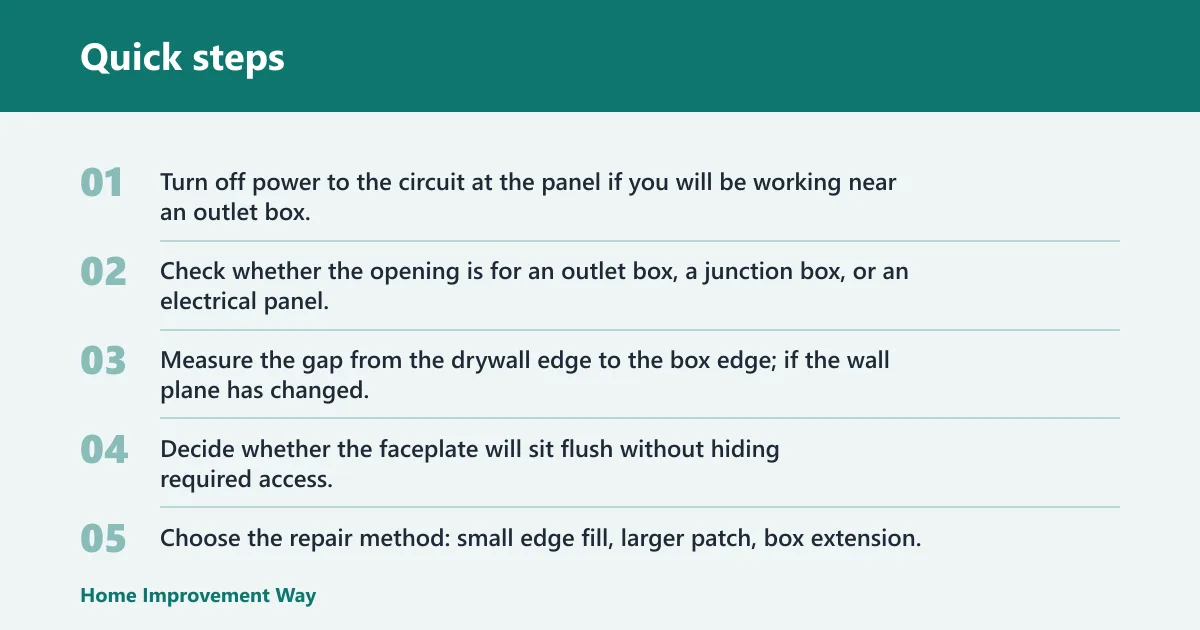
- Turn off power to the circuit at the panel if you will be working near an outlet box.
- Check whether the opening is for an outlet box, a junction box, or an electrical panel.
- Measure the gap from the drywall edge to the box edge; if the wall plane has changed, confirm whether a box extension is needed.
- Decide whether the faceplate will sit flush without hiding required access.
- Choose the repair method: small edge fill, larger patch, box extension, or no patch because the opening must stay open.
How do you repair small edge damage?
Trim loose paper, brush out dust, and fill only the damaged edge if the opening is small and the box still sits where it should. Small drywall holes are defined as up to about 1/2 inch in diameter, and small holes can be repaired with spackling compound. Use this only for minor chips and nicks, not for unsupported gaps.
- Cut away torn paper with a utility knife.
- Wipe dust from the edge with a damp sponge and let the surface dry.
- Load spackling compound on a putty knife and apply it slightly overfilled.
- If the edge is a nail-size defect, leave a small proud bead, then check it again after the patch dries.
- Let the repair dry for one to two hours, longer in warm or humid areas.
- Sand with fine-grit sandpaper or a sanding sponge until the patch sits flush.
- Feather the edge outward. Then prime the repair and paint it after sanding.
If the outlet opening has a chipped corner about 3/8 inch wide, and the receptacle still sits flush with the cover plate overlapping the cut, it can be treated as a patch job. That is a patch job, not a box problem. A thin coat of spackle, then sanding and primer, is usually enough.
How do you fix larger or sloppy cuts?
Use joint compound and backing support when the cut is too large for a simple filler patch. Larger holes need more than a single dab of filler. Build the repair in thin coats, sand between coats, and blend the texture so the finished wall does not telegraph the old cut line. For the wall opening itself, a drywall repair method for larger damaged openings is the right approach when the faceplate no longer hides the damage.
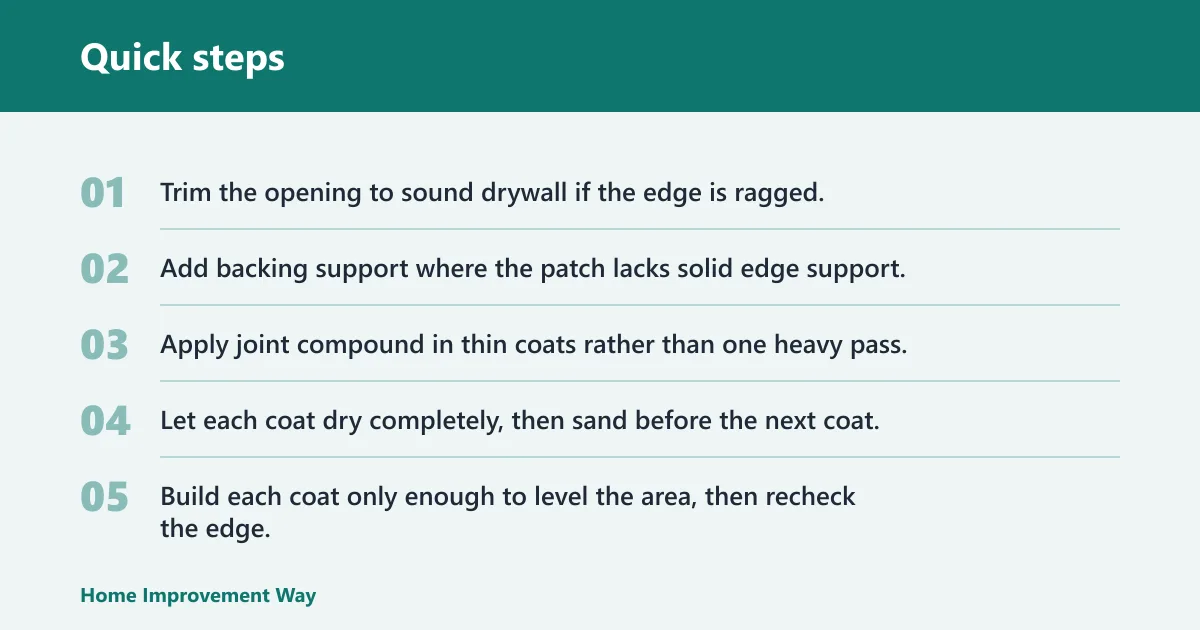
- Trim the opening to sound drywall if the edge is ragged.
- Add backing support where the patch lacks solid edge support.
- Apply joint compound in thin coats rather than one heavy pass.
- Let each coat dry completely, then sand before the next coat.
- Build each coat only enough to level the area, then recheck the edge.
- Match the texture with a damp sponge while the surface is still workable, if needed.
- Prime and paint after the repaired area dries smooth.
Suppose the drywall cut around a receptacle is jagged and the faceplate barely covers the opening. That is not a spackle-only fix. A larger patch with backing support gives the edge something solid to bond to, and a box extension may be needed if the wall plane now sits farther out. For box depth correction, use a listed extender or ring sized for the device opening.
Common mistakes
Burying a junction box behind drywall is the biggest error. It must remain accessible and covered properly, so do not close it in. A panel opening is even more sensitive because service access and working clearance must stay open. NEC 314.29 covers junction-box accessibility, while panel working clearance is governed by NEC 110.26 and related service equipment rules.
Another mistake is hiding a bad cut with a faceplate when the box itself is wrong. If the box sits too deep, a faceplate alone will not fix the access problem. A box extension can restore the correct depth after a wall-thickness change, and box extenders are the standard fix called out by manufacturers and inspectors when the finished wall moves out beyond the box front.
Using spackle on a gap that needs support also fails fast. Spackling compound is best for small holes, while joint compound suits larger repairs with multiple coats. A hammer can leave large marks in the wall if used carelessly, so cut cleanly instead of forcing the opening wider.
If that didn’t work, try this next
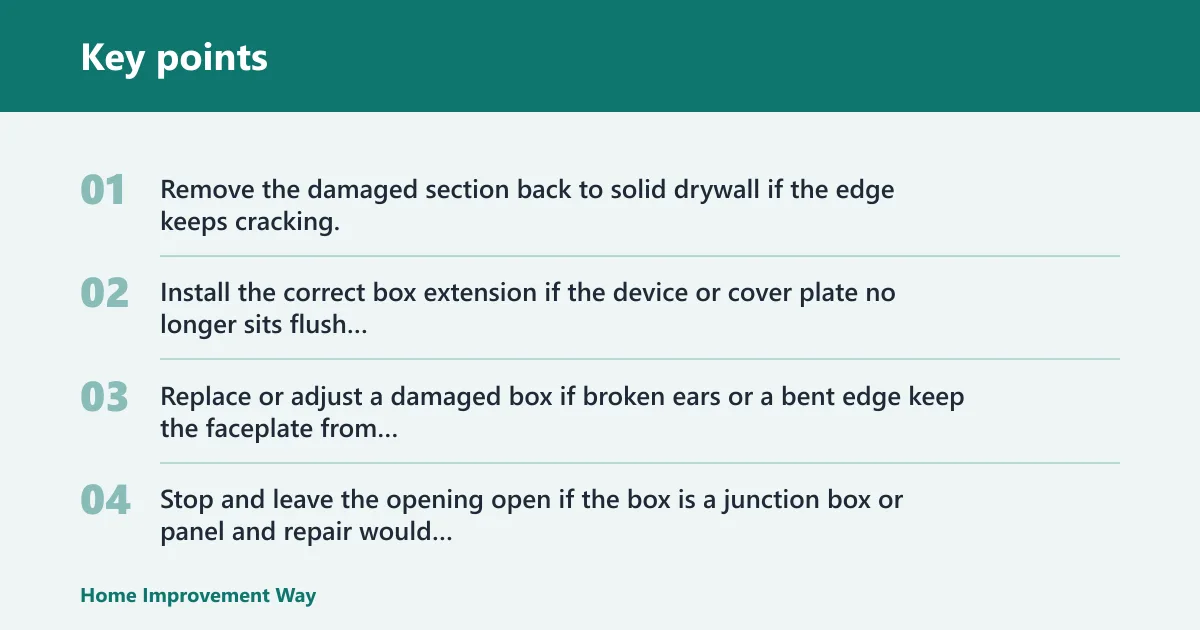
- Remove the damaged section back to solid drywall if the edge keeps cracking.
- Install the correct box extension if the device or cover plate no longer sits flush after the wall repair.
- Replace or adjust a damaged box if broken ears or a bent edge keep the faceplate from seating.
- Stop and leave the opening open if the box is a junction box or panel and repair would hide it.
How do you repair drywall around electrical box?
Repair the drywall only after you confirm the box stays accessible and the finished wall will not bury the front edge. For outlet boxes, clean the cut, fill minor chips with spackle, and use joint compound with backing support for larger damage. If the wall moved outward, add a box extension first.
How do you repair drywall around outlet box?
A standard receptacle opening can usually be repaired if the plate still covers the cut and the receptacle screws remain reachable. Small edge damage gets spackling compound; larger sloppy cuts need joint compound and, sometimes, a larger faceplate. If the device sits too deep after the repair, use a box extender.
How do you fix drywall around electrical outlets?
Fix the drywall only when the outlet box remains flush enough for safe device access. If the opening is merely chipped or rough, patch it and feather the edge. If the cut is oversized or the box is recessed after a wall change, correct the depth before finishing the wall. If the recess is beyond the finished wall plane, use a listed extender instead of relying on filler.
How do you patch drywall around electrical panel?
Do not patch over an electrical panel opening. The panel must remain open, with working clearance and service access unobstructed. If drywall has been cut too close to the panel, trim the edge back for clean clearance, then leave the area open and protected with the proper panel cover arrangement.
How do you fix drywall around junction box?
Do not close a junction box behind drywall. The box has to remain accessible and needs a cover plate, so the repair is around the box, not over it. If the drywall cut is ragged, clean the edge and patch only the surrounding wall, leaving the box face reachable.
Frequently asked questions
Can you drywall over a junction box?
No. A junction box must remain accessible for inspection and servicing, and it cannot be buried behind drywall. Leave the box face open, keep the cover plate in place, and patch only the surrounding wall. If the opening is in the wrong spot, the box itself needs adjustment, not concealment.
Sponsored / affiliate links. As an Amazon Associate I earn from qualifying purchases. I may earn additional commission from eligible campaigns.