Basement Waterproofing Cost by Method: What Each Fix Costs
Basement waterproofing is often priced by failure type and repair method: crack injection commonly runs in the low hundreds per crack, interior drain systems often run in the low thousands, exterior excavation can reach the high thousands or more, and sump pumps are often in the low-thousands range. Pricing by square foot can miss the leak path and leave the basement wet, which can lead to mold, damaged finishes, and repeat bids. This guide breaks down what each method fixes, what it cannot fix, and which line items should appear in a quote.
Basement waterproofing cost matrix
Start with the failure, then match the method. A damp wall after light rain does not call for the same scope as groundwater pressure under the slab, and that difference can change quotes by thousands.
| Method | Problem it solves | Typical cost | Red-flag limits | Quote extras to expect |
|---|---|---|---|---|
| Grading and downspout extensions | Moves roof runoff and surface water away from the foundation | $0-$200 for common DIY fixes; professional regrading can cost more | Will not stop groundwater pressure or a leaking crack by itself | Downspout elbows, extension pipe, splash blocks, soil, hauling, regrading labor |
| Waterproofing paint or sealant | Surface moisture control and cosmetic improvement | About $50-$200 DIY for materials; Bob Vila lists $3 to $7 per square foot by coating type | Can fail under hydrostatic pressure and can hide a leak instead of fixing it | Prep work, cleaning, patching, primer, moisture testing, multiple coats |
| Crack injection | Seals a specific wall crack | $50-$100 DIY kits; $400-$900 per crack professionally | Not for bowing walls, widening cracks, or ongoing structural movement | Crack prep, ports, resin or epoxy, cleanup, follow-up sealing if needed |
| Sump pump | Removes collected water from a pit | $150-$400 for the unit; $600-$1,800 installed or replaced on its own | Does not work alone without drainage that feeds the pit | Pit, basin, check valve, discharge line, electrical work, backup battery if specified |
| Interior drain tile / perimeter drain | Captures water at footing level and sends it to a sump pit | $50-$100 per linear foot of wall; $3,000-$8,000 for an interior French drain and sump pump system | Needs a sump and proper discharge; does not stop water from entering the wall itself | Concrete removal, drain board, gravel, sump pit, pump, inspection ports, restoration |
| Exterior waterproofing | Blocks water outside the foundation | $8,000-$30,000 | Most labor and equipment intensive; access can drive cost higher | Excavation, membrane or coating, drainage board, footing drain, backfill, restoration, permits |
| Damp proofing | Limits soil moisture transfer through foundation walls | Usually lower than waterproofing per square foot; Bob Vila lists interior sealing at $200 to $3,000 and exterior sealing at $1,000 to $15,000 | Not a groundwater solution | Surface prep, coating type, access, exterior excavation if done outside |
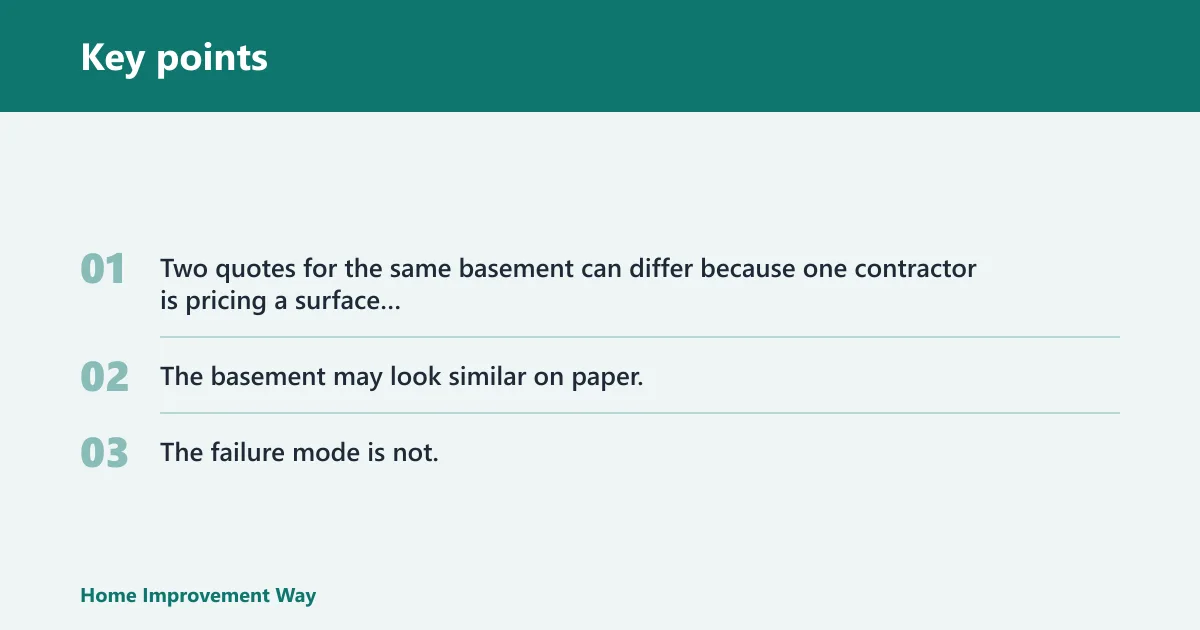
Two quotes for the same basement can differ because one contractor is pricing a surface coating and another is pricing excavation, drainage, and restoration. The basement may look similar on paper. The failure mode is not.
What is the cheapest fix?
The cheapest first step is usually grading and downspout work. Common DIY spending is about $0-$200, and that low cost makes sense only when roof runoff or surface water pools near the foundation, not when groundwater pushes through the wall or slab.
Grading and downspout extensions
These are the lowest-cost prevention steps because they move water away from the house before it loads the foundation. If gutters dump beside the wall or the soil slopes toward the basement, correcting that path can reduce seepage fast.
Professional regrading can cost more when crews need to move soil, rework hardscape, or correct a yard that slopes back toward the house over a wide area. That is still usually cheaper than opening a wall or excavating the exterior.
Say your downspout ends one foot from the foundation and water stains appear only after heavy rain. Extending that outlet farther from the wall may solve the issue without touching the basement finish. If the wall still leaks during long wet spells, the problem is deeper than runoff.
When a low-cost fix is enough
A low-cost fix is enough when the basement stays dry between storms and the issue tracks with a visible water path outside. Look for clogged gutters, short downspouts, low spots beside the wall, or splash-back near window wells.
When cheap fixes stop working
Cheap fixes stop working once the house sees hydrostatic pressure, which pushes water through cracks, joints, and porous concrete. At that point, surface corrections can help, but they will not replace drainage or exterior work.
How much does crack injection cost?
Crack injection usually costs $50-$100 for a DIY kit or $400-$900 per crack for professional repair. It is best for a non-structural wall crack that leaks water, not for a bowing wall or a crack that is widening, offset, or tied to foundation movement.
DIY kits versus pro pricing
DIY kits can look inexpensive because they cover materials only. The lower price makes sense when the crack is narrow, stable, and clearly the leak path. Professional pricing buys crack prep, resin selection, and labor for injection ports and cleanup.
Keep the scope narrow. One crack can be a reasonable injection job; a wall with multiple leaks may point to a drainage problem, not three separate crack repairs.
Non-structural crack limits
Injection seals the opening. It does not straighten a wall, stop a wall from moving, or solve pressure that keeps opening the crack. If the crack is stair-stepped, widening, or paired with displacement, that needs a structural evaluation before sealing.
Signs a crack needs more than injection
If the crack leaks after dry-weather periods, grows wider at the top or bottom, or comes with wall bowing, injection alone is a poor bet. In that case, drainage correction or structural repair may be the real project.
Interior drain tile and sump pump costs
An interior French drain and sump pump system can cost $3,000-$8,000, and a full interior drain tile system is roughly $50-$100 per linear foot of wall. This method is for water that reaches the basement perimeter and needs a controlled path to a sump pit.
Perimeter drain pricing basics
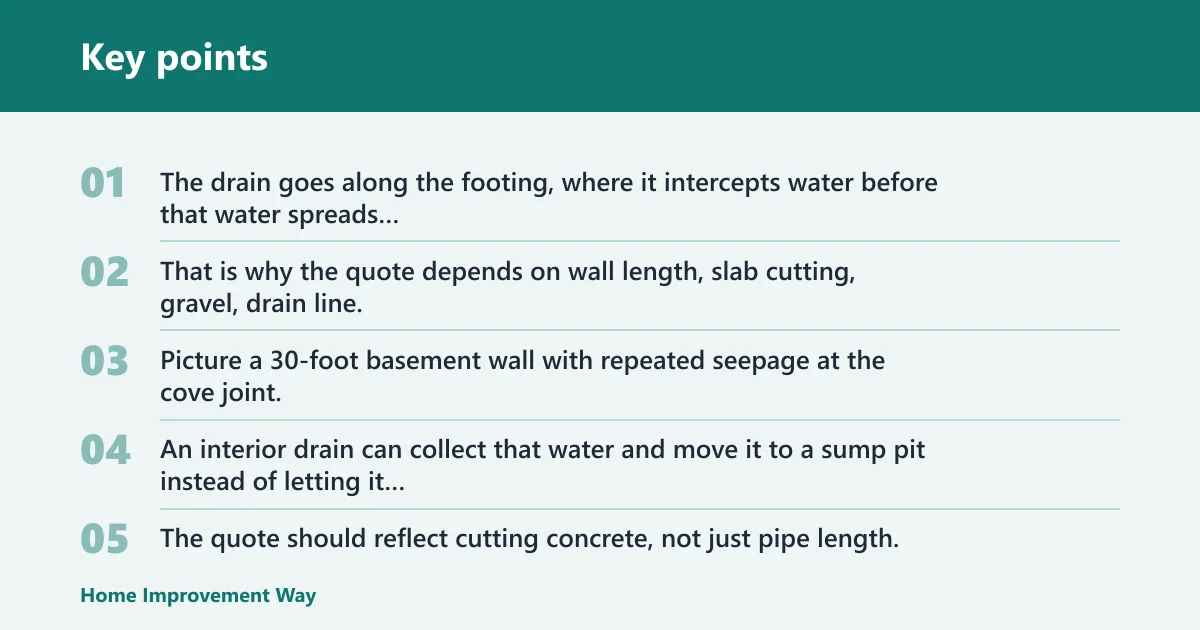
The drain goes along the footing, where it intercepts water before that water spreads across the floor. That is why the quote depends on wall length, slab cutting, gravel, drain line, and where the water exits the system.
Picture a 30-foot basement wall with repeated seepage at the cove joint. An interior drain can collect that water and move it to a sump pit instead of letting it seep across finished flooring. The quote should reflect cutting concrete, not just pipe length.
Sump pit and pump installed cost
A sump pump installed or replaced on its own can cost $600-$1,800, and the pump unit alone can cost $150-$400. A pump is a separate line item from the drainage system that feeds it.
The pump is a wear item. It has a replacement cycle, so quotes should make clear whether the bid includes only the current install or also future service, battery backup, or alarm equipment.
Replacement and maintenance costs
Interior drainage systems usually need some maintenance. Debris clearing, pump checks, float testing, and eventual pump replacement are recurring costs that homeowners should plan for after the initial install.
When does exterior waterproofing cost more?
Exterior waterproofing costs more when the contractor must excavate around the foundation to install a membrane or coating. Typical cost is $8,000-$30,000, and that range rises with access problems, deep digging, and restoration after the wall is exposed.
Excavation and membrane work
Exterior work addresses the wall before water gets inside, which is why it is often more effective for groundwater pressure. It is also the most labor and equipment intensive common method.
The price includes digging, cleaning the wall, applying the membrane or coating, and then backfilling correctly. If a contractor quotes only the membrane, the bid is incomplete.
Labor, equipment, and access
Access drives cost. Tight lots, decks, porches, trees, patios, and buried utilities can make the dig slower and more expensive. Equipment time matters here more than with interior sealing or crack repair.
Restoration after the dig
Exterior quotes should include restoration after excavation. That may mean replacing landscaping, repairing walkways, resetting window wells, or fixing disturbed soil so water does not route right back to the foundation.
Sealant, damp proofing, and interior sealing
Waterproofing paint and sealant are surface coatings. They can help with minor moisture control, but they are not a cure for active leaks under pressure. Damp proofing is different from waterproofing because it handles soil moisture better than groundwater.
Waterproofing paint and sealant limits
Bob Vila lists acrylic paint at $3 to $4 per square foot, silicate at $4 to $6 per square foot, and epoxy at $5 to $7 per square foot. Those products can improve the wall surface, but hydrostatic pressure can push water through or behind them.
That is why a coated wall may look better and still leak. If the wall is taking active pressure, the coating can fail at seams, cracks, or weak concrete.
Damp proofing versus waterproofing
Damp proofing is a lower-cost treatment for soil moisture. Waterproofing is the stronger standard when the site has groundwater, repeated seepage, or a history of standing water around the foundation.
The same source says interior basement sealing can cost $200 to $3,000, while exterior sealing can cost $1,000 to $15,000. The larger outside number reflects excavation and better access to the source of the leak.
Where interior sealing fits in the price spectrum
Interior sealing sits below full drainage and excavation in cost, but it should be matched to the problem. It is useful for light seepage, cosmetic cleanup, or as part of a larger system, not as the only defense against steady groundwater pressure.
Basement waterproofing quote line items
The quote should tell you what water path the contractor is addressing and what is included to finish the job. A low headline price can rise quickly if the bid leaves out drainage, routing, permits, or restoration.
- Identify the water source: runoff, wall crack, cove joint seepage, or groundwater pressure.
- Check whether the bid includes a sump pit, not just the pump.
- Confirm discharge routing to a legal, usable outlet.
- Look for permit costs where required.
- Look for excavation, concrete removal, and backfill if the method needs them.
- Ask whether restoration is included after the work is done.
- Ask about maintenance, pump replacement, and access panels if the system needs them.
Sump discharge routing
Discharge routing can add cost when the line must travel farther from the house, cross a finished area, or tie into a specific outlet. A pump without a proper discharge path is not a finished solution.
Permits, excavation, and restoration
Permits matter more on exterior work and some drainage changes. Excavation and restoration can be the biggest hidden cost divider because they turn a simple materials bid into a labor-heavy project.
Drainage maintenance and recurring costs
Some costs repeat. Pump replacement, alarm batteries, and drain maintenance are not the same as the first install, and they should be treated separately when comparing bids.
Frequently asked questions
How much does basement waterproofing cost by method?
By method, the range is wide because the scope is different.
What is the cheapest way to waterproof a basement?
The cheapest first move is usually grading and downspout extensions, especially if roof runoff is the source. That work often costs $0-$200 in common DIY situations. It is only enough when the problem is surface water, not groundwater pressure or an active structural crack.
How much does an interior French drain and sump pump cost?
An interior French drain and sump pump system can cost $3,000-$8,000. A full interior drain tile system is roughly $50-$100 per linear foot of wall, so longer walls or more concrete removal push the price up. The sump, pit, and discharge path should be included in the quote.
How much does exterior basement waterproofing cost?
Exterior basement waterproofing can cost $8,000-$30,000. Excavation, membrane work, drainage, backfill, and site restoration drive that number higher than interior methods. Access problems, hardscaping, and utility conflicts can push it beyond the common range.
What does a sump pump installation cost?
That is separate from a full interior drainage system. Quotes should show whether the bid covers only the pump or also the pit, discharge, and electrical work.
When is waterproofing paint enough and when does it fail?
Paint or sealant can be enough for minor moisture control, cosmetic cleanup, or a dry wall that only needs surface protection. It can fail under hydrostatic pressure, especially if water is coming through a crack, joint, or porous wall from the outside. Active leaks need a drainage or crack fix.
What costs should be included in a basement waterproofing quote?
A complete quote should include the source of the fix, not just the coating or pipe. Look for sump pit and pump details, discharge routing, permits, excavation, restoration, and any recurring maintenance or replacement costs. If those items are missing, the final price may climb after the job starts.
Sponsored / affiliate links. As an Amazon Associate I earn from qualifying purchases. I may earn additional commission from eligible campaigns.