Basement Waterproofing Cost Per Linear Foot: When It Applies
Basement waterproofing is priced per linear foot mainly for perimeter drainage, footing drains, and some crack or wall repairs, so ask what depth, membrane, gravel, pipe, and labor the rate includes. If you compare quotes without that scope, a low per-foot number can hide excavation, pump work, backfill, or finishing costs. This guide breaks down when linear-foot pricing is valid and how to compare interior drainage, exterior excavation, and add-ons line by line.
When does per-foot pricing apply?
Per-foot pricing makes sense when the contractor is treating a measured stretch of basement perimeter, not a vague “waterproofing” package. That perimeter may be the full basement perimeter or only the affected wall sections, and the quote should say which one. It works best for repeatable scope, such as drain installation, membrane work, crack repair, or wall treatment along a defined length.
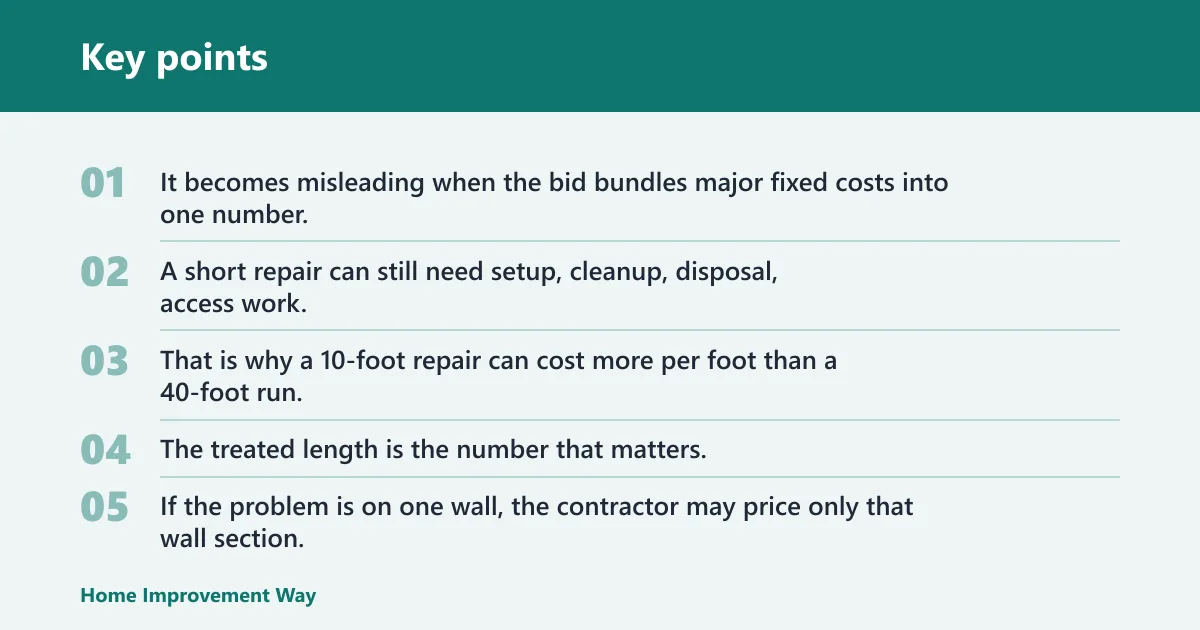
It becomes misleading when the bid bundles major fixed costs into one number. A short repair can still need setup, cleanup, disposal, access work, or a sump connection, so the cost may not scale neatly from foot to foot. That is why a 10-foot repair can cost more per foot than a 40-foot run.
What length should the quote use?
The treated length is the number that matters. If the problem is on one wall, the contractor may price only that wall section. If groundwater pressure is affecting the whole basement, the quote may use the full perimeter. Never compare one-wall pricing against full-perimeter pricing as if they mean the same job.
Why small repairs may not scale linearly
Small repairs often carry minimum job charges. A contractor still has to mobilize equipment, open the slab or wall, remove debris, and restore the work area. Those fixed costs do not shrink much just because the treated length is short.
Interior drainage cost per linear foot
Interior perimeter drainage is commonly listed at $28-$60 per linear foot. This system manages water after it enters, usually by collecting it at the basement perimeter and sending it to a sump pump. It is often priced by treated length because the trench, drain line, and installation labor track the wall run.
That range is not a complete system price by itself if the quote leaves out the pump, discharge routing, concrete restoration, or disposal. The page data also notes that the calculator can auto-fill a typical per-foot rate when you choose the method, but you still need the line-item scope. Interior drainage typically costs less than exterior excavation.
Why sump pump cost is often separate
A sump pump is commonly listed as an add-on, not part of the drainage foot price. A typical sump pump add-on is priced from $500 to $2,000 per unit. If the quote includes interior drainage but no pump, ask whether the system is meant to discharge by gravity or whether the pump is extra.
Expected lifespan and maintenance
Interior drainage systems are often described as having a typical lifespan of about 10-15 years. That figure helps set expectations, but it does not replace maintenance. Pump testing, outlet checks, and discharge line care still matter, especially in homes with repeated groundwater entry.
Exterior excavation cost per linear foot
Exterior excavation waterproofing is commonly listed at $100-$200 per linear foot. This method involves digging outside the foundation, applying or repairing the waterproofing layer, and backfilling the trench. It stops water before wall contact, which is why it usually costs more than interior drainage per foot.
Hydrostatic pressure is one reason exterior work may be needed. When groundwater pushes against the foundation, it can force water through walls, joints, and cracks. If the quote says exterior waterproofing but omits excavation, backfill, or restoration, the number is incomplete.
What the line item should include
At minimum, an exterior line should identify the treated wall length, excavation depth or wall height involved, waterproofing method, backfill, disposal, and any surface restoration. Without those items, you cannot tell whether the number covers a basic coating or a full dig-and-repair system.
Why exterior work costs more
Exterior jobs carry more labor, equipment, and site disruption. Soil removal, hauling, waterproofing material, and restoration add time and cost. Wet soil, tight side yards, and buried utilities can raise the price quickly even when the linear footage stays the same.
Is the quote for the whole basement perimeter?
Ask this first. A per-foot quote can refer to the full basement perimeter or only the affected wall sections, and the difference can be large. If the contractor measured one wall and another bid measured all four, the numbers are not comparable even if the unit price looks similar.
Say your basement is 28 feet by 20 feet. A quote for one damp 28-foot wall will look cheaper than a quote for the full perimeter, but the latter is treating four sides, not one. That difference changes both the total and the value of the per-foot number.
How to measure treated length
- Ask which walls are included.
- Confirm whether corners and returns count in the total.
- Check whether the line uses full perimeter or only the damaged sections.
- Match the stated length to the actual work area on the bid.
- Ask whether wall height affects the price if the basement is 7-9 ft tall, which is the standard height used by the calculator.
What to ask before comparing bids
Ask for the treated length, method, restoration, and add-ons in separate lines. Also ask whether the number includes disposal, permits, or pump work. A quote with all of those items bundled may look simple, but it can hide the real scope difference.
Basement waterproofing cost per table
This table translates common per-foot line items into the scope you should verify before comparing bids.
| Line item | Treated length | Method | Included restoration | Sump pump | Crack injection | Permit / inspection | Disposal | Access multiplier | Valid only when | Red flag if missing |
|---|---|---|---|---|---|---|---|---|---|---|
| Interior perimeter drainage | Full perimeter or affected wall sections | Drain trench, pipe, gravel, interior collection | Concrete patching or slab restoration may be included, but confirm | Often separate | Not usually included | May be separate | Usually separate line or bundled | Limited or difficult access can raise the rate | The quote states the run length and says the system is interior drainage | No pump detail, no trench depth, or no restoration note |
| Exterior excavation waterproofing | Full perimeter or a specific wall segment | Excavation, membrane or coating, drainage layer, backfill | Grade, landscaping, and surface repair may be separate | Usually separate unless specified | Sometimes separate | Often separate or required by jurisdiction | Often included because digging creates spoil | Limited access adds 15%; difficult access adds 30% | The quote states excavation depth, wall length, and restoration scope | No excavation detail, no backfill detail, or no disposal note |
| Crack sealing / crack injection | Only the cracked section | Injection or sealing at isolated non-structural cracks | Patch-up around the crack may be included | No | Yes, this is the method | Usually no | Usually minimal | Limited access may still affect labor | The quote is for a specific crack, not a full drainage system | The bid treats crack repair as if it fixes perimeter seepage |
| Sump pump installation | Not a per-foot item | Pump basin, pump, discharge routing | Floor cutting or patching may be included or separate | Yes | No | May be separate | May be separate | Limited access can affect discharge routing | The drainage system needs active discharge | The quote omits discharge routing, outlet, or basin details |
Why sump pumps and crack injection are often separate

Sump pumps and crack injection solve different problems. A pump moves collected water out of the basement, while crack injection targets one leak path. That is why both are often listed separately from a linear-foot drainage or wall treatment price.
Crack sealing is listed at $8-$40 per linear foot, and that range fits isolated non-structural cracks rather than a full-system fix. If the wall is leaking from multiple points or from hydrostatic pressure, a patch on one crack may not address the larger water path. Interior drainage often needs a pump, especially when water must be lifted to a discharge line.
Suppose a 12-foot wall has one visible crack and the rest of the basement stays dry. Crack injection may be the narrower repair. If seepage shows up along the cove joint after storms, a perimeter drainage system is the more relevant bid line.
How access, soil, and permits change the price
Access, soil, and permits can move the final unit price even when the linear footage stays fixed. Limited access adds 15% to the baseline rate, and difficult or obstructed access adds 30%. Tight side yards, deck removal, interior obstructions, and haul-out distance all matter.
Soil and groundwater conditions matter too. Wet, heavy, or unstable soil slows excavation and backfill. High water tables can increase the need for drainage or pump capacity, and hydrostatic pressure may push the job from a simple repair into a more complete exterior system.
Permit and inspection fees
Permit and inspection fees may be bundled or separate. One source shows about $100 to $800, while other regional jobs may run from $0 to $5,000 depending on scope and local rules. Ask whether the bid includes permit handling, inspection coordination, and reinspection fees.
How to read the access multiplier
Use the multiplier as a warning, not a guess. If the baseline rate assumes normal access, limited access adds 15% and difficult access adds 30%. That means a quoted per-foot rate can be valid only for normal access conditions, not for a crawlspace, obstruction-heavy basement, or tight exterior dig zone.
Frequently asked questions
When does basement waterproofing get priced per linear foot?
Per-foot pricing is most useful when the contractor is treating a measurable run of wall or perimeter, such as interior drainage, exterior excavation waterproofing, or crack repair. It is less useful for small jobs with heavy fixed costs, because mobilization, disposal, and restoration can outweigh the short length.
What is a fair cost per linear foot for basement waterproofing?
A fair number depends on method. A quote is only fair if it uses the same treated length and same included scope.
Does per-foot pricing mean the whole basement perimeter or just one wall?
It can mean either one, and that is why the quote must say so. Full-perimeter pricing uses the whole basement perimeter, while affected-wall pricing only counts the damaged sections. If you do not confirm the treated length, two bids can look similar while covering very different work.
How much more does exterior waterproofing cost than interior drainage per foot?
The gap reflects excavation, backfill, and restoration, not just a different material choice. The exterior method also tries to stop water before wall contact.
What is usually included in a basement waterproofing per-foot quote?
A good quote should list treated length, method, included restoration, disposal, and whether a sump pump, crack repair, permits, or inspection are separate. If it only gives one per-foot number, you do not know whether the bid covers drainage only or a much larger system.
Can a small leak be fixed for less than a full per-foot waterproofing system?
Yes, sometimes. A single crack can often be repaired for less than a full drainage system, and crack sealing is listed at $8-$40 per linear foot. But if the leak comes from groundwater pressure or multiple entry points, a narrow repair may only delay the larger fix.
Sponsored / affiliate links. As an Amazon Associate I earn from qualifying purchases. I may earn additional commission from eligible campaigns.