Best Basement Waterproofing 2026: based on specs and reviews
The best waterproofing for basement floors and slabs depends on slab condition: use a crack-bridging epoxy or polyurethane system for active seepage and cracks, a vapor-tolerant epoxy for dry but damp concrete, and a dimple membrane plus finished floor for chronic moisture. Get this wrong, and you can trap moisture, peel coatings, grow mold, or damage new flooring. This guide compares the right systems for cracks, vapor, seepage, and uneven slabs.
This guide is part of our Basement waterproofing series.
Best waterproofing for basement floors and slabs
There is no single best waterproofing for every basement slab. Start with the slab, not the finish. A sound, dry slab can take a coating; a damp slab usually needs vapor control; a cracked, moving, or uneven slab often needs repair, leveling, or a floating system before any finish goes down.
Concrete basement slabs sit below grade and can pull moisture from wet soil. That means you need to separate vapor control from liquid water control before you choose epoxy, a membrane, a sealer, or a flooring layer. If moisture is moving through the slab, the top layer will fail sooner than the concrete below it.
Best pick for sound, dry slabs
For a slab that is structurally sound, flat, and dry enough to pass moisture testing, epoxy coating is usually the cleanest direct-apply option. It bonds well to properly prepared concrete, seals the surface, and gives you a finished floor without adding height. It is not a fix for groundwater or active seepage.
Best pick for damp slabs with vapor
For damp but not leaking slabs, a moisture vapor barrier paired with a floating floor system is often safer than a direct coating. This approach controls vapor migration from below while avoiding the peel-and-blister risk that comes with coating concrete that still emits too much moisture.
Best pick for cracked or uneven slabs
For cracked or uneven slabs, start with crack repair and flattening, then choose the finish system. Polyurea or polyurethane can handle minor movement better than epoxy, while self-leveling underlayment can correct flatness before a floating floor or tile system. Active seepage still needs drainage or moisture control first.
📊 It identifies eight basement flooring options in 2026. Source: Best Waterproof Basement Flooring 2026: Options, Costs & ROI.
Quick comparison
| Product | Badge | Best for | Price | ||
|---|---|---|---|---|---|
 |
Uncoupling Membrane for Tile Floor, 323 Sq Ft TileJJ CARE | Our pick | 323 sq ft uncoupling HDPE roll | $259.89
Price as of 14 Oct 2026
|
View |
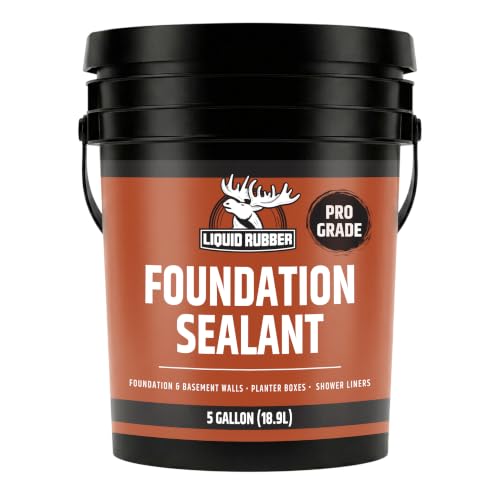 |
Liquid Rubber Foundation Sealant – Basement WaterproofLiquid Rubber | Pair with it | 5 gal black liquid rubber sealer | $179.95
Price as of 14 Oct 2026
|
View |
 |
Rust-Oleum EpoxyShield Satin Gray Basement Floor Coating KitRust-Oleum | Also great | Satin 2-part epoxy floor kit | $102.88
Price as of 14 Oct 2026
|
View |
 |
Farm Plastic Supply – Concrete Vapor Barrier – 15 mil – 14′Farm Plastic Supply | Budget pick | 15 mil heavy duty polyolefin roll | $359.99
Price as of 14 Oct 2026
|
View |
 |
ARDEX TL 2000 Fiber Reinforced Self-Leveling FloorGTDsupply | Upgrade pick | 50 lb fiber-reinforced self-leveling compound | $62.79
Price as of 14 Oct 2026
|
View |
Basement floors deal with damp air, soil moisture, and occasional flooding, so the right system depends on how the slab behaves under load and under moisture. The wrong choice often fails at the bond line, not the top surface.
SPC luxury vinyl plank is presented as 100% waterproof in the 2026 guide, but that only helps if the slab below it is dry enough or isolated with a proper vapor layer.
How we chose
The comparison centers on four things: moisture tolerance, crack and movement tolerance, prep demands, and the slab condition each system can safely handle. A product that looks strong on paper can still fail if it cannot tolerate slab vapor or movement.
Moisture testing matters first. Relative humidity testing or calcium chloride testing can help you judge whether a coating, underlayment, or floating floor is a suitable match for the concrete basement slab.
We also weighed how each system handles common failure modes: peeling, blistering, debonding, telegraphing cracks, and trapped vapor. Those problems usually come from a mismatch between slab condition and system design.
Epoxy coating: best for sound, dry slabs
Rust-Oleum EpoxyShield is for a dry, sound basement slab that has already been cleaned, patched, and moisture-tested. Based on the spec sheet and owner feedback, it is a straightforward choice when you want a sealed surface and the concrete is stable enough for a coating system.
The upside is a finished-looking floor that can handle ordinary foot traffic. The drawback is simple: epoxy can fail if moisture vapor is too high, and it is less forgiving than more flexible systems when the slab moves or hairline cracks reopen.
Where epoxy works well
Epoxy coating works best on concrete basement slabs with low moisture, tight joints, and no active seepage. It is a coating type, not a waterproofing cure for water intrusion from below. If the slab passes moisture testing and the cracks are repaired, it can be a solid finish layer.
Prep and crack repair before coating
Prep must include thorough cleaning, grinding or etching as required by the manufacturer, and repair of cracks and joints. Epoxy injection is used for structural or dormant cracks when you want a rigid repair. Polyurethane crack filler is better for cracks that may move slightly.
Do not coat over dirt, salts, old adhesive, or glossy concrete. Even a good epoxy fails when the bond line is weak. If a slab is uneven or patchy, self-leveling underlayment may be needed before coating or before a floating floor.
When epoxy is the wrong choice
Epoxy is the wrong choice when the slab is damp enough to fail moisture testing, when seepage is active, or when movement is ongoing. In those cases, the coating can blister, peel, or debond. A basement floor must handle moisture from below through the slab, so the slab condition has to be known first.
Polyurea or polyurethane coating: best for minor movement
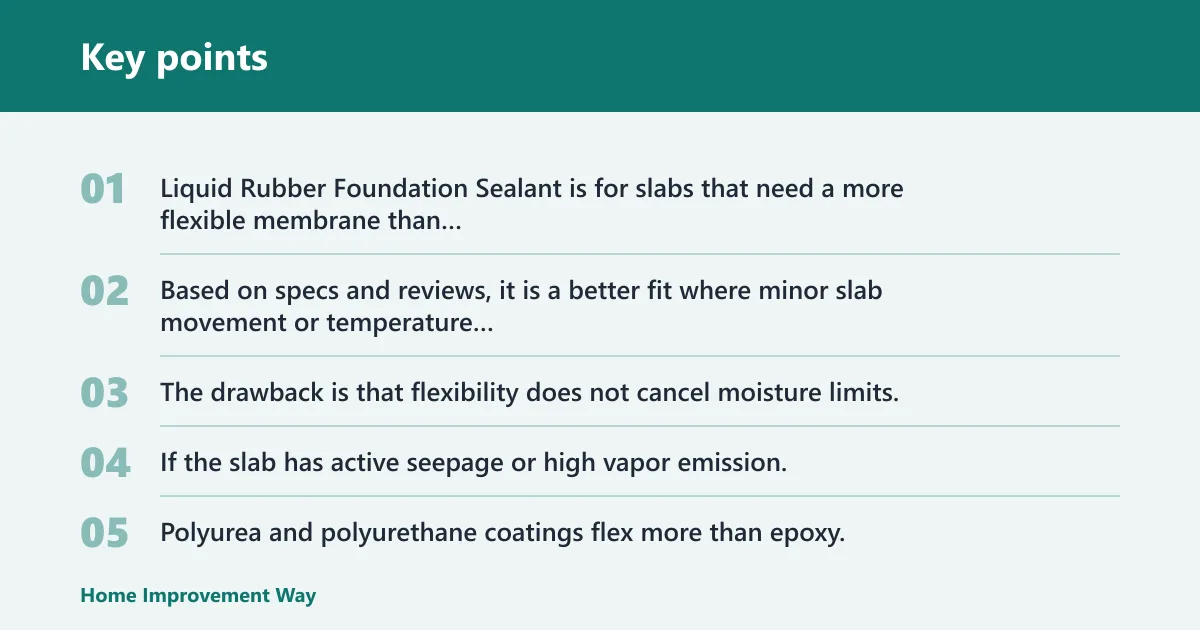
Liquid Rubber Foundation Sealant is for slabs that need a more flexible membrane than epoxy can offer. Based on specs and reviews, it is a better fit where minor slab movement or temperature change is part of the problem, because flexibility helps resist cracking and loss of adhesion.
The drawback is that flexibility does not cancel moisture limits. If the slab has active seepage or high vapor emission, even a flexible coating can still fail unless the concrete is properly prepared and the moisture condition is acceptable.
Why flexibility matters on basement slabs
Polyurea and polyurethane coatings flex more than epoxy, so they tolerate minor movement better. That matters on basement slabs that expand, contract, or show small shifts at control joints and hairline cracks. For a slab with minor heaving, a flexible coating can be a smarter choice than a rigid one.
Moisture limits you still need to respect
Flexible does not mean waterproof against every condition. If the slab is pushing water, the coating still needs a compatible moisture profile and proper surface prep. If moisture vapor pressure is high, the system can trap vapor and fail from below even if the top surface looks intact for a while.
Best use cases versus epoxy
Choose polyurethane or polyurea over epoxy when the slab is sound but shows minor movement, or when you want a sealed floor system with more crack tolerance. Choose epoxy when the slab is dry, stable, and you want a harder finish. Both need moisture testing before installation.
Moisture vapor barrier with floating floor: best for damp slabs
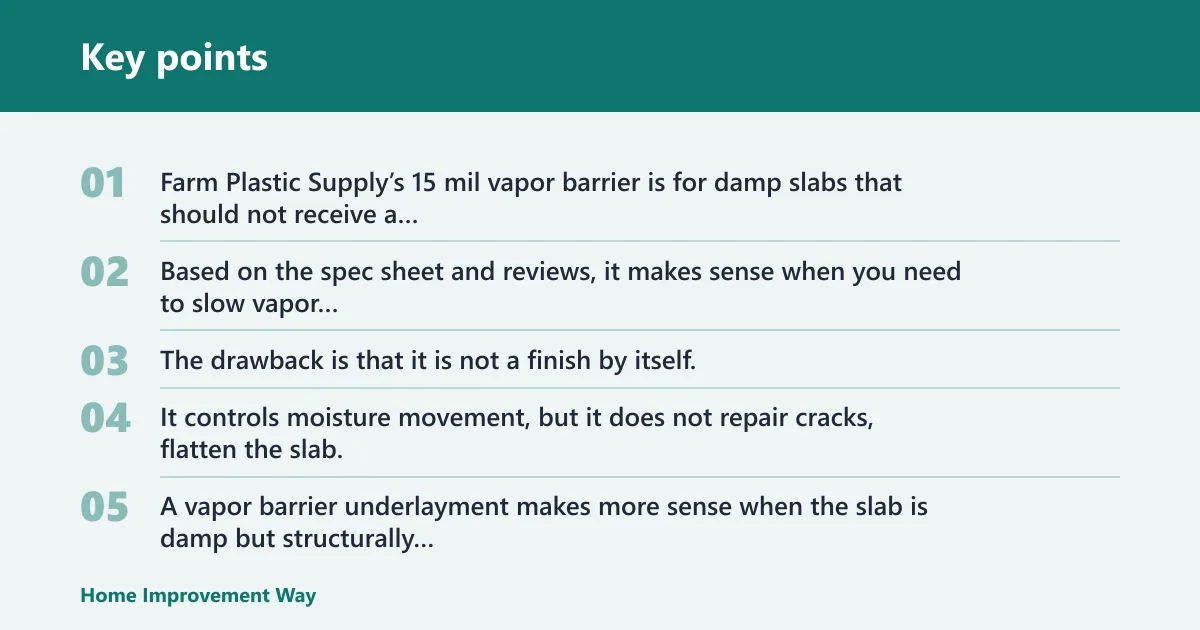
Farm Plastic Supply’s 15 mil vapor barrier is for damp slabs that should not receive a direct-bond coating. Based on the spec sheet and reviews, it makes sense when you need to slow vapor migration and create a buffer under a floating floor or underlayment.
The drawback is that it is not a finish by itself. It controls moisture movement, but it does not repair cracks, flatten the slab, or stop active water intrusion from below.
When a vapor barrier underlayment makes more sense
A vapor barrier underlayment makes more sense when the slab is damp but structurally stable. It is often paired with a floating floor system, especially when the finish layer should not bond directly to concrete. That separation helps avoid coating failures caused by ongoing vapor emission.
How floating floors manage moisture risk
A floating floor system sits above the slab and is not fastened directly to the concrete in the way a coating is. That helps it move with small changes below and limits direct bond failure. The moisture-control layer below it must still match the slab’s test results.
Say your basement is 400 square feet and the slab shows no visible leaks, but a plastic-sheet test fogs up overnight. That is a vapor problem, not a flooring problem. A floating system over a proper vapor barrier is safer than coating over concrete that still emits too much moisture.
Common mistakes that trap moisture
Do not trap moisture under foam, underlayment, or a floating floor without a vapor layer. Do not apply a coating over a slab that fails moisture testing. Do not assume a surface sealer stops moisture from below; many sealers reduce dust or staining, but they do not solve vapor transmission through the slab.
Self-leveling underlayment: best for uneven slabs
ARDEX TL 2000 is for slabs that need flatness correction before the finish layer goes down. Based on the spec sheet and reviews, it is a strong choice when the slab is uneven but otherwise suitable for a floor system that requires a flatter surface.
The drawback is that self-leveling underlayment is not a moisture fix by itself. It still needs primer, correct mixing, and curing per spec, and it can be moisture sensitive if the slab is not ready.
Why flatness comes first
Uneven slabs create stress points under coatings, tile, and floating floors. If you can feel ridges, dips, or patch transitions, fix the geometry before you think about the final floor. Otherwise, the finish telegraphs every defect and can fail at the weak spots.
Primer and cure requirements
Most self-leveling products need the right primer to bond properly and reduce pinholes or premature drying. Cure time matters too. Rushing the next layer traps moisture, weakens bond strength, and can create failures under vinyl, tile, or a coating system.
When leveling is the wrong first step
If the slab has active seepage, solve the water problem first. Leveling compound can bridge minor defects, but it will not stop water from entering the concrete. Use moisture control and repair work before flattening if the slab is wet, leaking, or visibly deteriorating.
Concrete basement slab basics
A concrete basement slab is a below-grade substrate, so it can move moisture from soil even when no puddles are visible. That is why moisture testing is the required first step before coatings, membranes, underlayments, or floating floors. Cracks and control joints should be addressed before finish work starts.
The key point is simple: vapor and liquid water are not the same problem. Vapor can cause slow bond failure, while liquid water intrusion can overwhelm coatings, bubble membranes, and damage the finish layer above the slab.
Moisture testing before sealing
Relative humidity testing and calcium chloride testing are common ways to judge slab readiness. The test result matters because epoxy, underlayment, and floating floor systems all have compatibility limits. A slab that looks dry can still emit enough moisture to break the bond later.
- Inspect for visible seepage, staining, efflorescence, and soft spots.
- Test moisture with relative humidity or calcium chloride methods.
- Repair cracks and joints with the right filler or injection method.
- Flatten uneven areas with primer and self-leveling underlayment if needed.
- Choose the finish only after the slab condition is clear.
Slab-condition decision table: which system fits which problem?
| Slab condition | Safest waterproofing approach | Required prep | Avoid this mistake |
|---|---|---|---|
| Damp vapor only | Moisture vapor barrier with floating floor or vapor-tolerant system | Moisture test first; clean slab; confirm no active leaks | Direct-bond epoxy over untested concrete |
| Hairline cracks | Epoxy injection for dormant cracks or polyurethane filler for slight movement | Open, clean, and repair the crack before coating or finish work | Covering cracks and hoping the finish hides them |
| Active seepage | Drainage or structural moisture control before finish materials | Find the source of water entry; do not rely on a surface coat alone | Sealing over water that is still moving through the slab |
| Minor heaving | Polyurea or polyurethane coating after movement is understood | Check for ongoing movement; repair and prep the surface carefully | Using a rigid coating that cannot handle movement |
| Uneven slab | Self-leveling underlayment, then the chosen finish system | Prime correctly, level the low spots, let it cure per spec | Installing tile, vinyl, or coating over dips and ridges |
Which one should you buy
If your slab is dry and sound, start with an epoxy coating. If it is damp but not leaking, use a vapor barrier and a floating floor system instead of a direct-bond finish. If it is cracked, moving, or uneven, repair and flatten the slab first, then choose the finish.
If flooding has happened before, do not treat the finish layer as the fix. A finish can be replaced; a moisture problem cannot be painted away. Picture a 12-by-20-foot basement room with recurring damp corners after rain. That room needs moisture control and slab diagnosis before any decorative layer.
For a damp basement slab, what flooring works best depends on the layer below it. SPC luxury vinyl plank is listed as 100% waterproof, porcelain tile is listed as 100% waterproof, and rubber flooring is listed as 100% waterproof. Those finishes still need a moisture strategy below them if the slab emits vapor.
Do not default to carpet tiles, water-resistant laminate, or engineered hardwood when the slab is questionable. Water-resistant laminate is only 70% waterproof and surface-only, engineered hardwood survives about 24 hours of standing water, and carpet tiles provide only 50 percent waterproofing from the backing side.
Cold concrete is uncomfortable, and radiant heat can help if the slab system and finish allow it. Polished concrete is described as 95% sealed, but sealing is not the same as full vapor control. Choose the system for the slab condition first, then the finish layer.
Frequently asked questions
Can you waterproof a basement slab from the inside?
You can control vapor and seal the surface from the inside, but interior-only systems have limits. They can work on dry or mildly damp slabs, yet they cannot cure active seepage or groundwater pressure by themselves. If water is moving through the slab, address the source before choosing a finish system.
Is epoxy a good waterproofing option for basement concrete?
Epoxy is a good option only when the slab is sound, dry, and properly prepped. It gives a clean, sealed surface and works well on concrete that has passed moisture testing. It is not a universal answer, and it can peel or blister if vapor emission is too high.
Do I need to test moisture before sealing a basement floor?
Yes. Moisture testing is the required first step before sealing a basement floor. Relative humidity testing or calcium chloride testing helps show whether a coating, underlayment, or floating floor will stay bonded. A slab can look dry and still release enough vapor to cause failure later.
What flooring works best over a damp basement slab?
Over a damp slab, a floating floor over a proper vapor barrier is usually safer than a direct-bond coating. The finish layer should be chosen only after the moisture-control layer is in place. SPC luxury vinyl plank, porcelain tile, and rubber flooring can work well if the slab is properly isolated.
How do I stop vapor coming through a concrete basement slab?
You stop vapor with a system, not a single coat. Use moisture testing first, then choose a vapor barrier, sealed underlayment, or compatible coating based on the reading. If the slab is damp but stable, a floating floor over a vapor barrier often controls risk better than a direct coating.
What basement floor waterproofing lasts longest after flooding?
After flooding, the longest-lasting solution is usually the one that fixes moisture at the source rather than covering it. Drainage correction, drying, and slab repair come before the finish. Once the slab is stable, a system matched to the moisture level will last longer than any surface-only product over wet concrete.
Sponsored / affiliate links. As an Amazon Associate I earn from qualifying purchases. I may earn additional commission from eligible campaigns.