Best Paint Finish for Crown Molding: Satin, Semi-Gloss, or Gloss?
Choose satin for older or uneven crown molding, semi-gloss for most rooms and average trim, and gloss only for very smooth molding in bright, formal spaces. Pick the wrong sheen, and flaws, dust, and brush marks stand out fast. This guide shows how room use, light, and molding condition should steer your choice.
Best sheen for crown molding
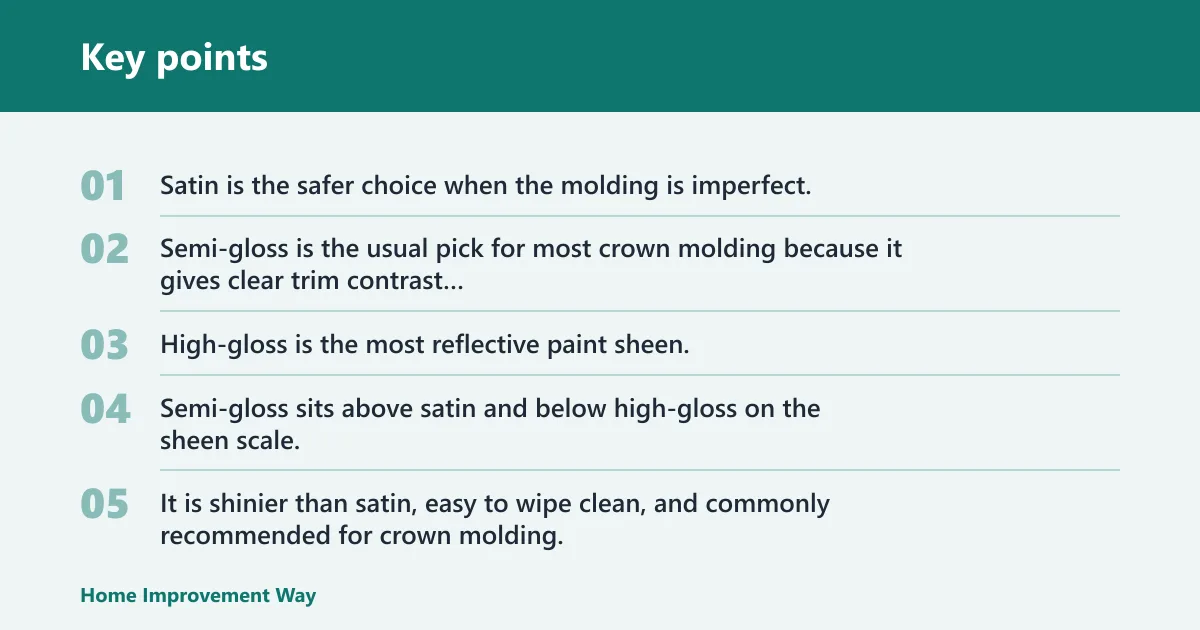


Satin is the safer choice when the molding is imperfect. Semi-gloss is the usual pick for most crown molding because it gives clear trim contrast and handles cleaning well. High-gloss is the most reflective paint sheen, but it belongs on carefully prepared statement trim, not on rough or patched surfaces.
When semi-gloss is the default
Semi-gloss sits above satin and below high-gloss on the sheen scale, so it gives crown molding enough shine to read as trim without turning every flaw into a feature. It is shinier than satin, easy to wipe clean, and commonly recommended for crown molding, baseboards, and window trim.
It also fits the usual job of crown molding: define the ceiling line, catch light, and separate wall from ceiling without looking harsh. That is why semi-gloss fits architectural trim while still staying practical in occupied rooms.
When satin looks better
Satin has a soft, low-sheen look with a gentle glow. It is less shiny than semi-gloss and more forgiving on brush marks, so it often looks better on older crown molding, patch-repaired trim, or rooms that do not need a hard reflective line at the ceiling.
Use satin when you want subtle trim rather than high contrast. It works well in living spaces and other rooms where the molding should feel finished, not flashy.
Crown molding decision table
This table gives the practical rule: match sheen to surface quality, light, and room use. A better sheen can hide less; the right sheen for the substrate often wins.
| Room condition | Recommended sheen | Why it wins | Do not use |
|---|---|---|---|
| Flawless new trim | High-gloss or semi-gloss | Very smooth molding can handle stronger reflection, and gloss creates a crisp, formal edge. | Brush marks, dust nibs, flashing |
| Older trim with patching | Satin | Lower reflectivity hides seam repair, caulk lines, and minor surface variation better than semi-gloss. | Obvious repair seams, lap marks |
| Humid rooms and high-traffic spaces | Semi-gloss | It is more resistant to moisture and easier to wipe clean, which suits kitchens, bathrooms, and busy hallways. | Moisture stains, frequent scrubbing wear |
| Low-ceiling rooms | Satin | Less glare keeps the ceiling edge from feeling harder or lower than it already is. | Hot reflections, glaring brush strokes |
| Bright rooms with lots of daylight | Satin or carefully applied semi-gloss | Strong daylight can expose dust nibs and lap marks, so a softer sheen is often more forgiving. | Flashing, roller stipple, dust nibs |
| Historical or design-led rooms | High-gloss or satin, depending on style | Gloss suits formal statement trim; satin works when the room calls for restraint and lower contrast. | Heavy brush marks, visible patching |
Satin vs semi-gloss vs gloss
Satin gives the softest look of the three. Semi-gloss reflects more light and usually reads as the safer trim finish. High-gloss is the most reflective, so it creates the strongest visual separation but also exposes the most flaws.
Reflectivity and visual impact
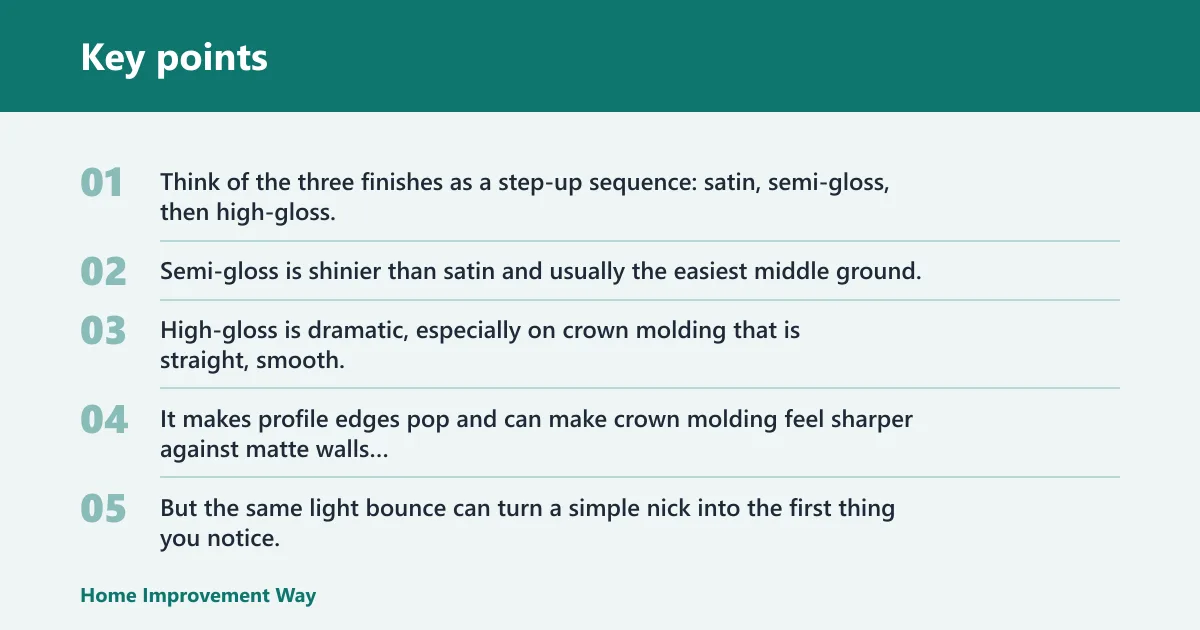
Think of the three finishes as a step-up sequence: satin, semi-gloss, then high-gloss. The same source gives subtle shine. Semi-gloss is shinier than satin and usually the easiest middle ground. High-gloss is dramatic, especially on crown molding that is straight, smooth, and fully prepped.
That extra reflection can be useful. It makes profile edges pop and can make crown molding feel sharper against matte walls or ceilings. But the same light bounce can turn a simple nick into the first thing you notice.
Cleanability and moisture resistance
Semi-gloss is more resistant to moisture and easier to wipe clean than satin, which is why it is recommended for steamy bathrooms and other damp areas. That practical edge matters in kitchens too, where grease film can settle near the ceiling line.
Satin still cleans reasonably well, but it does not erase scuffs as easily as a higher sheen. High-gloss cleans well too, yet it only stays attractive when the surface prep is excellent and touch-ups are controlled.
What each sheen reveals on the surface
High-gloss reveals imperfections most clearly. That includes brush marks, flashing, dust nibs, and patch edges. Semi-gloss also shows those defects, but usually less aggressively. Satin is the most forgiving of the three for crown molding with small substrate problems.
Suppose a 12-foot dining room has patched corner joints and one caulk line that still telegraphs through the finish. Satin will soften that seam far better than semi-gloss. If the same molding were sanded glass-smooth and primed correctly, semi-gloss could look cleaner and more deliberate.
Which sheen fits each room?
The best room choice depends on moisture, traffic, and the look you want the ceiling line to create. Semi-gloss is the usual all-around answer, satin is the softer option, and gloss is the special-case finish for very smooth trim in formal rooms.
Kitchens and bathrooms
Semi-gloss is the most practical choice here. It is recommended for steamy bathrooms, and the same logic fits kitchens where humidity, splatter, and cleaning matter. A mildew-resistant latex, acrylic latex, or water-based enamel finish is often the better match in these rooms.
If the molding is a newer install with tight joints and clean caulk lines, semi-gloss gives a bright, washable finish. If the trim is older or patched near a vent or shower wall, satin may look calmer and hide repairs better.
Living rooms and bedrooms
Satin often looks best in calmer spaces, especially when crown molding is meant to read as part of the room rather than a hard architectural stripe. It is a softer choice for living rooms and can suit bedrooms where lower contrast feels more relaxed.
Semi-gloss still works well if the room has crisp trim, taller ceilings, or a more traditional look. Use gloss only when the molding is exceptionally smooth and the room design calls for a stronger statement.
Hallways and staircases
Hallways and staircases see more scuffs and hand contact, so semi-gloss is usually the sensible balance of appearance and cleanability. It stands up well to repeated wiping and helps the trim stay visible in passage areas with mixed light.
If the space is narrow, with close walls and a low ceiling, satin can reduce glare and make the trim line feel less hard. The choice depends on whether you want sharper definition or a softer edge.
How light changes the finish
Lighting changes how crown molding reads. Strong daylight can increase glare and reveal defects, while dimmer rooms can mute shine and make very flat finishes disappear into the ceiling line. Ceiling height also changes the result.
Bright daylight and glare
Rooms with large windows, skylights, or strong side light can make semi-gloss and gloss feel more intense. That is not always bad, but it does mean every lap mark, dust nib, and uneven touch-up has a better chance of showing.
In bright rooms, satin often gives the best balance. It still separates the molding from the wall, yet it avoids the hard shine that can make small flaws look bigger than they are.
Low ceilings and shadow lines
Low ceilings usually benefit from a less reflective crown finish. Satin softens the transition between wall and ceiling, which can keep the room from feeling chopped up by a bright trim line.
That does not mean semi-gloss is wrong. It means the sheen should respond to the room height. A bright ceiling edge in a compact room can feel busier than the same finish in a taller space.
Upper walls, windows, and trim contrast
Where crown molding sits near tall windows or direct sun, semi-gloss and gloss demand better prep. The more contrast the room has, the more every flaw stands out. Lower-contrast spaces tolerate satin more easily.
Picture a south-facing family room with white walls, a 9-foot ceiling, and new polyurethane crown molding. Semi-gloss can look sharp there. Put the same sheen on an old plaster crown with patched nail holes, and the repairs may jump out.
Material and prep

Crown molding material changes both adhesion and how much sheen you can safely use. Wood, MDF, and polyurethane do not behave the same way, especially at cut edges and joints. Prep decides whether the finish looks smooth or noisy.
Wood versus MDF versus polyurethane
Wood takes paint well, but grain, knots, and joint movement can telegraph through the finish if you skip priming and sanding. MDF has a smooth face, but its cut edges absorb moisture and need careful sealing before topcoat. Polyurethane is dimensionally stable, yet it still needs cleaning and proper primer for reliable adhesion.
For MDF crown molding, satin or semi-gloss usually makes the most sense. High-gloss is possible, but only if the substrate is sealed, sanded, and fully smooth. On wood, semi-gloss is forgiving enough for most rooms. On polyurethane, the surface can support a more polished look if the prep is thorough.
Sanding and priming before topcoat
- Sand the molding smooth, including joints, caulk lines, and repaired spots.
- Prime bare wood, MDF cut edges, and patched areas so the topcoat absorbs evenly.
- Feather repair edges so flashing does not show after the sheen dries.
- Use a brush with a fine edge or a sprayer for trim work, and keep a wet edge to reduce lap marks.
- Check touch-up readiness in raking light before you call the job done.
Prep matters more as sheen rises. Satin is forgiving. Semi-gloss needs more care. High-gloss demands the smoothest substrate and the cleanest application you can manage.
Brush marks, flashing, and touch-up control
Brush marks show more clearly as sheen increases, especially on long crown profiles. Flashing happens when a patched or unevenly primed area reflects light differently from the rest of the trim. Dust nibs and roller stipple become more visible on glossy finishes too.
A common first-timer mistake is choosing high-gloss because it looks polished in the paint store, then applying it over rough caulk and sanding scratches. The finish does exactly what it is supposed to do: it reflects everything.
Should trim match the walls?
Crown molding usually should not disappear into the wall unless the design is deliberately low-contrast. In most rooms, the trim finish should stand apart from flat walls and ceilings so the molding reads as a clean line. That difference can come from color, sheen, or both.
Matching trim to wall color
You can match the color and still separate the surfaces with sheen. For example, a wall color in eggshell or matte with crown molding in satin or semi-gloss will still give you a visible edge. That works well when you want calm walls and defined trim.
Flat or eggshell on crown molding is usually a poor choice for most homes. It tends to look too dull on trim and gives up the clean edge that crown molding is meant to provide.
Keeping crown molding distinct from the ceiling
Ceilings are commonly flatter than trim, so crown molding needs enough sheen to read as a transition. Semi-gloss is the standard way to do that. Satin can also work when you want the molding to stay present but less assertive.
When a lower-contrast look works
Lower-contrast crown molding can look right in modern interiors, especially when the room already has strong shapes, pale walls, or limited natural light. In those spaces, satin often beats semi-gloss because it adds definition without making the trim the loudest feature.
That is one reason satin is not a compromise finish. On the right molding and in the right room, it is the better design choice.
Frequently asked questions
Should crown molding be satin or semi-gloss?
For crown molding, semi-gloss is often used because it balances visibility, wipeability, and trim definition. Satin is the better choice when the molding is older, patched, or in a room where lower contrast looks cleaner. The condition of the trim should decide the sheen, not a universal rule.
Is gloss too shiny for crown molding?
Gloss is often too shiny unless the molding is very smooth and the room design calls for a bold finish. High-gloss is the most reflective paint sheen, so it shows brush marks, dust nibs, and seam repair more clearly than satin or semi-gloss. It suits statement trim, not casual repairs.
What sheen is best for crown molding in kitchens and bathrooms?
Semi-gloss is usually the best fit for kitchens and bathrooms because it is more resistant to moisture and easier to wipe clean. It also suits steamy conditions better than satin. If the trim has patching or uneven joints, satin may still be the better visual choice, but not the most washable one.
Does satin hide imperfections better than semi-gloss on trim?
Yes. Satin hides imperfections better than semi-gloss because it reflects less light and is more forgiving on brush marks, flashing, and small repair seams. That makes it a strong choice for older crown molding. Semi-gloss gives sharper trim contrast, but it also reveals more of the surface underneath.
What paint finish works best on MDF crown molding?
MDF crown molding usually does well with satin or semi-gloss, provided the cut edges are sealed and the substrate is primed smoothly. MDF is sensitive at exposed edges, so prep matters more than on solid wood. High-gloss can work, but only on a very smooth, fully sealed surface.
How do lighting and ceiling height affect crown molding sheen choice?
Bright daylight and low ceilings both push you toward a softer sheen. Strong light makes flaws and glare easier to see, while low ceilings can feel harsher with too much reflection. Satin often works best in those conditions. Semi-gloss fits taller or darker rooms where stronger trim definition helps.
Sponsored / affiliate links. As an Amazon Associate I earn from qualifying purchases. I may earn additional commission from eligible campaigns.