Best Crown Molding for Bathrooms (2026): We Compared
Use PVC for shower-adjacent ceilings, primed finger-jointed wood or PVC for powder rooms, and moisture-tolerant primed wood or PVC with 100% acrylic paint for standard baths. Pick the wrong material or joint detail, and crown can swell, open at seams, crack at corners, or peel where humidity and washdown hit hardest. This guide breaks down the best crown molding, paint system, and joint treatment by bathroom zone and failure risk.
Quick comparison
| Product | Badge | Best for | Price | ||
|---|---|---|---|---|---|
 |
Creative Crown Engel LED Foam Molding Kit, 48 Ft 3.5in,Austin Crown Molding | Our pick | 48 ft · 3.5 in · Classic profile | $169.96
Price as of 15 Oct 2026
|
View |
 |
Art3d High Impact Crown Molding Trim for Ceiling, 10-Pack,Art3d | Budget pick | 2.5 in · 10-pack · White | $49.99
Price as of 15 Oct 2026
|
View |
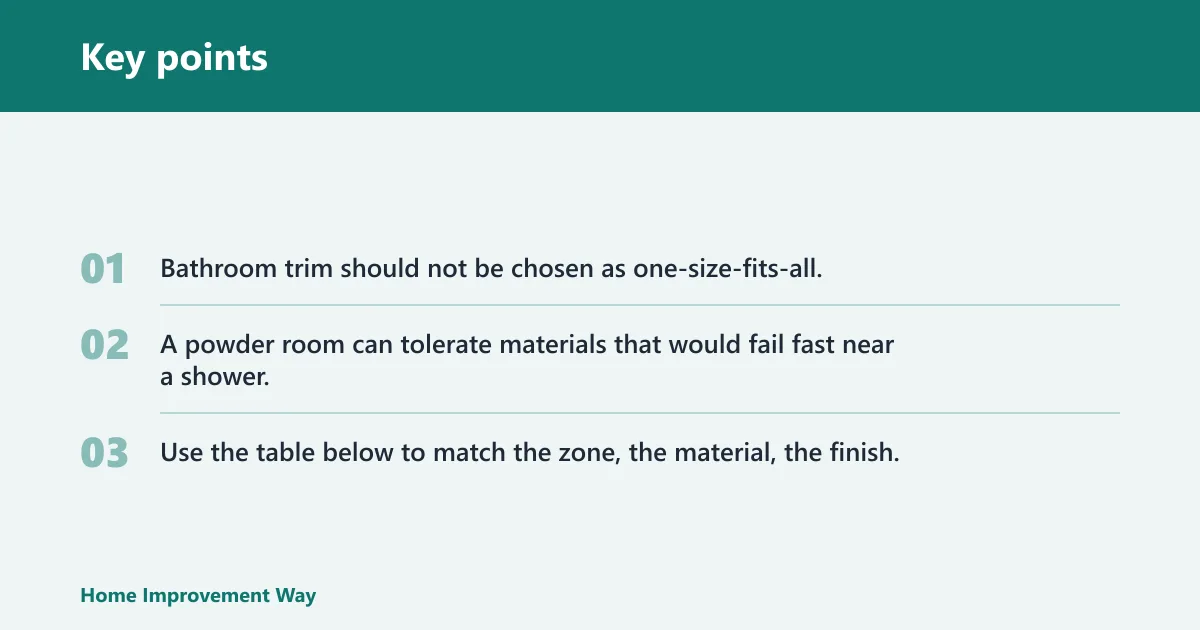
Bathroom trim should not be chosen as one-size-fits-all. A powder room can tolerate materials that would fail fast near a shower, while a bath with weak ventilation needs the most moisture-proof option you can justify.
Use the table below to match the zone, the material, the finish, and the joint treatment to the actual exposure level.
| Bathroom zone | Recommended material | Paint sheen | Caulk type | Ventilation threshold | Do-not-use warnings |
|---|---|---|---|---|---|
| Powder room | Solid wood, moisture-resistant MDF, or PVC | Satin or semi-gloss | Paintable wet-area caulk at top and bottom edges | No shower; normal room ventilation is usually enough | Do not assume unprimed wood is safe; do not use flat paint |
| Standard full bath | Cellular PVC or polyurethane; moisture-resistant MDF only if ventilation is strong | Semi-gloss preferred | Paintable wet-area caulk rated for wet areas | At least 1 CFM per square foot of floor area | Do not use standard latex caulk; avoid untreated wood near the tub zone |
| Shower/tub-adjacent zone | Cellular PVC | Semi-gloss | Paintable wet-area caulk, mildew-resistant | At least 1 CFM per square foot, with the fan run during use and after | Do not use MDF or solid wood; avoid standard wood filler in exposed seams |
| Poorly ventilated bath | Cellular PVC | Semi-gloss | Paintable wet-area caulk rated for wet areas | Fan should meet at least 1 CFM per square foot; 80 CFM gives margin in many baths | Do not use MDF, standard wood, or matte paint; skip crown if humidity stays high |
How we chose
The main filters are exposure, ventilation, movement, and finish compatibility. Bathroom crown can look fine for months and still fail at seams if the substrate sees daily humidity swings or direct splash.
Baths can swing from dry to steamy several times a day. That makes expansion, paint adhesion, and caulk choice as important as the profile itself.
Material cost matters, but failure risk matters more. A cheaper trim that swells or peels near a shower costs more after the repair.
Simple installability also counts. Some products cut and fasten like wood, while others are better suited to adhesive-only installs or ornate profiles where weight is a concern.
Cellular PVC crown molding: best for wet bathrooms
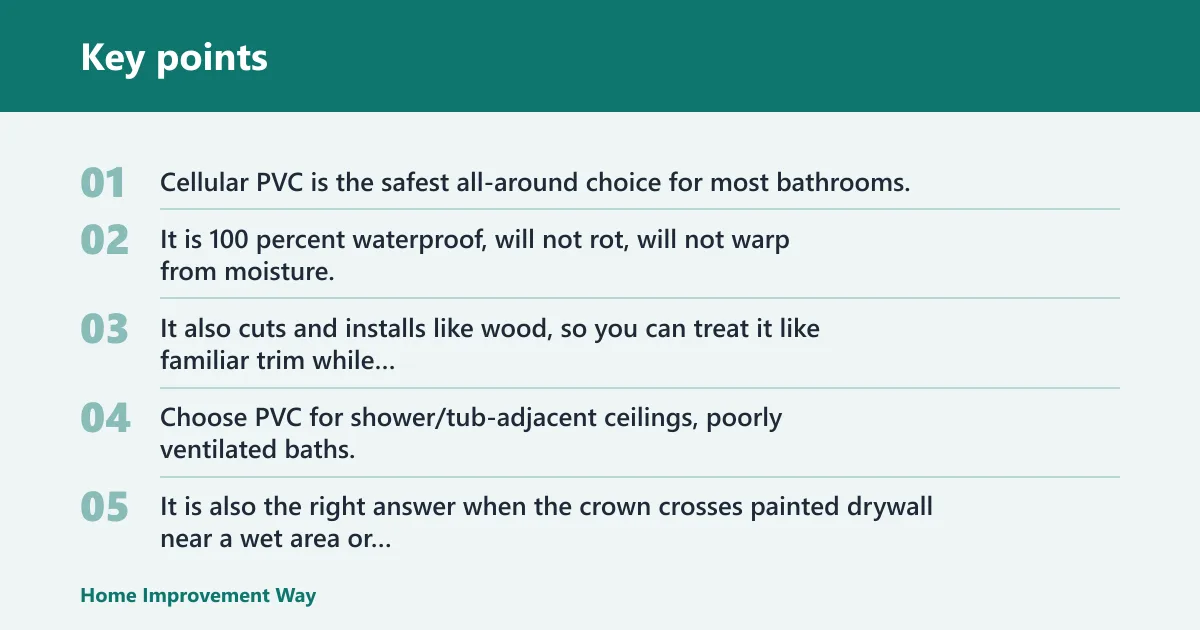
Cellular PVC is the safest all-around choice for most bathrooms, especially shower-adjacent ceilings and rooms with weak ventilation. It is 100 percent waterproof, will not rot, will not warp from moisture, and will not grow mildew.
It also cuts and installs like wood, so you can treat it like familiar trim while getting better moisture resistance. Typical cost is $2 to $5 per linear foot.
Best uses by bathroom zone
Choose PVC for shower/tub-adjacent ceilings, poorly ventilated baths, and any location where humidity lingers after use. It is also the right answer when the crown crosses painted drywall near a wet area or transitions to tile where caulk movement is likely.
In a standard full bath, PVC is still the conservative pick if you want the least maintenance. In a powder room, it may be more material than you need.
Cutting, fastening, and finishing notes
PVC takes paint well, but it still needs a bathroom-safe finish. Use satin or semi-gloss paint, then seal the top and bottom edges with paintable wet-area caulk rated for mildew resistance.
Keep expansion gaps modest and consistent at long runs, especially where trim meets tile or plaster. Fasten into framing where possible, and do not rely on adhesive alone for long spans in active wet zones.
Picture a 5-by-8 bath with a tub and a fan that barely clears steam. PVC keeps the crown from swelling at the joint line when the ceiling repeats that dry-to-humid cycle every day.
Polyurethane crown molding: best for ornate profiles
Polyurethane makes sense when you want a more decorative profile without the weight penalty of wood. It is lightweight, waterproof, comes pre-primed, and works well for ornate shapes that are harder to mill in moisture-proof wood alternatives.
Typical cost is $3 to $8 per linear foot. The tradeoff is that it is better for appearance and ease than for rough handling or exposed structural contact.
When lightweight trim makes sense
Polyurethane suits standard full baths and powder rooms where the profile matters and the room still sees normal bathroom humidity. It can also work above a vanity wall when you want a deeper look without adding much load.
Because it comes pre-primed, the finish process is straightforward. Use satin or semi-gloss paint, and seal joints with a paintable wet-area caulk at the perimeter.
Where it fits and where it does not
Do not make polyurethane your first choice for direct splash zones or areas that stay damp after every shower. It resists water, but the real failure point in many bathrooms is the joint system, not the core material.
If the bath has poor fan performance, PVC still offers more margin. Polyurethane is best when the profile is ornate and the room is damp, not wet.
Moisture-resistant MDF crown molding: best for dry, well-vented baths
Moisture-resistant MDF is acceptable only in powder rooms or baths with strong ventilation. Prime all six sides, seal every cut, and keep it away from shower spray, tub splash, and chronic condensation.
Typical cost is $1.50 to $4 per linear foot. That lower price comes with stricter prep and a narrower use zone.
When MDF is acceptable
Use moisture-resistant MDF in a powder room, a half bath, or a full bath that has strong fan performance and no direct wet exposure at the crown line. It is a reasonable budget choice when the room dries quickly after use.
A fan should meet at least 1 CFM per square foot of floor area. A 50-square-foot bath needs at least 50 CFM, and 80 CFM gives margin in many rooms.
Prime-all-sides and cut-edge sealing
MDF fails at exposed edges first. Prime every side before installation, then reseal every cut, miter, cope, and nail hole so the substrate does not drink in moisture.
Use paintable wet-area caulk at the top and bottom edges, not standard latex. If the bath stays steamy for long periods, choose PVC instead.
Say your 60-square-foot hall bath has a quiet fan and a tub that steams the ceiling twice a day. MDF can still fail at the cut line near the tile if the edges were not sealed perfectly.
Solid wood crown molding: best for powder rooms
Solid wood crown molding, such as poplar or pine, belongs only in low-moisture powder rooms with no shower nearby. It must be fully primed and painted, and it should stay out of tub surrounds, shower ceilings, and any zone that gets repeated direct moisture.
Wood can work well when the room is dry and the trim is protected. In the wrong zone, it swells, opens at the seams, and can peel where moisture lingers.
Poplar vs. pine in low-moisture rooms
Poplar is a common choice when you want a smoother, more uniform paint surface. Pine is widely available and can be economical, but knots and grain telegraph more easily through paint if prep is rushed.
Either way, the paint system matters. Prime fully, topcoat with satin or semi-gloss, and use paintable wet-area caulk at the seams.
Why wood should stay out of wet zones
Wood near a shower or tub transition is exposed to repeated humidity swings and occasional splash. That movement is what opens joints and cracks paint, especially where the crown meets painted drywall or plaster.
If the ceiling line meets tile, give the joint room to move and avoid tight, brittle filler. A flexible wet-area caulk handles that movement better than a hard, standard trim caulk.
Which one should you buy?
Start with moisture risk, then budget. If the crown will sit above a shower or in a bath that fogs up every day, buy cellular PVC. If the room is dry and decorative detail matters, polyurethane is a strong second choice. For a powder room, moisture-resistant MDF or solid wood can be fine if the room is truly low-moisture.
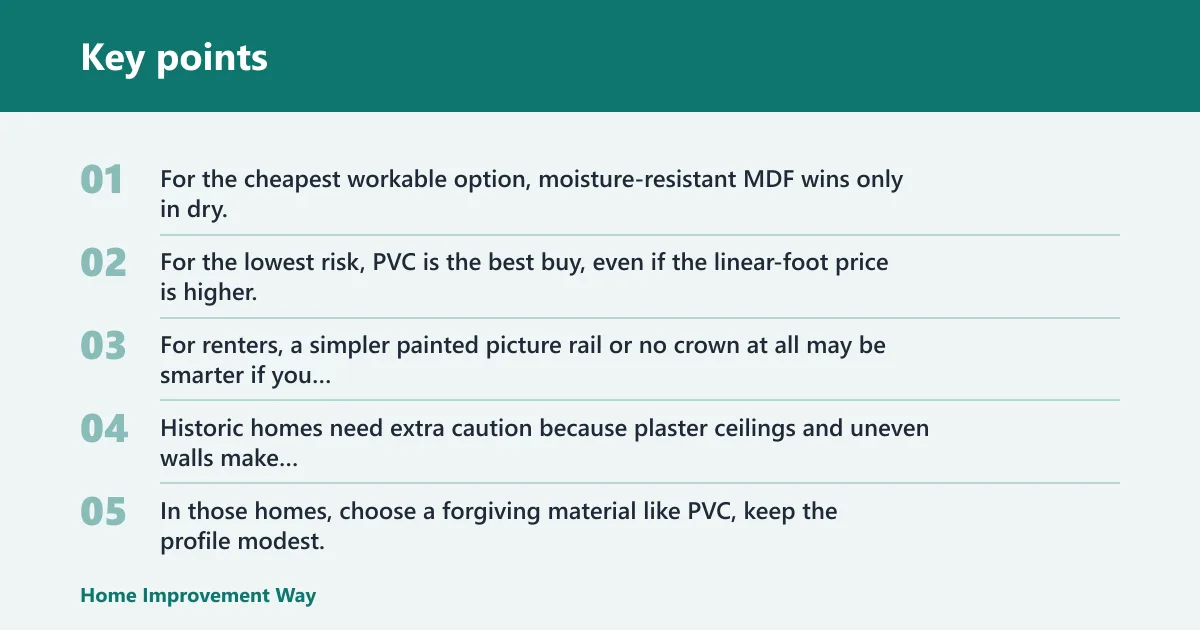
For the cheapest workable option, moisture-resistant MDF wins only in dry, well-vented rooms. For the lowest risk, PVC is the best buy, even if the linear-foot price is higher. For renters, a simpler painted picture rail or no crown at all may be smarter if you cannot control the ventilation or modify the trim substrate.
Historic homes need extra caution because plaster ceilings and uneven walls make movement more visible. In those homes, choose a forgiving material like PVC, keep the profile modest, and allow a clean caulk line instead of forcing tight joints into irregular corners.
Bathroom crown size should also match the ceiling. For 8-foot ceilings, crown should be 3.5 to 5 inches across the face. For 9- to 10-foot ceilings, 5 to 7 inches across the face usually reads better.
Picture a small bath with 8-foot ceilings, a tile tub surround, and a fan that runs only when someone remembers it. That is a PVC situation, or a situation for simpler wall-to-ceiling trim if the humidity never settles down.
Best pick by budget
If budget is the main issue and the room is dry, moisture-resistant MDF is the lowest-cost option. If you can spend more for fewer failures, PVC is the safer long-term buy.
Best pick by humidity risk
For shower-adjacent ceilings and poorly ventilated baths, cellular PVC is the direct answer. Polyurethane is acceptable when the bath is only moderately damp and the profile calls for a lighter decorative material.
Best pick for renters and historic homes
Renters should choose the least invasive option allowed by the space, and historic homes should favor materials that tolerate movement. If ventilation is poor and the ceiling is hard to access, skip crown and use a simpler painted ceiling edge or a narrower trim line.
Bathroom crown molding installation basics
Start by checking where the trim will touch drywall, plaster, or tile. Those transitions are the usual failure points, and they need small, controlled gaps that stay flexible rather than hard-packed.
Find framing, fasten into studs where possible, and use a consistent fastener pattern so the crown stays tight without being overstressed. On long runs, leave room for movement instead of forcing the ends hard into every corner.
Inside corners vs outside corners
Coping is preferred for inside corners because it survives seasonal movement better than miters. A miter may look fine on day one, but a tiny change in humidity can open the seam.
Outside corners are usually mitered, but the joint still needs careful fastening and finish work. If the corner sits near a shower or tub, use the most moisture-proof material you can justify.
Paint and caulk sequence
- Prime bare wood, MDF, or cut edges before installation.
- Fasten the crown and check for open seams at corners.
- Apply paintable wet-area caulk at the top and bottom edges.
- Let the caulk cure fully before topcoating.
- Finish with satin or semi-gloss paint for wipe-clean durability.
Do not use standard latex caulk in wet areas. It is the wrong product for a bathroom crown joint that needs movement and mildew resistance.
Do not treat ventilation as optional. If the fan is undersized or rarely used, even a good material can fail at the finish line.
Frequently asked questions
What is the best crown molding material for a bathroom?
Cellular PVC is the best overall choice for most bathrooms because it is 100 percent waterproof and resists rot, warping, and mildew. It is the safest pick for shower-adjacent ceilings and poorly ventilated baths, where wood and MDF are most likely to fail.
Can you use MDF crown molding in a bathroom?
Yes, but only in powder rooms or well-vented baths with no direct wet exposure at the crown line. Prime all six sides, seal every cut, and use paintable wet-area caulk. Do not use MDF over a tub or near a shower ceiling.
Is PVC crown molding good for bathrooms?
Yes. PVC is one of the best bathroom materials because it is waterproof, cuts and installs like wood, and takes paint well. It is especially useful where humidity spikes or where crown meets tile, drywall, or plaster that moves with seasonal changes.
How do you keep crown molding from warping in a bathroom?
Choose a moisture-proof material, size the fan correctly, and seal all joints. A fan should provide at least 1 CFM per square foot of floor area, and it should run during showers and for 20 minutes after. Use flexible wet-area caulk, not standard latex.
What size crown molding works in a bathroom with 8-foot ceilings?
For 8-foot ceilings, crown should usually be 3.5 to 5 inches across the face. That range looks proportionate without crowding the ceiling line. In a small bath, staying near the lower end often keeps the room from feeling top-heavy.
Do you need special caulk for bathroom crown molding?
Yes. Use paintable wet-area caulk that is mildew-resistant and rated for wet areas. Apply it at the top and bottom edges of the crown. Standard latex caulk is not the right choice where humidity stays high or where splash is possible.
Should crown molding be installed above a shower or tub?
Only if you use cellular PVC or another moisture-proof material and the room has proper ventilation. Even then, the joint details matter. Avoid solid wood and MDF above showers or tubs, because direct moisture and steam are the fastest route to seam failure.
What paint finish is best for bathroom crown molding?
Satin or semi-gloss is best because both resist moisture and wipe clean more easily than flat paint. Semi-gloss is the traditional trim sheen. In a bathroom, it also gives you a little more protection when condensation hits the ceiling line.
Sponsored / affiliate links. As an Amazon Associate I earn from qualifying purchases. I may earn additional commission from eligible campaigns.