Best Crown Molding for Kitchens (2026): We Compared
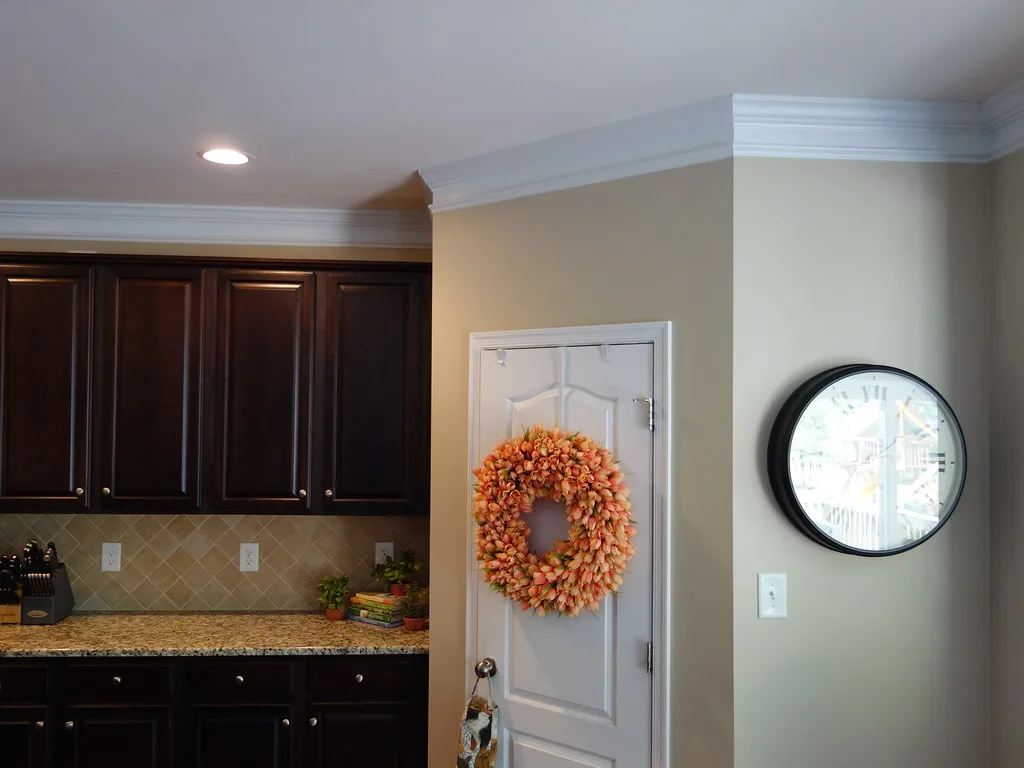
A simple cove or ogee crown is commonly used for 8-foot kitchen ceilings, a medium profile for 9-foot ceilings, and a flat cap is often preferred when cabinet tops sit about 1 inch from the ceiling or when strong under-cabinet lighting is present. Too much profile on short cabinets throws heavy shadows and makes the run look crowded. This guide matches crown profile to cabinet style, ceiling gap, and kitchen light so you can pick the right look without guesswork.
Quick comparison
| Product | Badge | Best for | Price | ||
|---|---|---|---|---|---|
 |
Crown Molding – Polyurethane Crown Moulding ManufactureduDecor | Our pick | 3" breadth · 47 ft · Polyurethane | $125.99
Price as of 17 Oct 2026
|
View |
 |
Creative Crown Foam Molding | 560 Linear Ft of 3.5" EngelAustin Crown Molding | Budget pick | 3.5" height · Bulk · Foam | $1,459.95
Price as of 17 Oct 2026
|
View |
A practical first step is to measure the cabinet-to-ceiling gap, then check cabinet style and lighting. In kitchens, light changes how the crown reads, so the same profile can look quiet in one room and heavy in another.
How we chose
This guide weighs four things: ceiling height, cabinet height, gap above the uppers, and how the profile behaves under daylight or task lighting. It also considers fastening difficulty, repaintability, and whether a profile looks balanced on framed or frameless boxes.
That matters because upper cabinets often stop near 8 feet, leaving a gap that crown, a frieze, or nothing must fill. On 9- or 10-foot ceilings, the leftover space above cabinets must be addressed with trim choices, and the wrong profile can look oversized fast.
uDecor polyurethane crown: best for a simple built-up look
This is a good fit if you want a lightweight crown that cuts cleanly and can bridge a modest gap without a lot of fuss. Based on the published product details, uDecor’s polyurethane profile suits painted kitchens, especially when you want a built-up look without the labor of a multi-piece assembly.
The main limitation is visual depth. A 3" breadth can read small on tall ceilings or over 42-inch uppers, so it is best when the cabinet run needs definition rather than a large closing piece. It also gives you less shadow relief than a stacked build, which can matter in bright kitchens.
Austin Crown Molding foam crown: best for long LED-lit runs
This is the stronger pick when you need a long, uniform run and want a profile that works near indirect LED lighting. Based on the manufacturer’s published details, the flat back and foam body should make mitering and long installs easier, especially in larger kitchens where repeatable cuts matter.
The drawback is that foam is less traditional in look and feel than wood or polyurethane, and the 560 linear feet bulk box is far more material than many DIY kitchen projects need. It is also a better visual match for simple lines than for ornate cabinet work.
Kitchen crown selector table
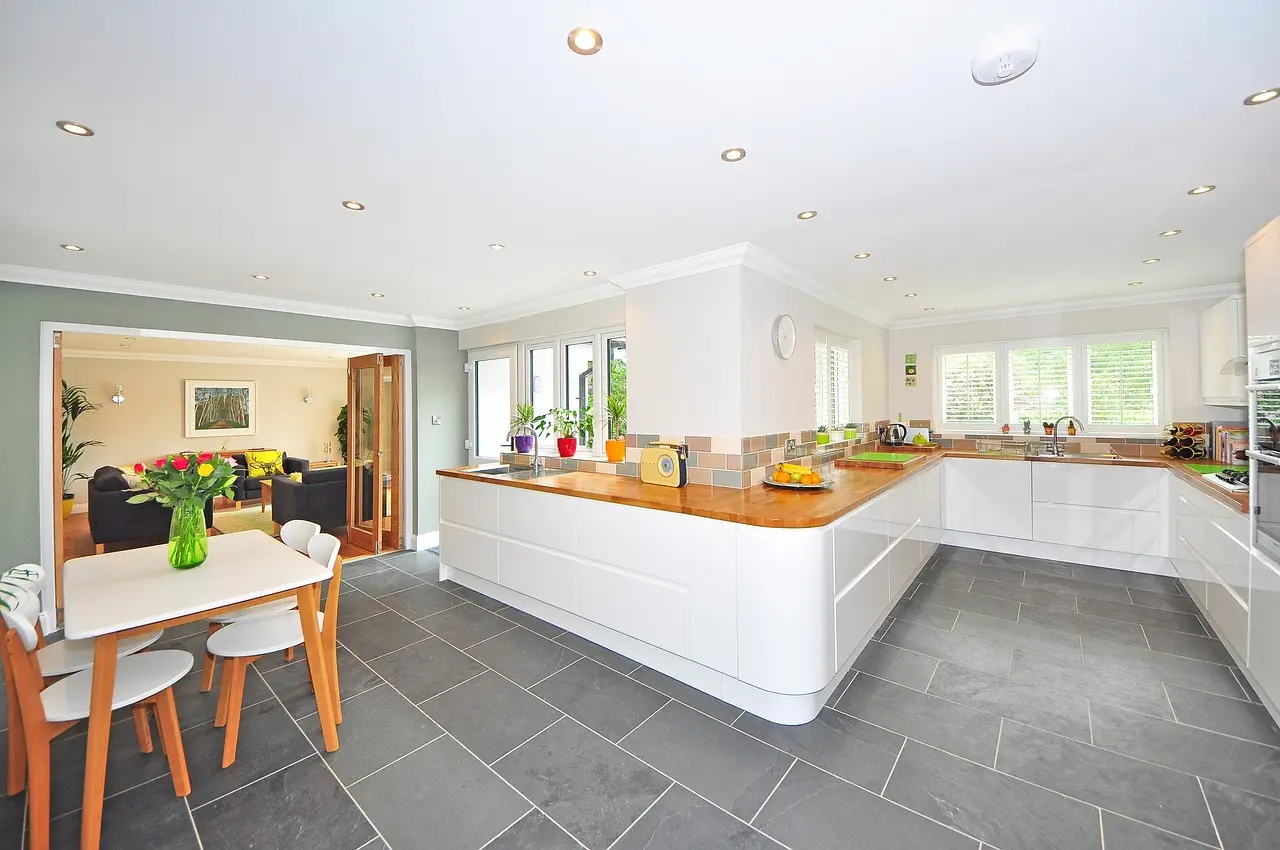
Use this table to match the crown to the room, not just the door style. Measure the cabinet-to-ceiling gap, then check how much light hits the top edge and whether the cabinet line already feels busy. The same molding can look right at 8 feet and wrong at 9 feet.
| Ceiling height | Cabinet height | Gap above cabinets | Cabinet style | Recommended profile | Risk notes | Too heavy / too ornate warning |
|---|---|---|---|---|---|---|
| 8-foot | 30-inch | Up to 12 inches | Modern or frameless | Flat crown or no crown | Keep the edge slim so daylight and task lighting do not create a dark band. | A stacked, ogee, or dentil profile can look crowded and top-heavy. |
| 8-foot | 36-inch | 6 inches | Shaker | Cove or stepped crown | Good proportion for a small gap; painted to match the doors if you want a built-in look. | Large ogee or dentil detail is usually too busy at this scale. |
| 9-foot | 30-inch | 18 inches | Traditional or custom | Stacked crown | Use a built-up face to close the gap; a single piece often looks underfilled. | A single thin cap may disappear, while oversized ornament can make the run feel heavy. |
| 9-foot | 36-inch | 12 inches | Shaker or transitional | Stepped or cove crown | Good balance when you want trim visible but not dominant. | Dentil blocks add labor and can look fussy in a compact kitchen. |
| 10-foot | 42-inch | Up to 18 inches | Traditional | Stacked crown or ogee | Best when the upper run needs a larger visual bridge to the ceiling. | Too little profile leaves a floating look; too much detail can crowd soffits or lighting. |
| Any height | Frameless box | Varies | Modern or transitional | Flat cap with blocking or a riser | Fastening must be planned before purchase because the box has no face frame for direct attachment. | Heavy profiles without backing can fail at the joint line or telegraph caulk seams. |
What each column means
The ceiling and cabinet height set the overall scale. The gap tells you whether the crown is closing a small visual line or spanning a real open zone. Cabinet style helps you decide whether the profile should disappear, tie into the door design, or become part of the room’s trim vocabulary.
Rules for choosing flat, cove, stepped, or stacked crown
- Choose flat crown when the cabinet tops are close to the ceiling, when the kitchen is modern, or when bright daylight makes shadows look harsher.
- Choose cove crown when you want one clean curve, especially with shaker cabinets or classic painted finishes.
- Choose stepped crown when cabinet depths or heights change, because the tiers can follow the layout instead of forcing one rigid line.
- Choose stacked crown when the gap is large, the ceiling is 9 or 10 feet, or a single piece would look thin and unfinished.
Warning signs for profiles that are too heavy or too ornate
If the kitchen has short uppers, a low ceiling, or strong under-cabinet lights, ornate profiles read darker and more dominant. Ogee and dentil details can also look out of scale on narrow runs or in kitchens where every inch of wall space is already busy with tile, vents, and appliance trim.
A common first-timer mistake is buying crown before checking the actual gap above the uppers. Suppose you have 30-inch cabinets on a 96-inch ceiling: the leftover space is 12 inches, which is big enough that a tiny cap can look accidental and a heavy dentil can look overbuilt.
Stacked crown: best for tall kitchen gaps
Stacked crown is the top pick for many kitchens because it closes awkward spaces better than a one-piece profile. It uses two or more moldings into one built-up face, and the two-piece version is often described as a flat cap over a crown, which helps bridge taller gaps above the cabinets.
Why this is the top pick for many kitchens
When the cabinet run sits below a 9- or 10-foot ceiling, the leftover space must be addressed somehow. Stacked crown gives you enough visual mass to finish the transition without making the run look like a thin strip floating under the ceiling.
It is especially useful above 36-inch or 42-inch uppers, where a single piece may not fill the height cleanly. If the kitchen has mixed cabinet depths or a soffit break, the layered face can also hide small changes better than a one-piece trim.
Where stacked crown can look too heavy
It can overpower short cabinets, low ceilings, and small kitchens with a lot of upper wall clutter. Under bright daylight, deep layers also cast stronger shadows, so the profile can read darker and more prominent than expected.
Installation time is higher than with a flat cap. More pieces mean more miter work, more caulk lines, and more chances for a joint to show after paint dries.
Flat crown: best for modern kitchens
Flat crown is a straight band or slim cap with square or lightly eased edges. It is the best fit when you want the trim to stay quiet, especially in contemporary kitchens where strong lines and minimal shadow line matter more than decorative detail.
Best cabinet pairings
Flat crown works best on modern cabinets and on frameless boxes with proper backing. It also pairs well with painted runs where the goal is to finish the top edge without drawing attention away from hardware, backsplash, or lighting.
If the cabinet tops sit within 1 inch of the ceiling, flat crown is often enough. In that situation, a larger profile can look forced because there is not enough room for the shadow pattern to settle naturally.
When a simple cap is enough
Use a simple cap when under-cabinet lighting is strong, when daylight washes the kitchen in from more than one direction, or when you want the trim to disappear into the cabinet color. The lighter visual line keeps the top of the run from feeling boxed in.
Flat profiles also make repainting easier because they have fewer edges for grease and dust to collect. That matters in kitchens, where maintenance often matters more than ornament.
Cove crown: best for shaker cabinets
Cove crown is a single piece with one concave curve. It reads clean in kitchens because the curve is simple, and it often feels right with shaker cabinets, painted cabinet finishes, and smaller rooms where a fussy profile would look crowded.
Why the curve reads clean in kitchens
The smooth curve gives the eye a clear stopping point without adding too many steps. For shaker doors, that matches the simple door style and avoids fighting the flat center panel and squared rails.
Shaker cabinets usually pair with stepped or cove crown, painted to match the doors. That keeps the top treatment tied to the cabinet rather than making the ceiling line feel separate.
How lighting changes the shadow line
Daylight and under-cabinet lighting change how cove crown reads. A curved profile makes a softer shadow than dentil or ogee detail, so it tends to look calmer under bright task lights and less bulky in smaller kitchens.
Say your kitchen has a 6-inch gap above 36-inch uppers on an 8-foot ceiling. A cove profile can close that space without throwing a hard dark band across the wall, which is useful when the room already has strong under-cabinet LEDs.
Stepped crown: best for mixed cabinet heights
Stepped crown rises in tiers and follows the cabinet layout instead of running as one line. It is the best choice when cabinet heights change, when a custom kitchen has uneven transitions, or when you need the trim to resolve more than one height at once.
When tiered profiles solve alignment problems
Stepped profiles make sense above mixed runs, such as a fridge surround beside shorter uppers or a pantry stack that breaks the line. The tiered face can bridge those changes more cleanly than a single rigid molding.
It also helps when the cabinet-to-ceiling gap varies across the room. Instead of forcing every section to look identical, the stepped build can follow the layout and keep the top line from looking accidental.
Cost and fitting considerations
Stepped crown usually takes more layout time than a flat or cove piece. Each tier has to land in the right place, which means more cutting, more checking, and more caulk at the joints.
That extra labor can be worth it when the kitchen layout is irregular. Still, in a very small kitchen, the profile may look busier than it needs to if the upper run is already visually dense.
Should crown match cabinets or ceiling height?
Match the cabinet style first when the gap is small, and let ceiling height lead when the gap is large. A short gap above the uppers calls for a profile that stays quiet. A larger gap needs enough visual weight to close the space so the cabinets do not look stranded below the ceiling.
Prioritize cabinet style when the gap is small
If the gap is 1 to 6 inches, the crown should behave like a finish detail, not a major feature. That is why modern runs usually do better with flat cap, while shaker cabinets often look best with cove or stepped profiles that echo the door language.
For framed painted cabinetry, matching the crown color to the doors is usually the safer move. It reduces the chance that the trim line will break up a compact wall run.
Prioritize ceiling height when the gap is large
When the ceiling climbs to 9 or 10 feet, the crown has to solve the distance above the cabinets. That is where stacked crown becomes useful because the built-up face gives the eye a clear transition instead of leaving a blank expanse.
Picture a 96-inch ceiling with 30-inch uppers. The leftover space is 12 inches, and that is enough room for a crown treatment to matter visually. In that kind of layout, ceiling height should guide the scale more than door style alone.
Can you use crown on frameless cabinets?
Yes, but not the same way you would on a framed box. Frameless cabinets need blocking or a riser before any crown goes up, because there is no face frame to accept the fastening the way a framed cabinet does.
Why blocking or a riser is needed
Blocking gives you a solid attachment point, and a riser can create the extra face height needed for the molding. Without that support, the crown has little to bite into, which makes movement and visible joints more likely after installation.
Flat or simple profiles are usually easier to support on frameless cabinets than ornate ones. Heavier profiles add more load and more stress at the fastener line, so planning the backing matters before you buy the trim.
Fastening options to plan for before you buy
- Check whether the cabinet top is solid enough for screws or if you need added blocking.
- Decide whether a riser is needed to lift the molding into the right visual position.
- Match the crown profile to the available attachment depth, not only to the door style.
- Plan for caulk-visible seams at the ceiling and repaint them after install.
Which one should you buy?
Start with the gap, then choose the simplest profile that solves it cleanly. If the budget is tight and the kitchen is modern, flat crown is the safest buy. If the kitchen is shaker or transitional, cove or stepped crown usually gives the best balance of appearance and labor.
Best choice by budget and layout
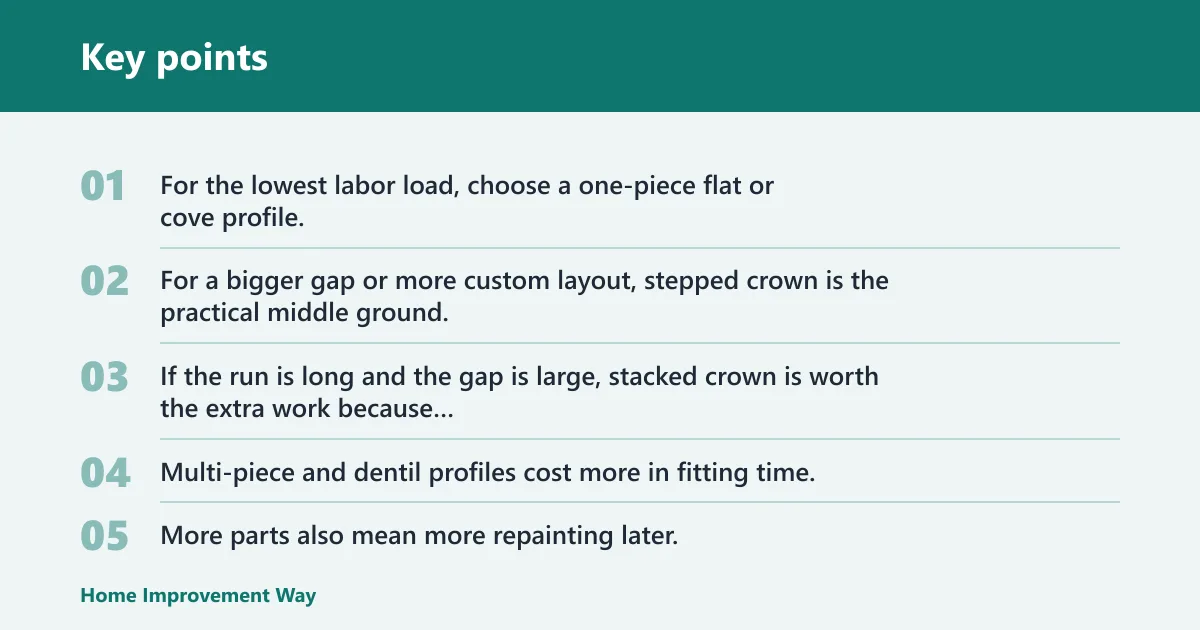
For the lowest labor load, choose a one-piece flat or cove profile. For a bigger gap or more custom layout, stepped crown is the practical middle ground. If the run is long and the gap is large, stacked crown is worth the extra work because it finishes the top edge more convincingly.
Multi-piece and dentil profiles cost more in fitting time, and that labor matters as much as the material. More parts also mean more repainting later, because every seam and caulk line shows grease and touch-up faster than a simple cap.
Best choice by ceiling height
On 8-foot ceilings, keep the profile simple unless the cabinet run has a substantial gap. On 9-foot ceilings, a medium profile often lands best. On 10-foot ceilings, stacked crown usually gives the cleanest proportion, especially above 36-inch or 42-inch uppers.
Best choice by cabinet style
For shaker cabinets, cove or stepped crown is the cleanest match. For modern cabinets, flat crown or no crown at all is the most restrained choice. For traditional kitchens, ogee or dentil detail fits the design vocabulary better, but only when the room is large enough to carry it.
A common first-timer mistake is choosing dentil because it looks detailed in the sample rack. In a small kitchen with 8-foot ceilings and bright LEDs, that same detail can look busy and hard to keep clean.
Best choice if you want the least maintenance
Choose the simplest profile you can live with. Flat and cove crowns are easier to repaint, easier to wipe down, and less likely to show caulk failures than a multi-piece built-up assembly. In kitchens, that matters because grease and steam collect on edges fast.
Frequently asked questions
What crown molding style works best in a kitchen?
The best kitchen crown depends on the cabinet-to-ceiling gap, not style alone. Flat works best for modern kitchens and tight spaces, cove suits shaker cabinets, stepped handles mixed heights, and stacked is the better answer when the gap is large enough to need a built-up face.
Should crown molding match kitchen cabinets or ceiling height?
Match the cabinets first when the gap is small, and let ceiling height drive the choice when the gap is large. If the upper run is close to the ceiling, a simple profile should stay quiet. If the ceiling is high, the crown needs enough body to close the distance.
How tall should kitchen cabinet crown molding be?
There is no single correct height, but the profile should fit the gap without looking compressed or overbuilt. A standard 96-inch ceiling with 36-inch uppers leaves 6 inches, while 30-inch uppers leave 12 inches. Those gaps point to very different trim scales.
Is stacked crown molding better for tall kitchen ceilings?
Yes, stacked crown is often the better choice above 9-foot ceilings or where the cabinet-to-ceiling gap is large. The built-up face fills visual space better than one thin piece, and it prevents the cabinets from looking undersized under a tall ceiling.
What crown molding works with shaker cabinets?
Shaker cabinets usually look best with cove or stepped crown, painted to match the doors. Those profiles echo the simple lines of the door style without adding too much visual noise. In smaller kitchens, cove is often the safer pick because it reads cleanly.
Can I use crown molding on frameless kitchen cabinets?
Yes, but you need blocking or a riser before installation. Frameless boxes do not have a face frame for the same fastening method used on framed cabinets. Plan that support first, or the crown may not hold well and the seams are more likely to show.
Sponsored / affiliate links. As an Amazon Associate I earn from qualifying purchases. I may earn additional commission from eligible campaigns.