How to Choose a Ceiling Light Fixture for Bedrooms
Choose a flush-mount or low-profile semi-flush light for 8-foot bedroom ceilings, and move to a deeper semi-flush or pendant only when ceiling height and headroom allow it. Pick the wrong fixture, and you can end up with glare, poor sleep lighting, or a light that feels too low or too dim for the room. This guide explains how to choose by ceiling height, room use, bedtime comfort, and wiring limits.
Bedroom ceiling light basics



A bedroom ceiling light does more than brighten the room. It changes how evenly light lands across the bed, whether closet doors cast shadows, and how calm the room feels at night. The best choice balances ceiling height, fixture spread, dimming, and how the room gets used.
In bedrooms, light spread matters as much as fixture style. A bare bulb or narrow beam can throw glare onto pillows. A fixture with a frosted lens or wider diffuser usually gives softer ambient light, while still leaving enough output for dressing and cleaning.
How bedroom use changes the choice
If the bedroom is mainly for sleep, a warm dimmable fixture with broad light spread usually fits best. If the room also functions as a dressing area, you need higher output and better whole-room coverage. For a child’s room, predictable dimming and low glare matter because bedtime lighting needs to drop fast and stay calm.
Say your bedroom has a reach-in closet on one wall and a queen bed centered under the fixture. A light that hangs too low may cast a hard shadow over the closet and hit the pillow area with direct glare. In that layout, a flush or shallow semi-flush fixture often works better than a pendant.
Common light distribution problems
Glare on pillows usually happens when the bulb is visible from bed or the shade opening points downward too sharply. Shadows over wardrobes happen when the fixture is too small, too dim, or placed off-center from the walking path. Oversized fixtures can also overpower small rooms and make the ceiling feel lower than it is.
Which fixture type fits your ceiling?
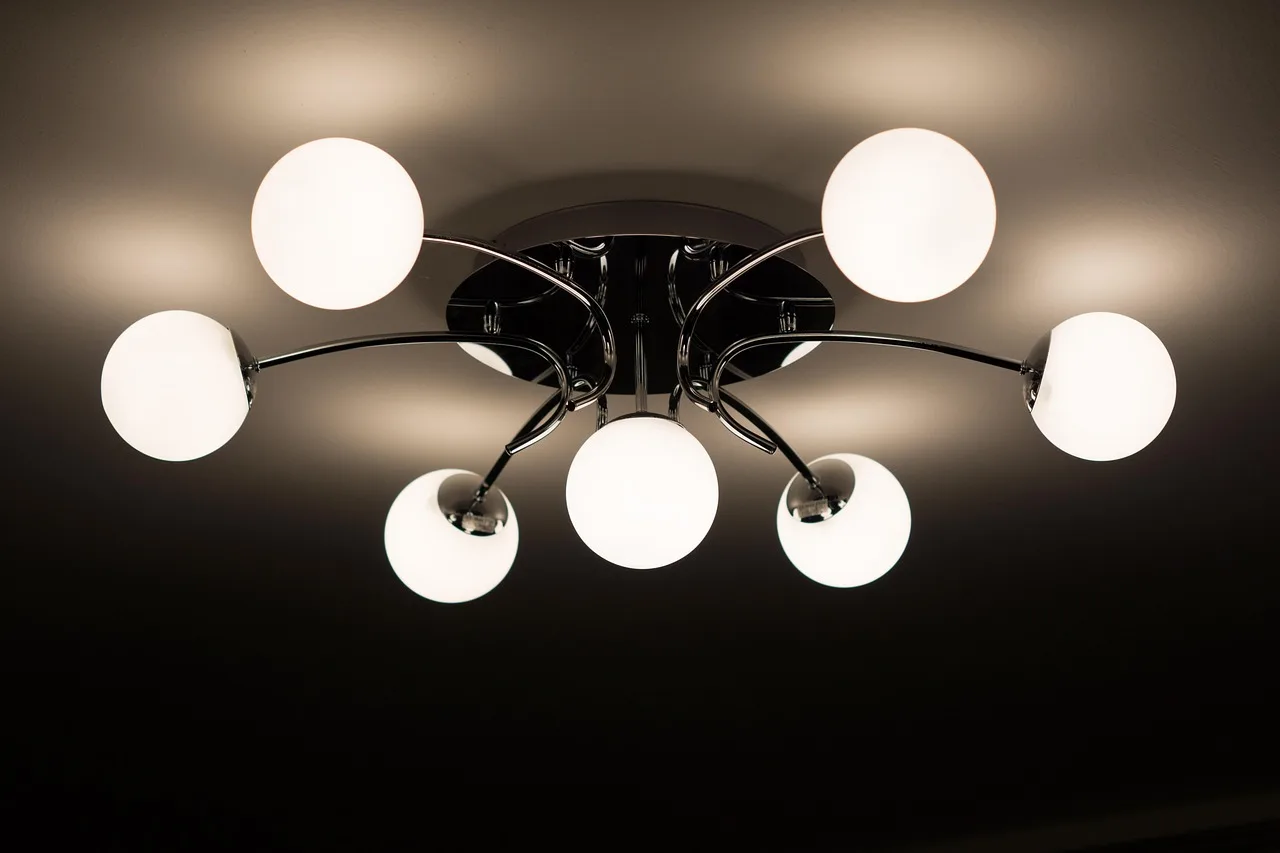
Ceiling height should usually narrow the fixture type first. Use flush mount for low ceilings, low-profile semi-flush for standard 8-foot rooms, and taller semi-flush or pendant styles only when you have enough clearance. If the room also needs air movement, a ceiling fan light kit may be the better fit.
Flush mount for low ceilings
Flush mount fixtures sit close to the ceiling and are the safest choice when headroom is limited. They help in 8-foot bedrooms, attic rooms, and spaces with sloped ceilings where a hanging fixture would feel crowded. Many low-profile flush mounts use LED panels or frosted lenses to spread light without lowering the ceiling line.
Semi-flush mount for standard rooms
Semi-flush fixtures drop a short distance below the ceiling, which can improve light spread without taking much headroom. They often suit standard bedrooms with 8-foot to 9-foot ceilings when you want a little more visual presence than a flush mount provides. Keep the drop shallow if the bed sits directly under the fixture.
Pendant and fan light options for taller rooms
Pendants fit best in taller bedrooms where the ceiling can handle extra drop and the light will not sit in the line of sight from bed. For rooms with vaulted or 10-foot-plus ceilings, a pendant can provide better scale and stronger visual balance. A ceiling fan light kit is worth considering when the room needs both light and air circulation.
How low can a hanging bedroom light hang above the floor?
A common clearance rule is to keep any hanging bedroom light at least 7 feet above the floor in normal walkways. If it hangs over the bed rather than a path, the fixture can sit lower, but it still should not block sightlines or create a head bump risk when making the bed.
Bedroom size and fixture scale
Fixture diameter should match room size so the light looks intentional instead of tiny or oversized. A small bedroom usually needs a compact fixture, while a primary bedroom can support a larger shade, wider diffuser, or more substantial semi-flush profile. Scale matters for both appearance and light spread.
How to judge diameter against room size
A simple rule of thumb is to add the room’s length and width in feet and use that number as the fixture diameter in inches. A 10-by-12-foot bedroom points to about a 22-inch fixture. For a smaller room, drop a few inches if the ceiling is low or the bed is close to the center point.
For bedrooms with compact layouts, a fixture that is too wide can feel heavy and reduce the sense of height. For a larger primary bedroom, a very small fixture can look undersized and leave the room feeling underlit, especially if there are dark furnishings or a large headboard.
What style of bedroom ceiling light looks best in a small room?
Small rooms usually look best with flush mounts or slim semi-flush fixtures in lighter finishes. A compact drum, frosted dome, or small flat panel keeps the ceiling line clean and reduces visual crowding. Avoid long drops, large cages, or oversized globes unless the ceiling is tall enough to support them.
How bright should a bedroom light be?
Bedroom brightness should match the room’s job. General ambient lighting usually needs moderate output, while dressing areas and reading corners need more. Dimmable control is important because the same room often needs bright light in the morning and much softer light before sleep.
Lumens for general lighting
For many bedrooms, about 1,000 to 2,000 lumens from the ceiling fixture is a practical starting range. Smaller bedrooms often work well closer to the low end, while larger primary bedrooms or rooms with dark finishes may need more. If the fixture is the only overhead light, lean higher within that range.
Dimmable output for bedtime control
Dimming matters because bedtime light should drop without losing all function. A dimmable fixture or dimmable bulb setup gives you room to read, get dressed, and then reduce output for sleep routines. For a child’s room, a smooth dimming range is useful for bedtime transitions and night checks.
Reading and dressing needs
Reading in bed needs controlled light that does not shine straight into the eyes. Dressing needs more even room coverage so colors and textures are easier to judge. If the ceiling fixture does not reach those tasks well, add bedside lamps or a closet light instead of oversizing the overhead fixture.
Bedroom light decision matrix
This matrix gives a simple rule set for choosing fixture type, brightness, and compatibility checks together. Use ceiling height first, then room size, then how the room is used. That order avoids choosing a fixture that fits the decor but fails on clearance or output.
| Ceiling height | Room size | Best fixture type | Suggested brightness | Compatibility checks |
|---|---|---|---|---|
| 8 feet | Small bedroom, about 10 x 10 ft | Flush mount | 1,000 to 1,500 lumens | Low-profile body, flush canopy, dimmer-ready source, no long drop |
| 8 feet | Primary bedroom, about 12 x 14 ft | Low-profile semi-flush | 1,500 to 2,000 lumens | Short drop, wide diffuser, centered over room, dimmer compatibility |
| 9 feet | Small to medium room | Semi-flush | 1,500 to 2,000 lumens | Check visual scale, shade width, and whether the fixture sits clear of door swings |
| 10 feet or more | Medium to large room | Deeper semi-flush or pendant | 1,800 to 2,500 lumens | Confirm hanging height, sloped ceiling adapter if needed, and support rating |
| Any height | Room needs air circulation too | Ceiling fan light kit | 1,500 to 2,500 lumens | Fan-rated box or listed support, wiring access, and compatible controls |
What bulb and dimmer setup should you choose?
Most bedrooms do best with warm white light in the 2700K to 3000K range. That color temperature usually feels calmer at night than cooler white light. After that, the next decision is bulb base and dimmer match, especially if you want to avoid flicker.
Warm white color temperature
Warm white in the 2700K to 3000K range gives a softer bedroom feel and is less likely to look harsh against bedding and painted walls. Cooler white can feel sharp at night and may make the room seem more alert than relaxed. For sleep routines, warmer light is the safer default.
LED compatibility and E26 bases
Many bedroom fixtures use standard E26 bases, which accept a wide range of LED bulbs. If you want flexibility, a replaceable bulb fixture is easier to service than an integrated LED fixture. Integrated LED units can look sleek, but when the light source fails, replacement usually means swapping the whole fixture or module.
Dimmer match and flicker risk
Use a dimmer that is labeled for the bulb or fixture type you choose. Some LED bulbs need an LED-compatible dimmer, and mismatched controls can cause flicker, limited dim range, or buzzing. If the bedroom needs very low light at night, check that the dimmer can go down smoothly without unstable output.
Installation checks before you buy
Before buying, confirm that the ceiling box is present, rated for the fixture’s weight, and compatible with the mounting hardware. Older bedrooms often need a closer check than newer ones, especially if you are replacing a fan, moving from a bare bulb, or adding a heavier fixture.
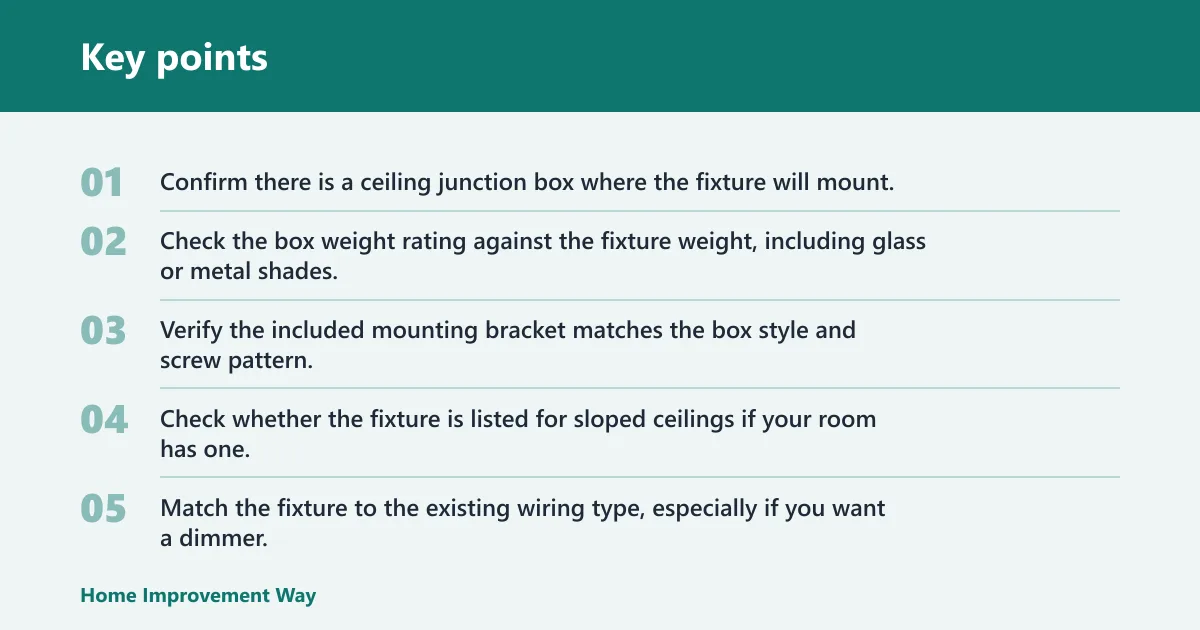
- Confirm there is a ceiling junction box where the fixture will mount.
- Check the box weight rating against the fixture weight, including glass or metal shades.
- Verify the included mounting bracket matches the box style and screw pattern.
- Check whether the fixture is listed for sloped ceilings if your room has one.
- Match the fixture to the existing wiring type, especially if you want a dimmer.
- For a ceiling fan light kit, verify the box and support are rated for fan loads, not just a light fixture.
Junction box and weight rating
A bedroom ceiling light should mount to an electrical junction box, not to drywall alone. The box must be rated to support the fixture’s weight. If the fixture is heavy, glass-heavy, or combined with a fan, the box rating becomes a primary safety check, not a detail.
Mounting hardware and support
Most fixtures include a mounting strap or bracket, but the hardware still has to match the box and the fixture pattern. Do not assume a previous fixture’s screws, crossbar, or canopy will fit the new one. If the old hardware is damaged, replace it instead of reusing it.
Sloped ceiling compatibility
Bedrooms with vaulted or sloped ceilings need a fixture that can hang plumb or use an adapter rated for angled mounting. Without that, the fixture may lean, cast uneven light, or look awkward from the bed. Pendants and some semi-flush models include slope hardware; many flush mounts do not need it.
Can I put a ceiling fan light in a bedroom instead of a fixture?
Yes, if the room needs both light and air circulation. A ceiling fan light kit can replace a standard fixture when the box and wiring support fan loads. The key checks are fan-rated support, compatible controls, and enough ceiling height so the fan blades and light stay clear and comfortable.
How do I choose a ceiling light fixture for a bedroom?
Start with ceiling height, then match the fixture to room size and how you use the bedroom. Low ceilings point to flush or very low semi-flush styles, standard rooms usually fit shallow semi-flush fixtures, and taller rooms can take pendants. Finish with warm dimmable light and a box that can support the weight.
Say your 11-by-12-foot bedroom has an 8-foot ceiling and you mainly use it for sleep. A low-profile flush mount with 1,200 to 1,500 lumens, 2700K light, and a dimmer gives enough general light without hanging into the room or throwing glare across the pillows.
How do I replace a bedroom ceiling light fixture?
Replacing a bedroom ceiling light starts with shutting off power at the breaker, removing the old fixture, checking the box, and wiring the new fixture to match hot, neutral, and ground connections. If the new light is heavier, a fan kit, or needs a different box type, the replacement can stop there until the support is corrected.
How to change light fixture in bedroom
Turn off the breaker, confirm the light is dead, remove the old canopy or shade, and loosen the wire connections. Install the new mounting bracket, connect matching wires, secure the fixture to the box, and test operation before reinstalling any decorative parts. If the box is loose, damaged, or not fan-rated for a fan light kit, stop and correct that first.
Frequently asked questions
What size light fixture do I need for my bedroom?
A common rule is to add the room’s length and width in feet to estimate fixture diameter in inches. A 10-by-12-foot room points to about a 22-inch fixture. If the ceiling is low or the room is compact, choose a slightly smaller diameter so the light does not feel crowded.
How bright should a bedroom ceiling light be?
Most bedrooms work well with about 1,000 to 2,000 lumens from the ceiling fixture, depending on room size and whether the light is the main source. Smaller rooms can sit near the low end. Larger rooms, or rooms used for dressing, often need more output or a second light source.
Should bedroom ceiling lights be warm or cool white?
Warm white is usually the better choice for bedrooms. A range of 2700K to 3000K gives a softer feel that is easier on the eyes at night. Cooler light can make the room feel more alert and can look harsh on bedding, walls, and skin tones.
Is a flush mount or semi-flush mount better for a bedroom?
Flush mount is better when headroom is limited or the ceiling is 8 feet. Semi-flush is better when you want a little more visual presence and better light spread, and the ceiling height allows a short drop. The right answer depends on clearance as much as style.
Sponsored / affiliate links. As an Amazon Associate I earn from qualifying purchases. I may earn additional commission from eligible campaigns.
 NUWATT 24 Pack 5/6 Inch Flush Mount Ceiling Light Disk LED Can Light Replacement, Connects to Junction Box or Recessed Lighting Socket, Dimmable 1100 LM Disc Lights, 3000K Warm White
 ASD 2 Inch Trimless LED Recessed Ceiling Light Fixture, Mud-in Canless Downlight with Junction Box, 5CCT Selectable 2700K-5000K, 8W 643 Lumens, CRI90+, Anti-Glare, Dimmable, IC & Wet Rated, ETL