Best Glue for Baseboard Repairs and Trim Touch-Ups
For most baseboard repairs, use paintable acrylic latex caulk for hairline gaps, construction adhesive for loose sections that need re-bonding, and wood glue with clamps for popped miters; choose caulk when the joint still moves slightly and needs a paint-ready finish. Pick the wrong adhesive and the repair can crack, telegraph through paint, or fail again as the trim shifts. This guide covers which glue fits each common baseboard fix, plus how to prep, apply, and paint the repair cleanly.
Top pick and quick picks
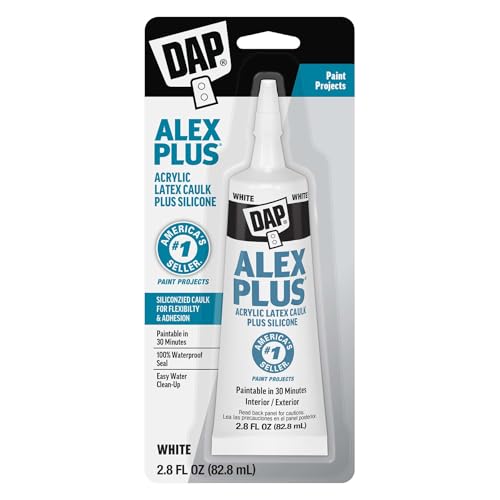


Top pick: paintable construction adhesive is the best all-purpose choice for most baseboard touch-ups because it bonds wood trim to drywall, plaster, concrete, tile, masonry, and brick, while still giving you a workable open time for realignment.
Quick picks
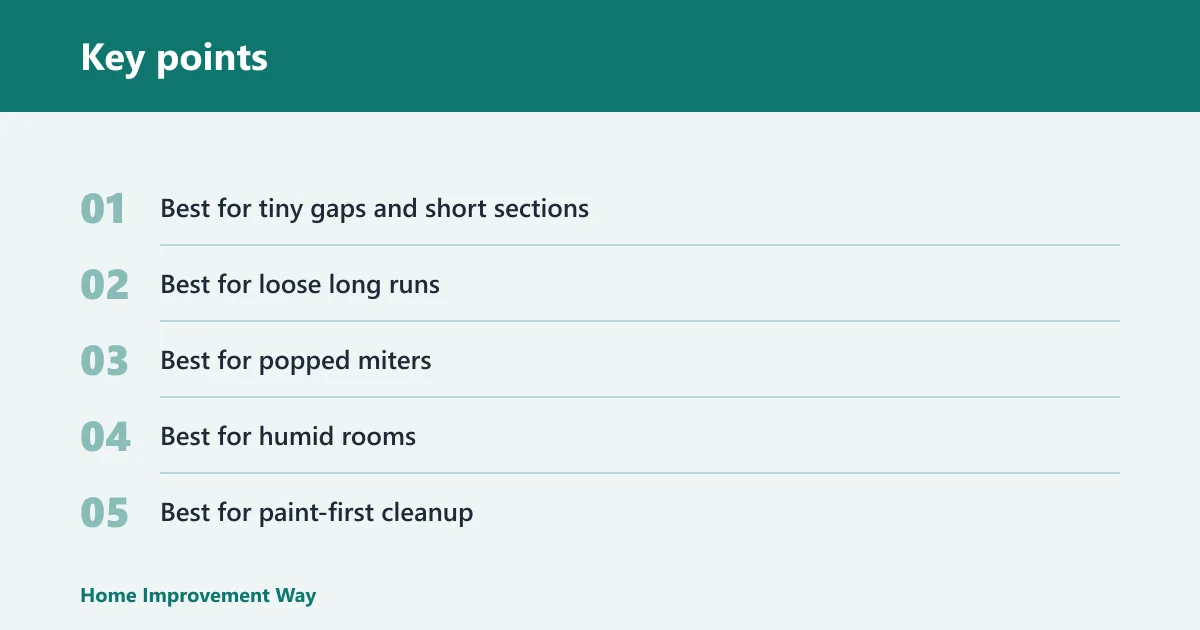
- Best for tiny gaps and short sections: cyanoacrylate gel. It fixtures very fast, stays put on vertical surfaces, and can bridge small voids at a miter or corner.
- Best for loose long runs: construction adhesive in a caulk-gun tube. It gives repositioning time and stronger re-bonding across longer baseboard sections.
- Best for popped miters: wood glue only when the joint is wood-to-wood and you can clamp it. For painted trim touch-ups, keep squeeze-out under control.
- Best for humid rooms: hybrid polymer or MS polymer adhesive. It stays flexible, has low odor, and tolerates seasonal movement better than brittle options.
- Best for paint-first cleanup: white or clear paintable construction adhesive, depending on whether the seam will be visible after touch-up.
Baseboard repair decision matrix
Match the adhesive to the failure mode, not just the trim material. A 2-inch corner gap needs a different approach from a 6-foot loose run, and a visible miter crack needs different cleanup than a hidden re-bond behind the baseboard.
| Loose section length | Substrate type | Visible seam risk | Recommended next step | Adhesive type | Working time | Cleanup risk | Clamping or brad nails needed? |
|---|---|---|---|---|---|---|---|
| Under 3 inches | Painted drywall or MDF | High | Fix the gap and touch up paint after curing | Cyanoacrylate gel | Very fast fixture time | Low if applied sparingly | Usually no, but hold for alignment |
| 3 to 18 inches | Wood trim on drywall | Medium | Re-bond the loose edge and wipe squeeze-out immediately | Construction adhesive | About five minutes repositioning time on some formulas | Medium | Optional brads for a stubborn edge |
| 2 to 6 feet | Pine, hardwood, or pre-primed trim on drywall | Medium to high | Reset the run, press flat, and secure while the adhesive cures | Construction adhesive or hybrid polymer adhesive | Repositionable open time; full cure about 24 hours for many formulas | Medium to high | Yes, brad nails or temporary clamping usually help |
| Any length with movement | Plaster, masonry, brick, tile, or concrete | Medium | Use a bond designed for the wall surface, then support until set | Construction adhesive or hybrid polymer adhesive | Repositionable open time | Medium | Often yes, especially on uneven walls |
| Miters at corners | Wood or MDF-to-wood joint | High | Glue the joint, close the seam, and sand after cure if needed | Cyanoacrylate gel or wood glue | Very fast for cyanoacrylate gel; slower for wood glue | High if over-applied | Clamping is usually needed for wood glue |
Which glue works for your repair?
Use cyanoacrylate gel for tiny, clean fixes; use construction adhesive for reattachment; use polyurethane or hybrid polymer when the bond needs more resilience. The right adhesive depends on repair size, the wall surface, and whether the seam stays visible after paint.
Cyanoacrylate gel for fast spot fixes
Cyanoacrylate gel is best for short trim sections and small repairs where you need a very fast fixture time. Its gel consistency helps on vertical surfaces, and it can fill micro-voids at a small chip, hairline gap, or popped outside corner without running.
FastCap 2P-10 Professional Jel is described as a cyanoacrylate gel, and Titebond Instant Bond Thick has an 18-second fixture time. That combination fits quick spot repairs, not long baseboard runs that need time for positioning.
Construction adhesive for reattachment
Construction adhesive is the strongest general repair choice for loose baseboard sections that need re-bonding to the wall. It comes in a caulk-gun tube, offers repositionable working time, and is commonly available in paintable or clear versions for cleaner trim touch-ups.
It bonds wood to drywall and also works on concrete, tile, masonry, and brick. Loctite Power Grab Ultimate Crystal Clear is listed as a construction adhesive, and Gorilla Heavy Duty Construction Adhesive is commonly recommended for baseboards and trim. A few formulas offer about five minutes of repositioning time.
Polyurethane adhesive for stronger bonds
Polyurethane adhesive is a strong option when you need a durable bond and the joint can be supported while it cures. It expands slightly during cure, so it is not the best choice for a visible seam unless you can control squeeze-out and hold the trim firmly in place.
Dad Improvement identifies Loctite PL Premium as a polyurethane construction adhesive. Treat it as a support-needed product, especially on long loose runs or uneven walls, because the expansion can shift a small trim piece if you leave it unsupported.
Hybrid polymer adhesive for movement
Hybrid polymer or MS polymer adhesive is the premium trim option when you want low odor, a flexible bond, and better tolerance for seasonal movement. It is useful where baseboards meet materials that expand and contract at different rates.
Gorilla Max Strength Construction Adhesive is described as a hybrid construction adhesive. For repair work in finished rooms, that flexibility matters more than raw grab alone, especially on long painted runs that may move slightly with temperature and humidity.
Do baseboards need glue and nails?
Baseboards do not always need both, but longer runs usually need more than glue alone. For short repairs and tight seams, adhesive may be enough. For loose sections, uneven walls, or pieces that spring away from the substrate, brad nails or clamping often make the difference between a temporary fix and a clean repair.
When glue alone is enough
Glue alone is often enough for small repairs under a few inches, especially on trim that still sits close to the wall. Cyanoacrylate gel can hold tiny miters and micro-gaps, while construction adhesive can reset a short loose edge when the wall surface is still sound.
When brad nails still help
Brad nails still help when the trim has spring, the wall is uneven, or the loose run is long enough to sag before the adhesive sets. Nails are also useful when you need to keep a long piece tight to the wall while you wait for full cure.
When clamping matters
Clamping matters most for wood-to-wood joints and popped miters. Wood glue needs pressure to close the joint, and polyurethane adhesive also benefits from support because it can expand slightly during cure. If you skip pressure, the seam may reopen after paint.
What glue works on painted drywall and trim?
Painted drywall is the most common repair surface, but the trim material still changes the choice. MDF, pine, hardwood, PVC, and pre-primed trim each behave differently, and the wall surface may be drywall, plaster, tile, concrete, masonry, or brick.
MDF and pre-primed trim
MDF and pre-primed trim pair well with construction adhesive or hybrid polymer adhesive for reattachment, but MDF edges can swell if the repair gets too wet. Use a controlled bead, keep squeeze-out minimal, and avoid soaking raw cut edges with watery products.
Pine, softwood, and hardwood trim
Pine, softwood, and hardwood trim can take construction adhesive for wall reattachment, and wood glue for wood-to-wood joints such as a popped miter. Do not use wood glue as the default for painted wall repairs; it is best for tight wood joints, not trim-to-drywall bonding.
PVC trim on slick walls
PVC is smoother and less forgiving than wood, so a hybrid polymer or construction adhesive is usually the safer choice. On slick walls or in moisture-prone rooms, look for a formula with strong grab and low visible residue after wipe-down.
Plaster, tile, concrete, masonry, and brick
Harder wall surfaces need adhesives that bond to masonry-like substrates, not just wood. Construction adhesive is the practical default here, and it is one of the few options in this group that can bond wood trim to tile, concrete, masonry, or brick without changing the repair plan.
How long does baseboard glue take to dry?
Baseboard adhesive timing varies a lot by chemistry. Some glues fixture almost immediately, some give about five minutes of repositioning time, and many construction adhesives need about 24 hours for full cure before you sand, caulk, or paint over the repair.
Immediate hold and short grab times
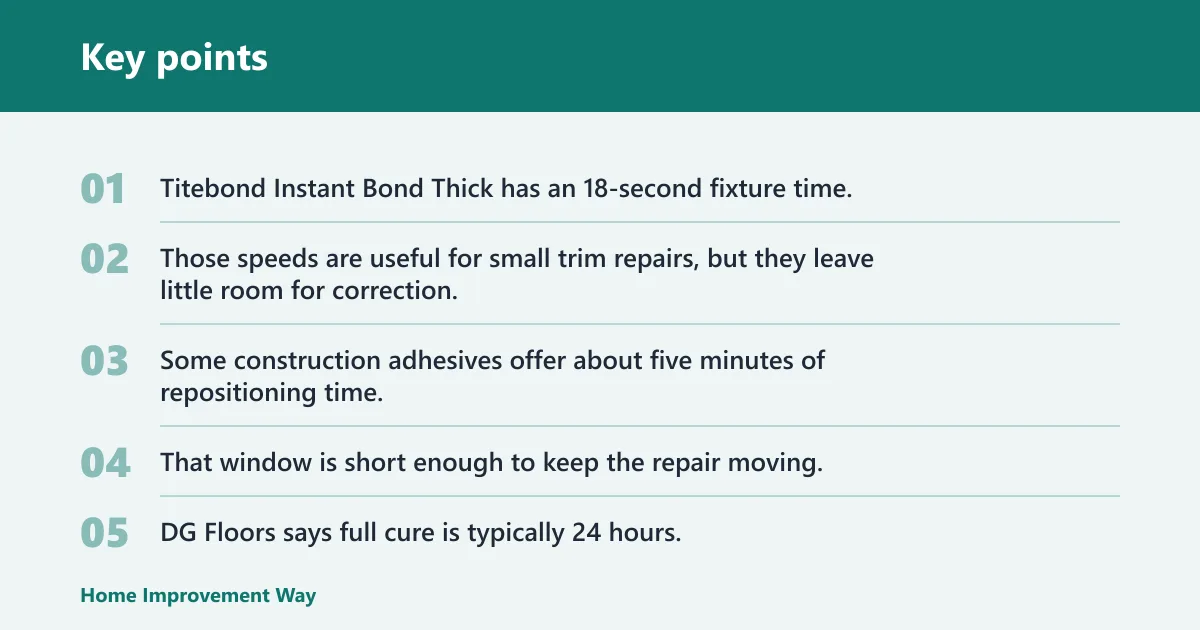
Cyanoacrylate gels grab fastest. Titebond Instant Bond Thick has an 18-second fixture time, and Axe and Answered says Loctite Power Grab Express has zero-second immediate hold. Those speeds are useful for small trim repairs, but they leave little room for correction.
Five-minute reposition windows
Some construction adhesives offer about five minutes of repositioning time, which is useful for a loose section that needs to be nudged flush before setting. That window is short enough to keep the repair moving, but long enough to correct a slight bow or alignment error.
Full cure timelines before paint
DG Floors says full cure is typically 24 hours, and that is a sensible benchmark for many construction adhesive repairs. If you paint too soon, the seam can shift, the finish can wrinkle, or hidden squeeze-out can telegraph through the topcoat.
Say your 8-inch outside corner gap is on painted MDF over drywall. A cyanoacrylate gel can close the tiny void quickly, but only if the joint already sits nearly flush. If the trim is pulling away from the wall, construction adhesive and a bit of pressure are the better repair.
Suppose a 5-foot baseboard on plaster has lifted away near the center. Caulk will only cover the line, not reattach the board. Construction adhesive, plus brads or temporary support, is the repair that actually puts the trim back in contact with the wall.
Paintable finish and cleanup
Paintable finish matters as much as bond strength on white trim. White or clear adhesive can reduce visible seams, but the real goal is controlled squeeze-out, because hardened adhesive along a paint line can be harder to hide than the original gap.
White versus clear adhesive
White adhesive is useful when the trim will stay painted white and the seam is exposed. Clear adhesive can be a better choice where a bead might show through a thin edge or on a mixed-finish repair. Either way, the label should say paintable if the repair will be painted.
How to stop squeeze-out from showing
Use only the bead you need, especially near the face of the board. The same source recommends a 3/8-inch zigzag or S-shaped bead for many trim applications, but repair work often needs less than that. Keep a damp rag nearby, press the trim in place, and remove squeeze-out before it skins over.
When caulk or filler is the final step
Caulk and filler are finish steps, not structural fixes. Use caulk for hairline seams after the baseboard is reattached. Use filler for small nail holes or minor surface defects. If the trim still moves, the adhesive choice and support method need to change first.
Frequently asked questions
What is the best glue for baseboard repairs?
For most repair-only touch-ups, construction adhesive is the best starting point because it bonds trim to common wall substrates and gives you time to align the piece. Use cyanoacrylate gel for tiny fast fixes and wood glue only for tight wood-to-wood joints such as popped miters.
Can I use construction adhesive on baseboards?
Yes. Construction adhesive is one of the main repair adhesives for baseboards, especially when the board has loosened from drywall, plaster, masonry, tile, or concrete. It is also the better choice when the section is long enough that you need repositioning time before it sets.
What glue works on painted drywall and wood trim?
For painted drywall and wood trim, construction adhesive is usually the most practical choice because it bonds to both surfaces and leaves room for alignment. If the repair is a small wood-to-wood miter, wood glue can work, but it is not the default for painted wall repairs.
Which glue is best for white trim without visible residue?
Use a paintable white or clear construction adhesive when the seam may remain visible on white trim. For tiny gaps, cyanoacrylate gel can work if it stays inside the joint. The key is low squeeze-out and prompt cleanup, because dried residue is what usually ruins the finish.
Sponsored / affiliate links. As an Amazon Associate I earn from qualifying purchases. I may earn additional commission from eligible campaigns.