Does Humidity Affect Glue Drying Time?
High humidity is commonly reported to slow many water-based glues. Once room humidity stays above about 60% RH, expect longer open time and slower cure for some adhesives, but the effect is glue-specific rather than universal; polyurethane and moisture-curing adhesives react differently, and cyanoacrylate can misbehave in damp air (manufacturer TDS guidance and technical adhesive resources). Ignore it and joints can stay soft, creep, or fail after clamping. This guide explains how humidity affects PVA, wood glue, polyurethane, epoxy, and CA, plus the room conditions that matter most for indoor repairs.
How humidity changes glue drying and curing

Yes. Humidity can change how fast adhesive water leaves the joint, how quickly some glues start to set, and whether a bond reaches full strength on schedule. The effect is not the same for every glue family. Water-based glues usually slow down in damp air, while moisture-cured products can behave faster up to a point.
How room conditions change adhesive behavior
Relative humidity, or RH, is the amount of water vapor in the air. For water-based glues, higher RH mainly slows evaporation; for moisture-curing adhesives, it can speed the chemical reaction; and for any adhesive, damp air can increase the risk of contamination or condensation on the substrate. Typical indoor targets are useful starting points, not universal rules.
Temperature and airflow work together. Warm air usually speeds drying and curing. Cold air slows it. Moving air helps carry moisture away from the glue line, which matters in damp rooms, but airflow does not replace cure time.
Damp substrate moisture matters too. If the wood, drywall, or other surface is already wet, the glue has more moisture to fight through and the bond can weaken. A surface can feel dry to the touch and still be too wet for a reliable bond.
For related guidance, see wood glue clamp time and how to dry damp wood before gluing.
Why indoor humidity matters in real repairs
For indoor repairs, humidity affects open time, clamp time, and full cure time in different ways. Open time is the working window before tack-up. Clamp time is how long the joint must stay under pressure. Full cure is when the adhesive reaches its intended strength.
Those are not the same stage. A joint can be safe to unclamp and still not be ready for stress, load, or sanding. That distinction matters most in humid basements, bathrooms, laundry rooms, and kitchens where air and substrate moisture can both be high (manufacturer clamp-time and cure-time guidance).
Say your plywood edge banding is glued in a basement workshop on a humid day. The glue line may still feel tacky after the usual clamp window, but the real problem is not only slow drying. The joint can remain weak if the wood itself picked up moisture before assembly.
The 70% RH tipping point
Once room humidity rises above about 70% RH, problems become more likely for many household adhesives, so treat that number as a warning threshold rather than a hard failure point (technical adhesive resources; manufacturer TDS pages). Water-based glue tends to slow down, some moisture-sensitive products can foam or cure unevenly, and surface quality becomes less predictable. That does not mean every glue fails at 70% RH, but it is a warning sign for indoor repairs.
At that point, you should think about the room, the substrate, and the adhesive family together. A simple delay is one thing. A bond that never reaches good strength is another.
How room conditions change adhesive behavior
Humidity, temperature, and airflow work as a system. A warm, dry room can shorten open time and speed evaporation. A cool, damp room can stretch the working window but slow cure. The same glue can behave well in one room and poorly in another if the conditions are different enough.
Relative humidity in plain terms
For water-based glues, moderate indoor RH is usually the easiest place to work. Too dry can shorten open time so much that the joint starts to grab before you finish positioning. Too damp can keep water in the bond line and delay final strength. For many home repairs, a moderate indoor target is the most predictable starting point.
Temperature and airflow working together
Warm air moves more moisture away from the glue line, so it usually speeds drying. Cold air slows the process. Fans can help by moving humid air out of the area, especially near a damp wall or floor, but a fan aimed straight at a wet glue line can skin over the surface too quickly.
That skin can trap moisture underneath. The joint may look ready before it is ready. That is a common trap with water-based glue in small rooms.
Why damp substrate moisture matters
A wet substrate changes the bond from the inside out. It can dilute some adhesives, slow water loss, and reduce contact between adhesive and surface. On wood, damp stock can also swell, then shrink later as it dries, which can open up a joint that seemed fine during clamping.
Suppose a cabinet side gets glued in a bathroom after a shower. The air is damp, but the bigger issue is the panel itself. If the substrate is holding moisture, the glue line may cure slowly and the final bond can be weaker than expected.
Glue drying time by adhesive type
Different adhesive families react differently to humidity. That is why one blanket rule does not work. Some glues slow down in damp air, some need moisture to start curing, and some are affected more by temperature than by ordinary indoor humidity.
PVA wood glue
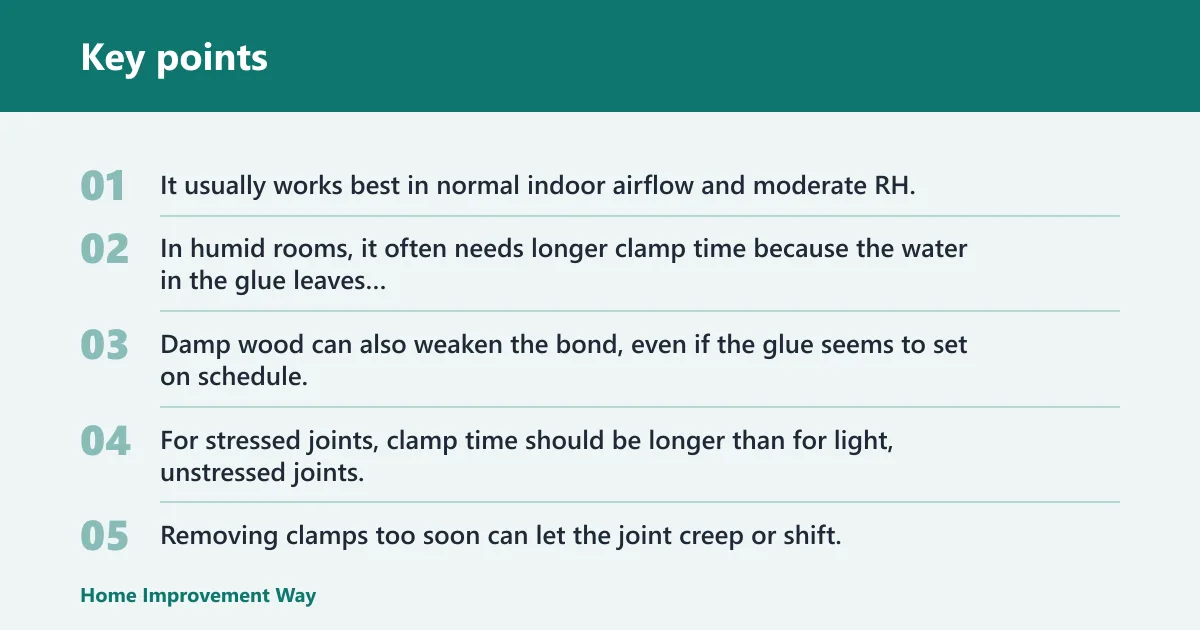
PVA wood glue is water-based. It usually works best in normal indoor airflow and moderate RH. In humid rooms, it often needs longer clamp time because the water in the glue leaves more slowly (manufacturer TDS guidance). Damp wood can also weaken the bond, even if the glue seems to set on schedule.
For stressed joints, clamp time should be longer than for light, unstressed joints. Removing clamps too soon can let the joint creep or shift. Full cure still takes longer than clamp removal (see wood glue clamp time).
Cyanoacrylate adhesive
Cyanoacrylate, or CA, starts to cure only with moisture present. That makes it fast, but it also means damp air can change how it behaves at the surface. High humidity can speed tack-up, yet the bond may still need a longer full cure window before it reaches full strength (technical adhesive resources).
This is where people often confuse grab with strength. A part can feel stuck in seconds and still need time before it can handle load. The bond line is not at full cure just because it no longer moves.
Polyurethane glue
Polyurethane glue is moisture-activated, so humidity can speed cure up to a point. It still needs the right amount of clamping because the glue can foam as it reacts (manufacturer TDS guidance). Too much moisture, or a damp substrate, can create excess foam, a messy joint line, or weak foam-filled areas.
That means humid air is not always bad for polyurethane. Excess moisture is the problem. The line between helpful and harmful can be narrow when the wood or room is already damp.
Epoxy and hide glue
Epoxy is mainly a chemical cure adhesive, so humidity has a smaller effect than temperature does. In ordinary indoor conditions, temperature usually drives cure time more than room moisture, and epoxy is generally less humidity-sensitive than water-based or moisture-activated glues (manufacturer TDS guidance). Cold rooms slow epoxy more than mildly humid rooms do. For a room-specific approach, see epoxy cure temperature.
Hide glue also responds to moisture and temperature, but it is less forgiving in damp spaces than many people expect. High humidity can slow surface drying and complicate tack, while cold rooms extend the working window and the time to reach handling strength.
How humidity affects glue drying: decision table
| Adhesive | Ideal RH range | Humidity effect | What changes first | Best room-condition fix | Likely failure mode above 70% RH | Practical homeowner action |
|---|---|---|---|---|---|---|
| PVA wood glue | About 40-60% RH as a typical indoor target | High humidity mainly slows evaporation | Open time and clamp time | Improve ventilation or dehumidify before assembly | Longer clamp time, weak bond on damp wood, creep under load | Wait longer, improve ventilation, or dehumidify |
| Cyanoacrylate | About 40-60% RH as a typical indoor target | Moisture mainly affects surface reaction and contamination risk | Open time | Dry the parts and reduce ambient moisture before bonding | Premature grab, brittle or uneven cure, surface whitening in some joints | Choose a different adhesive if the room or part is too damp |
| Polyurethane | About 40-60% RH as a typical indoor target | Humidity mainly affects moisture-triggered cure | Clamp time and foam expansion | Reduce moisture in the room and on the substrate | Foaming, voids, weak foam-filled bond, messy squeeze-out | Reduce moisture, improve ventilation, or pick another adhesive |
| Epoxy | About 40-60% RH as a typical indoor target | Humidity mainly affects substrate contamination risk, not the cure chemistry | Full cure | Keep the substrate dry and control temperature | Usually minimal; damp surfaces can still weaken adhesion | Focus on temperature control and dry surfaces |
| Hide glue | About 40-60% RH as a typical indoor target | Humidity mainly slows surface drying | Open time and tack | Use better airflow and keep the room drier | Slow tack, softer bond line, shorter shelf-like working control in the joint | Wait longer, improve ventilation, or choose a different adhesive |
This table is the fastest way to match the adhesive to the room. If the space is damp and the bond is structural, move toward better ventilation, dehumidification, or a different glue family instead of counting on extra clamp time alone. For bathroom-specific repairs, see choosing glue for bathroom repairs and dehumidifying a workshop.
Does humidity affect epoxy dry time?
Only a little, compared with temperature. Epoxy is a chemical cure adhesive, so ordinary indoor humidity is usually less important than room temperature and mix ratio. Cold rooms slow epoxy far more than normal damp air does. In a cool basement, that temperature drop can matter more than a small RH change.
Why temperature usually matters more
Epoxy cure rate depends heavily on temperature. Warmer conditions generally shorten the time to handling strength, while colder conditions slow it down. If the room is cool, the epoxy may stay tacky longer even when humidity is only moderate.
That is why a homeowner should not treat epoxy like PVA. The two glues do not answer to room conditions in the same way.
When damp air still causes problems
Humidity still matters if the surfaces are damp or if condensation is present. Moisture on the substrate can interfere with wet-out and adhesion, especially on porous materials. So even though epoxy is less sensitive to air humidity, it still needs a dry bond surface.
A damp room can also create condensation on a cold substrate, which is a hidden failure point. The air may seem only muggy, but the part can be wet enough to cause trouble.
What to do in cool or humid rooms
For epoxy in a cool room, gentle heat is usually more helpful than more waiting. For a humid room, dry the space and the substrate first. If the surface is visibly damp or cold enough to sweat, delay the repair until conditions improve.
Do not assume an epoxy joint is fine because the surface feels hard. Full cure still takes time, and load should wait until the adhesive has reached the stage the maker specifies.
You can influence glue behavior indoors, but the goal is control, not speed for its own sake. Air movement, temperature, and moisture management should support the adhesive, not push it past its limits. The wrong shortcut can make the bond worse, not faster.
Use ventilation the right way
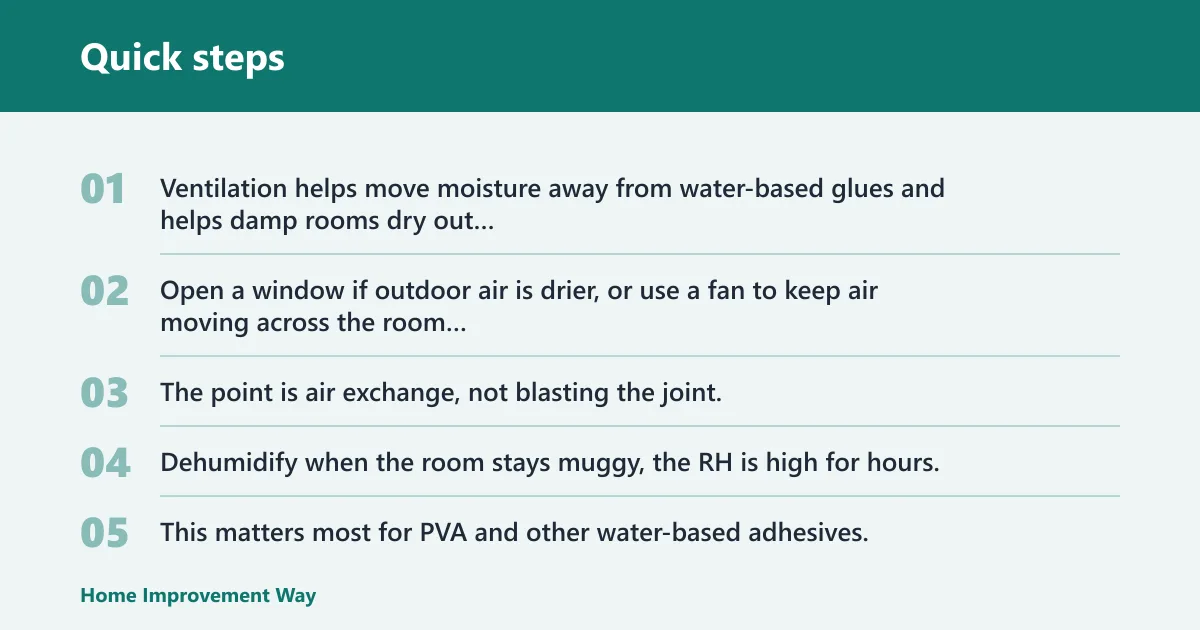
Ventilation helps move moisture away from water-based glues and helps damp rooms dry out faster. Open a window if outdoor air is drier, or use a fan to keep air moving across the room rather than directly at the glue line. The point is air exchange, not blasting the joint.
When dehumidify the room
Dehumidify when the room stays muggy, the RH is high for hours, or the substrate has been holding moisture. This matters most for PVA and other water-based adhesives. It also helps in basements, laundry areas, and bathrooms where the air itself can keep the glue line wet.
When heat helps and when it hurts
Heat helps when the room is cool and the adhesive is temperature-sensitive, especially epoxy. Heat hurts when it dries the surface too fast, skins the bond line, or disturbs a joint before clamp pressure has done its job. Keep the heat gentle and indirect.
Heat is not a fix for wet wood. If the substrate is damp, warm air alone can create a dry-looking surface with moisture still trapped inside.
What blow drying can do to the joint
Blow drying can speed surface evaporation, but it can also overheat the glue line, move parts out of alignment, or skin the surface before the interior has cured. Use it only with caution, from a distance, and never as a replacement for proper clamp time or dry substrate conditions.
A common first-timer mistake is trying to rescue a damp PVA joint with a high setting from a hair dryer. The surface may look ready, while the bond underneath stays weak.
Frequently asked questions
How does humidity affect adhesive drying time?
Humidity changes how quickly moisture leaves water-based glues and how fast some moisture-cured glues start to react. High RH usually slows PVA and hide glue, while polyurethane can cure faster with some moisture. Epoxy is less sensitive to humidity and more sensitive to temperature (manufacturer TDS guidance and technical adhesive resources).
Does humidity affect drying time?
Yes. It changes open time, clamp time, and full cure time in different ways. In damp rooms, many water-based glues stay workable longer but take longer to reach strength. In very dry rooms, the opposite can happen, with shorter working time and faster skinning.
Does heat make glue dry faster?
Usually, yes. Warm conditions speed drying for many adhesives and speed chemical cure for epoxy. But too much heat can skin over the surface, distort parts, or make a joint seem ready before it is. Gentle warmth helps more than aggressive heating.
Does blow drying glue make it dry faster?
It can speed surface evaporation, but it is not a safe shortcut for every joint. A strong airstream can move parts, overheat the glue line, or create a dry-looking surface with a weak bond underneath. Use fans and heat only when they fit the adhesive type and the substrate is dry.
How long should wood glue dry before removing clamps?
Follow the adhesive label first, because clamp time varies by formula and joint stress. In general, unstressed joints can come out of clamps sooner than joints carrying load. In humid rooms, PVA wood glue usually needs longer clamp time, and full cure takes longer still (manufacturer clamp-time and cure-time guidance).
Will high humidity slow down glue drying in a house?
Often yes, especially for water-based glues. High RH slows moisture loss and can extend both open time and clamp time. It can also leave damp substrates weaker, which matters as much as the air itself. Some moisture-curing glues behave differently, so the adhesive family still matters.
Does polyurethane glue need moisture to cure?
Yes. Polyurethane glue is moisture-activated, so it needs some moisture to start curing. That is why a little humidity can help. Too much moisture, though, can cause foaming and weak foam-filled spots, especially if the wood or room is already damp (manufacturer TDS guidance).
Sponsored / affiliate links. As an Amazon Associate I earn from qualifying purchases. I may earn additional commission from eligible campaigns.